Calorie Deficit Tracker
Monitor your weight loss progress • 2026 guidelines
Deficit Formula:
Show the tracker\( \text{Daily Deficit} = \text{Calories Expended} - \text{Calories Consumed} \)
\( \text{Weekly Weight Loss} = \frac{\text{Average Daily Deficit} \times 7}{3,500} \)
\( \text{Days to Goal} = \frac{\text{Weight to Lose (lbs)} \times 3,500}{\text{Average Daily Deficit}} \)
Where:
- Calories Expended = TDEE (Total Daily Energy Expenditure)
- Calories Consumed = Daily food intake
- 1 pound of fat = 3,500 calories
- Healthy weight loss = 1-2 lbs/week
- Safe daily deficit = 500-1000 calories
This formula calculates your daily and weekly calorie deficits for weight loss.
Example: For a person with TDEE of 2,200 calories consuming 1,700 calories:
Daily Deficit = 2,200 - 1,700 = 500 calories
Weekly Weight Loss = (500 × 7) ÷ 3,500 = 1 lb/week
Thus, this person would lose approximately 1 pound per week.
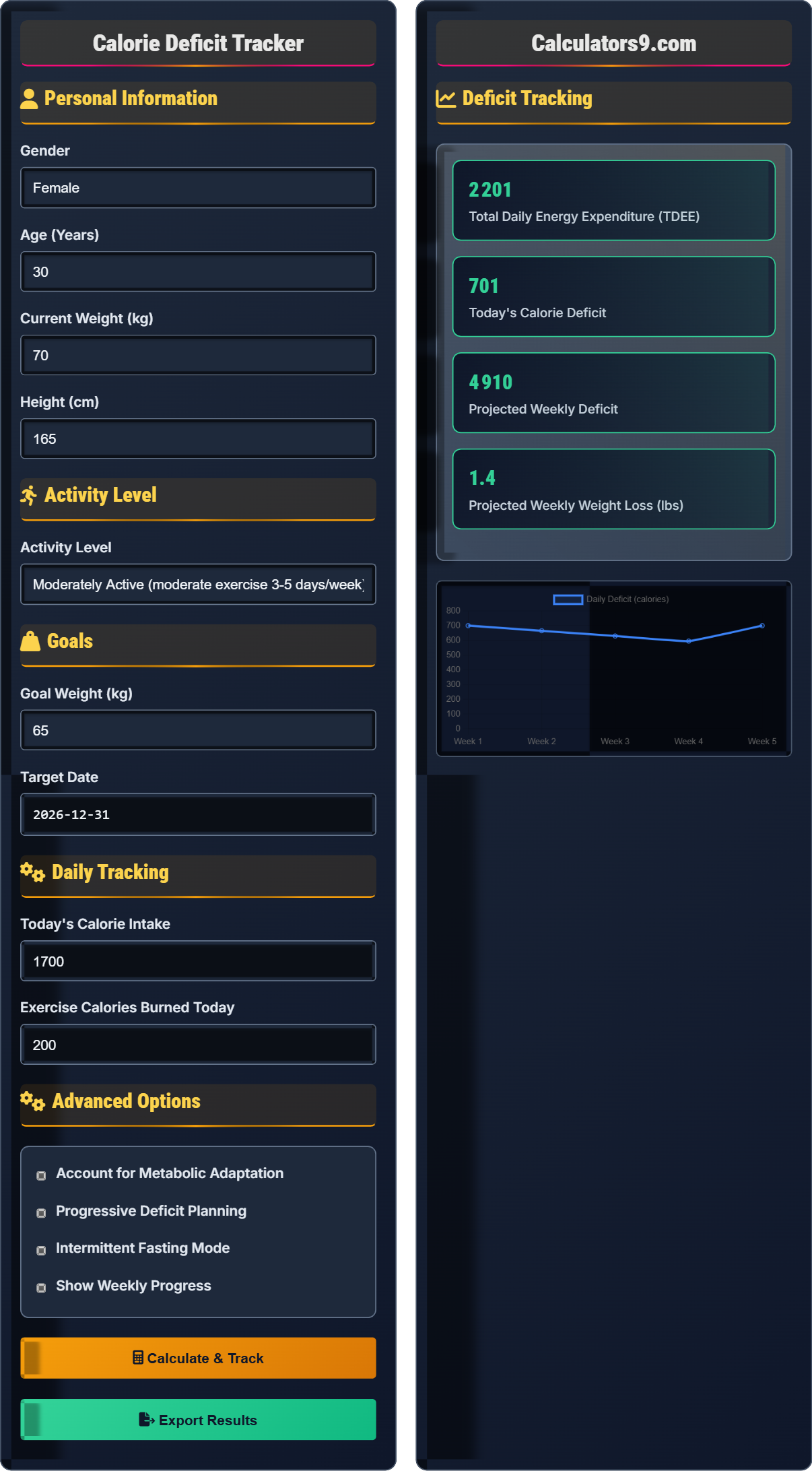
Personal Information
Activity Level
Goals
Daily Tracking
Advanced Options
Deficit Tracking
| Date | Intake | Deficit | Weight | Notes |
|---|
| Metric | Value | Target | Progress |
|---|
Calorie Deficit Guide
Calorie deficit occurs when you consume fewer calories than your body burns. This fundamental principle drives weight loss by forcing your body to use stored fat for energy. A sustainable deficit typically ranges from 500-1000 calories per day, leading to 1-2 pounds of weight loss per week.
The basic formula for calorie deficit:
Where:
- TDEE = Total Daily Energy Expenditure (calories burned daily)
- 3,500 calories = approximately 1 pound of body fat
- Healthy weight loss = 1-2 lbs per week
Effective deficit tracking includes:
- Calories Consumed: All food and beverages ingested
- Exercise Calories: Calories burned through physical activity
- Basal Metabolism: Calories burned at rest (BMR)
- Non-Exercise Activity: Walking, fidgeting, standing
- Thermic Effect of Food: Calories burned digesting food
Accurate tracking requires consistency and attention to detail.
- Protein Priority: Maintain adequate protein to preserve muscle mass
- Progressive Adaptation: Adjust as metabolism adapts to deficit
- Exercise Integration: Combine cardio and strength training
- Hydration: Drink plenty of water to support metabolism
- Sleep: 7-9 hours to maintain hormonal balance
Deficit Basics
Consuming fewer calories than your body burns to lose weight.
\( \text{Daily Deficit} = \text{TDEE} - \text{Calories Consumed} \)
Where deficit=calories below maintenance level.
- 1 lb fat = 3,500 calories
- Safe deficit: 500-1000 cal/day
- Women: min 1,200 cal/day
Optimization
Metabolism adjusts to calorie restriction over time, requiring plan adjustments.
- Calculate maintenance calories
- Set appropriate deficit (500-1000 cal)
- Monitor progress weekly
- Adjust as needed
- Track consistently
- Account for exercise
- Monitor for metabolic adaptation
- Adjust protein intake
Calorie Deficit Learning Quiz
How many calories must be burned in excess of consumed calories to lose 1 pound of fat?
The answer is C) 3,500 calories. One pound of body fat contains approximately 3,500 calories. Therefore, to lose 1 pound of fat, you need to create a calorie deficit of 3,500 calories through diet, exercise, or a combination of both.
This fundamental principle of energy balance is the foundation of weight management. Creating a daily deficit of 500 calories will theoretically result in 1 pound of weight loss per week (500 × 7 = 3,500). However, actual results may vary due to metabolic adaptations and other factors.
Calorie Deficit: Consuming fewer calories than your body burns
Energy Balance: The relationship between calories consumed and calories burned
Body Fat: Stored energy in adipose tissue
• 1 lb of fat = 3,500 calories
• 500 cal/day deficit = 1 lb/week loss
• Metabolic adaptation may affect results
• Remember: 3,500 calories per pound
• Combine diet and exercise for best results
• Expecting immediate results
• Not accounting for metabolic changes
• Focusing only on calories without nutrition quality
Calculate the daily calorie deficit for a person with TDEE of 2,400 calories who consumes 1,800 calories daily. What is their projected weekly weight loss?
Step 1: Calculate daily deficit
• Daily Deficit = TDEE - Calories Consumed
• Daily Deficit = 2,400 - 1,800 = 600 calories
Step 2: Calculate weekly deficit
• Weekly Deficit = Daily Deficit × 7
• Weekly Deficit = 600 × 7 = 4,200 calories
Step 3: Calculate projected weight loss
• Weekly Weight Loss = Weekly Deficit ÷ 3,500
• Weekly Weight Loss = 4,200 ÷ 3,500 = 1.2 pounds
Therefore, this person has a daily deficit of 600 calories and can expect to lose approximately 1.2 pounds per week.
This example demonstrates how to calculate daily and weekly deficits based on TDEE. The person has a moderate deficit that falls within the recommended range of 500-750 calories per day, which should result in safe and sustainable weight loss.
TDEE (Total Daily Energy Expenditure): Total calories burned in a day
Daily Deficit: Calories burned minus calories consumed
Projected Weight Loss: Expected loss based on deficit calculations
• Daily Deficit = TDEE - Calories Consumed
• Weekly Weight Loss = (Daily Deficit × 7) ÷ 3,500
• Safe deficit range: 500-1000 cal/day
• Calculate TDEE first
• Aim for 500-1000 cal deficit
• Track consistently for accuracy
• Not accounting for exercise calories
• Setting unrealistic deficits
• Forgetting to recalculate as weight changes
Sarah started with a TDEE of 2,300 calories and was consuming 1,800 calories daily. After 8 weeks, her TDEE dropped to 2,100 calories due to weight loss and metabolic adaptation. If she continues eating 1,800 calories, what is her new daily deficit and projected weekly weight loss?
Step 1: Calculate new daily deficit
• New TDEE = 2,100 calories
• Calories consumed = 1,800 calories
• New Daily Deficit = 2,100 - 1,800 = 300 calories
Step 2: Calculate new weekly deficit
• New Weekly Deficit = 300 × 7 = 2,100 calories
Step 3: Calculate new projected weight loss
• New Weekly Weight Loss = 2,100 ÷ 3,500 = 0.6 pounds
Step 4: Compare to original plan
• Original deficit: 500 calories/day (1.0 lb/week)
• New deficit: 300 calories/day (0.6 lb/week)
Therefore, due to metabolic adaptation, Sarah's projected weight loss has decreased from 1.0 to 0.6 pounds per week. She may need to adjust her calorie intake or increase activity to maintain her original weight loss pace.
This example demonstrates metabolic adaptation, a natural response to weight loss. As body weight decreases, the TDEE decreases proportionally. Additionally, the body becomes more metabolically efficient during caloric restriction. This means that after initial weight loss, the same caloric deficit produces a smaller net negative energy balance, slowing further weight loss.
Metabolic Adaptation: Decreased energy expenditure during weight loss
Metabolic Efficiency: Body's improved energy conservation
Compensatory Mechanisms: Physiological responses to caloric restriction
• Recalculate TDEE with weight changes
• Expect metabolic slowdown
• Adjust calories periodically
• Recalculate when weight changes by 5-10 lbs
• Plan for metabolic adaptation
• Consider temporary breaks from deficit
• Not adjusting for weight loss
• Expecting linear weight loss
• Not accounting for metabolic changes
John has a TDEE of 2,500 calories and wants to lose 1.5 lbs per week. He burns an average of 300 calories per day through exercise. How many calories should he consume daily to achieve his goal?
Step 1: Calculate required weekly deficit
• Target weight loss = 1.5 lbs/week
• Required weekly deficit = 1.5 × 3,500 = 5,250 calories
Step 2: Calculate required daily deficit
• Required daily deficit = 5,250 ÷ 7 = 750 calories
Step 3: Calculate daily intake including exercise
• TDEE = 2,500 calories
• Exercise calories burned = 300 calories
• Total calories burned = 2,500 + 300 = 2,800 calories
• Required daily intake = 2,800 - 750 = 2,050 calories
Step 4: Verify the calculation
• Daily deficit = (2,500 + 300) - 2,050 = 750 calories
• Weekly weight loss = (750 × 7) ÷ 3,500 = 1.5 lbs
Therefore, John should consume 2,050 calories daily while maintaining his exercise routine to achieve 1.5 lbs of weight loss per week.
This example shows how to incorporate exercise into calorie planning. Exercise increases the total daily energy expenditure, which can help achieve larger deficits without reducing food intake as drastically. This approach can be more sustainable and maintain muscle mass better than severe calorie restriction alone.
Exercise Integration: Incorporating activity into calorie planning
Total Energy Expenditure: All calories burned including exercise
Combined Deficit: Deficit from both diet and exercise
• Include exercise in TDEE calculation
• Exercise increases total calorie burn
• Combined approach is more sustainable
• Track exercise calories burned
• Use both diet and exercise
• Maintain muscle with resistance training
• Not accounting for exercise calories
• Setting overly restrictive diets
• Ignoring the benefits of exercise
What is the minimum recommended daily calorie intake for women to maintain health while dieting?
The answer is B) 1,200 calories. Health professionals generally recommend that women consume at least 1,200 calories per day, and men at least 1,500 calories per day, to maintain health while dieting. Going below these levels without medical supervision can lead to nutrient deficiencies and metabolic damage.
Safety is paramount in weight loss planning. Extremely low-calorie diets can cause muscle loss, nutrient deficiencies, gallstones, and other health problems. The minimum recommendations ensure that essential nutrients can be obtained while maintaining a calorie deficit. These values may vary based on individual needs and medical conditions.
Minimum Calorie Intake: Lowest safe daily calorie consumption
Nutrient Adequacy: Meeting nutritional needs within calorie limits
Metabolic Damage: Long-term harm from extreme calorie restriction
• Women: minimum 1,200 cal/day
• Men: minimum 1,500 cal/day
• Medical supervision for very low calories
• Focus on nutrient density
• Include protein and fiber
• Consult healthcare provider
• Going below safe calorie limits
• Not considering nutrient needs
• Ignoring individual health conditions
FAQ
Q: How do I know if my calorie deficit is too aggressive?
A: Signs that your deficit is too aggressive include:
- Feeling constantly tired or dizzy
- Difficulty concentrating or mood swings
- Loss of muscle mass (strength decreases)
- Plateauing weight loss despite adherence
- Disordered eating patterns
- Hormonal disruptions (irregular periods, low libido)
Safe deficit ranges are 500-1000 calories per day for most people. Women should not go below 1,200 calories per day and men below 1,500 without medical supervision.
Q: How should I adjust my deficit tracking for high activity levels?
A: For high activity levels, you need to account for exercise calories burned:
Tracking approach:
- Track total daily energy expenditure including exercise
- Account for post-exercise calorie burn (EPOC)
- Ensure adequate protein intake (1.6-2.2g per kg of body weight)
- Time nutrition around training sessions
For athletes, a moderate deficit of 300-500 calories per day is often more appropriate to maintain performance while promoting gradual weight loss. Rapid weight loss can compromise athletic performance and recovery.