Fasting Window Timer
Intermittent fasting tracker • Health optimization
Fasting Schedule Formula:
Show the calculator\( \text{Fasting Window} = \text{Start Time} + \text{Duration (hours)} \)
Where:
- \( \text{Start Time} \): Beginning of fasting period (e.g., 7:00 PM)
- \( \text{Duration (hours)} \): Length of fast (e.g., 16 hours for 16:8 method)
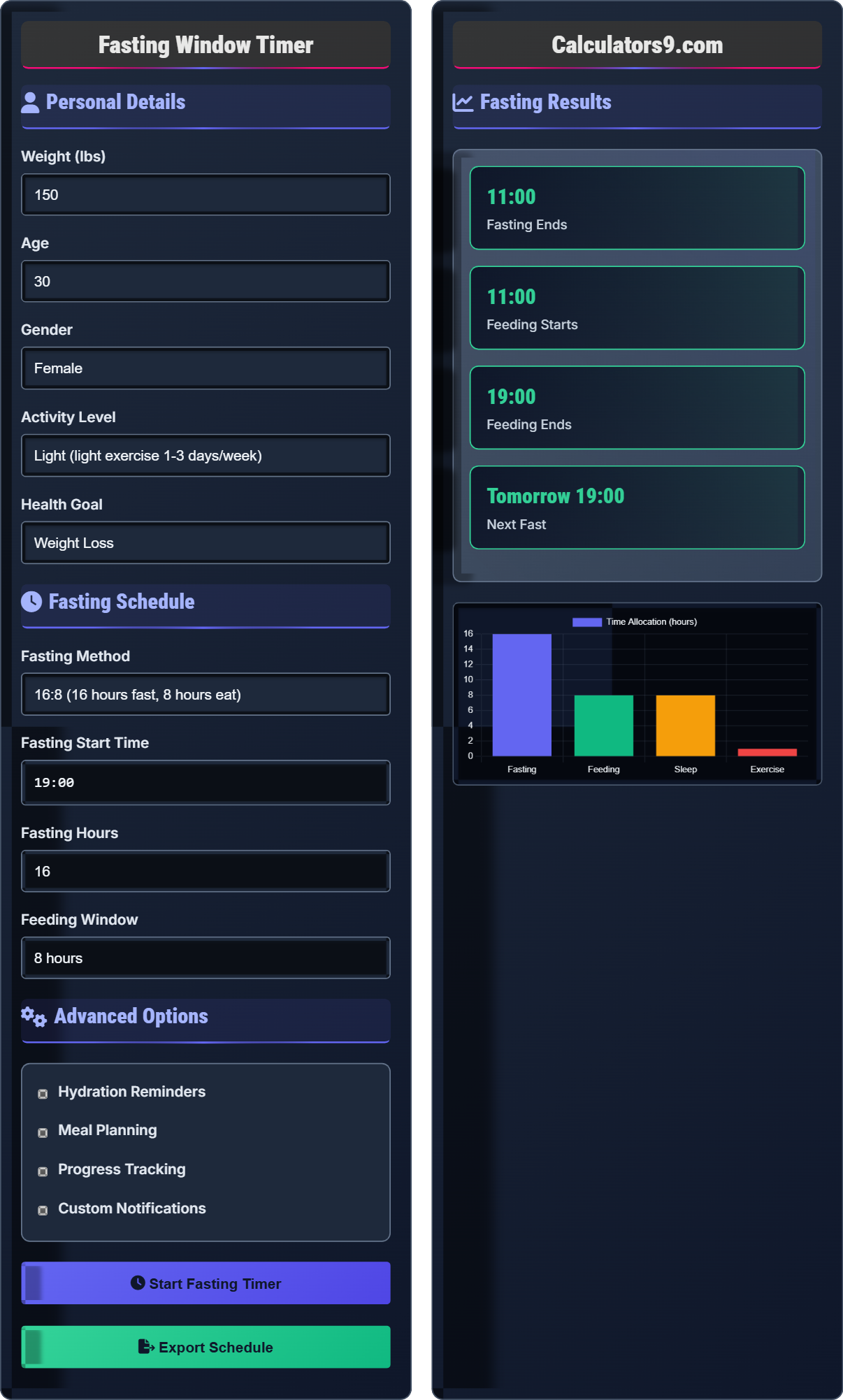
- \( \text{End Time} \): Start Time + Duration (e.g., 7:00 PM + 16 hours = 11:00 AM next day)
- \( \text{Feeding Window} \): Time between end of fast and start of next fast
This formula calculates personalized fasting windows based on your schedule and goals. The 16:8 method involves fasting for 16 hours and eating during an 8-hour window. Other popular methods include 5:2 (two non-consecutive days of restricted calories) and 24-hour fasts.
Example: Starting a 16-hour fast at 7:00 PM:
Fasting ends at 11:00 AM the next day (7:00 PM + 16 hours = 11:00 AM)
During the fasting period, only non-caloric beverages are consumed. The feeding window allows for normal eating patterns.
Personal Details
Fasting Schedule
Advanced Options
Fasting Results
| Time | Activity | Description |
|---|
| Day | Completed | Duration | Notes |
|---|
| Benefit | Timeline | Explanation |
|---|
Comprehensive Intermittent Fasting Guide
Intermittent fasting (IF) is an eating pattern that cycles between periods of fasting and eating. It doesn't specify which foods to eat but rather when to eat them. During fasting periods, the body shifts from using glucose as its primary fuel source to burning fat for energy. This metabolic switch triggers various cellular repair processes and hormone changes that may improve health and aid in weight loss.
The standard fasting schedule calculation uses the following approach:
Where:
- \( \text{Start Time} \): Beginning of fasting period
- \( \text{Duration (hours)} \): Length of fast (e.g., 16 hours for 16:8 method)
- \( \text{End Time} \): Start Time + Duration
- \( \text{Feeding Window} \): Time between end of fast and start of next fast
Intermittent fasting offers numerous health benefits:
- Weight Loss: Promotes fat burning and reduces overall calorie intake
- Improved Insulin Sensitivity: Helps regulate blood sugar levels
- Cellular Repair: Triggers autophagy, removing damaged cells
- Brain Health: May improve cognitive function and protect against neurodegenerative diseases
- Longevity: May extend lifespan and improve healthspan
- Start Gradually: Begin with shorter fasting periods and increase duration over time
- Stay Hydrated: Drink plenty of water, herbal teas, and other non-caloric beverages
- Listen to Your Body: Adjust schedule based on how you feel
- Plan Meals: Prepare nutritious meals for feeding windows
- Track Progress: Monitor changes in energy, mood, and health markers
Fasting Basics
Eating pattern that cycles between fasting and eating periods.
\( \text{Fasting End} = \text{Start Time} + \text{Duration (hours)} \)
Where: Start time + fasting duration = end time.
- No calories during fasting
- Non-caloric beverages OK
- Normal eating during feeding
Fasting Strategies
16 hours fasting, 8 hours eating window.
- Choose fasting window (e.g., 7 PM - 11 AM)
- Stick to schedule consistently
- Eat balanced meals during feeding
- Track your progress
- Start with 12:12 if 16:8 feels too long
- Adjust based on your schedule
- Stay hydrated during fasts
- Listen to your body
Fasting Learning Quiz
If someone starts a 16:8 fast at 8:00 PM, when will their fasting period end?
The answer is B) 12:00 PM the next day. Starting at 8:00 PM and fasting for 16 hours means the fast ends at 12:00 PM the following day (8:00 PM + 16 hours = 12:00 PM).
Understanding how to calculate fasting windows is crucial for successful intermittent fasting. The 16:8 method involves fasting for 16 hours and eating during an 8-hour window. Counting hours across midnight requires careful attention to the 12-hour clock format.
Fasting Window: Period when no calories are consumed
Feeding Window: Period when eating is allowed
16:8 Method: 16 hours fasting, 8 hours eating
• Count hours across midnight carefully
• Fasting includes sleep time
• Non-caloric beverages are allowed during fasts
• Use a 24-hour clock to avoid confusion
• Include sleep time in fasting
• Plan your feeding window around your schedule
• Forgetting to count hours across midnight
• Including calories during fasting
• Not accounting for sleep time
A person wants to follow a 14:10 fasting schedule starting at 7:30 PM. Calculate their feeding window and explain the benefits of this gentler approach compared to 16:8.
Fasting starts: 7:30 PM
Fasting duration: 14 hours
Fasting ends: 7:30 PM + 14 hours = 9:30 AM next day
Feeding window: 9:30 AM to 7:30 PM (10 hours)
Benefits of 14:10 vs 16:8: More manageable for beginners, easier to maintain, allows for breakfast, less disruption to social eating patterns.
The 14:10 method is an excellent starting point for those new to intermittent fasting. With a 10-hour feeding window, it allows for 3 regular meals and provides flexibility while still offering many of the benefits of intermittent fasting. This gentler approach can help people transition to longer fasting periods if desired.
14:10 Method: 14 hours fasting, 10 hours eating
Feeding Window: Time period for eating
• 14:10 is beginner-friendly
• Allows for breakfast inclusion
• Still provides metabolic benefits
• Start with 14:10 before advancing to 16:8
• Gradually extend fasting periods
• Listen to your body's response
• Jumping straight to 16:8 without preparation
• Not considering lifestyle constraints
• Ignoring hunger cues
Sarah works night shifts from 11:00 PM to 7:00 AM and wants to try 16:8 fasting. She usually eats dinner around 10:00 PM. What would be an appropriate fasting schedule that accommodates her work schedule?
Since Sarah works nights, a traditional evening-morning schedule won't work. She could:
Finish dinner at 10:00 PM
Start fasting at 10:00 PM
Continue through her shift until 2:00 PM (end of 16-hour fast)
Break fast with lunch around 2:00 PM
Continue eating until 10:00 PM
This way, her fasting period includes her work hours and most of her sleep time.
Intermittent fasting schedules should be adapted to individual lifestyles and work schedules. Night shift workers may need to reverse traditional fasting windows. The key is maintaining consistency with the chosen schedule, regardless of whether it aligns with conventional day-night patterns.
Work Schedule Adaptation: Modifying fasting to fit job demands
Consistency: Maintaining the same fasting schedule
• Adapt schedule to work/life constraints
• Maintain consistency
• Include sleep time in fasting
• Align fasting with work hours
• Plan meals around work schedule
• Stay hydrated during shifts
• Forcing traditional schedules on night workers
• Not considering shift timing
• Inconsistent scheduling
Explain the timeline of health benefits that typically occur during a 16-hour fast, including the metabolic processes involved and when they begin.
Timeline of benefits during a 16-hour fast:
Hours 1-3: Blood glucose and insulin levels begin to decrease
Hours 4-8: Glycogen stores are depleted in the liver
Hours 8-12: Body begins switching to fat for fuel (lipolysis)
Hours 12-16: Increased ketone production, enhanced autophagy begins
Hours 16+: Full ketosis, peak autophagy, growth hormone release
Metabolic processes: Switch from glucose to fat oxidation, cellular repair, hormone optimization.
During fasting, the body undergoes several metabolic transitions. Initially, it uses stored glucose (glycogen). After glycogen depletion, it begins burning fat for fuel and producing ketones. Extended fasting triggers cellular repair processes like autophagy, where damaged cells are cleared out. Growth hormone increases, supporting fat burning and muscle preservation.
Ketosis: Metabolic state using fat for fuel
Autophagy: Cellular cleanup process
Lipolysis: Fat breakdown process
• Metabolic switch occurs after glycogen depletion
• Autophagy peaks after 12-16 hours
• Individual responses may vary
• 16-hour fasts optimize autophagy
• Consistency enhances benefits
• Individual timing may vary
• Expecting immediate results
• Not allowing full metabolic transition
• Inconsistent fasting schedule
Which group of people should generally avoid intermittent fasting without medical supervision?
The answer is B) Pregnant or breastfeeding women. Individuals who should avoid intermittent fasting without medical supervision include: pregnant or breastfeeding women, children and adolescents, people with a history of eating disorders, those with certain medical conditions (like diabetes on medications), and individuals taking medications that require food intake.
While intermittent fasting is generally safe for healthy adults, certain populations have special nutritional needs or medical considerations that make it inappropriate without professional guidance. Pregnant and breastfeeding women require consistent nutrition for fetal development and milk production. Medical conditions and medications may interact with fasting protocols.
Medical Supervision: Professional oversight for health protocols
Special Populations: Groups with unique nutritional needs
• Consult healthcare providers before starting
• Certain conditions require medical clearance
• Pregnant women have special needs
• Always consult healthcare providers first
• Disclose medical conditions
• Monitor for adverse effects
• Starting without medical clearance
• Ignoring contraindications
• Not disclosing medical conditions
FAQ
Q: Is it safe to exercise while fasting, and what types of exercise are best?
A: Yes, exercising while fasting is generally safe and can be beneficial. During fasting, your body relies more on fat for fuel, which can enhance fat burning during exercise. However, the type of exercise matters:
• Low-intensity cardio: Walking, jogging, cycling (well-tolerated)
• Moderate activities: Yoga, stretching, light resistance training
• High-intensity: May cause fatigue initially, but tolerance improves
• Strength training: Generally safe, may preserve muscle better
Start with lighter activities during fasting and gradually increase intensity as your body adapts. Stay hydrated and listen to your body's signals.
Q: How long does it take to see results from intermittent fasting for weight loss?
A: Results from intermittent fasting typically appear in stages:
• Week 1-2: Initial water weight loss (2-5 lbs)
• Week 3-4: Noticeable changes in body composition
• Month 1-2: 5-10 lbs of fat loss with consistency
• Months 3-6: Significant changes in body composition
Individual results vary based on adherence, starting point, and overall diet quality. The key is consistency and maintaining a caloric deficit during feeding windows. Combining IF with regular exercise enhances results.
Q: What can I drink during my fasting period without breaking the fast?
A: During fasting, you can safely consume zero-calorie beverages:
• Water: Plain, carbonated, or with lemon/lime
• Black coffee: Without cream, sugar, or sweeteners
• Herbal teas: Rooibos, chamomile, peppermint (unsweetened)
• Green tea: Without milk or sweeteners
• Sparkling water: Plain or with natural flavoring
• Diet beverages: Controversial, some may trigger appetite
Anything under 50 calories generally won't break a fast, but zero calories is safest for maintaining the metabolic benefits of fasting.