Fiber Daily Goal Calculator
Personalized fiber intake tracker • Digestive health
Fiber Recommendation Formula:
Show the calculator\( \text{Daily Fiber Goal} = \text{Age} \times \text{Gender Factor} + \text{Activity Adjustment} \)
Where:
- \( \text{Gender Factor} \): Male: 14g per 1000 calories, Female: 12.5g per 1000 calories
- \( \text{Activity Adjustment} \): Sedentary: +0g, Active: +2-5g, Athlete: +5-10g
- \( \text{Standard Recommendations} \): Men 19-50: 38g, Women 19-50: 25g
This formula calculates personalized daily fiber needs based on age, gender, and activity level to support digestive health, blood sugar control, and heart health.
Example: For a 30-year-old active male:
Daily fiber goal: 38g + 3g (activity adjustment) = 41g of fiber per day
For optimal health benefits, aim for 25-35g for women and 30-40g for men, with additional amounts for increased activity levels.
Personal Details
Advanced Options
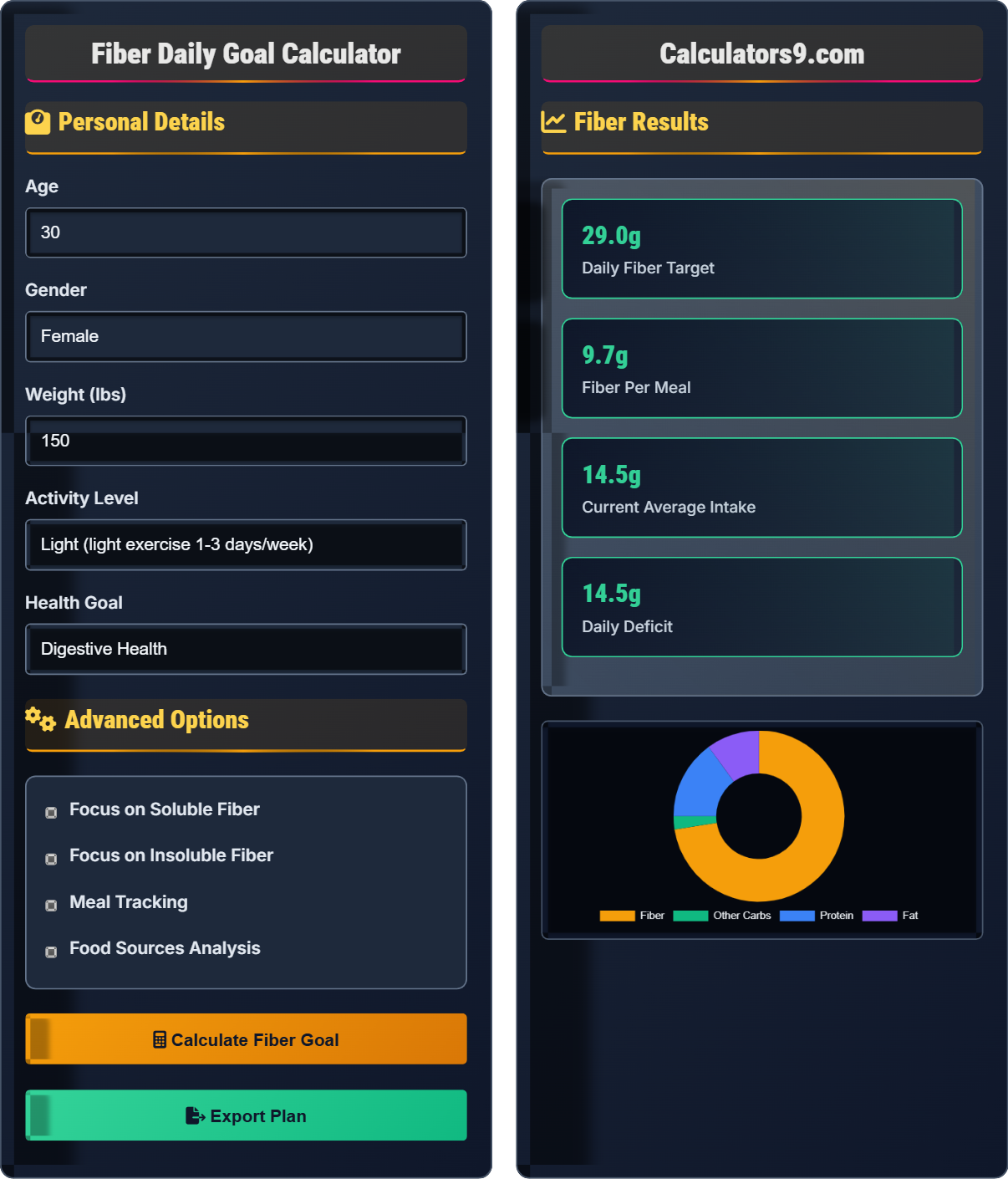
Fiber Results
| Food Source | Fiber (g) | Portion | Type |
|---|
| Meal | Time | Food | Fiber (g) |
|---|
| Day | Target | Achieved | Status |
|---|
Comprehensive Fiber Guide
Dietary fiber consists of the indigestible parts of plant foods that pass relatively unchanged through your digestive system. There are two main types: soluble fiber dissolves in water and forms a gel-like substance that helps lower cholesterol and glucose levels, while insoluble fiber promotes bowel movement and prevents constipation. The recommended daily intake is 25g for women and 38g for men.
The standard fiber recommendation uses the following approach:
Where:
- \( \text{Age-based Factor} \) = 14g per 1000 calories for men, 12.5g per 1000 calories for women
- \( \text{Gender Adjustment} \) = Standard recommendations vary by gender
- \( \text{Activity Adjustment} \) = +2-5g for active individuals
Dietary fiber provides numerous health benefits:
- Digestive Health: Promotes regular bowel movements and prevents constipation
- Heart Health: Soluble fiber helps lower cholesterol levels
- Blood Sugar Control: Slows sugar absorption and improves blood glucose levels
- Weight Management: Increases satiety and reduces calorie absorption
- Gut Health: Feeds beneficial gut bacteria and supports microbiome diversity
- Gradual Increase: Add fiber slowly to avoid digestive discomfort
- Hydration: Drink plenty of water when increasing fiber intake
- Variety: Include different types of fiber from various food sources
- Timing: Distribute fiber intake throughout the day
- Whole Foods: Prioritize natural sources over supplements
Fiber Basics
Indigestible carbohydrates found in plant foods that support digestive health.
\( \text{Daily Fiber} = \text{Age-based Factor} + \text{Gender Adjustment} + \text{Activity Adjustment} \)
Where: Age, gender, and activity determine requirements.
- Women need 25g daily
- Men need 38g daily
- Increase gradually to avoid discomfort
Optimization Strategies
Soluble fiber dissolves in water; insoluble fiber adds bulk to stool.
- Add 5-10g per meal
- Include variety of sources
- Balance soluble and insoluble
- Stay hydrated
- Gradual increase to prevent gas
- Drink 8+ glasses of water daily
- Monitor digestive response
- Combine with probiotics
Fiber Learning Quiz
Which of the following foods is highest in dietary fiber per serving?
The answer is C) 1 cup of cooked split peas (16g). Split peas contain 16g of fiber per cup, which is significantly higher than the other options. Legumes like split peas, lentils, and beans are among the richest sources of dietary fiber, providing both soluble and insoluble fiber.
Legumes are exceptional sources of dietary fiber, often containing 10-15g per cooked cup. This makes them valuable for meeting daily fiber goals. Other high-fiber foods include whole grains, fruits with skins, vegetables, nuts, and seeds. Understanding the fiber content of common foods helps with meal planning.
Dietary Fiber: Indigestible carbohydrates found in plant foods
Soluble Fiber: Dissolves in water, helps lower cholesterol
Insoluble Fiber: Adds bulk to stool, prevents constipation
• Legumes are highest in fiber content
• Fruits with skin have more fiber than peeled fruits
• Whole grains have more fiber than refined grains
• Remember: Legumes > Grains > Fruits/Vegetables > Nuts/Seeds
• Always eat fruits with skin when possible
• Choose whole grain versions of staple foods
• Assuming all grains are equal in fiber content
• Peeling fruits unnecessarily
• Not including legumes regularly
A 35-year-old female weighs 140 pounds and exercises moderately 4 times per week. She wants to improve her digestive health. Calculate her daily fiber goal using appropriate adjustments and explain your reasoning.
Step 1: Apply standard recommendation for women aged 19-50: 25g
Step 2: Add activity adjustment: Moderate activity adds 3g
Step 3: Add health goal adjustment: Digestive health adds 2g
Step 4: Calculate: 25g + 3g + 2g = 30g of fiber per day
Therefore, she needs approximately 30 grams of fiber daily for optimal digestive health.
Fiber requirements vary based on age, gender, activity level, and health goals. The standard recommendation is 25g for women aged 19-50, with additional amounts for increased activity or specific health goals. For digestive health, slightly higher fiber intake is often recommended to promote regular bowel movements and support gut bacteria.
Digestive Health: Proper functioning of the digestive system
Gut Microbiome: Community of beneficial bacteria in the digestive tract• Standard recommendation for women: 25g
• Add 2-5g for active individuals
• Digestive health may require additional fiber
• Start with standard recommendations
• Adjust based on activity and health goals
• Monitor digestive response
• Using same recommendation for all ages
• Not accounting for activity level
• Ignoring specific health goals
Sarah needs 30g of fiber per day and plans to eat 4 meals. She has already consumed 8g of fiber at breakfast (oatmeal with berries). How much fiber does she need from her remaining three meals? If she wants to distribute the remaining fiber equally, how much should each meal contain?
Step 1: Calculate remaining fiber needed: 30g - 8g = 22g
Step 2: Divide remaining fiber across 3 meals: 22g ÷ 3 = 7.3g per meal
Sarah needs 22g of fiber from her remaining three meals, with approximately 7.3g per meal.
Meal planning for fiber involves distributing daily requirements across meals to ensure consistent intake. It's important to account for fiber consumed early in the day and plan accordingly for remaining meals. Spreading fiber intake throughout the day can help with digestion and nutrient absorption.
Fiber Distribution: Spreading fiber intake across meals
Consistent Intake: Regular fiber consumption throughout the day
• Track fiber consumed at each meal
• Plan remaining intake for subsequent meals
• Aim for 5-10g per meal
• Keep a food diary to track fiber intake
• Plan high-fiber options for each meal
• Include fiber-rich snacks
• Only consuming fiber at certain meals
• Not accounting for fiber already consumed
• Relying only on supplements
Explain the importance of balancing soluble and insoluble fiber in the diet. What are the benefits of each type, and what is the ideal ratio for optimal digestive health?
Soluble fiber dissolves in water and forms a gel-like substance that helps lower cholesterol, regulate blood sugar, and feed beneficial gut bacteria. Insoluble fiber adds bulk to stool and promotes regular bowel movements. The ideal ratio is approximately 25-35% soluble fiber and 65-75% insoluble fiber. A balanced intake provides both types of benefits: digestive regularity from insoluble fiber and metabolic benefits from soluble fiber.
Both types of fiber serve important functions in the body. Soluble fiber is fermented by gut bacteria and produces short-chain fatty acids that nourish colon cells. Insoluble fiber speeds up the passage of food and waste through the gut. A balanced intake from various plant foods naturally provides both types in appropriate proportions.
Soluble Fiber: Dissolves in water, feeds gut bacteria
Insoluble Fiber: Adds bulk, promotes regularity
Short-Chain Fatty Acids: Beneficial compounds produced by fiber fermentation
• Both types are essential for health
• Natural food sources provide balanced ratios
• Include variety of plant foods
• Eat fruits, vegetables, and legumes for soluble fiber
• Include whole grains and nuts for insoluble fiber
• Vary your plant food choices
• Focusing on only one type of fiber
• Not understanding the different benefits
• Relying on processed foods for fiber
What is the recommended approach when increasing dietary fiber intake?
The answer is B) Increase gradually over several weeks. Rapid increases in fiber can cause bloating, gas, cramping, and diarrhea. Gradually increasing fiber intake over 2-4 weeks allows the digestive system to adapt and beneficial bacteria to adjust, minimizing uncomfortable side effects while achieving the desired fiber goals.
The digestive system and gut bacteria need time to adapt to increased fiber intake. When fiber is introduced gradually, the body can adjust enzyme production and bacterial populations to handle the increased load more efficiently. This prevents the common side effects associated with rapid fiber increases.
Gradual Increase: Slowly raising fiber intake over time
Digestive Adaptation: Body's adjustment to higher fiber levels
• Increase by 2-5g per week
• Allow 2-4 weeks for full adaptation
• Stay hydrated during increase
• Add 1-2 high-fiber foods per week
• Drink more water when increasing fiber
• Monitor digestive response
• Increasing fiber too quickly
• Not drinking enough water
• Ignoring digestive symptoms
FAQ
Q: How do I know if I'm getting enough fiber in my diet?
A: To determine if you're getting enough fiber:
1. Track your intake for a few days using a food diary or app
2. Look for signs of adequate intake: regular bowel movements, feeling satisfied after meals, stable blood sugar
3. Aim for 25g for women and 38g for men daily
Signs of adequate fiber intake include regular, soft bowel movements, reduced hunger between meals, and stable energy levels. Signs of insufficient intake include constipation, frequent hunger, and blood sugar spikes after meals.
For example, a simple tracking method: Breakfast (oatmeal: 4g) + Lunch (salad: 5g) + Dinner (quinoa with vegetables: 8g) + Snack (apple: 4g) = 21g daily.
Q: How does fiber help with weight loss?
A: Fiber supports weight loss through several mechanisms:
• Increases satiety: Fiber adds bulk to food without calories, making you feel full longer
• Slows digestion: Fiber slows gastric emptying, leading to prolonged feelings of fullness
• Reduces calorie absorption: Some fiber passes through undigested, reducing net calorie intake
• Stabilizes blood sugar: Prevents spikes and crashes that lead to cravings
Research shows that each additional gram of fiber consumed daily is associated with about 0.25kg (0.5 lbs) of weight loss over time. For optimal weight management, aim for 25-35g of fiber daily, focusing on whole foods rather than supplements.
Q: What are the best high-fiber foods for digestive health?
A: For digestive health, focus on these high-fiber foods that support gut function:
• Chia Seeds: 10g fiber per ounce, forms gel that soothes the digestive tract
• Ground Flaxseed: 8g fiber per 2 tbsp, contains both soluble and insoluble fiber
• Oats: 4g fiber per cup, beta-glucan helps regulate digestion
• Apples (with skin): 4.5g fiber per medium apple, pectin feeds beneficial bacteria
• Broccoli: 5g fiber per cup, contains sulforaphane for gut health
• Legumes: 10-15g fiber per cup, resistant starch feeds good bacteria
Start with small portions and gradually increase as tolerated. Pair with adequate hydration to prevent digestive discomfort.