Grocery Budget Planner
Weekly shopping calculator • Nutrition budget tracker
Grocery Budget Formula:
Show the calculator\( \text{Weekly Budget} = \text{Household Size} \times \text{Per Person Amount} \times \text{Nutrition Factor} \)
Where:
- \( \text{Household Size} \): Number of people in household
- \( \text{Per Person Amount} \): $50-$100 per person (USDA guidelines)
- \( \text{Nutrition Factor} \): 1.0 for basic, 1.2 for healthy, 1.5 for premium organic
- \( \text{Discount Factor} \): 0.8-0.9 for bulk buying, coupons, sales
This formula calculates personalized weekly grocery budgets based on household size and dietary preferences. The USDA recommends $50-100 per person weekly for a thrifty to moderate food plan. Adjustments account for healthy eating preferences and cost-saving strategies.
Example: For a family of 4 with healthy eating goals:
Weekly budget: 4 × $75 × 1.2 = $360
With 20% savings from smart shopping: $360 × 0.8 = $288 weekly budget.
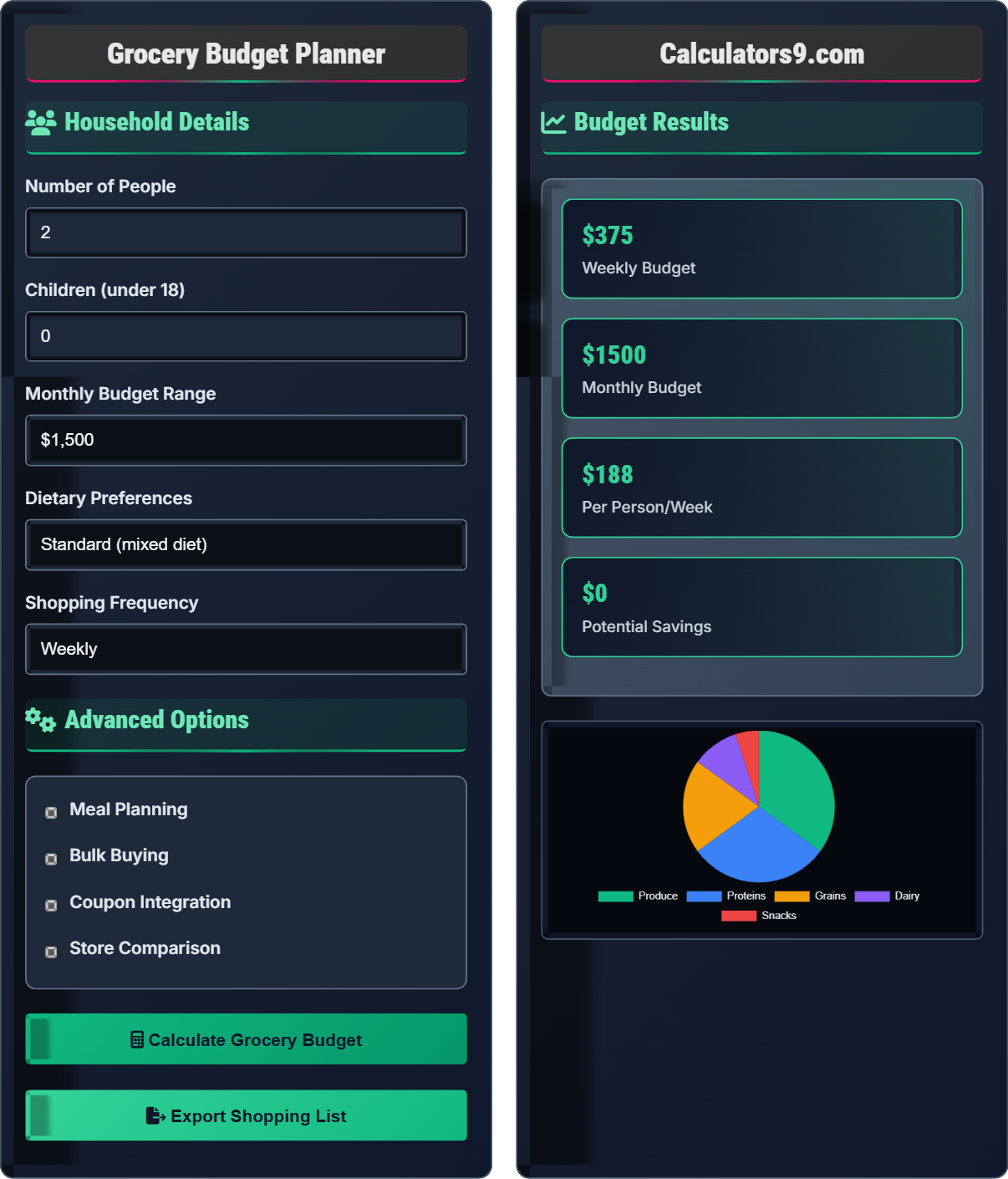
Household Details
Advanced Options
Budget Results
| Category | Budget | Allocation | Estimated Items |
|---|
| Item | Quantity | Unit Price | Total |
|---|
| Day | Meal | Recipe | Ingredients |
|---|
Comprehensive Grocery Budget Guide
Effective grocery budgeting combines strategic planning with smart shopping techniques. The key is to plan meals around sales, use store apps for digital coupons, and shop with a detailed list to avoid impulse purchases. Bulk buying for non-perishables and seasonal produce can significantly reduce costs while maintaining nutritional quality.
The standard grocery budget calculation uses the following approach:
Where:
- \( \text{Household Size} \): Total number of people
- \( \text{Per Person Amount} \): $50-$100 based on dietary needs
- \( \text{Nutrition Factor} \): 1.0 for basic, 1.2 for healthy, 1.5 for premium
- \( \text{Discount Factor} \): Applied after initial calculation
Implement these strategies to maximize your grocery budget:
- Plan Meals: Create weekly meal plans based on sales and seasonal produce
- Make Lists: Shop with detailed lists organized by store sections
- Buy Generic: Choose store brands for 20-40% savings
- Use Coupons: Combine manufacturer and store coupons for maximum savings
- Buy Seasonal: Purchase produce when it's in season for lower prices
- Shop Sales Cycles: Learn your store's weekly sale patterns
- Buy in Bulk: Purchase non-perishables in larger quantities
- Compare Unit Prices: Check cost per unit rather than package price
- Limit Convenience Foods: Avoid pre-cut/prepared foods for savings
- Grow Herbs: Small indoor gardens can reduce spice costs
Budget Basics
Planned spending allocation for food and household essentials.
\( \text{Weekly Budget} = \text{Household Size} \times \text{Per Person Amount} \times \text{Nutrition Factor} \)
Where: Household size, per-person amount, nutrition factor.
- Plan before shopping
- Stick to your list
- Track spending
Optimization Strategies
Cost per unit of measure to compare value.
- Plan meals around sales
- Use store apps for deals
- Buy generic brands
- Shop seasonal produce
- Seasonal price variations
- Store loyalty programs
- Transportation costs
- Storage capacity
Grocery Budget Learning Quiz
According to standard grocery budgeting practices, what percentage of your budget should be allocated to fresh produce?
The answer is B) 30-40%. Fresh produce typically represents 30-40% of a well-balanced grocery budget. This allocation allows for adequate fruits and vegetables while leaving room for proteins, grains, and other essentials.
Proper budget allocation ensures nutritional balance while maintaining affordability. The 30-40% rule for produce helps prioritize nutrient-dense foods while recognizing that other categories like proteins and grains are also essential for a balanced diet.
Produce: Fresh fruits and vegetables
Budget Allocation: Percentage of total budget assigned to categories
• Produce: 30-40% of budget
• Proteins: 25-35% of budget
• Grains: 20-25% of budget
• Buy seasonal produce for savings
• Consider frozen options when fresh is expensive
• Shop the perimeter of the store first
• Allocating too little for produce
• Not accounting for seasonal price changes
• Forgetting to budget for snacks
A family of 4 (2 adults, 2 children) wants to plan a healthy grocery budget. Calculate their weekly budget using standard guidelines and explain the factors that influence this recommendation.
Step 1: Base calculation: 4 people × $75/person = $300
Step 2: Apply nutrition factor for healthy eating: $300 × 1.2 = $360
Step 3: Apply discount factor for smart shopping: $360 × 0.85 = $306
The family should budget approximately $306 per week for groceries.
Grocery budgeting considers household size, dietary preferences, and shopping strategies. The base rate of $75 per person balances affordability with nutrition. The healthy eating factor accounts for potentially higher-cost nutritious options, while the discount factor reflects savings from smart shopping techniques.
Base Rate: Standard amount per person
Nutrition Factor: Adjustment for dietary quality
• USDA recommends $50-100 per person
• Healthy eating may increase costs
• Smart shopping reduces costs
• Plan meals around weekly sales
• Use store apps for digital coupons
• Buy generic brands for savings
• Underestimating children's consumption
• Not accounting for dietary restrictions
• Forgetting to budget for snacks
Sarah has a $200 weekly grocery budget for her family of 3. She plans to allocate 35% to produce, 30% to proteins, 20% to grains and pantry items, 10% to dairy, and 5% to snacks. Calculate how much money she should spend in each category and explain why this allocation might be beneficial.
Produce: $200 × 0.35 = $70
Proteins: $200 × 0.30 = $60
Grains/Pantry: $200 × 0.20 = $40
Dairy: $200 × 0.10 = $20
Snacks: $200 × 0.05 = $10
This allocation prioritizes nutrient-dense foods while maintaining balance across food groups.
Category-based budgeting ensures balanced nutrition while preventing overspending in any one area. The high allocation to produce and proteins supports a nutrient-rich diet, while the limited snack budget helps control discretionary spending. This approach maintains nutritional priorities within budget constraints.
Category Budgeting: Allocating funds to specific food groups
Nutrient-Dense: Foods providing high nutrition per calorie
• Prioritize nutrient-dense foods
• Limit discretionary spending
• Maintain food group balance
• Track spending by category
• Adjust allocations seasonally
• Reassess monthly for effectiveness
• Overspending on convenience foods
• Not adjusting for seasonal prices
• Forgetting to budget for household items
A 16-ounce bag of organic apples costs $4.50, while conventional apples cost $2.50 for the same size. Calculate the unit price for each and explain when it might be worth paying the premium for organic produce.
Organic apples: $4.50 ÷ 16 oz = $0.28/oz
Conventional apples: $2.50 ÷ 16 oz = $0.16/oz
The organic option costs $0.12 more per ounce. Organic might be worth it for "Dirty Dozen" produce or if you prefer to avoid pesticides.
Unit pricing reveals the true cost comparison between products. While organic often costs more, the "Dirty Dozen" list identifies produce with highest pesticide residues, where organic premiums may be justified. For other items, conventional options may offer better value.
Unit Price: Cost per unit of measure
Dirty Dozen: EWG list of produce with highest pesticide residues
• Always check unit prices
• Prioritize organic for Dirty Dozen
• Compare before assuming value
• Calculate unit prices mentally
• Focus organic purchases strategically
• Look for organic sales
• Assuming all organic is worth the premium
• Not calculating unit prices
• Buying organic for "Clean Fifteen" items
Which of the following is the most effective strategy for maximizing your grocery budget?
The answer is B) Plan meals around weekly sales and use coupons. This strategy combines multiple cost-saving approaches: meal planning reduces waste, shopping sales maximizes value, and coupons provide additional discounts. This comprehensive approach typically saves 20-30% compared to unplanned shopping.
Effective grocery budgeting requires a multi-faceted approach. Simply choosing the cheapest brand ignores opportunity costs and may sacrifice quality or nutrition. Strategic planning leverages multiple savings opportunities simultaneously for maximum impact.
Strategic Shopping: Coordinated approach to maximize savings
Opportunity Cost: Value of the next best alternative
• Plan before shopping
• Combine multiple strategies
• Focus on per-unit costs
• Use store apps for circulars
• Stack manufacturer and store coupons
• Plan meals around weekly ads
• Shopping without a plan
• Ignoring unit prices
• Not using available discounts
FAQ
Q: How can I stick to my grocery budget when my kids want expensive snacks and treats?
A: Managing children's requests while staying on budget requires strategic planning:
• Involve kids in meal planning to give them ownership
• Set aside a small "treat budget" within your total budget
• Teach comparison shopping skills using unit prices
• Find healthier alternatives to expensive snacks
• Use the "one treat per week" rule to limit requests
• Stock up on sale items when they're on the list
Explain budgeting concepts to older children so they understand the limitations and can make informed choices.
Q: What are the best ways to save money on healthy foods without sacrificing nutrition?
A: Maximize nutrition while minimizing costs with these strategies:
• Buy in seasons: Purchase fruits and vegetables when they're abundant
• Choose store brands: Generic options offer 20-40% savings
• Buy frozen: Frozen produce retains nutrition and costs less
• Shop the perimeter: Focus on whole foods over processed
• Buy generic staples: Rice, beans, pasta at lower cost
• Plan around sales: Build meals around discounted items
Focus on nutrient-dense foods that provide the most nutrition per dollar spent.
Q: How do I budget for specialty dietary needs like gluten-free or organic foods?
A: Special dietary needs require adjusted budgeting strategies:
• Focus organic purchases on "Dirty Dozen" items
• Buy generic gluten-free products when available
• Make homemade versions of expensive specialty items
• Shop warehouse clubs for bulk specialty items
• Look for sales and clearance on specialty items
• Consider if all items truly require specialty versions
Often, focusing on whole foods naturally meets dietary restrictions while controlling costs.