Keto Macro Calculator
Optimize your ketogenic diet • 2026 guidelines
Keto Macro Formula:
Show the calculator\( \text{Net Carbs (g)} = \text{Total Carbs} - \text{Fiber} \)
\( \text{Protein (g)} = \text{Body Weight (kg)} \times \text{Protein Factor (g/kg)} \)
\( \text{Fat (g)} = \frac{\text{Daily Calories} - (\text{Protein Cal} + \text{Carb Cal})}{9} \)
Where:
- Standard Keto: 5-10% carbs, 20-25% protein, 70-75% fat
- Protein Factor: 0.8-1.2g/kg body weight (higher for athletes)
- Net Carbs: Should stay under 20-50g daily for ketosis
- Calories: Adjust based on TDEE and goals
- Protein: 4 calories per gram
- Carbs: 4 calories per gram
- Fat: 9 calories per gram
This formula calculates your ketogenic macronutrient targets based on body weight and goals.
Example: For a 70kg person with 2,000 calorie daily intake:
Protein: 70kg × 1.0g/kg = 70g (280 cal)
Carbs: 20g net (80 cal)
Fat: (2,000 - 280 - 80) ÷ 9 = 182g
Thus, the daily intake would be 70g protein, 20g net carbs, 182g fat.
Personal Information
Activity Level
Goals
Keto Variants
Advanced Options
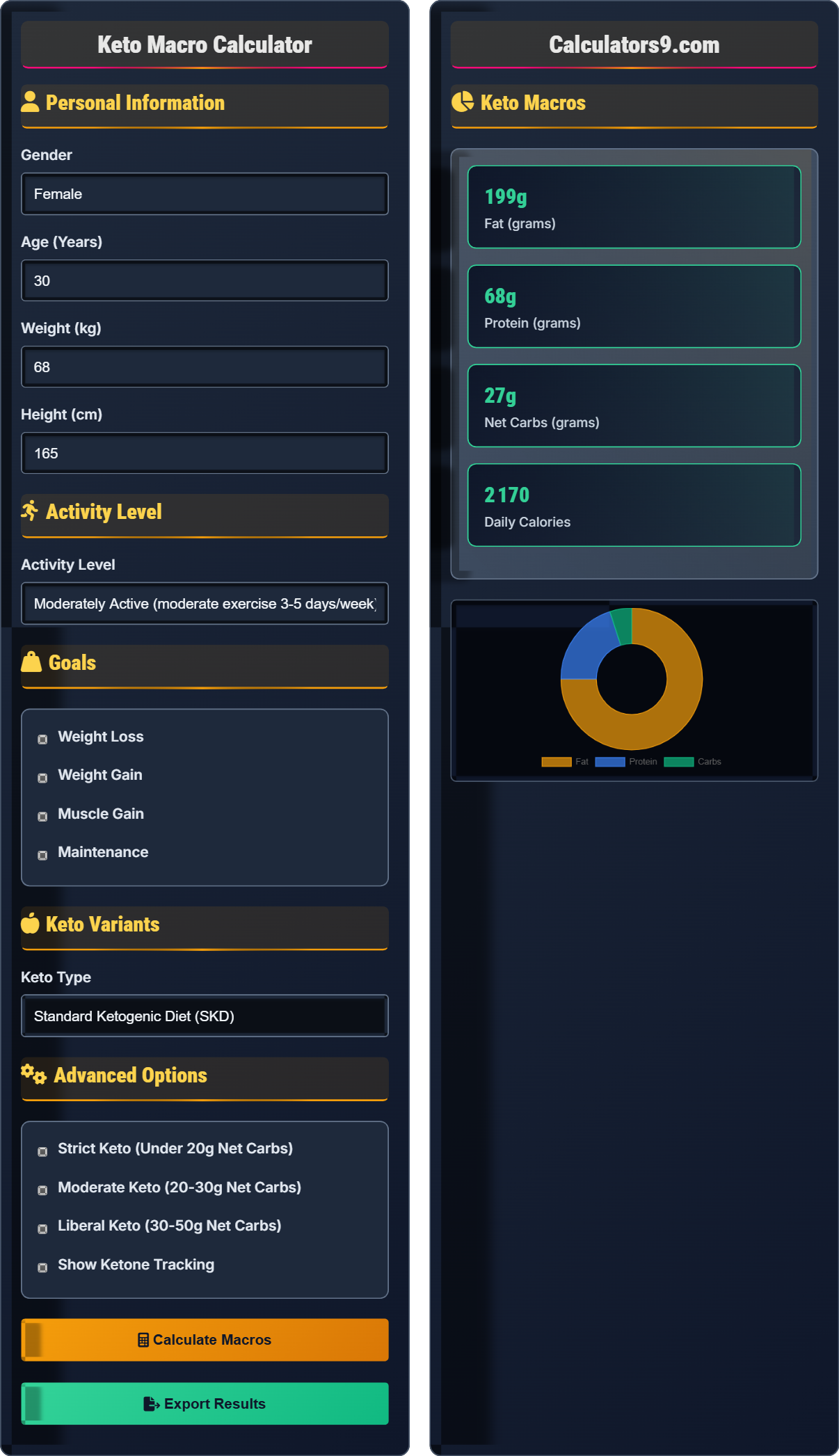
Keto Macros
| Macronutrient | Grams | Calories | Percentage |
|---|
| Food Group | Examples | Net Carbs (per 100g) | Protein (per 100g) |
|---|
Keto Macro Guide
The ketogenic diet is a high-fat, moderate-protein, low-carbohydrate diet that shifts your body's metabolism from burning glucose to burning ketones for energy. This metabolic state, called ketosis, typically occurs when net carbohydrate intake drops below 20-50 grams per day.
Standard ketogenic diet macronutrient distribution:
Where:
- Net carbs = Total carbs - Fiber
- Protein: 0.8-1.2g per kg of body weight
- Higher protein for athletes (1.2-1.6g/kg)
Net carbs are calculated as total carbohydrates minus fiber:
- Net Carbs = Total Carbs - Fiber
- Some include sugar alcohols if >5g per serving
- Most sugar alcohols have minimal impact on ketosis
- Track net carbs to stay under 20-50g daily
For ketosis, most people need to keep net carbs below 20-50g per day, though individual tolerance varies.
- Restrict Carbs: Keep net carbs under 20-50g daily
- Track Intake: Use apps to monitor macros precisely
- Focus on Fat: Make healthy fats the primary energy source
- Moderate Protein: Avoid excess protein that can be converted to glucose
- Hydration: Drink plenty of water and replenish electrolytes
Keto Basics
Metabolic state where the body burns fat for fuel instead of glucose.
\( \text{Net Carbs} = \text{Total Carbs} - \text{Fiber} \)
Where net carbs=available carbohydrates.
- Net carbs under 20-50g/day
- 75% calories from fat
- Moderate protein intake
Macro Targets
0.8-1.2g per kg of body weight (higher for athletes).
- Fat: 70-75% of calories
- Protein: 20-25% of calories
- Carbs: 5-10% of calories
- Net carbs: 20-50g/day
- Adjust for activity level
- Track net carbs, not total carbs
- Include healthy fats
- Monitor ketone levels
Keto Macro Learning Quiz
What are the standard macronutrient ratios for the ketogenic diet?
The answer is B) 75% fat, 20% protein, 5% carbs. The standard ketogenic diet is characterized by high fat intake (70-75% of calories), moderate protein (20-25%), and very low carbohydrates (5-10%). This ratio forces the body to use ketones for energy instead of glucose.
The high fat content is essential for maintaining ketosis. The moderate protein prevents muscle loss while not converting to excessive glucose. The extremely low carb intake keeps blood sugar low, encouraging the body to burn fat for fuel.
Ketosis: Metabolic state where body burns ketones for energy
Standard Ketogenic Diet: High-fat, moderate-protein, very-low-carb diet
Macronutrient Ratios: Percentage distribution of fat, protein, and carbs
• Fat: 70-75% of calories
• Protein: 20-25% of calories
• Carbs: 5-10% of calories
• 75-20-5 rule for standard keto
• Focus on healthy fats
• Moderate protein intake
• Not eating enough fat
• Too much protein
• Confusing total carbs with net carbs
Calculate the keto macros for a 70kg person with 2,000 daily calories using 75% fat, 20% protein, and 5% carbs. Show your work.
Step 1: Calculate calories from each macro
• Fat calories: 2,000 × 0.75 = 1,500 calories
• Protein calories: 2,000 × 0.20 = 400 calories
• Carb calories: 2,000 × 0.05 = 100 calories
Step 2: Convert calories to grams
• Fat grams: 1,500 ÷ 9 = 167g
• Protein grams: 400 ÷ 4 = 100g
• Carb grams: 100 ÷ 4 = 25g
Step 3: Verify protein requirement
• Recommended: 70kg × 1.0g/kg = 70g (actual 100g is acceptable)
Step 4: Verify carb limit
• 25g net carbs is within keto range (20-50g)
Therefore, the keto macros are 167g fat, 100g protein, and 25g net carbs.
This example demonstrates the systematic approach to calculating keto macros. First, determine calorie distribution based on percentages, then convert those calories to grams using the known calorie values for each macronutrient. Finally, verify that the protein and carb amounts fall within recommended ranges.
Macro Distribution: Percentage allocation of calories to each macro
Calorie Conversion: Mathematical process of changing calories to grams
Net Carbs: Total carbs minus fiber
• Calculate calories first, then convert to grams
• Use correct calories-per-gram values
• Verify protein and carb limits
• Calculate calories by macro percentage first
• Divide by correct conversion factor
• Check against keto guidelines
• Dividing percentages directly by conversion factors
• Using wrong calories-per-gram values
• Not verifying against keto limits
If a food has 8g total carbs and 6g fiber, what are the net carbs? How does this affect ketosis?
Step 1: Calculate net carbs
• Net Carbs = Total Carbs - Fiber
• Net Carbs = 8g - 6g = 2g
Step 2: Analyze impact on ketosis
• This food contributes only 2g net carbs to daily intake
• Since fiber doesn't raise blood sugar, it doesn't interfere with ketosis
• Foods with high fiber and low net carbs are ideal for keto
Step 3: Understand fiber's role
• Soluble fiber feeds beneficial gut bacteria
• Insoluble fiber passes through undigested
• Both types of fiber don't affect blood sugar or ketosis
Therefore, this food has only 2g net carbs and is suitable for maintaining ketosis.
Understanding net carbs is crucial for keto success. Fiber is indigestible and doesn't raise blood sugar, so it's subtracted from total carbs. This allows for consumption of high-fiber vegetables and nuts while staying in ketosis. Sugar alcohols are sometimes subtracted from net carbs if they have minimal impact on blood sugar.
Net Carbs: Digestible carbohydrates that affect blood sugar
Fiber: Indigestible carbohydrate that doesn't affect ketosis
Ketosis: Metabolic state where body burns fat for fuel
• Net Carbs = Total Carbs - Fiber
• Fiber doesn't affect ketosis
• Track net carbs, not total carbs
• Always check net carbs
• High-fiber foods are keto-friendly
• Read labels carefully
• Counting total carbs instead of net carbs
• Not accounting for fiber
• Forgetting about sugar alcohols
Why is protein moderation important on the ketogenic diet? How much protein should a 65kg person consume daily?
Step 1: Explain protein moderation importance
• Excess protein can be converted to glucose through gluconeogenesis
• This process can raise blood sugar and potentially kick you out of ketosis
• However, adequate protein is needed to maintain muscle mass
Step 2: Calculate protein needs
• Standard: 65kg × 1.0g/kg = 65g protein
• Athletic: 65kg × 1.2g/kg = 78g protein
• Range: 65-78g protein daily
Step 3: Explain optimal approach
• Aim for 0.8-1.2g protein per kg of body weight
• Higher end for active individuals or muscle preservation
• Lower end for strict ketosis maintenance
Step 4: Discuss protein sources
• High-quality sources: Meat, fish, eggs, cheese, nuts
• Avoid processed meats with added sugars
• Include protein in every meal for satiety
Therefore, a 65kg person should consume 65-78g of protein daily to maintain ketosis while preserving muscle mass.
Protein moderation is a delicate balance on keto. Too little protein leads to muscle loss, while too much can inhibit ketosis through gluconeogenesis. The goal is to consume just enough protein to maintain muscle mass while keeping the body in ketosis. This requires careful calculation based on body weight and activity level.
Gluconeogenesis: Process of creating glucose from non-carb sources
Protein Moderation: Balancing protein to maintain muscle without inhibiting ketosis
Body Weight Protein: Protein calculated per kg of body weight
• 0.8-1.2g protein per kg body weight
• Excess protein → glucose → less ketosis
• Adequate protein prevents muscle loss
• Calculate protein by body weight
• Include protein in every meal
• Choose high-quality sources
• Consuming too much protein
• Not calculating protein needs
• Confusing protein with fat requirements
What is the typical range for blood ketone levels in nutritional ketosis?
The answer is B) 0.5-3.0 mmol/L. Nutritional ketosis is defined as blood ketone levels between 0.5 and 3.0 mmol/L. This range indicates that the body is efficiently burning ketones for fuel without being in a dangerous state of ketoacidosis (which occurs at much higher levels).
Blood ketone testing is the most accurate way to measure ketosis. Levels of 0.5-3.0 mmol/L indicate nutritional ketosis, which is safe and beneficial. Levels above 3.0 mmol/L may indicate deeper ketosis but could also signal insufficient food intake. Levels above 15 mmol/L are associated with diabetic ketoacidosis, which is dangerous.
Nutritional Ketosis: Safe metabolic state with elevated ketones
Blood Ketones: Beta-hydroxybutyrate levels in blood
Ketoacidosis: Dangerous condition with extremely high ketones
• Ketosis: 0.5-3.0 mmol/L
• Safe and beneficial range
• Monitor for optimal levels
• 0.5-3.0 mmol/L = nutritional ketosis
• Test ketones in morning or evening
• Consistent tracking shows trends
• Confusing ketosis with ketoacidosis
• Not understanding safe ranges
• Testing inconsistently
FAQ
Q: How do I calculate net carbs when sugar alcohols are present?
A: Calculating net carbs with sugar alcohols depends on the type and amount:
General rules:
- Subtract all sugar alcohols if total is less than 5g per serving
- Subtract half the sugar alcohols if total is more than 5g per serving
- Erythritol: Subtract 100% (doesn't affect blood sugar)
- Xylitol, Stevia blend: Subtract 50-70%
Formula: Net Carbs = Total Carbs - Fiber - (Sugar Alcohols × Adjustment Factor)
Always check how the sugar alcohol affects your individual blood sugar response.
Q: Can athletes successfully follow a ketogenic diet?
A: Yes, athletes can follow a ketogenic diet, but it requires specific approaches:
Keto-adapted athletes:
- Can perform well in endurance sports after adaptation period
- May benefit from Cyclical Ketogenic Diet (CKD) for high-intensity activities
- Should increase protein to 1.2-1.6g per kg of body weight
- Need careful electrolyte management
Considerations:
- Power and sprint athletes may perform better with targeted carbs
- Adaptation period can take 2-4 weeks
- Hydration and electrolyte needs increase
Consult with a sports nutritionist familiar with keto for optimal performance.