Macro Nutrient Split Calculator
Optimize your protein, carb, fat ratios • 2026 guidelines
Macro Nutrient Formula:
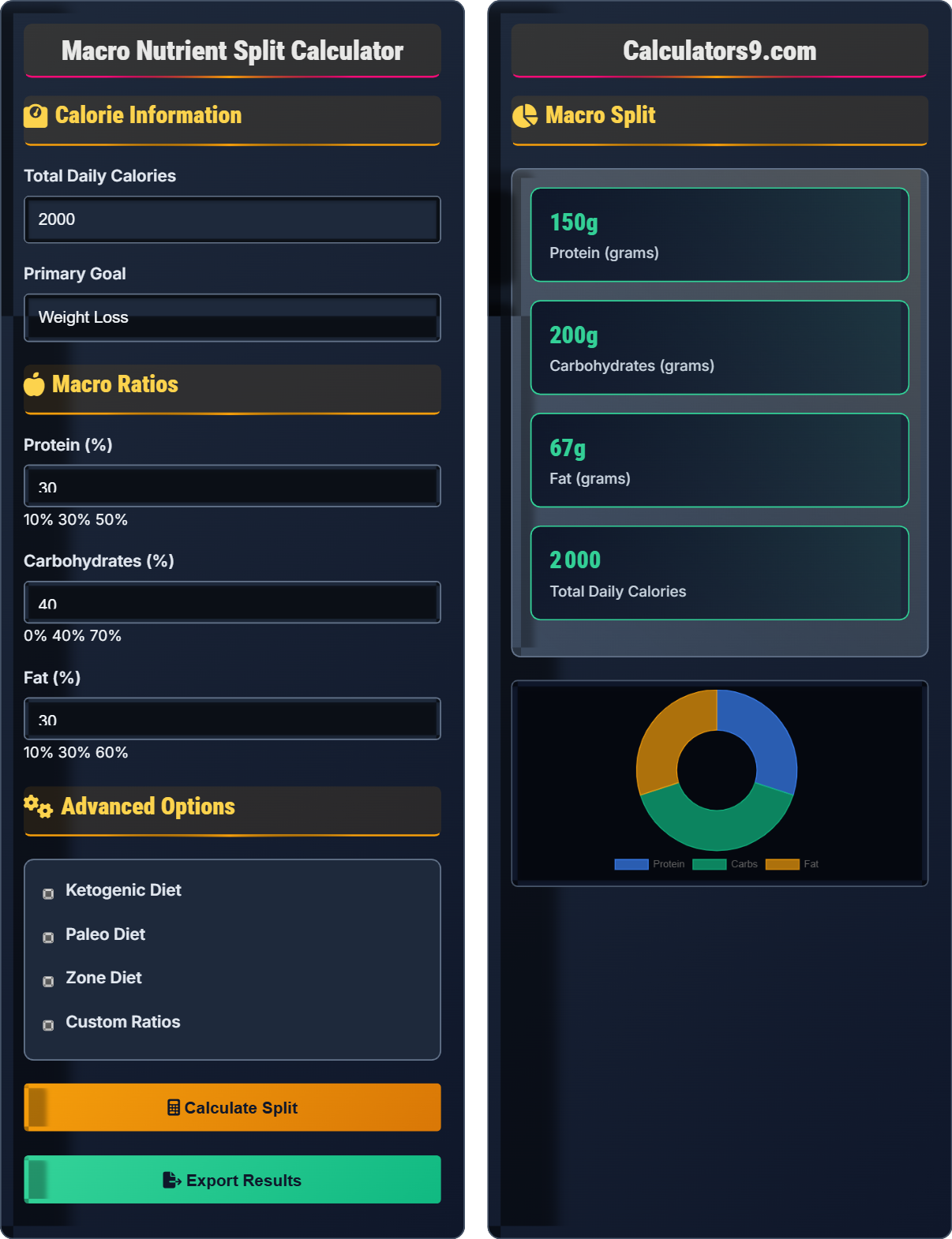
Show the calculator\( \text{Protein (g)} = \frac{\text{Total Calories} \times \text{Protein \%}}{4} \)
\( \text{Carbs (g)} = \frac{\text{Total Calories} \times \text{Carb \%}}{4} \)
\( \text{Fat (g)} = \frac{\text{Total Calories} \times \text{Fat \%}}{9} \)
Where:
- Protein = 4 calories per gram
- Carbohydrates = 4 calories per gram
- Fat = 9 calories per gram
- Standard ratios: 30% protein, 40% carbs, 30% fat
- Keto ratios: 20% protein, 5% carbs, 75% fat
- Zone ratios: 30% protein, 40% carbs, 30% fat
This formula calculates macro gram amounts based on total daily calories and desired ratios.
Example: For 2,000 calories with 30% protein, 40% carbs, 30% fat:
Protein: (2,000 × 0.30) ÷ 4 = 150g
Carbs: (2,000 × 0.40) ÷ 4 = 200g
Fat: (2,000 × 0.30) ÷ 9 = 67g
Thus, the daily intake would be 150g protein, 200g carbs, 67g fat.
Calorie Information
Macro Ratios
Advanced Options
Macro Split
| Macronutrient | Grams | Calories | Percentage |
|---|
| Food Source | Protein (g) | Carbs (g) | Fat (g) |
|---|
Macro Nutrient Split Guide
Macronutrients are nutrients required in large amounts by the human body. They include proteins, carbohydrates, and fats. Each provides energy (calories) and serves specific functions in the body. Balancing macronutrients is crucial for optimal health, performance, and body composition.
Each macronutrient provides different amounts of energy per gram:
Where:
- Protein supports muscle building and repair
- Carbohydrates provide quick energy
- Fat supports hormone production and cell function
Macronutrient ratios should align with your specific goals:
- Muscle Gain: Higher protein (30-35%), moderate carbs (35-40%), moderate fat (25-30%)
- Weight Loss: Higher protein (30-35%), moderate carbs (25-35%), moderate fat (25-35%)
- Endurance Training: Higher carbs (45-55%), moderate protein (20-25%), moderate fat (20-30%)
- Strength Training: Higher protein (30-35%), moderate carbs (30-40%), moderate fat (25-30%)
Adjustments should consider individual preferences, activity level, and metabolic health.
- Protein: Aim for 0.8-1.2g per lb of body weight for muscle preservation
- Carbohydrates: Time around workouts for active individuals
- Fats: Include essential fatty acids for hormone production
- Hydration: Drink plenty of water, especially on low-carb diets
- Tracking: Use apps to monitor macro intake accuracy
Macro Basics
Proteins, carbohydrates, and fats required in large amounts for energy and function.
\( \text{Grams} = \frac{\text{Calories}}{\text{Calories per gram}} \)
Where protein/carbs=4 cal/g, fat=9 cal/g.
- Protein = 4 calories/gram
- Carbs = 4 calories/gram
- Fat = 9 calories/gram
Goal-Specific Ratios
Higher protein (30-35%) to support muscle synthesis and recovery.
- Muscle Gain: 30-35% protein, 30-40% carbs, 25-30% fat
- Weight Loss: 30-35% protein, 25-35% carbs, 25-35% fat
- Endurance: 20-25% protein, 45-55% carbs, 20-30% fat
- Ketogenic: 20% protein, 5% carbs, 75% fat
- Adjust based on activity level
- Consider metabolic health
- Account for food preferences
- Monitor progress and adjust
Macro Nutrient Split Learning Quiz
How many calories per gram does fat contain compared to protein and carbohydrates?
The answer is C) 9 calories per gram. Fat contains 9 calories per gram, while protein and carbohydrates each contain 4 calories per gram. This is important to know when calculating macronutrient targets.
This fundamental knowledge is essential for macro counting. Because fat has more than twice the calories per gram compared to protein and carbs, it has a greater impact on total calorie intake. Understanding these values allows for accurate macro calculations and meal planning.
Calories per Gram: Energy density of different macronutrients
Macronutrients: Nutrients required in large amounts (protein, carbs, fats)
Energy Density: Calories contained in a unit of food
• Fat = 9 calories/gram
• Protein = 4 calories/gram
• Carbs = 4 calories/gram
• Remember: 4-4-9 rule for calories per gram
• Fat is more calorie-dense than protein/carbs
• Assuming all macros have equal calories per gram
• Not accounting for fat's higher calorie density
• Confusing calories with grams
Calculate the grams of protein, carbs, and fat for a 2,200 calorie diet with 30% protein, 40% carbs, and 30% fat. Show your work.
Step 1: Calculate calories from each macronutrient
• Protein calories: 2,200 × 0.30 = 660 calories
• Carbohydrate calories: 2,200 × 0.40 = 880 calories
• Fat calories: 2,200 × 0.30 = 660 calories
Step 2: Convert calories to grams
• Protein grams: 660 ÷ 4 = 165g
• Carbohydrate grams: 880 ÷ 4 = 220g
• Fat grams: 660 ÷ 9 = 73g
Step 3: Verify the total
Total calories: (165 × 4) + (220 × 4) + (73 × 9) = 660 + 880 + 657 = 2,197 calories (rounded from 2,200)
Therefore, the macro split is 165g protein, 220g carbs, and 73g fat.
This example demonstrates the systematic approach to calculating macro targets. First, determine the calorie distribution based on percentages, then convert those calories to grams using the known calorie values for each macronutrient. This process is fundamental to macro counting.
Macro Distribution: Percentage allocation of calories to each macronutrient
Calorie Conversion: Mathematical process of changing calories to grams
Percentage Allocation: Distribution of total calories among macros
• Calculate calories first, then convert to grams
• Use correct calories-per-gram values
• Verify total calories match original target
• Calculate calories by macro percentage first
• Divide by correct conversion factor
• Double-check total calorie calculation
• Dividing percentages directly by conversion factors
• Using wrong calories-per-gram values
• Not verifying the total calorie sum
Sarah is following a ketogenic diet with 1,800 daily calories. The keto diet typically recommends 20% protein, 5% carbs, and 75% fat. Calculate her macro targets in grams and explain why this ratio promotes ketosis.
Step 1: Calculate calories from each macronutrient
• Protein calories: 1,800 × 0.20 = 360 calories
• Carbohydrate calories: 1,800 × 0.05 = 90 calories
• Fat calories: 1,800 × 0.75 = 1,350 calories
Step 2: Convert calories to grams
• Protein grams: 360 ÷ 4 = 90g
• Carbohydrate grams: 90 ÷ 4 = 23g
• Fat grams: 1,350 ÷ 9 = 150g
Step 3: Explain ketosis promotion
The ketogenic ratio promotes ketosis by severely restricting carbohydrate intake (only 5% of calories), forcing the body to use fat as its primary fuel source. With minimal carbs available for energy, the liver converts fats into ketones, which serve as an alternative energy source for the brain and muscles.
Therefore, Sarah's keto macro targets are 90g protein, 23g carbs, and 150g fat.
The ketogenic diet is characterized by very low carbohydrate intake, which shifts the body's metabolism from glucose-based to fat-based energy systems. This metabolic state, called ketosis, occurs when the body uses ketones produced from fat as its primary fuel source instead of glucose from carbohydrates.
Ketosis: Metabolic state where the body burns fat for fuel
Ketones: Molecules produced when fat is broken down for energy
Low-Carb Diet: Diet restricting carbohydrate intake to promote fat burning
• Keto: Low carbs (5%), High fat (75%)
• Restricts glucose availability
• Promotes fat oxidation
• Keto = High fat, very low carb
• Monitor carb intake strictly
• Adequate protein to preserve muscle
• Including too many carbs in keto calculation
• Not understanding ketosis mechanism
• Confusing keto with other low-carb diets
John is a strength athlete who needs 2,800 calories daily. He wants to optimize muscle gain with 35% protein, 35% carbs, and 30% fat. Calculate his macro targets and explain why this ratio is beneficial for strength training.
Step 1: Calculate calories from each macronutrient
• Protein calories: 2,800 × 0.35 = 980 calories
• Carbohydrate calories: 2,800 × 0.35 = 980 calories
• Fat calories: 2,800 × 0.30 = 840 calories
Step 2: Convert calories to grams
• Protein grams: 980 ÷ 4 = 245g
• Carbohydrate grams: 980 ÷ 4 = 245g
• Fat grams: 840 ÷ 9 = 93g
Step 3: Explain benefits for strength training
This ratio is beneficial for strength training because:
- High protein (35%) provides amino acids for muscle protein synthesis
- Moderate carbs (35%) fuel intense workouts and replenish glycogen stores
- Moderate fat (30%) supports hormone production including testosterone
Therefore, John's macro targets are 245g protein, 245g carbs, and 93g fat.
Strength athletes have increased protein needs to support muscle protein synthesis and recovery from resistance training. The higher protein intake helps maintain positive nitrogen balance, which is essential for muscle growth. Carbohydrates provide the energy needed for high-intensity training, while dietary fats support hormonal health and overall well-being.
Muscle Protein Synthesis: Process of building new muscle proteins
Glycogen Stores: Carbohydrate reserves in muscles and liver
Nitrogen Balance: Relationship between protein intake and breakdown
• Strength athletes need 30-35% protein
• Adequate carbs for workout energy
• Sufficient fat for hormone production
• Higher protein for muscle building
• Time carbs around workouts
• Include healthy fats for hormones
• Not enough protein for muscle building
• Too few carbs for intense training
• Insufficient fat for hormonal health
What is the typical macro ratio for the Zone Diet?
The answer is B) 30% protein, 40% carbs, 30% fat. The Zone Diet, developed by Dr. Barry Sears, emphasizes this balanced ratio to control insulin levels and promote optimal health. The diet focuses on portion control using a system of blocks rather than just percentages.
The Zone Diet is designed to maintain steady blood sugar and insulin levels by balancing macronutrients. The 30-40-30 ratio is intended to optimize the hormonal response to food, particularly insulin release. This diet emphasizes lean proteins, low-glycemic carbohydrates, and monounsaturated fats in specific proportions.
Zone Diet: Balanced macro diet focusing on insulin control
Insulin Control: Managing blood sugar response to food
Block System: Zone Diet's portion measurement method
• Zone Diet: 30/40/30 ratio
• Focus on insulin response
• Emphasizes portion control
• Zone = 30/40/30 ratio
• Focus on food quality
• Control insulin response
• Confusing Zone with other 30/40/30 diets
• Not understanding insulin control concept
• Confusing with standard balanced diet
FAQ
Q: How do I know if my macro split is working for my goals?
A: Monitor these key indicators to assess if your macro split is effective:
Physical markers:
- Progress toward your goal (weight loss, gain, or maintenance)
- Body composition changes (muscle gain vs. fat loss)
- Energy levels throughout the day
- Sleep quality and recovery
Nutritional markers:
- Consistency in hitting macro targets
- Food satisfaction and cravings
- Performance in workouts
Give your body 2-3 weeks to adapt to new macro ratios before making adjustments. If you're not seeing expected results, adjust by 5-10% increments rather than making dramatic changes.
Q: Should I adjust my macros on workout vs. rest days?
A: Yes, adjusting macros based on activity level can optimize performance and recovery. This approach, called "nutritional periodization," involves:
On training days:
- Higher carbohydrates to fuel the workout
- Adequate protein for muscle recovery
- Adjust fats to maintain calorie balance
On rest days:
- Maintain protein for muscle preservation
- Reduce carbohydrates since energy demands are lower
- May slightly increase healthy fats
For example, if your maintenance is 2,200 calories with 30/40/30, you might eat 2,400 calories (30/45/25) on heavy training days and 2,000 calories (30/35/35) on rest days.