Meal Plan Generator
Create your personalized nutrition plan • 2026 guidelines
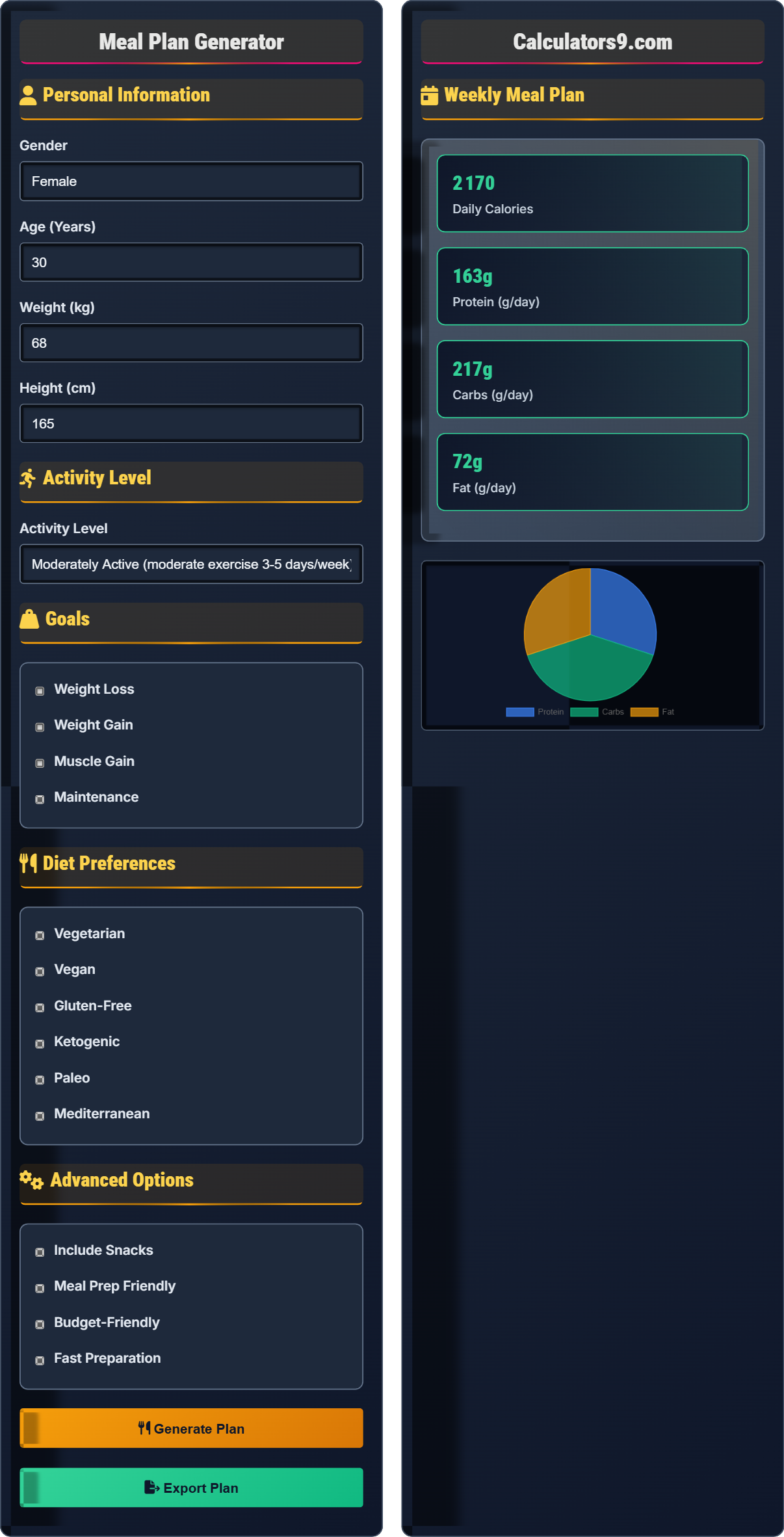
Meal Planning Formula:
Show the generator\( \text{Daily Calories} = \text{BMR} \times \text{Activity Factor} \pm \text{Goal Adjustment} \)
\( \text{Protein (g)} = \frac{\text{Daily Calories} \times \text{Protein \%}}{4} \)
\( \text{Carbs (g)} = \frac{\text{Daily Calories} \times \text{Carb \%}}{4} \)
\( \text{Fat (g)} = \frac{\text{Daily Calories} \times \text{Fat \%}}{9} \)
Where:
- Activity Factors: Sedentary (1.2), Light (1.375), Moderate (1.55), Active (1.725), Very Active (1.9)
- Goal Adjustments: Weight Loss (-500 to -1000), Weight Gain (+250 to +500)
- Protein: 4 calories per gram
- Carbohydrates: 4 calories per gram
- Fat: 9 calories per gram
- Standard Ratios: 30% protein, 40% carbs, 30% fat
This formula calculates your daily caloric needs and macronutrient targets.
Example: For a 2000 calorie diet with 30% protein, 40% carbs, 30% fat:
Protein: (2000 × 0.30) ÷ 4 = 150g
Carbs: (2000 × 0.40) ÷ 4 = 200g
Fat: (2000 × 0.30) ÷ 9 = 67g
Thus, the daily intake would be 150g protein, 200g carbs, 67g fat.
Personal Information
Activity Level
Goals
Diet Preferences
Advanced Options
Weekly Meal Plan
| Day | Breakfast | Lunch | Dinner | Snacks |
|---|
| Ingredient | Quantity | Category | Estimated Cost |
|---|
Meal Planning Guide
Meal planning offers numerous benefits including better nutrition, time savings, reduced food waste, and cost efficiency. It helps you make healthier choices by preparing nutritious meals in advance, avoiding last-minute unhealthy options.
Standard macronutrient ratios for different goals:
Where:
- Protein: 4 calories per gram
- Carbohydrates: 4 calories per gram
- Fat: 9 calories per gram
Include foods from all major groups for balanced nutrition:
- Proteins: Lean meats, poultry, fish, eggs, legumes, tofu, dairy
- Vegetables: Dark leafy greens, colorful vegetables, cruciferous vegetables
- Fruits: Berries, citrus fruits, apples, bananas, seasonal varieties
- Grains: Whole grains, oats, quinoa, brown rice, whole wheat products
- Fats: Avocados, nuts, seeds, olive oil, fatty fish
Emphasize variety and nutrient density for optimal health outcomes.
- Batch Cooking: Cook large portions and divide into containers
- Prep Components: Prepare proteins, grains, and vegetables separately
- Use Freezer: Freeze portions for extended storage
- Invest in Containers: Use quality containers for food safety
- Plan Variety: Rotate recipes to avoid monotony
Planning Basics
Strategic preparation of meals in advance to achieve nutrition goals efficiently.
\( \text{Protein (g)} = \frac{\text{Calories} \times \text{Protein \%}}{4} \)
Where protein=grams needed for target percentage.
- Calculate macros based on goals
- Include variety in food choices
- Consider dietary restrictions
Prep Strategies
Prepare large quantities of food components to assemble throughout the week.
- Wash and chop vegetables
- Cook proteins in bulk
- Prepare grains and starches
- Assemble salads in jars
- Pre-cook breakfast options
- Food safety guidelines
- Storage duration limits
- Texture preservation
- Flavor enhancement
Meal Planning Learning Quiz
For muscle gain, what is an appropriate macronutrient distribution?
The answer is B) 30% protein, 40% carbs, 30% fat. For muscle gain, a balanced approach with adequate protein (30%) supports muscle protein synthesis, while sufficient carbs (40%) provide energy for intense training and recovery.
Muscle gain requires adequate protein to support muscle protein synthesis, sufficient carbohydrates to fuel intense training sessions, and healthy fats for hormone production. The 30-40-30 ratio provides the right balance of nutrients to support muscle growth and recovery.
Protein Synthesis: Process of building new muscle proteins
Carbohydrate Loading: Storing carbs for energy
Macronutrient Distribution: Percentage allocation of macros
• Muscle gain: 30% protein minimum
• Adequate carbs for training
• Sufficient fats for hormones
• 30-40-30 for muscle gain
• Not enough protein for muscle synthesis
• Too few carbs for energy
• Ignoring meal timing
Calculate the daily macro targets for a 2,200 calorie diet with 30% protein, 40% carbs, and 30% fat. Show your work.
Step 1: Calculate calories from each macronutrient
• Protein calories: 2,200 × 0.30 = 660 calories
• Carbohydrate calories: 2,200 × 0.40 = 880 calories
• Fat calories: 2,200 × 0.30 = 660 calories
Step 2: Convert calories to grams
• Protein grams: 660 ÷ 4 = 165g
• Carbohydrate grams: 880 ÷ 4 = 220g
• Fat grams: 660 ÷ 9 = 73g
Step 3: Verify the total
Total calories: (165 × 4) + (220 × 4) + (73 × 9) = 660 + 880 + 657 = 2,197 calories (rounded from 2,200)
Therefore, the daily macro targets are 165g protein, 220g carbs, and 73g fat.
This example demonstrates the systematic approach to calculating macro targets. First, determine the calorie distribution based on percentages, then convert those calories to grams using the known calorie values for each macronutrient. This process is fundamental to macro counting and meal planning.
Macro Distribution: Percentage allocation of calories to each macro
Calorie Conversion: Mathematical process of changing calories to grams
Percentage Allocation: Distribution of total calories among macros
• Calculate calories first, then convert to grams
• Use correct calories-per-gram values
• Verify total calories match original target
• Calculate calories by macro percentage first
• Divide by correct conversion factor
• Double-check total calorie calculation
• Dividing percentages directly by conversion factors
• Using wrong calories-per-gram values
• Not verifying the total calorie sum
How should a vegetarian meal plan be modified to ensure complete protein intake?
For a vegetarian meal plan to ensure complete protein intake:
Step 1: Include complementary proteins throughout the day
• Combine legumes with grains (beans and rice, lentil soup with bread)
• Combine nuts/seeds with grains (hummus on whole grain pita)
• Include complete plant proteins (quinoa, soy products, hemp seeds)
Step 2: Plan protein distribution
• Aim for 20-30g protein per meal
• Include protein in every meal and snack
• Consider slightly higher daily intake (add 10-15%) due to lower digestibility
Step 3: Focus on key nutrients
• B12 supplementation (not found in plant foods)
• Iron from fortified cereals, legumes, dark leafy greens
• Zinc from nuts, seeds, legumes
• Omega-3s from flaxseed, chia seeds, walnuts
Therefore, a vegetarian meal plan should emphasize complementary proteins, adequate portions, and key nutrients typically found in animal products.
Vegetarian meal planning requires more attention to protein quality and completeness. Plant proteins are often incomplete, lacking one or more essential amino acids. By combining different plant proteins throughout the day, vegetarians can ensure they get all essential amino acids needed for optimal health.
Complete Protein: Contains all essential amino acids
Complementary Proteins: Incomplete proteins combined to form complete profiles
Amino Acid Profile: Pattern of amino acids in a protein source
• Combine complementary proteins
• Include complete plant proteins
• Consider higher protein needs
• Include soy, quinoa, hemp seeds
• Combine grains with legumes
• Plan protein throughout day
• Not combining complementary proteins
• Assuming all plant proteins are complete
• Not accounting for digestibility
What are the most effective strategies for meal prepping a 7-day meal plan while maintaining food safety and freshness?
Effective meal prep strategies for a 7-day plan:
Step 1: Plan and organize
• Choose 2-3 main proteins to cook in bulk
• Select versatile grains/starches (rice, quinoa, sweet potatoes)
• Prepare fresh vegetables separately to maintain texture
Step 2: Follow food safety guidelines
• Cool cooked foods within 2 hours before refrigerating
• Store in shallow containers for faster cooling
• Refrigerate at 40°F or below
• Consume refrigerated meals within 3-4 days
Step 3: Storage optimization
• Freeze portions not eaten within 4 days
• Use airtight containers to prevent freezer burn
• Label containers with dates
• Thaw frozen meals safely in refrigerator
Step 4: Maintain variety
• Prepare versatile components to mix and match
• Use different seasonings for variety
• Include fresh toppings/add-ons
Therefore, successful meal prep balances convenience, safety, and variety while following proper storage protocols.
Meal prepping requires balancing efficiency with food safety. Proper storage techniques extend the shelf life of prepared meals while preventing bacterial growth. The key is to prepare versatile components that can be assembled in different ways to prevent monotony while maintaining nutritional value.
Food Safety: Practices to prevent foodborne illness
Temperature Danger Zone: Range where bacteria multiply rapidly (40-140°F)
Shelf Life: Duration food remains safe and palatable
• Cool foods within 2 hours
• Consume within 3-4 days
• Freeze for longer storage
• Cook proteins in bulk
• Use glass containers
• Label with dates
• Not following food safety guidelines
• Preparing too much variety at once
• Ignoring storage duration limits
What is the typical macronutrient distribution for a ketogenic diet?
The answer is B) 20% protein, 5% carbs, 75% fat. The ketogenic diet is characterized by very low carbohydrate intake, moderate protein, and high fat consumption to induce ketosis, where the body burns fat for fuel instead of carbohydrates.
The ketogenic diet shifts the body's primary fuel source from glucose to ketones produced from fat. This metabolic state, called ketosis, occurs when carbohydrate intake is severely restricted. The high fat intake provides the primary energy source, while protein intake is moderated to prevent gluconeogenesis.
Ketosis: Metabolic state where body burns fat for fuel
Ketones: Molecules produced when fat is broken down for energy
Gluconeogenesis: Process of making glucose from non-carb sources
• Keto: Very low carbs (5%)
• High fat (75%)
• Moderate protein (20%)
• Monitor carb intake strictly
• Including too many carbs in keto calculation
• Not understanding ketosis mechanism
• Confusing keto with other low-carb diets
FAQ
Q: How do I adjust my meal plan if I'm not seeing the results I want?
A: If you're not seeing desired results after 2-3 weeks, consider these adjustments:
For weight loss plateaus:
- Reduce daily calories by 100-200 (but not below 1,200 for women or 1,500 for men)
- Increase physical activity or exercise intensity
- Reassess portion sizes with measuring tools
- Consider metabolic adaptation and temporary breaks
For muscle gain without scale changes:
- Increase daily calories by 200-300
- Add 5-10g protein to each meal
- Focus on progressive overload in training
Track your actual intake with an app to ensure accuracy.
Q: How can I ensure I'm getting enough protein on a vegetarian meal plan?
A: Vegetarians can meet protein needs by incorporating these high-protein plant foods:
Complete protein sources:
- Soy products (tofu, tempeh, edamame) - 20-30g protein per serving
- Quinoa - 8g protein per cup cooked
- Hemp seeds - 10g protein per 3 tbsp
- Chia seeds - 4g protein per ounce
Complementary protein combinations:
- Legumes + Grains (beans and rice, hummus and pita)
- Legumes + Nuts/Seeds (chickpea salad with sunflower seeds)
Plan for 0.8-1.2g protein per kg of body weight, and consider slightly higher intake due to lower digestibility of some plant proteins.