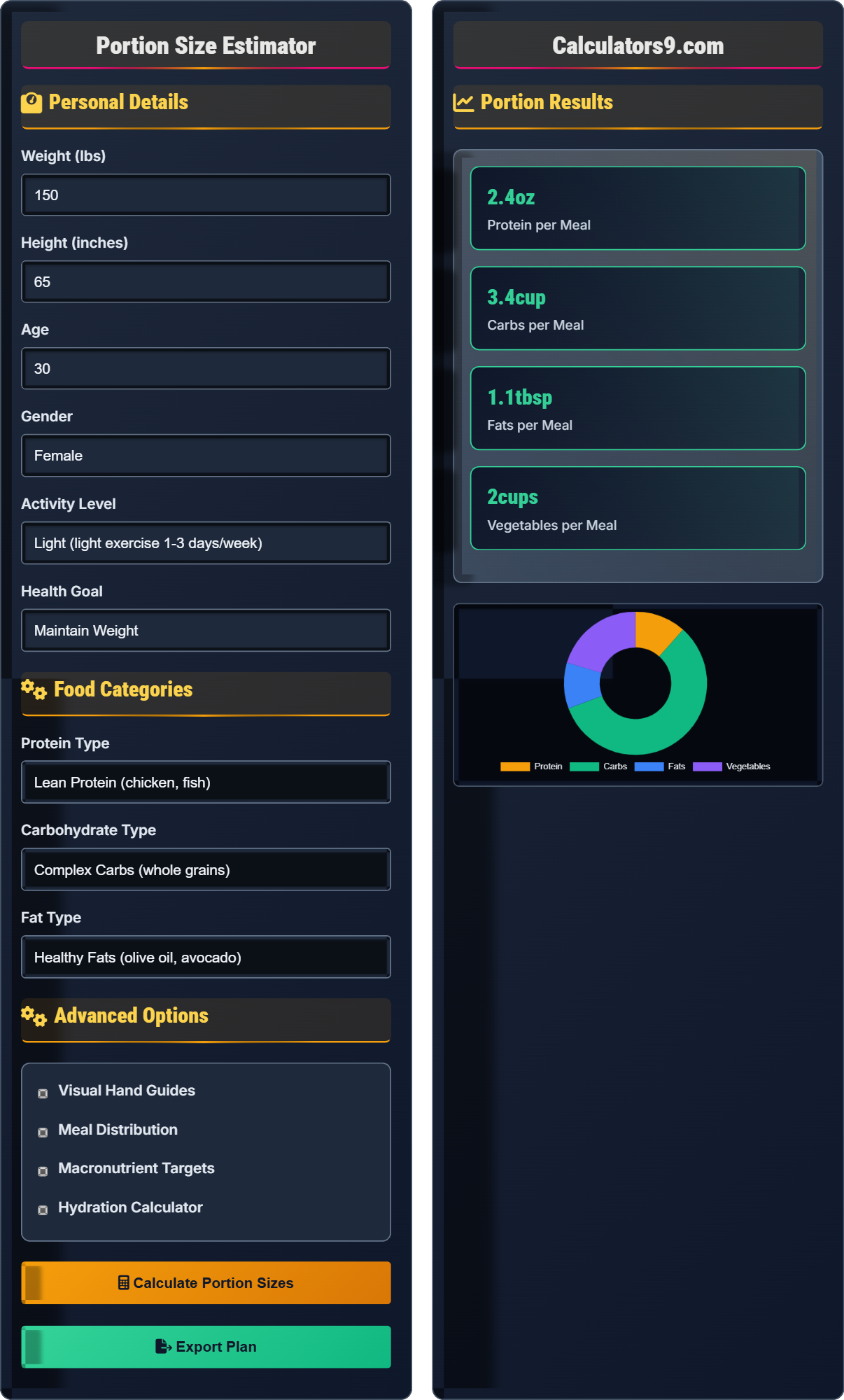
Portion Size Estimator
Visual serving calculator • Nutrition guide
Portion Size Formula:
Show the calculator\( \text{Recommended Portion} = \text{Body Weight (kg)} \times \text{Nutrient Factor} \)
Where:
- \( \text{Body Weight (kg)} \): Weight in kilograms (lbs ÷ 2.2)
- \( \text{Protein Factor} \): 0.8-2.2 g/kg depending on activity
- \( \text{Carb Factor} \): 4-7 g/kg depending on activity
- \( \text{Fat Factor} \): 0.8-1.2 g/kg depending on goals
- \( \text{Visual Estimation} \): Hand measurements (palm, fist, thumb)
This formula calculates personalized portion sizes based on body weight and activity level. The visual estimation method uses hand measurements as practical guides: palm-sized portions for protein, fist-sized for vegetables, cupped handful for carbs, and thumb-sized for fats.
Example: For a 150lb person (68kg) with moderate activity:
Protein: 68kg × 1.2g = 82g (about 3 palm-sized portions)
Carbs: 68kg × 5g = 340g (about 3-4 cupped handfuls)
Fats: 68kg × 0.9g = 61g (about 6 thumb-sized portions)
Personal Details
Food Categories
Advanced Options
Portion Results
| Food Group | Visual Guide | Measurement | Examples |
|---|
| Food Group | Per Meal | Per Day | Total Servings |
|---|
| Food Item | Portion Size | Category | Visual Equivalent |
|---|
Comprehensive Portion Size Guide
Portion control is essential for maintaining a healthy diet and achieving nutritional goals. A portion is the amount of food you choose to eat at one time, while a serving is a standardized amount listed on nutrition labels. Proper portion sizing helps manage calorie intake, maintain stable blood sugar, and ensure adequate nutrient consumption. The visual hand method provides practical, portable guides for estimating portions without measuring tools.
The standard portion calculation uses the following approach:
Where:
- \( \text{Body Weight (kg)} \): Weight in kilograms (lbs ÷ 2.2)
- \( \text{Protein Factor} \): 0.8-2.2 g/kg depending on activity
- \( \text{Carb Factor} \): 4-7 g/kg depending on activity
- \( \text{Fat Factor} \): 0.8-1.2 g/kg depending on goals
Proper portion control provides numerous health benefits:
- Weight Management: Controls calorie intake for healthy weight
- Blood Sugar Control: Stabilizes glucose levels
- Energy Stability: Prevents energy crashes
- Nutrient Balance: Ensures adequate vitamin and mineral intake
- Digestive Health: Prevents overeating and discomfort
- Use Smaller Plates: Creates visual satisfaction with smaller portions
- Pre-portion Foods: Divide large packages into individual servings
- Wait Before Seconds: Allow 20 minutes for fullness signal
- Measure Initially: Learn visual equivalents over time
- Eat Mindfully: Focus on food and chew slowly
Portion Basics
Amount of food chosen to eat at one time.
\( \text{Portion Size} = \text{Body Weight (kg)} \times \text{Nutrient Factor} \)
Where: Body weight in kg, nutrient-specific factors.
- Portion ≠ Serving
- Visual guides are approximate
- Adjust for activity level
Visual Guides
Practical, portable portion estimation tools.
- Palm = Protein
- Fist = Vegetables
- Cupped Hand = Carbs
- Thumb = Fats
- Hand size affects accuracy
- Learn actual measurements
- Combine with mindful eating
- Track for consistency
Portion Size Learning Quiz
Which hand measurement is most appropriate for estimating a 3-4 ounce protein portion?
The answer is B) Palm of hand. The palm of your hand (excluding fingers) is equivalent to about 3-4 ounces of protein, which is the recommended portion size for most adults. This visual guide is approximately the size of a deck of cards and works well for chicken breast, fish fillets, tofu, and other protein sources.
The palm method is effective because it provides a portable, consistent measurement that adjusts slightly with hand size. For most people, their palm size correlates appropriately with their protein needs. This technique eliminates the need for measuring tools while providing reasonable accuracy for portion control.
Portion: Amount of food you choose to eat
Serving: Standardized amount on nutrition labels
Visual Guide: Body-based measurement tool
• Palm = Protein (3-4 oz)
• Fist = Vegetables (1-2 cups)
• Cupped hand = Carbs (1 cup)
• Practice with actual measuring tools first
• Compare to familiar objects (deck of cards)
• Adjust for hand size variations
• Confusing palm with fist measurements
• Not accounting for different food densities
• Using visual guides without practice
A 160-pound person with moderate activity wants to calculate their daily protein needs and per-meal portions. Calculate their requirements using appropriate factors and explain the reasoning.
Step 1: Convert weight to kg: 160 lbs ÷ 2.2 = 72.7 kg
Step 2: Apply protein factor for moderate activity: 1.2 g/kg
Step 3: Calculate daily needs: 72.7 kg × 1.2 g/kg = 87.2g
Step 4: Calculate per-meal portions (4 meals): 87.2g ÷ 4 = 21.8g per meal
Step 5: Convert to visual guide: 21.8g ÷ 7g per oz ≈ 3.1 oz per meal
Protein requirements vary based on activity level, age, and goals. The 1.2 g/kg factor is appropriate for moderately active individuals. More active people may need 1.6-2.2 g/kg, while sedentary individuals may need 0.8-1.0 g/kg. The conversion from grams to ounces (1 oz = 28g) helps translate scientific recommendations into practical measurements.
Protein Factor: Amount per body weight unit
Activity Level: Physical activity intensity
• Sedentary: 0.8-1.0 g/kg
• Moderate: 1.2 g/kg
• Active: 1.6-2.2 g/kg
• Round calculations for simplicity
• Adjust based on fitness goals
• Distribute protein throughout the day
• Using same factor for all activity levels
• Not converting units properly
• Concentrating protein in one meal
Sarah wants to eat 4 meals per day with balanced portions. If her recommended protein per meal is 4oz, carbs are 1 cup, and fats are 2 tbsp, calculate her daily totals and explain how she can visualize these portions using hand measurements.
Daily totals:
Protein: 4oz × 4 meals = 16oz (1 lb)
Carbs: 1 cup × 4 meals = 4 cups
Fats: 2 tbsp × 4 meals = 8 tbsp (1/2 cup)
Visual guides: Palm for protein, cupped hand for carbs, thumb for fats.
Scaling portions for multiple meals requires multiplication while maintaining balance. The visual guides remain consistent regardless of meal frequency, making it easy to maintain proper proportions across all eating occasions. Consistency in portion sizes helps regulate blood sugar and energy levels throughout the day.
Meal Frequency: Number of eating occasions per day
Portion Balance: Appropriate ratio of food groups
• Multiply portions by meal count
• Maintain food group balance
• Use consistent visual guides
• Plan portions for each meal
• Use visual guides consistently
• Track intake for awareness
• Not accounting for total daily intake
• Inconsistent portioning across meals
• Focusing only on one food group
Explain how hand size affects visual portion estimation and what strategies can be used to account for differences between small, medium, and large hands.
Hand size does affect visual estimation accuracy. Small hands may underestimate portions while large hands may overestimate. To account for this: 1) Use the general hand guides as starting points, 2) Calibrate with actual measurements occasionally, 3) Adjust based on results (weight changes, energy levels), 4) Consider using smaller plates with larger hands, 5) Practice with known portion sizes to refine accuracy.
Visual guides are approximations that work well for most people but aren't perfectly accurate for all hand sizes. The correlation between hand size and nutritional needs is imperfect. Regular calibration with actual measuring tools helps individuals fine-tune their visual estimation skills and achieve more accurate portion control.
Visual Calibration: Adjusting estimates based on actual measurements
Portion Accuracy: Closeness to recommended amounts
• Visual guides are approximate
• Adjust based on individual results
• Practice with measuring tools initially
• Use visual guides as reminders
• Monitor outcomes for adjustments
• Treating visual guides as exact measurements
• Not calibrating for hand size
• Ignoring individual responses
Which of the following foods would require the most adjustment when using visual portion guides?
The answer is B) Leafy greens. Leafy greens like spinach, lettuce, and kale have very low density, meaning a large volume (fist size) contains relatively few calories and nutrients compared to denser foods. A fist of spinach contains significantly fewer calories than a fist of cooked rice, even though the visual portion appears identical.
Visual guides work best for foods of average density. Low-density foods like leafy greens can be eaten in larger volumes without excessive calories, while high-density foods like nuts and oils require more careful portioning. Understanding food density helps refine visual estimation for optimal nutrition.
Food Density: Calories per unit volume
Volume vs Weight: Different relationships for different foods
• Low-density foods: Eat larger volumes
• High-density foods: Control portions strictly
• Average density: Visual guides work well
• Fill half plate with low-density vegetables
• Use smaller portions for high-density foods
• Learn density characteristics of common foods
• Applying same portions to all food densities
• Underestimating calories in dense foods
• Overestimating volume of light foods
FAQ
Q: How accurate are hand measurements compared to using measuring cups and scales?
A: Hand measurements are approximately 80-90% accurate for most people compared to precise measuring tools. The advantages include portability, convenience, and practicality in real-world settings. However, they're less accurate than scales for precise macro tracking. For general portion control, hand measurements are highly effective. For competitive athletes or those with specific medical conditions requiring exact measurements, scales are more appropriate.
Q: How should I adjust portions if I'm trying to lose weight?
A: For weight loss, consider these adjustments:
• Protein: Maintain at 1.2-1.6g/kg to preserve muscle
• Carbs: Reduce to 3-5g/kg depending on activity
• Fats: Moderate to 0.8-1.0g/kg
• Vegetables: Keep generous portions (fill half your plate)
• Caloric deficit: Aim for 500-750 calorie daily reduction
Focus on nutrient-dense, lower-calorie foods while maintaining satiety. The visual hand guides can be adjusted by using slightly smaller cupped hands for carbs and moderate reductions in fat portions.
Q: What are the best strategies for maintaining portion control when eating out?
A: Restaurant portion control strategies include:
• Share entrees: Split large portions with dining partners
• Box half: Ask for takeout container immediately
• Appetizer approach: Order two appetizers instead of entree
• Vegetable focus: Choose dishes with lots of vegetables
• Ask for sides: Substitute vegetables for fries/rice
• Slow down: Take breaks between bites to recognize fullness
Remember that restaurant portions are typically 2-3 times larger than recommended portions, so planning ahead is essential for maintaining control.