Protein Requirement Calculator
Calculate your optimal daily protein intake • 2026 guidelines
Protein Intake Formula:
Show the calculator\( \text{Protein (g)} = \text{Body Weight (kg)} \times \text{Protein Factor (g/kg)} \)
Where:
- Sedentary Adults: 0.8 g/kg body weight
- Active Individuals: 1.2-1.6 g/kg body weight
- Strength Athletes: 1.6-2.2 g/kg body weight
- Endurance Athletes: 1.2-1.6 g/kg body weight
- Weight Loss: 1.6-2.4 g/kg body weight
- Muscle Building: 1.6-2.2 g/kg body weight
This formula calculates daily protein needs based on body weight and activity level.
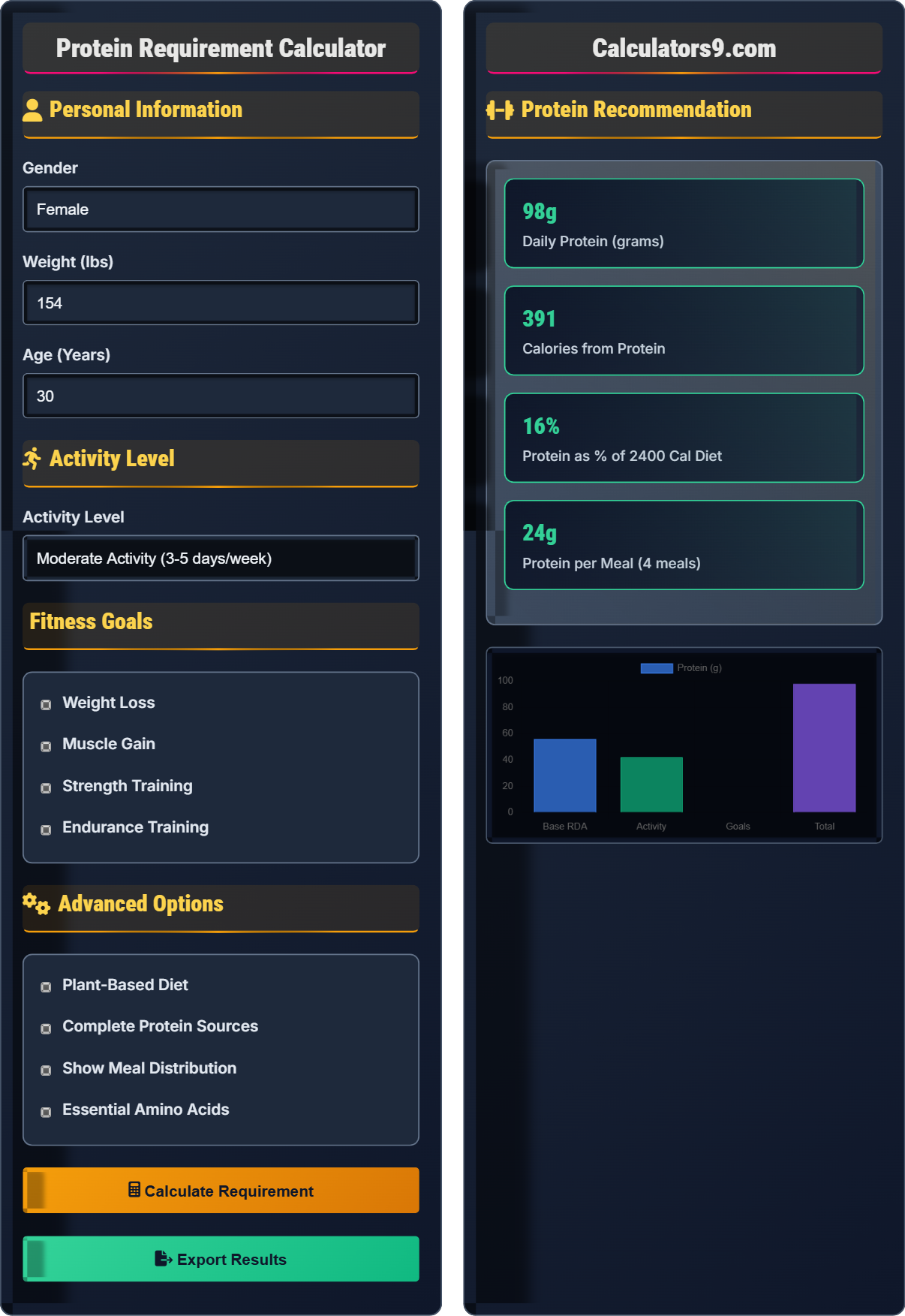
Example: For a 70kg (154lb) moderately active person:
Protein = 70kg × 1.4 g/kg = 98g protein per day
Convert to calories: 98g × 4 cal/g = 392 calories from protein
Thus, the daily intake would be 98g of protein.
Personal Information
Activity Level
Fitness Goals
Advanced Options
Protein Recommendation
| Factor | Value | Adjustment | Impact |
|---|
| Food Source | Portion Size | Protein (g) | Calories |
|---|
Protein Requirement Guide
Protein is essential for building and repairing tissues, producing enzymes and hormones, and supporting immune function. It's composed of amino acids, nine of which are essential and must be obtained from food. Adequate protein intake is crucial for muscle maintenance, bone health, and overall physiological function.
Recommended protein intake varies based on activity level and goals:
Where:
- Sedentary: 0.8 g/kg
- Light Activity: 1.0-1.2 g/kg
- Moderate Activity: 1.2-1.6 g/kg
- Active/Strength Training: 1.6-2.2 g/kg
- Weight Loss: 1.6-2.4 g/kg
- Endurance Training: 1.2-1.6 g/kg
Protein quality is determined by amino acid profile and digestibility:
- Complete Proteins: Contain all essential amino acids (meat, fish, eggs, dairy)
- Incomplete Proteins: Lacking one or more essential amino acids (plant sources)
- Complementary Proteins: Combining incomplete proteins to form complete profiles
- Leucine Content: Critical amino acid for muscle protein synthesis (2-3g per meal)
For plant-based diets, combining different protein sources ensures adequate amino acid intake.
- Even Distribution: Spread protein intake across meals (25-30g per meal)
- Post-Workout: Consume protein within 2-3 hours of exercise
- Leucine Trigger: 2-3g leucine per meal maximizes muscle protein synthesis
- Bedtime Protein: Casein protein before sleep supports overnight recovery
Protein Basics
Building and repairing tissues, producing enzymes, supporting immune function.
\( \text{Protein (g)} = \text{Weight (kg)} \times \text{Factor (g/kg)} \)
Where factor=activity-based multiplier.
- General population: 0.8 g/kg
- Athletes: 1.6-2.2 g/kg
- Weight loss: 1.6-2.4 g/kg
Optimization
Complete proteins contain all essential amino acids; incomplete proteins need combination.
- 25-30g per meal
- Even distribution
- Post-workout timing
- Leucine trigger
- Adjust for activity level
- Consider health goals
- Account for diet type
- Monitor protein quality
Protein Requirement Learning Quiz
What is the Recommended Dietary Allowance (RDA) for protein for sedentary adults?
The answer is B) 0.8 g/kg body weight. The RDA for protein for sedentary adults is 0.8 grams per kilogram of body weight. This is the minimum amount needed to meet basic nutritional requirements for most healthy individuals.
The RDA represents the minimum amount of protein needed to prevent deficiency in most healthy individuals. However, many experts suggest that active individuals and those with specific goals may benefit from higher intakes than the RDA suggests.
RDA (Recommended Dietary Allowance): Minimum daily amount of a nutrient needed to prevent deficiency
Protein Requirement: Amount of protein needed for optimal health
Sedentary: Little or no physical activity
• RDA for sedentary adults: 0.8 g/kg
• Higher needs for active individuals
• Individual needs may vary
• RDA = 0.8 g/kg for sedentary
• Athletes need more protein
• Using RDA for active individuals
• Not adjusting for activity level
• Confusing RDA with optimal intake
Calculate the daily protein requirement for a 165-pound (75kg) moderately active person. Show your work.
Step 1: Identify the appropriate protein factor
• Moderately active person: 1.4 g/kg body weight
Step 2: Apply the formula
• Protein (g) = Body weight (kg) × Protein factor
• Protein (g) = 75 kg × 1.4 g/kg = 105 g
Step 3: Convert to calories (optional)
• Calories from protein = 105 g × 4 cal/g = 420 calories
Therefore, this person should aim for 105 grams of protein daily.
This example demonstrates how to calculate personalized protein needs based on body weight and activity level. The key is selecting the appropriate factor based on the individual's lifestyle and goals. For a moderately active person, 1.4 g/kg represents a balanced approach.
Protein Factor: Multiplier based on activity level and goals
Personalized Requirement: Individual protein needs based on specific factorsBody Weight: Measurement used in protein calculations
• Use body weight in kg
• Select appropriate factor
• Adjust for goals
• Convert lbs to kg (lbs ÷ 2.2)
• Use higher factors for athletes
• Adjust for specific goals
• Using lbs instead of kg
• Not adjusting for activity level
• Using RDA for active individuals
Mike weighs 180 pounds (82kg) and is trying to build muscle through strength training. He exercises 5 days per week. Calculate his optimal protein intake and explain why this amount is beneficial for muscle building.
Step 1: Identify the appropriate protein factor
• Strength training athlete: 1.6-2.2 g/kg body weight
• For muscle building, use upper range: 2.0 g/kg
Step 2: Apply the formula
• Protein (g) = 82 kg × 2.0 g/kg = 164 g
Step 3: Explain benefits for muscle building
This protein amount is beneficial because:
- Provides adequate amino acids for muscle protein synthesis
- Supplies leucine (about 3g per meal) to trigger muscle building
- Supports recovery from intense training sessions
- Prevents muscle breakdown during caloric deficits
Therefore, Mike should aim for approximately 164 grams of protein daily to optimize muscle building.
Strength training athletes have higher protein needs due to increased muscle protein turnover and repair demands. The 1.6-2.2 g/kg range reflects research showing optimal muscle protein synthesis rates. Higher intakes support the creation of new muscle tissue and recovery from training stress.
Muscle Protein Synthesis: Process of building new muscle proteins
Leucine: Essential amino acid that triggers muscle building
Protein Turnover: Balance of protein synthesis and breakdown
• Strength athletes: 1.6-2.2 g/kg
• Muscle building: Upper range
• Recovery: Higher protein needs
• Strength training: 1.6-2.2 g/kg
• Distribute protein across meals
• Include leucine-rich sources
• Not using higher factors for athletes
• Not distributing protein evenly
• Forgetting post-workout timing
Sarah follows a vegetarian diet and weighs 140 pounds (64kg). She exercises moderately 3 times per week. Calculate her protein needs and explain how she should plan her protein intake to ensure complete amino acid profiles.
Step 1: Calculate protein requirement
• Moderately active: 1.4 g/kg
• Protein = 64 kg × 1.4 g/kg = 89.6 g ≈ 90 g daily
Step 2: Address plant-based considerations
For a vegetarian diet, Sarah should:
- Combine complementary proteins (rice and beans, hummus and bread)
- Include complete plant proteins (quinoa, soy products, hemp seeds)
- Ensure adequate intake of lysine and methionine
- Consider slightly higher intake (add 10-15%) due to lower digestibility
Step 3: Practical planning
• Breakfast: Greek yogurt or soy milk with nuts
• Lunch: Legume-based dish with grains
• Dinner: Tofu or tempeh with rice
• Snacks: Nuts, seeds, or legumes
Therefore, Sarah should aim for 90g of protein daily, with careful attention to amino acid completeness.
Plant-based diets require more planning to ensure complete amino acid profiles. Vegetarians and vegans need to combine different protein sources throughout the day to obtain all essential amino acids. Soy products and quinoa are complete proteins, but most plant sources require complementation.
Complete Protein: Contains all essential amino acids
Complementary Proteins: Incomplete proteins combined to form complete profiles
Amino Acid Profile: Pattern of amino acids in a protein source
• Plant proteins need complementation
• Slightly higher needs for vegetarians
• Combine throughout the day
• Include soy, quinoa, hemp seeds
• Combine grains with legumes
• Plan protein throughout day
• Not combining complementary proteins
• Assuming all plant proteins are complete
• Not accounting for digestibility
What is the optimal protein intake per meal for maximizing muscle protein synthesis?
The answer is B) 20-30 grams. Research shows that 20-30 grams of high-quality protein per meal is optimal for stimulating muscle protein synthesis in most adults. This amount provides sufficient amino acids, particularly leucine, to trigger the muscle-building process.
Protein distribution throughout the day is as important as total daily intake. The 20-30 gram threshold represents the amount needed to maximally stimulate muscle protein synthesis per meal. Consuming more than this amount in a single sitting doesn't provide additional benefit for muscle building.
Muscle Protein Synthesis: Process of building new muscle proteins
Protein Distribution: Spreading protein intake across meals
Leucine Threshold: Amount needed to trigger muscle building
• 20-30g per meal optimal
• Even distribution throughout day
• Include leucine-rich sources
• 20-30g per meal
• 4-6 meals for even distribution
• Include post-workout protein
• Consuming all protein at one meal
• Not reaching the threshold amount
• Forgetting post-workout timing
FAQ
Q: Can I consume too much protein?
A: While protein toxicity is rare in healthy individuals, excessive protein intake can have some drawbacks:
Potential concerns:
- Increased kidney workload (especially important for those with kidney disease)
- Displacement of other important nutrients
- Caloric surplus leading to weight gain
- Digestive discomfort in some individuals
Research suggests that intakes up to 2.5-3.0 g/kg body weight are safe for healthy individuals. However, the benefits of protein intake plateau beyond 1.6-2.2 g/kg for most goals, so additional protein doesn't provide extra benefit.
Q: How can vegetarians and vegans meet their protein needs?
A: Vegetarians and vegans can meet protein needs by combining different plant protein sources:
Complete protein sources:
- Quinoa
- Soy products (tofu, tempeh, edamame)
- Hemp seeds
- Chia seeds
- Quorn (mycoprotein)
Complementary protein combinations:
- Legumes + Grains (beans and rice, hummus and pita)
- Legumes + Nuts/Seeds (chickpea salad with sunflower seeds)
- Grains + Dairy/Eggs (for lacto-ovo vegetarians)
Consider slightly higher intake (10-15% more) due to lower digestibility of some plant proteins.