Sodium Intake Tracker
Daily sodium calculator • Heart health monitoring
Sodium Recommendation Formula:
Show the calculator\( \text{Daily Sodium Limit} = \text{Base Recommendation} + \text{Health Condition Adjustment} \)
Where:
- \( \text{Base Recommendation} \): Healthy adults: 2,300mg (1 tsp salt), Hypertension: 1,500mg
- \( \text{Health Condition Adjustment} \): Age, kidney disease, diabetes, or heart conditions may require further reduction
- \( \text{Conversion} \): 1 gram of salt = 390mg sodium
This formula calculates personalized daily sodium limits based on health status to support cardiovascular health and manage blood pressure. The American Heart Association recommends no more than 2,300mg daily, with an ideal limit of 1,500mg for most adults.
Example: For a 45-year-old with hypertension:
Daily sodium limit: 1,500mg (hypertension adjustment) = 3.8g of salt
For optimal heart health, aim to reduce sodium intake by 1,000mg daily to significantly lower blood pressure and cardiovascular risk.
Health Profile
Advanced Options
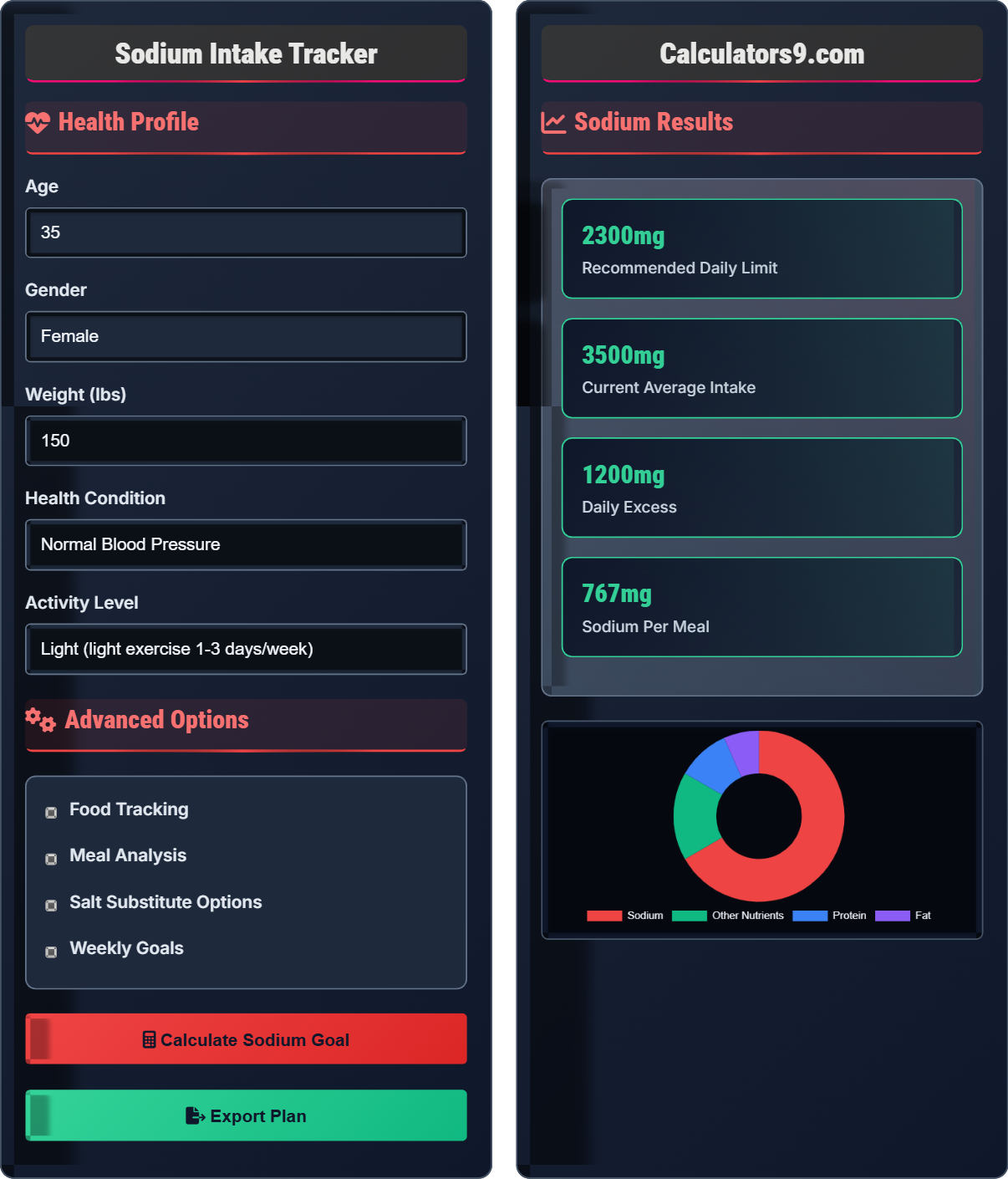
Sodium Results
| Food Item | Sodium (mg) | Portion | Category |
|---|
| Strategy | Implementation | Expected Savings (mg) |
|---|
| Day | Target | Achieved | Status |
|---|
Comprehensive Sodium Guide
Sodium is an essential mineral that helps regulate fluid balance and nerve transmission. However, excessive sodium intake is linked to high blood pressure, heart disease, and stroke. The average American consumes about 3,400mg of sodium daily, which is significantly higher than the recommended 2,300mg for healthy adults. For those with hypertension or other health conditions, the recommendation drops to 1,500mg daily.
The standard sodium recommendation uses the following approach:
Where:
- \( \text{Base Recommendation} \) = 2,300mg for healthy adults
- \( \text{Health Condition Adjustment} \) = -800mg for hypertension, diabetes, or heart conditions
- \( \text{Age Adjustment} \) = Further reduction for adults over 50
Reducing sodium intake provides numerous health benefits:
- Blood Pressure: Reduces systolic blood pressure by 2-8 mmHg
- Heart Health: Lowers risk of heart disease and stroke
- Kidney Function: Reduces strain on kidneys
- Bone Health: Decreases calcium excretion
- Stomach Health: May reduce risk of stomach cancer
- Read Labels: Check nutrition facts for sodium content
- Cook at Home: Prepare meals with fresh ingredients
- Use Alternatives: Flavor with herbs, spices, and citrus
- Gradual Reduction: Reduce sodium gradually to allow taste buds to adjust
- Shop Smart: Choose fresh over processed foods
Sodium Basics
Essential mineral that regulates fluid balance but can raise blood pressure when consumed in excess.
\( \text{Daily Sodium} = \text{Base Recommendation} + \text{Health Condition Adjustment} \)
Where: Base 2,300mg, adjustments for health conditions.
- Healthy adults: 2,300mg daily
- Hypertension: 1,500mg daily
- Read nutrition labels carefully
Reduction Strategies
Most sodium comes from processed foods, not table salt.
- Track current intake
- Reduce by 10-15% monthly
- Replace with herbs and spices
- Shop for low-sodium options
- Allow 2-4 weeks for taste adjustment
- Check all food labels
- Be cautious with salt substitutes
- Consult doctor for medical conditions
Sodium Learning Quiz
What is the maximum recommended daily sodium intake for a healthy adult?
The answer is B) 2,300mg. The American Heart Association recommends no more than 2,300mg of sodium per day for most healthy adults. However, the ideal limit is 1,500mg daily, especially for those with high blood pressure, diabetes, or heart disease.
The recommended sodium limit has been established based on extensive research showing that reducing sodium intake can significantly lower blood pressure and reduce the risk of heart disease and stroke. The 2,300mg limit is equivalent to about 1 teaspoon of salt per day.
Sodium: Essential mineral that helps regulate fluid balance
Milligram (mg): Unit of measurement for sodium content
Teaspoon of Salt: Contains approximately 2,300mg of sodium
• Healthy adults: 2,300mg daily maximum
• Ideal limit: 1,500mg daily
• Average American intake: 3,400mg daily
• Remember: 1 tsp salt = 2,300mg sodium
• Check nutrition labels regularly
• Cook at home more often
• Assuming all salt is added at the table
• Not reading nutrition labels
• Eating too many processed foods
A 50-year-old woman with high blood pressure weighs 160 pounds and exercises moderately. Calculate her recommended daily sodium intake and explain the factors that influence this recommendation.
Step 1: Apply standard recommendation for hypertension: 1,500mg
Step 2: Consider age factor: Additional reduction recommended for adults over 50
Step 3: Activity level: Maintains normal recommendation
Step 4: Calculate: 1,500mg - 200mg (age adjustment) = 1,300mg of sodium per day
Therefore, she needs approximately 1,300mg of sodium daily for optimal blood pressure management.
Sodium recommendations vary based on health conditions, age, and other factors. For individuals with hypertension, the recommendation is 1,500mg daily instead of the standard 2,300mg. Additional reductions may be recommended for older adults, as sensitivity to sodium increases with age.
Hypertension: High blood pressure condition
Sodium Sensitivity: Individual variation in blood pressure response to sodium
• Hypertension: 1,500mg maximum
• Adults over 50: Additional reduction
• Consult healthcare provider for medical conditions
• Start with 1,500mg recommendation
• Adjust based on medical advice
• Monitor blood pressure regularly
• Using general recommendation for medical conditions
• Not adjusting for age
• Not consulting healthcare providers
Sarah needs to limit her sodium intake to 1,500mg per day and plans to eat 4 meals. If she wants to distribute sodium equally across her meals, how much sodium should each meal contain? If she consumes 400mg of sodium at breakfast, how much remains for her other meals?
Step 1: Calculate sodium per meal: 1,500mg ÷ 4 meals = 375mg per meal
Step 2: Calculate remaining sodium after breakfast: 1,500mg - 400mg = 1,100mg
Step 3: Calculate remaining sodium for 3 meals: 1,100mg ÷ 3 = 367mg per remaining meal
Each meal should contain 375mg of sodium when distributed equally. After breakfast, 1,100mg remains for 3 meals, or 367mg per meal.
Meal planning for sodium involves distributing the daily limit across meals to ensure consistent intake. This approach helps prevent exceeding the daily limit and allows for better tracking of sodium consumption throughout the day. It's important to account for sodium consumed early in the day when planning later meals.
Sodium Distribution: Spreading intake across meals
Consistent Intake: Regular sodium consumption throughout the day
• Track sodium consumed at each meal
• Plan remaining intake for subsequent meals
• Aim for 300-400mg per meal
• Keep a food diary to track sodium intake
• Plan low-sodium options for each meal
• Include sodium content in recipes
• Only limiting sodium at dinner
• Not accounting for sodium already consumed
• Underestimating sodium in "healthy" foods
A can of soup contains 890mg of sodium per serving, and the label indicates 2 servings per container. If someone eats the entire can, what percentage of the daily recommended limit (2,300mg) have they consumed? How would this change if they had high blood pressure?
Step 1: Calculate total sodium in the can: 890mg × 2 servings = 1,780mg
Step 2: Calculate percentage of daily limit: (1,780mg ÷ 2,300mg) × 100 = 77.4%
Step 3: Calculate percentage for hypertension limit: (1,780mg ÷ 1,500mg) × 100 = 118.7%
One can of soup contains 77.4% of the daily sodium limit for healthy adults, and exceeds the limit by 18.7% for those with hypertension.
Reading nutrition labels is crucial for managing sodium intake. Pay attention to serving sizes, as many containers contain multiple servings. A single food item can contain a significant portion of the daily sodium limit, making it challenging to stay within recommendations throughout the day.
Nutrition Label: Information about food content
Serving Size: Standard portion used for nutritional information
• Always check serving sizes
• Multiply by number of servings consumed
• Look for "low sodium" (<140mg) options
• Choose foods with <5% daily value for sodium
• Look for "no salt added" options
• Rinse canned foods to reduce sodium
• Not reading serving sizes carefully
• Assuming "healthy" foods are low in sodium
• Eating entire containers labeled as multiple servings
Which of the following is the most effective strategy for reducing sodium intake?
The answer is B) Focus on reducing processed foods. About 70% of dietary sodium comes from processed and restaurant foods, not from salt added at the table. Reducing processed foods like deli meats, canned soups, frozen dinners, and snack foods has the greatest impact on sodium intake.
Many people mistakenly believe that reducing table salt is the primary way to lower sodium intake. In reality, the majority of sodium comes from processed foods where salt is added during manufacturing. Addressing these sources has a much greater impact on overall sodium consumption.
Processed Foods: Foods altered from their natural state
Hidden Sodium: Sodium not apparent to consumers
• 70% of sodium from processed foods
• Read labels on all packaged foods
• Cook with fresh ingredients when possible
• Choose fresh over frozen/processed
• Make homemade versions of processed foods
• Use herbs and spices for flavor
• Focusing only on table salt
• Not realizing sodium in "healthy" processed foods
• Using too many salt substitutes
FAQ
Q: How can I reduce sodium in my diet without losing flavor?
A: You can enhance flavor without sodium by using:
• Fresh herbs: basil, cilantro, parsley, dill
• Citrus: lemon juice, lime juice, orange zest
• Aromatics: garlic, ginger, onions, shallots
• Vinegars: balsamic, apple cider, rice vinegar
• Spices: cumin, paprika, turmeric, black pepper
It takes about 2-4 weeks for taste buds to adjust to less sodium. Start gradually reducing salt and increasing other flavors. Try making your own spice blends and herb mixes to keep meals interesting.
Q: What are the best low-sodium alternatives to common high-sodium ingredients?
A: Here are low-sodium alternatives to common high-sodium ingredients:
• Soy sauce: Use low-sodium soy sauce (575mg vs 920mg per tbsp) or tamari
• Stock/broth: Choose no-salt-added versions or make your own
• Salad dressings: Make homemade with olive oil, vinegar, and herbs
• Canned vegetables: Choose no-salt-added or rinse before cooking
• Delicious meats: Fresh or frozen instead of cured or deli versions
• Soups: Make from scratch or look for low-sodium varieties
Always read labels and choose products with less than 140mg sodium per serving to qualify as "low sodium."
Q: How quickly will I see improvements in my blood pressure after reducing sodium?
A: Blood pressure improvements can be seen within 1-4 weeks of sodium reduction, though the full effect may take 2-4 months. Studies show that reducing sodium intake by 1,000mg daily can lower systolic blood pressure by 2-8 mmHg. The response varies based on:
• Baseline blood pressure level
• Individual sodium sensitivity
• Overall diet quality
• Medication regimen
• Kidney function
For best results, combine sodium reduction with a diet rich in fruits, vegetables, and whole grains. Monitor your blood pressure regularly and consult your healthcare provider for medication adjustments.