Sugar Budget Calculator
Daily added sugar tracker • Health optimization
Sugar Budget Formula:
Show the calculator\( \text{Daily Sugar Limit} = \text{Body Weight (kg)} \times \text{Sugar Factor} \)
Where:
- \( \text{Body Weight (kg)} \): weight in kilograms (weight in lbs ÷ 2.2)
- \( \text{Sugar Factor} \): 25g for women, 36g for men (WHO recommendation), or 5-10% of daily calories
- \( \text{Conversion} \): 1 gram of sugar = 4 calories
- \( \text{Alternative} \): 6-9 teaspoons (4.2g per tsp) based on gender
This formula calculates personalized daily added sugar limits based on body weight and health goals to support metabolic health and prevent chronic diseases. The WHO recommends no more than 10% of daily calories from free sugars, with additional benefits from reducing below 5%.
Example: For a 150lb person (68kg):
Daily sugar limit: 25g for women or 36g for men = 6-9 teaspoons of sugar
For optimal health benefits, aim to reduce added sugars to less than 25g (6 teaspoons) daily for women and 36g (9 teaspoons) for men.
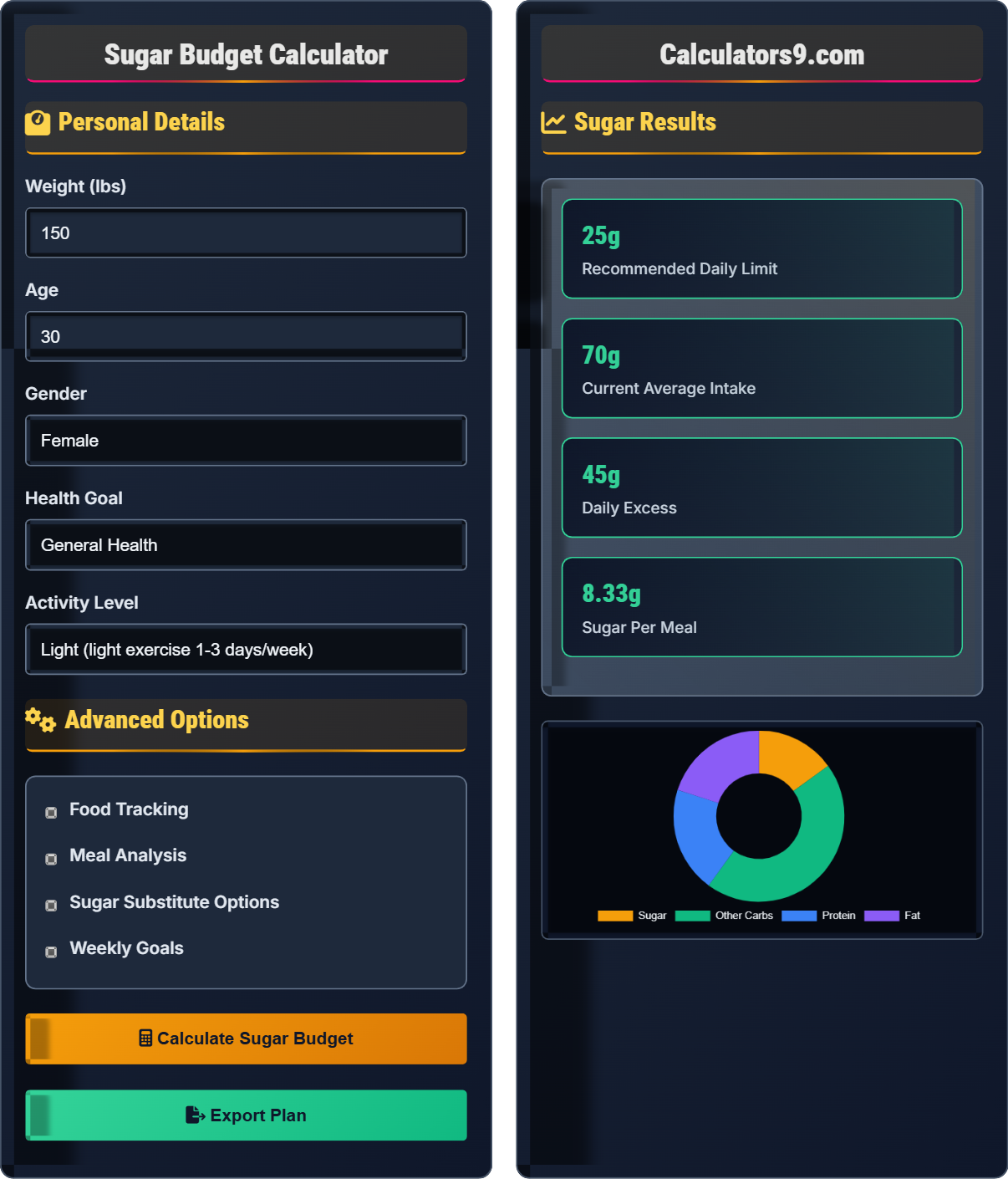
Personal Details
Advanced Options
Sugar Results
| Food Item | Sugar (g) | Portion | Category |
|---|
| Strategy | Implementation | Expected Savings (g) |
|---|
| Day | Target | Achieved | Status |
|---|
Comprehensive Sugar Guide
Added sugars are sugars and syrups that are added to foods or beverages during processing or preparation. This includes table sugar, high fructose corn syrup, honey, maple syrup, and other caloric sweeteners. The average American consumes about 77g (19 teaspoons) of added sugar daily, which is significantly higher than the recommended 25g for women and 36g for men. Natural sugars in whole fruits and dairy products are not included in added sugar recommendations.
The standard sugar recommendation uses the following approach:
Where:
- \( \text{Base Recommendation} \) = 25g for women, 36g for men
- \( \text{Health Goal Adjustment} \) = -10g for diabetes, -15g for weight loss
- \( \text{Conversion} \) = 1 tsp sugar = 4.2g
Excessive added sugar consumption has numerous negative health effects:
- Weight Gain: Contributes to obesity and visceral fat accumulation
- Diabetes Risk: Increases insulin resistance and type 2 diabetes risk
- Heart Disease: Raises triglycerides and increases cardiovascular risk
- Tooth Decay: Promotes dental caries and gum disease
- Metabolic Syndrome: Contributes to insulin resistance and inflammation
- Read Labels: Check ingredient lists for hidden sugars
- Choose Whole Foods: Select unprocessed foods when possible
- Water Instead: Replace sugary drinks with water
- Gradual Reduction: Reduce sugar gradually to allow taste preferences to adjust
- Healthy Alternatives: Use natural sweeteners like stevia or monk fruit
Sugar Basics
Sugars added to foods during processing, distinct from natural sugars in fruits and dairy.
\( \text{Daily Sugar} = \text{Base Recommendation} + \text{Health Goal Adjustment} \)
Where: Base 25g for women, 36g for men.
- Women: 25g daily maximum
- Men: 36g daily maximum
- Read ingredient labels carefully
Reduction Strategies
Most sugar comes from processed foods, not desserts.
- Track current intake
- Reduce by 10-15% weekly
- Replace with healthier alternatives
- Build sustainable habits
- Allow 2-4 weeks for taste adjustment
- Check all food labels
- Be cautious with artificial sweeteners
- Consult doctor for medical conditions
Sugar Learning Quiz
What is the maximum recommended daily added sugar intake for a healthy adult woman?
The answer is B) 25g. The World Health Organization and American Heart Association recommend no more than 25g (6 teaspoons) of added sugar per day for women. For men, the recommendation is 36g (9 teaspoons) daily.
The recommended sugar limits are based on extensive research showing that reducing added sugar intake can significantly lower the risk of obesity, type 2 diabetes, heart disease, and other chronic conditions. These recommendations represent maximum limits, not target intakes.
Added Sugar: Sugars added during processing or preparation
Gram (g): Unit of measurement for sugar content
Teaspoon of Sugar: Contains approximately 4.2g of sugar
• Women: 25g daily maximum
• Men: 36g daily maximum
• Average American intake: 77g daily
• Remember: 1 tsp sugar = 4.2g
• Check ingredient lists for "-ose" endings
• Choose unsweetened alternatives
• Confusing added sugar with natural sugars
• Not reading ingredient labels
• Eating too many processed foods
A 35-year-old woman with diabetes weighs 160 pounds and exercises moderately. Calculate her recommended daily sugar intake and explain the factors that influence this recommendation.
Step 1: Apply standard recommendation for women: 25g
Step 2: Apply diabetes adjustment: Reduce by 10g
Step 3: Activity level: Maintains normal recommendation
Step 4: Calculate: 25g - 10g = 15g of added sugar per day
Therefore, she needs approximately 15g of added sugar daily for optimal blood sugar management.
Sugar recommendations vary based on health conditions, age, and other factors. For individuals with diabetes, stricter limits are recommended to help manage blood glucose levels. Additional reductions may be appropriate for those with metabolic conditions.
Diabetes: Condition affecting blood sugar regulation
Added Sugar: Sugars added during food processing
• Diabetics: Reduce to 15-20g daily
• Consult healthcare provider for medical conditions
• Start with 25g recommendation
• Adjust based on medical advice
• Monitor blood sugar regularly
• Using general recommendation for medical conditions
• Not adjusting for health status
• Not consulting healthcare providers
Sarah needs to limit her added sugar intake to 25g per day and plans to eat 4 meals. If she wants to distribute sugar equally across her meals, how much sugar should each meal contain? If she consumes 8g of sugar at breakfast, how much remains for her other meals?
Step 1: Calculate sugar per meal: 25g ÷ 4 meals = 6.25g per meal
Step 2: Calculate remaining sugar after breakfast: 25g - 8g = 17g
Step 3: Calculate remaining sugar for 3 meals: 17g ÷ 3 = 5.67g per remaining meal
Each meal should contain 6.25g of sugar when distributed equally. After breakfast, 17g remains for 3 meals, or 5.67g per meal.
Meal planning for sugar involves distributing the daily limit across meals to ensure consistent intake. This approach helps prevent exceeding the daily limit and allows for better tracking of sugar consumption throughout the day. It's important to account for sugar consumed early in the day when planning later meals.
Sugar Distribution: Spreading intake across meals
Consistent Intake: Regular sugar consumption throughout the day
• Track sugar consumed at each meal
• Plan remaining intake for subsequent meals
• Aim for 5-7g per meal
• Keep a food diary to track sugar intake
• Plan low-sugar options for each meal
• Include sugar content in recipes
• Only limiting sugar at dinner
• Not accounting for sugar already consumed
• Underestimating sugar in "healthy" foods
A bottle of fruit juice contains 32g of sugar per serving, and the label indicates 2.5 servings per bottle. If someone drinks the entire bottle, what percentage of the daily recommended limit (25g for women) have they consumed? How would this change if they were a man?
Step 1: Calculate total sugar in the bottle: 32g × 2.5 servings = 80g
Step 2: Calculate percentage for women: (80g ÷ 25g) × 100 = 320%
Step 3: Calculate percentage for men: (80g ÷ 36g) × 100 = 222%
One bottle of juice contains 320% of the daily sugar limit for women, and 222% for men.
Reading nutrition labels is crucial for managing sugar intake. Pay attention to serving sizes, as many containers contain multiple servings. A single beverage can contain multiple times the daily sugar limit, making it challenging to stay within recommendations throughout the day.
Nutrition Label: Information about food content
Serving Size: Standard portion used for nutritional information
• Always check serving sizes
• Multiply by number of servings consumed
• Look for "no added sugar" options
• Choose beverages with 0g added sugar
• Dilute juices with water
• Choose whole fruits over juices
• Not reading serving sizes carefully
• Assuming "natural" juices are low in sugar
• Drinking entire bottles labeled as multiple servings
Which of the following is the most effective strategy for reducing added sugar intake?
The answer is B) Focus on eliminating sugary drinks. Beverages like soda, energy drinks, and fruit juices are the largest source of added sugar in most diets, contributing 40-50% of total added sugar intake. Eliminating these can dramatically reduce daily sugar consumption.
Many people mistakenly believe that reducing table sugar is the primary way to lower sugar intake. In reality, the majority of added sugar comes from beverages and processed foods, not from sugar added during cooking or at the table. Addressing these sources has the greatest impact on overall sugar consumption.
Added Sugars: Sugars added during food processing
Empty Calories: Calories without nutritional value
• Beverages contribute 40-50% of added sugar
• Read labels on all processed foods
• Choose water over sugary drinks
• Replace sodas with sparkling water
• Choose unsweetened versions
• Make homemade alternatives
• Focusing only on table sugar
• Not realizing sugar in "healthy" beverages
• Using too many artificial sweeteners
FAQ
Q: How can I satisfy my sweet tooth without consuming added sugars?
A: You can satisfy sweet cravings with:
• Fresh fruits: berries, apples, oranges
• Natural alternatives: stevia, monk fruit, erythritol
• Healthy treats: dark chocolate (70%+ cacao)
• Homemade options: chia seed pudding with vanilla
• Spices: cinnamon, vanilla extract, nutmeg
It takes about 2-4 weeks for taste buds to adjust to less sweetness. Start gradually reducing added sugars and increasing natural flavor enhancers. Try making your own healthy dessert recipes with natural sweeteners.
Q: What are the best sugar alternatives for people with diabetes?
A: Safe sugar alternatives for diabetics include:
• Stevia: Natural sweetener with zero glycemic impact
• Erythritol: Sugar alcohol with minimal effect on blood sugar
• Monk Fruit: Natural sweetener with no calories or carbs
• Allulose: Rare sugar with minimal absorption
• Xylitol: Sugar alcohol (use in moderation)
• Small amounts of: Stevia blends, sucralose
Always monitor blood glucose when introducing new sweeteners. Start with small amounts and observe your body's response. Consult your healthcare team before making significant changes to your diet.
Q: How quickly will I see improvements in my health after reducing added sugar?
A: Health improvements can be seen within 1-4 weeks of sugar reduction:
• Energy levels: 3-7 days
• Skin clarity: 1-2 weeks
• Weight changes: 2-4 weeks
• Blood sugar: 1-3 weeks
• Inflammation markers: 2-6 weeks
• Liver health: 1-3 months
The response varies based on baseline intake, overall diet quality, and individual metabolism. For best results, combine sugar reduction with a diet rich in whole foods, adequate sleep, and regular exercise. Monitor your progress with regular health checks.