TDEE Calculator
Calculate your total daily energy expenditure • 2026 guidelines
TDEE Formula:
Show the calculator\( \text{BMR (Mifflin-St Jeor)} = 10 \times \text{weight (kg)} + 6.25 \times \text{height (cm)} - 5 \times \text{age} + s \)
\( \text{BMR (Men)} = 10 \times \text{weight (kg)} + 6.25 \times \text{height (cm)} - 5 \times \text{age} + 5 \)
\( \text{BMR (Women)} = 10 \times \text{weight (kg)} + 6.25 \times \text{height (cm)} - 5 \times \text{age} - 161 \)
\( \text{TDEE} = \text{BMR} \times \text{Activity Factor} \)
Where:
- Activity Factors: Sedentary (1.2), Light (1.375), Moderate (1.55), Active (1.725), Very Active (1.9)
- Weight in kg and height in cm
- s = +5 for men, -161 for women
- TDEE = Total Daily Energy Expenditure (calories needed to maintain weight)
- Weight Loss: TDEE - 500 to 1000 calories deficit
- Weight Gain: TDEE + 250 to 500 calories surplus
This formula calculates your daily caloric needs based on BMR and activity level.
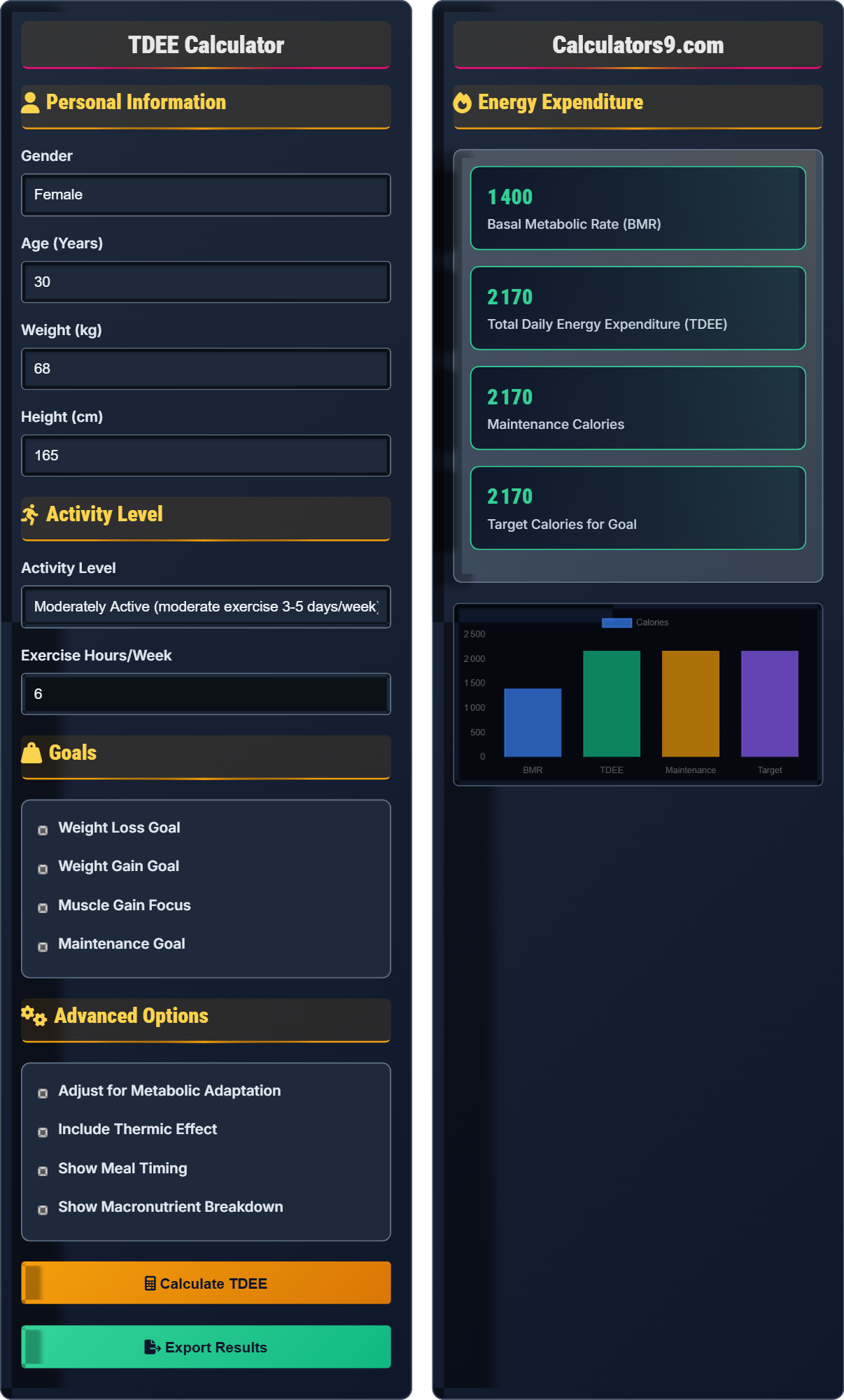
Example: For a 30-year-old woman weighing 68kg, 165cm tall, moderately active:
BMR = (10 × 68) + (6.25 × 165) - (5 × 30) - 161 = 680 + 1031.25 - 150 - 161 = 1,400.25 calories
TDEE = 1,400.25 × 1.55 = 2,170 calories
Thus, she would need approximately 2,170 calories per day to maintain her weight.
Personal Information
Activity Level
Goals
Advanced Options
Energy Expenditure
| Component | Calories | Percentage | Description |
|---|
| Goal | Daily Calories | Weekly Change | Timeline |
|---|
TDEE Calculation Guide
Total Daily Energy Expenditure (TDEE) is the total number of calories your body burns in a day. It includes your Basal Metabolic Rate (BMR), the thermic effect of food (TEF), and calories burned through physical activity. Understanding your TDEE is crucial for achieving weight management goals.
The Mifflin-St Jeor equation is considered the most accurate for calculating BMR:
Where:
- BMR = Basal Metabolic Rate (calories at rest)
- Weight in kg and Height in cm
- Age in years
Weight management is based on the principle of calorie balance:
- Maintenance: Consume calories equal to TDEE
- Weight Loss: Create a deficit of 500-1000 calories/day for 1-2 lbs/week loss
- Weight Gain: Create a surplus of 250-500 calories/day for 0.5-1 lb/week gain
Remember that 1 pound of fat equals approximately 3,500 calories.
- Accuracy: Use actual body measurements, not ideal weights
- Adjustment: Recalculate when body weight changes by 5-10 lbs
- Monitoring: Track weight changes to validate TDEE accuracy
- Metabolic Adaptation: Expect decreased needs during prolonged caloric restriction
- Non-Exercise Activity: Consider fidgeting, standing, walking
TDEE Basics
Total Daily Energy Expenditure - calories burned in a day including all activities.
\( \text{BMR (Women)} = 10 \times \text{kg} + 6.25 \times \text{cm} - 5 \times \text{age} - 161 \)
Where BMR=Basal Metabolic Rate.
- 1 lb fat = 3,500 calories
- Deficit of 500 cal/day = 1 lb/week loss
- Surplus of 500 cal/day = 1 lb/week gain
Goal Planning
1-2 lbs/week is considered safe and sustainable for long-term success.
- Maintenance: TDEE calories
- Weight Loss: TDEE - 500 to 1000 calories
- Weight Gain: TDEE + 250 to 500 calories
- Muscle Gain: TDEE + 250 calories with protein focus
- Adjust for metabolic adaptation
- Monitor progress regularly
- Account for non-exercise activity
- Recalculate with weight changes
TDEE Learning Quiz
How many calories need to be burned in excess of consumed calories to lose 1 pound of fat?
The answer is C) 3,500 calories. One pound of body fat contains approximately 3,500 calories. Therefore, to lose 1 pound of fat, you need to create a calorie deficit of 3,500 calories through diet, exercise, or a combination of both.
This fundamental principle of energy balance is the foundation of weight management. Creating a daily deficit of 500 calories will theoretically result in 1 pound of weight loss per week (500 × 7 = 3,500). However, actual results may vary due to metabolic adaptations and other factors.
Calorie Deficit: Consuming fewer calories than your body burns
Energy Balance: The relationship between calories consumed and calories burned
Body Fat: Stored energy in adipose tissue
• 1 lb of fat = 3,500 calories
• 500 cal/day deficit = 1 lb/week loss
• Metabolic adaptation may affect results
• Remember: 3,500 calories per pound
• Combine diet and exercise for best results
• Expecting immediate results
• Not accounting for metabolic changes
• Focusing only on calories without nutrition quality
Calculate the BMR for a 25-year-old female who weighs 60kg and is 160cm tall using the Mifflin-St Jeor equation. Show your work.
Using the Mifflin-St Jeor Equation for women:
BMR = (10 × weight in kg) + (6.25 × height in cm) - (5 × age) - 161
Step 1: Plug in the values
BMR = (10 × 60) + (6.25 × 160) - (5 × 25) - 161
Step 2: Calculate each component
• 10 × 60 = 600
• 6.25 × 160 = 1,000
• 5 × 25 = 125
Step 3: Add and subtract
BMR = 600 + 1,000 - 125 - 161 = 1,314 calories
Therefore, her BMR is approximately 1,314 calories per day.
This example demonstrates how the Mifflin-St Jeor equation calculates your Basal Metabolic Rate - the number of calories your body needs to maintain basic functions at rest. The equation accounts for gender-specific metabolic differences, as well as the effects of weight, height, and age on metabolic rate.
BMR (Basal Metabolic Rate): Calories needed at complete rest
Mifflin-St Jeor Equation: Formula to estimate BMR based on anthropometric data
Metabolic Rate: Speed at which your body burns calories
• BMR is just resting metabolism
• Must multiply by activity factor for TDEE
• Different equations for men and women
• Remember: BMR is resting calories only
• Use kg for weight, cm for height
• Age decreases BMR over time
• Confusing BMR with TDEE
• Using pounds instead of kilograms
• Using inches instead of centimeters
Sarah is a 30-year-old woman who weighs 70kg, is 170cm tall, and exercises moderately 4 times per week. Calculate her TDEE and determine how many calories she should consume daily to lose 1 pound per week.
Step 1: Calculate BMR using Mifflin-St Jeor equation
BMR = (10 × 70) + (6.25 × 170) - (5 × 30) - 161
BMR = 700 + 1,062.5 - 150 - 161 = 1,451.5 calories
Step 2: Calculate TDEE using activity factor
• Moderately active = activity factor of 1.55
• TDEE = 1,451.5 × 1.55 = 2,249.8 calories
Step 3: Calculate target calories for 1 lb/week loss
• 1 lb/week loss = 500 calorie daily deficit
• Target calories = 2,249.8 - 500 = 1,749.8 calories
Therefore, Sarah's TDEE is approximately 2,250 calories, and she should consume about 1,750 calories daily to lose 1 pound per week.
This example shows the complete process of calculating daily caloric needs. First, we determine the BMR, then multiply by an activity factor to get TDEE, and finally adjust for the desired weight change goal. This systematic approach ensures accurate calorie recommendations.
TDEE (Total Daily Energy Expenditure): Total calories burned including activity
Activity Factor: Multiplier based on physical activity level
Calorie Deficit: Consuming fewer calories than burned
• BMR × Activity Factor = TDEE
• 500 cal/day deficit = 1 lb/week loss
• Adjust for individual metabolic variations
• Calculate BMR first, then TDEE
• Use appropriate activity factor
• Monitor results and adjust as needed
• Skipping the activity factor calculation
• Using incorrect activity multiplier
• Setting unrealistic deficits
John has been in a 500-calorie daily deficit for 3 months and has noticed his weight loss has slowed significantly. He initially weighed 200 lbs (91 kg) and is now 180 lbs (82 kg). Calculate his new TDEE and explain why his weight loss has slowed.
Step 1: Calculate initial BMR (200 lbs/91 kg)
Initial BMR = (10 × 91) + (6.25 × 170) - (5 × 35) + 5 = 910 + 1,062.5 - 175 + 5 = 1,802.5 calories
Step 2: Calculate current BMR (180 lbs/82 kg)
Current BMR = (10 × 82) + (6.25 × 170) - (5 × 35) + 5 = 820 + 1,062.5 - 175 + 5 = 1,712.5 calories
Step 3: Calculate new TDEE with moderate activity (1.55)
New TDEE = 1,712.5 × 1.55 = 2,654.4 calories
Step 4: Calculate new deficit
Previous deficit: 500 calories
New deficit: 2,654.4 - (original intake of 2,302.5) = -351.9 calories
Explanation: Weight loss has slowed due to metabolic adaptation. As John lost weight, his BMR decreased because he now has less body mass to maintain. Additionally, the body adapts to caloric restriction by becoming more efficient, further reducing energy expenditure.
This example demonstrates metabolic adaptation, a natural response to weight loss. As body weight decreases, the BMR decreases proportionally. Additionally, the body becomes more metabolically efficient during caloric restriction. This means that after initial weight loss, the same caloric deficit produces a smaller net negative energy balance, slowing further weight loss.
Metabolic Adaptation: Decreased energy expenditure during weight loss
Metabolic Efficiency: Body's improved energy conservation
Compensatory Mechanisms: Physiological responses to caloric restriction
• Recalculate TDEE with weight changes
• Expect metabolic slowdown
• Adjust calories periodically
• Recalculate when weight changes by 5-10 lbs
• Plan for metabolic adaptation
• Consider temporary breaks from deficit
• Not adjusting for weight loss
• Expecting linear weight loss
• Not accounting for metabolic changes
Which activity level corresponds to exercising 3-5 days per week at moderate intensity?
The answer is C) Moderately Active. According to the standard activity multipliers used in TDEE calculations, exercising 3-5 days per week at moderate intensity corresponds to the "Moderately Active" category, which uses an activity factor of 1.55.
Selecting the correct activity level is crucial for accurate TDEE calculations. The activity multipliers are standardized, but individuals should honestly assess their activity level. Overestimating activity can lead to consuming too many calories for weight management goals.
Activity Factor: Multiplier to account for physical activity
Moderate Intensity: Exercise that raises heart rate and causes sweating
TDEE: Total Daily Energy Expenditure including activity
• Moderately Active = 1.55 multiplier
• Honest assessment of activity level
• Match activity level to actual routine
• Be honest about activity level
• Adjust as activity changes
• Consider all movement, not just exercise
• Overestimating activity level
• Not accounting for non-exercise activity
• Using wrong activity factor
FAQ
Q: How accurate is the Mifflin-St Jeor equation for calculating my daily calorie needs?
A: The Mifflin-St Jeor equation is considered the most accurate predictive equation for estimating BMR and TDEE, with an average error of about 10-15% for healthy adults. However, it's important to remember that it's an estimation.
Factors that can affect accuracy include:
- Muscle mass (more muscle = higher metabolic rate)
- Genetics and individual metabolic variations
- Hormonal factors and health conditions
- Age-related metabolic changes
Use the calculated value as a starting point, then monitor your weight for 2-3 weeks. If you're not seeing expected changes, adjust your calorie intake by 100-200 calories and reassess.
Q: Should I recalculate my TDEE as I lose weight?
A: Yes, you should recalculate your TDEE as your weight changes. As you lose weight, your BMR decreases because there's less body mass to maintain. A general rule is to recalculate when your weight changes by 5-10 pounds.
Example:
- If you started at 180 lbs and now weigh 170 lbs, recalculate your TDEE
- Your new TDEE will be lower than your original calculation
- This prevents metabolic adaptation from stalling your progress
Additionally, consider metabolic adaptation - your body becomes more efficient during caloric restriction, which may require further adjustments beyond just weight loss.