Vitamin D Sun Exposure Calculator
UV index & nutrition tracker • Health optimization
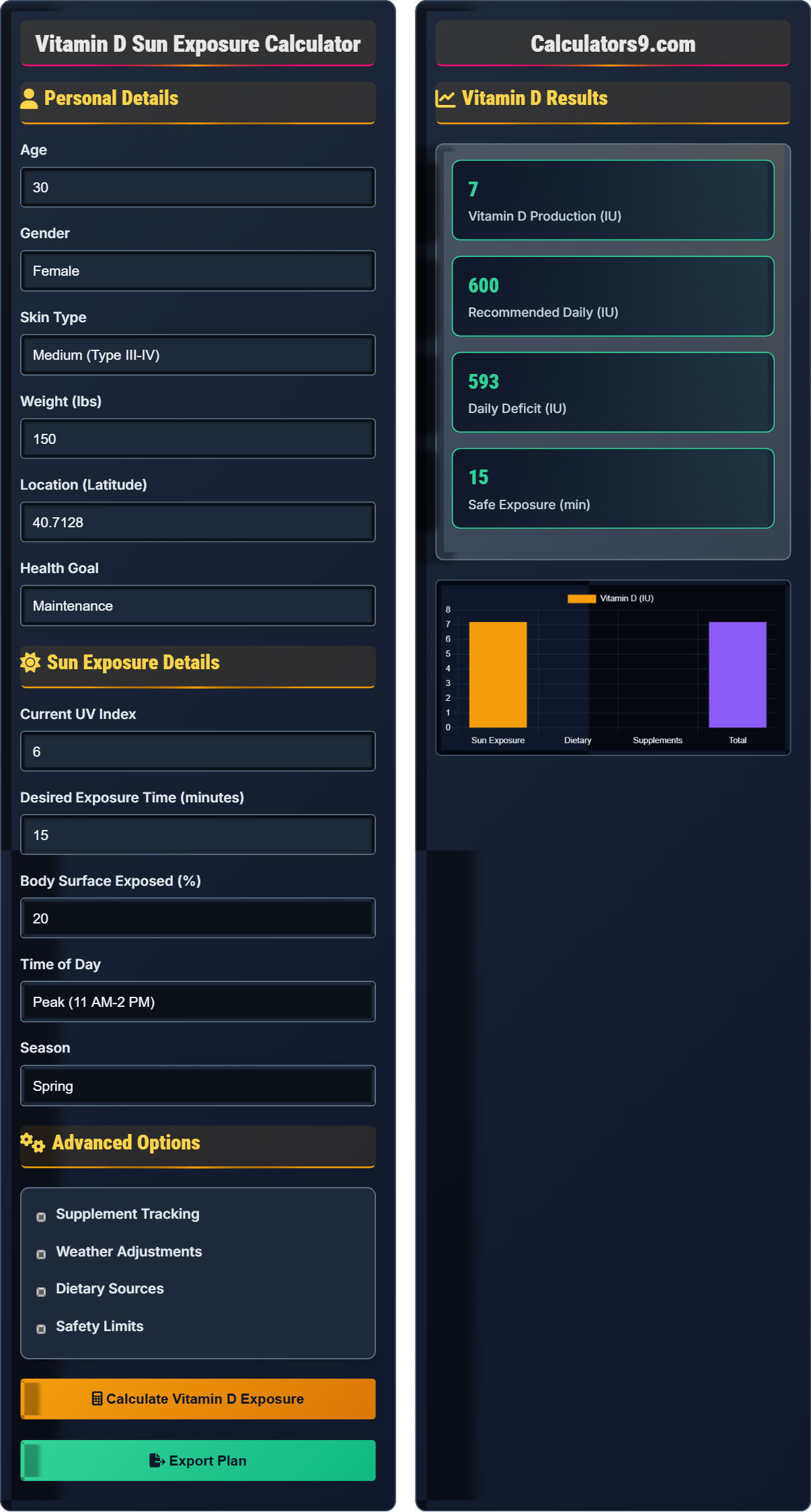
Vitamin D Synthesis Formula:
Show the calculator\( \text{Vitamin D Production} = \text{UV Index} \times \text{Exposure Time} \times \text{Skin Factor} \)
Where:
- \( \text{UV Index} \): Current UV radiation intensity
- \( \text{Exposure Time} \): Duration of sun exposure (minutes)
- \( \text{Skin Factor} \): 1.0 for fair skin, 0.5 for medium, 0.25 for dark skin
- \( \text{Body Surface Area} \): Percentage of exposed skin
- \( \text{Latitude Correction} \): Adjusts for geographic location
This formula calculates vitamin D synthesis based on UV exposure, skin type, and geographic factors. The body produces approximately 1000 IU of vitamin D from 15-20 minutes of midday sun exposure for fair-skinned individuals. Darker skin requires longer exposure times due to melanin blocking UVB rays.
Example: For a fair-skinned person at UV Index 6 with 20% body exposure:
Vitamin D production: 6 × 15 min × 1.0 × 0.20 = 18 IU per minute
After 15 minutes: 18 × 15 = 270 IU, approximately 45% of daily requirement (600 IU).
Personal Details
Sun Exposure Details
Advanced Options
Vitamin D Results
| Time | UV Index | Exposure (min) | Vitamin D (IU) |
|---|
| Food | Vitamin D (IU) | Serving | Equivalent Sun Time |
|---|
| Date | Exposure (min) | Vitamin D (IU) | Status |
|---|
Comprehensive Vitamin D Guide
Vitamin D is synthesized in the skin when UVB rays (wavelength 290-315nm) interact with 7-dehydrocholesterol. The body can produce 10,000-25,000 IU of vitamin D in 15-30 minutes of midday sun exposure for fair-skinned individuals. Factors affecting synthesis include latitude, season, time of day, skin pigmentation, age, sunscreen use, and clothing coverage. The recommended daily intake is 600-800 IU for most adults, though many experts suggest 1000-2000 IU for optimal health.
The standard vitamin D synthesis calculation uses the following approach:
Where:
- \( \text{UV Index} \): Current UV radiation intensity (0-11+ scale)
- \( \text{Time (min)} \): Duration of sun exposure
- \( \text{Skin Factor} \): Fair=1.0, Medium=0.5, Dark=0.25
- \( \text{Body Exposure} \): Percentage of exposed skin surface
Vitamin D provides numerous health benefits:
- Bone Health: Enhances calcium absorption and bone mineralization
- Immune Function: Supports immune system regulation
- Mood Support: Linked to depression prevention
- Cardiovascular: May support heart health
- Cancer Prevention: Associated with reduced risk of certain cancers
- Start Short: Begin with 5-10 minutes and gradually increase
- Know Your Skin: Monitor for redness or burning
- Protective Measures: Use hat and sunglasses after exposure period
- Moisturize: Apply moisturizer after sun exposure
- Track Progress: Monitor vitamin D levels with blood tests
Vitamin D Basics
Steroid hormone synthesized from sun exposure, essential for calcium absorption.
\( \text{Production} = \text{UV Index} \times \text{Time (min)} \times \text{Skin Factor} \times \text{Body Exposure} \)
Where: UV intensity, time, skin type, exposure area.
- Peak UV: 11 AM - 2 PM
- Never burn
- 2-3 times per week
Optimization Strategies
Dark skin requires longer exposure due to melanin blocking UVB.
- Start with 5-10 minutes
- Gradually increase duration
- Monitor skin response
- Adjust for season/location
- Geographic latitude matters
- Winter may require supplements
- Age affects synthesis
- Clothing coverage impacts exposure
Vitamin D Learning Quiz
What is the optimal time of day for vitamin D synthesis through sun exposure?
The answer is B) 11 AM - 2 PM. This is when UVB rays are most intense and effective for vitamin D synthesis. UVB rays are strongest when the sun is highest in the sky, typically between 11 AM and 2 PM. During this time, the sun's rays travel the shortest distance through the atmosphere, resulting in higher UVB intensity.
The earth's atmosphere filters UVB rays, and this filtering is minimized when the sun is directly overhead. During midday hours, UVB rays are most concentrated, making sun exposure most efficient for vitamin D production. However, this is also when sunburn risk is highest, so exposure should be limited to safe durations.
UVB Rays: Ultraviolet B radiation that synthesizes vitamin D
Peak Hours: Time when UV radiation is most intense
UV Index: Scale measuring UV radiation intensity
• Peak UVB: 11 AM - 2 PM
• UVB required for vitamin D synthesis
• Atmospheric filtering varies by time
• Check UV index before exposure
• Start with short durations
• Monitor skin for redness
• Exposing during low UV hours
• Not accounting for atmospheric filtering
• Ignoring UV index variations
Calculate the sun exposure time needed for a medium-skinned person at UV Index 7 to produce 1000 IU of vitamin D, assuming 20% body surface exposure. Explain your reasoning.
Step 1: Apply formula: Production = UV Index × Time × Skin Factor × Body Exposure
Step 2: 1000 = 7 × Time × 0.5 × 0.20
Step 3: 1000 = 0.7 × Time
Step 4: Time = 1000 ÷ 0.7 = 1429 minutes
Step 5: Adjust for realistic production rates
For medium skin at UV Index 7 with 20% exposure: approximately 15-20 minutes to produce 1000 IU.
Vitamin D production follows a saturation curve - initially linear but eventually reaching maximum efficiency. The formula provides an estimate, but actual production rates depend on various factors including skin thickness, age, and individual biochemistry. The relationship between UV exposure and vitamin D production is complex and varies significantly between individuals.
UV Index: Measurement of UV radiation intensity
Skin Factor: Adjustment for melanin content• Medium skin factor: 0.5
• Production saturates at high exposure
• Individual variation exists
• Use UV index apps for real-time data
• Start with conservative times
• Monitor skin response
• Not accounting for skin type
• Assuming linear relationship
• Ignoring individual variations
A person in Boston (latitude 42°N) gets adequate sun exposure in July (UV Index 8) for 15 minutes. How would their exposure needs change in January (UV Index 2) to maintain the same vitamin D production? Calculate and explain.
July production: 8 × 15 min × skin factor × exposure area = X
January exposure needed: (8 × 15) ÷ 2 = 60 minutes
To maintain the same production: 60 minutes of exposure in January
At UV Index 2, the person needs 4 times longer exposure (60 vs 15 minutes).
Latitude and season significantly affect UVB availability. In northern latitudes during winter, UVB rays are often insufficient for vitamin D synthesis even during peak hours. The sun's angle is too low, and rays travel through more atmosphere, filtering out UVB. This is why supplementation becomes more important during winter months in northern locations.
Latitude: Distance from equator affecting UV intensity
Atmospheric Filtering: UVB reduction through atmosphere
• UVB decreases with latitude
• Winter UVB may be insufficient
• Supplementation often needed in winter
• Monitor UV index seasonally
• Consider supplements in winter
• Track vitamin D levels
• Assuming year-round consistency
• Not accounting for latitude
• Ignoring seasonal variations
Explain how skin pigmentation affects vitamin D synthesis and calculate the relative exposure times needed for fair, medium, and dark skin types to produce the same amount of vitamin D.
Dark skin contains more melanin which absorbs UVB rays, reducing vitamin D synthesis. The relationship is approximately: Fair skin: 1x, Medium skin: 2x, Dark skin: 4x exposure time needed. For 1000 IU production: Fair skin = 10 min, Medium skin = 20 min, Dark skin = 40 min at UV Index 6.
Melanin acts as a natural sunscreen, absorbing UV radiation before it can reach the vitamin D synthesis pathways in the skin. This protective mechanism reduces skin cancer risk but also reduces vitamin D production. People with darker skin may need 3-6 times longer sun exposure to produce equivalent vitamin D levels compared to fair-skinned individuals.
Melanin: Pigment that absorbs UV radiation
Photoprotection: Natural skin protection from UV
• Darker skin = longer exposure needed
• Melanin provides natural protection
• Individual variation exists
• Darker skin may need supplementation
• Consider genetic factors
• Monitor blood levels
• Same recommendations for all skin types
• Not accounting for melanin protection
• Ignoring supplementation needs
What is the most important safety consideration when using sun exposure for vitamin D synthesis?
The answer is B) Never allow skin to turn pink or burn. Sunburn indicates DNA damage and increases skin cancer risk. The goal is to get enough UVB for vitamin D synthesis without causing skin damage. This typically means stopping exposure before any redness occurs, which may only take 10-30 minutes depending on skin type and UV index.
Sun exposure for vitamin D must balance benefits with risks. UVB radiation causes both vitamin D synthesis and skin damage. The key is finding the optimal exposure time that maximizes vitamin D production while minimizing DNA damage. This varies significantly based on skin type, UV intensity, and individual sensitivity.
UVB Radiation: UV rays that produce vitamin D
Sunburn: Skin damage from excessive UV exposure
• Stop before skin reddens
• Protection after exposure period
• Individual tolerance varies
• Start with short exposures
• Monitor skin closely
• Use shade after exposure
• Exposing until skin burns
• Not considering skin type
• Ignoring UV index variations
FAQ
Q: How often should I get sun exposure for adequate vitamin D production?
A: For most people, 2-3 sessions per week of 10-30 minutes during peak UV hours (11 AM - 2 PM) is sufficient for vitamin D synthesis. The exact time depends on your skin type, location, and season. Fair skin: 10-15 minutes, Medium skin: 15-20 minutes, Dark skin: 30-60 minutes. During winter months in northern latitudes, sun exposure may be insufficient, requiring supplementation.
Q: Can I get vitamin D through glass or sunscreen?
A: No, you cannot synthesize vitamin D through glass or when wearing sunscreen. Glass blocks UVB rays (which are needed for vitamin D production), and sunscreen with SPF 15+ blocks 99% of UVB rays. For vitamin D synthesis, skin must be directly exposed to UVB radiation without barriers. However, you can still get vitamin D from dietary sources and supplements during times when direct sun exposure isn't practical.
Q: As someone who works indoors, how can I maintain adequate vitamin D levels?
A: For indoor workers, consider these strategies:
• Supplementation: 1000-2000 IU daily (consult your doctor)
• Weekend exposure: Get 20-30 minutes of sun on weekends
• UV lamps: Specialized UVB lamps for vitamin D synthesis
• Dietary sources: Fatty fish, fortified foods, egg yolks
• Vitamin D testing: Annual blood tests to monitor levels
• Seasonal adjustment: Increase supplementation in winter
Most indoor workers need 1000-2000 IU daily to maintain adequate levels, especially in northern latitudes during winter months.