Water Intake Calculator
Calculate your optimal hydration needs • 2026 guidelines
Water Intake Formula:
Show the calculator\( \text{Base Water Needs} = \frac{\text{Body Weight (lbs)}}{2} \text{ ounces} \)
\( \text{Adjusted Water Needs} = \text{Base Needs} + \text{Activity Adjustment} + \text{Climate Adjustment} + \text{Health Adjustment} \)
Where:
- Base needs: Half your body weight in ounces
- Activity adjustment: +12 oz per 30 minutes of exercise
- Climate adjustment: +8-16 oz in hot weather
- Health adjustment: +8-16 oz for illness, caffeine, alcohol
- Alternative formula: 35-40ml per kg of body weight
- General guideline: 8×8 rule (8 glasses of 8 oz each = 64 oz)
This formula calculates your daily water needs based on weight, activity, climate, and health factors.
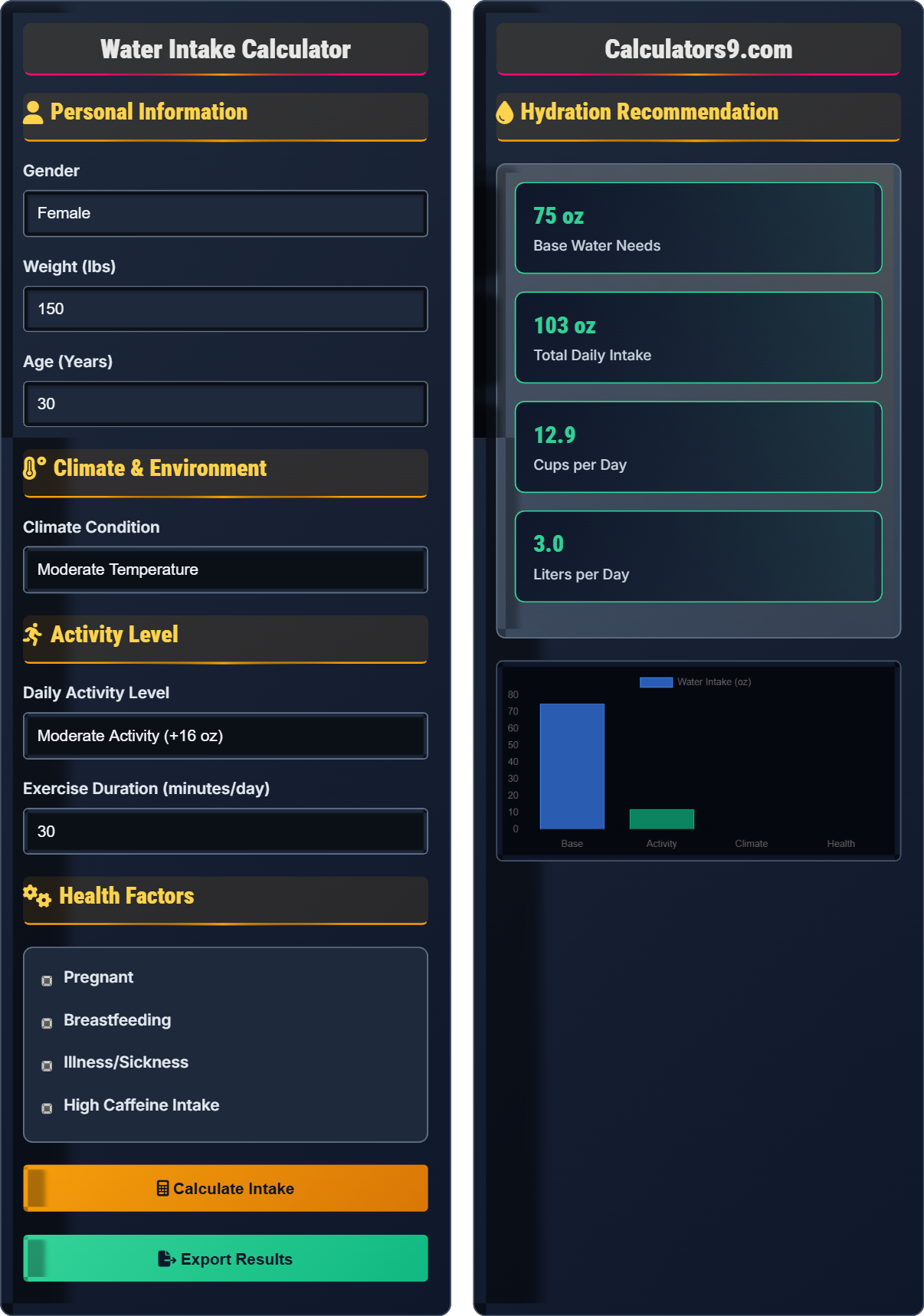
Example: For a 150lb person, sedentary, in moderate climate:
Base needs: 150 ÷ 2 = 75 oz
Activity adjustment: 0 (sedentary)
Climate adjustment: 0 (moderate)
Health adjustment: 0 (healthy)
Thus, the daily intake would be 75 oz (about 9 cups).
Personal Information
Climate & Environment
Activity Level
Health Factors
Hydration Recommendation
| Source | Amount (oz) | Percentage | Reason |
|---|
| Time of Day | Water Amount | Percentage | Recommendation |
|---|
Water Intake Guide
Water is essential for life and plays a crucial role in nearly every bodily function. It regulates body temperature, lubricates joints, transports nutrients, removes waste, and maintains blood volume. Proper hydration is fundamental to optimal health, cognitive function, and physical performance.
Several evidence-based formulas help determine daily water needs:
Where:
- Base needs account for body weight
- Activity adds for exercise and sweating
- Climate adjusts for environmental factors
- Health conditions may increase requirements
Water comes from multiple sources:
- Drinking Water: Plain water, the most effective hydration source
- Beverages: Coffee, tea, juice, milk (though caffeine/alcohol have diuretic effects)
- Foods: Fruits, vegetables, soups (contributes about 20% of daily intake)
- Metabolic Water: Water produced by cellular respiration (small amount)
Approximately 80% of daily water needs come from beverages, while 20% comes from food.
- Start Early: Begin hydrating before feeling thirsty
- Spread Throughout: Drink consistently rather than large amounts at once
- Monitor Urine: Pale yellow indicates good hydration
- Pre-Hydrate: Drink water before, during, and after exercise
- Flavor Enhancement: Add lemon, cucumber, or mint to plain water
Hydration Basics
Water is essential for temperature regulation, joint lubrication, and nutrient transport.
\( \text{Water Needs (oz)} = \frac{\text{Weight (lbs)}}{2} \)
Where weight=pounds, water needs=ounces.
- 8×8 rule: 8 glasses of 8 oz each
- Thirst is late indicator of dehydration
- Urine color indicates hydration status
Optimization
Dark urine, fatigue, headache, dizziness, dry mouth indicate inadequate hydration.
- Upon waking: 1-2 glasses
- Before meals: 1 glass
- During exercise: 6-8 oz every 15-20 min
- Evening: Reduce intake before bed
- Adjust for activity level
- Consider climate conditions
- Account for health status
- Monitor throughout the day
Water Intake Learning Quiz
According to the "half-pound rule," how much water should a 160-pound person drink daily?
The answer is B) 80 ounces. The "half-pound rule" suggests drinking half your body weight in ounces daily. For a 160-pound person: 160 ÷ 2 = 80 ounces.
The half-pound rule is a simple and effective way to estimate baseline water needs based on body weight. This personalized approach accounts for the fact that larger individuals have greater water requirements for cellular processes, temperature regulation, and other bodily functions.
Half-Pound Rule: Simple formula to estimate water needs based on body weight
Baseline Needs: Basic water requirements before adjustments
Personalized Approach: Adjusting recommendations based on individual factors
• Half-pound rule: weight ÷ 2 = ounces
• Adjust for activity and climate
• Individual needs may vary
• Remember: weight ÷ 2 = baseline ounces
• Adjust for exercise and weather
• Using the same amount for everyone
• Not adjusting for activity level
• Forgetting climate considerations
Calculate the total daily water needs for a 140-pound person who exercises for 45 minutes daily, lives in a warm climate, and drinks a lot of caffeine. Use the half-pound rule as the base and add appropriate adjustments. Show your work.
Step 1: Calculate base water needs
• Base needs = Body weight ÷ 2 = 140 ÷ 2 = 70 ounces
Step 2: Calculate exercise adjustment
• Exercise: 45 minutes ÷ 30 minutes = 1.5 intervals
• Exercise adjustment = 1.5 × 12 oz = 18 ounces
Step 3: Add other adjustments
• Climate adjustment (warm): +8 ounces
• Caffeine adjustment: +8 ounces
Step 4: Calculate total
• Total = 70 + 18 + 8 + 8 = 104 ounces
Therefore, this person should aim for approximately 104 ounces (about 13 cups) of water daily.
This example demonstrates how to calculate personalized water needs by starting with a baseline and then adding adjustments for various factors. The half-pound rule provides a good starting point, but individual circumstances like activity level, climate, and habits significantly impact total requirements.
Baseline Needs: Basic water requirements before adjustments
Personalized Hydration: Adjusting intake based on individual factors
Adjustment Factors: Variables that increase water requirements
• Start with baseline calculation
• Add adjustments for activity/climate
• Consider health/lifestyle factors
• Use half-pound rule as baseline
• Add 12 oz per 30 min exercise
• Account for environmental factors
• Only using the baseline amount
• Not accounting for exercise
• Forgetting climate adjustments
Sarah is pregnant and weighs 155 pounds. She exercises moderately for 30 minutes daily and lives in a moderate climate. How much additional water should she drink compared to her non-pregnant baseline, and what is her total recommended intake?
Step 1: Calculate baseline needs
• Non-pregnant baseline = 155 ÷ 2 = 77.5 ounces
Step 2: Calculate pregnancy-adjusted needs
• Pregnancy adds approximately 16 ounces daily
• Exercise adjustment = 12 ounces (30 minutes at +12 oz)
• Climate adjustment = 0 (moderate)
Step 3: Calculate total
• Total = 77.5 + 16 + 12 = 105.5 ounces
Step 4: Calculate additional amount
• Additional water during pregnancy = 16 ounces
Therefore, Sarah should drink approximately 105.5 ounces (about 13.2 cups) daily during pregnancy, which is 16 ounces more than her baseline non-pregnant needs.
Pregnancy significantly increases water requirements due to increased blood volume, amniotic fluid, and the baby's needs. The Institute of Medicine recommends an additional 16 ounces of fluids daily during pregnancy. This example shows how special circumstances require adjustments beyond standard calculations.
Pregnancy Hydration: Increased water needs during gestation
Blood Volume: Amount of blood in the circulatory system
Amniotic Fluid: Fluid surrounding the developing baby
• Pregnancy adds 16 oz daily
• Breastfeeding adds 32 oz daily
• Adjust for activity and climate
• Pregnancy: +16 oz daily
• Breastfeeding: +32 oz daily
• Monitor hydration closely
• Not adjusting for pregnancy
• Underestimating increased needs
• Confusing pregnancy and breastfeeding needs
John runs for 60 minutes in a hot climate. He weighs 180 pounds and drinks coffee regularly. Calculate his daily water needs and explain the importance of hydration during and after exercise.
Step 1: Calculate base needs
• Base needs = 180 ÷ 2 = 90 ounces
Step 2: Calculate exercise adjustment
• Exercise: 60 minutes ÷ 30 minutes = 2 intervals
• Exercise adjustment = 2 × 12 oz = 24 ounces
Step 3: Add other adjustments
• Climate adjustment (hot): +16 ounces
• Caffeine adjustment: +8 ounces
Step 4: Calculate total
• Total = 90 + 24 + 16 + 8 = 138 ounces
Importance of exercise hydration:
• Prevents dehydration and heat-related illness
• Maintains performance and endurance
• Regulates body temperature
• Replaces fluid lost through sweat
Therefore, John should aim for 138 ounces (about 17.3 cups) of water daily, with special attention to drinking before, during, and after his runs.
Exercise significantly increases water needs due to sweating and increased metabolic rate. During exercise, the body loses water through sweat to regulate temperature. The combination of exercise, hot climate, and caffeine intake creates a higher hydration demand that must be addressed to maintain performance and health.
Exercise Hydration: Fluid needs during and after physical activity
Sweat Rate: Amount of fluid lost during exercise
Heat Regulation: Body's mechanism to maintain temperature
• Drink 6-8 oz every 15-20 min during exercise
• Replace 150% of fluid lost in sweat
• Monitor hydration before exercise
• Pre-hydrate before exercise
• Drink during prolonged activity
• Rehydrate after exercise
• Waiting until thirsty to drink
• Not replacing post-workout fluids
• Ignoring climate effects
Which of the following is NOT an early sign of dehydration?
The answer is C) Pale skin. Pale skin is not an early sign of dehydration. Early signs of dehydration include dark yellow urine, thirst, fatigue, headache, dizziness, and dry mouth. Thirst is actually a late indicator, meaning dehydration has already begun when you feel thirsty.
Recognizing early signs of dehydration is crucial for maintaining optimal hydration. Dark yellow urine is one of the most reliable indicators of hydration status. Interestingly, thirst is actually a late indicator of dehydration, meaning the body is already experiencing some level of fluid deficit when you feel thirsty. Monitoring urine color throughout the day is a practical way to assess hydration status.
Dehydration: Loss of body water exceeding intake
Hydration Status: Level of body fluid balance
Urine Color: Indicator of hydration level
• Pale yellow urine = good hydration
• Thirst = late indicator of dehydration
• Monitor throughout the day
• Check urine color regularly
• Don't wait until thirsty
• Monitor during exercise/heat
• Relying only on thirst sensation
• Not monitoring urine color
• Ignoring environmental factors
FAQ
Q: Is it possible to drink too much water?
A: Yes, it is possible to drink too much water, though it's rare in healthy individuals. Overconsumption of water can lead to hyponatremia, a condition where sodium levels in the blood become dangerously diluted.
Warning signs of overhydration:
- Swelling in hands, feet, or face
- Headache and nausea
- Confusion or disorientation
- Seizures (in severe cases)
Healthy kidneys can process 20-28 liters of water per day but can only excrete about 0.8-1 liter per hour. As a general rule, don't exceed 1 liter per hour unless exercising in extreme heat.
Q: How should I time my water intake around exercise?
A: Proper timing of water intake around exercise is crucial for performance and recovery:
Before exercise (2-3 hours):
- Drink 16-24 oz of fluid
- Check urine color (pale yellow is ideal)
Before exercise (10-15 minutes):
- Drink 8-10 oz of fluid
During exercise:
- Every 15-20 minutes: 6-8 oz of fluid
- For sessions longer than 60 minutes: Consider electrolyte drink
After exercise:
- Replace 150% of fluid lost in sweat
- Weigh yourself before and after to estimate fluid loss
This systematic approach ensures optimal hydration for performance and recovery.