Caffeine Half-Life Calculator
Fast metabolism assessment • 2026 standards
Caffeine Half-Life Formula:
Show the calculator\( C(t) = C_0 \times \left(\frac{1}{2}\right)^{\frac{t}{HL}} \)
Where:
- \( C(t) \) = Caffeine concentration at time t (mg)
- \( C_0 \) = Initial caffeine intake (mg)
- \( t \) = Time elapsed since consumption (hours)
- \( HL \) = Half-life of caffeine (hours)
For multiple doses:
\( C_{total}(t) = \sum_{i=1}^{n} C_i \times \left(\frac{1}{2}\right)^{\frac{t-t_i}{HL}} \)
For elimination time calculation:
\( T_{elimination} = HL \times \log_2\left(\frac{C_0}{C_{threshold}}\right) \)
This formula calculates caffeine concentration over time based on half-life.
Example: For 200mg caffeine with 5-hour half-life after 10 hours:
\( C(10) = 200 \times \left(\frac{1}{2}\right)^{\frac{10}{5}} = 200 \times \left(\frac{1}{2}\right)^2 = 200 \times 0.25 = 50 \) mg
Thus, 50mg of caffeine remains after 10 hours.
Personal Details
Consumption Details
Advanced Options
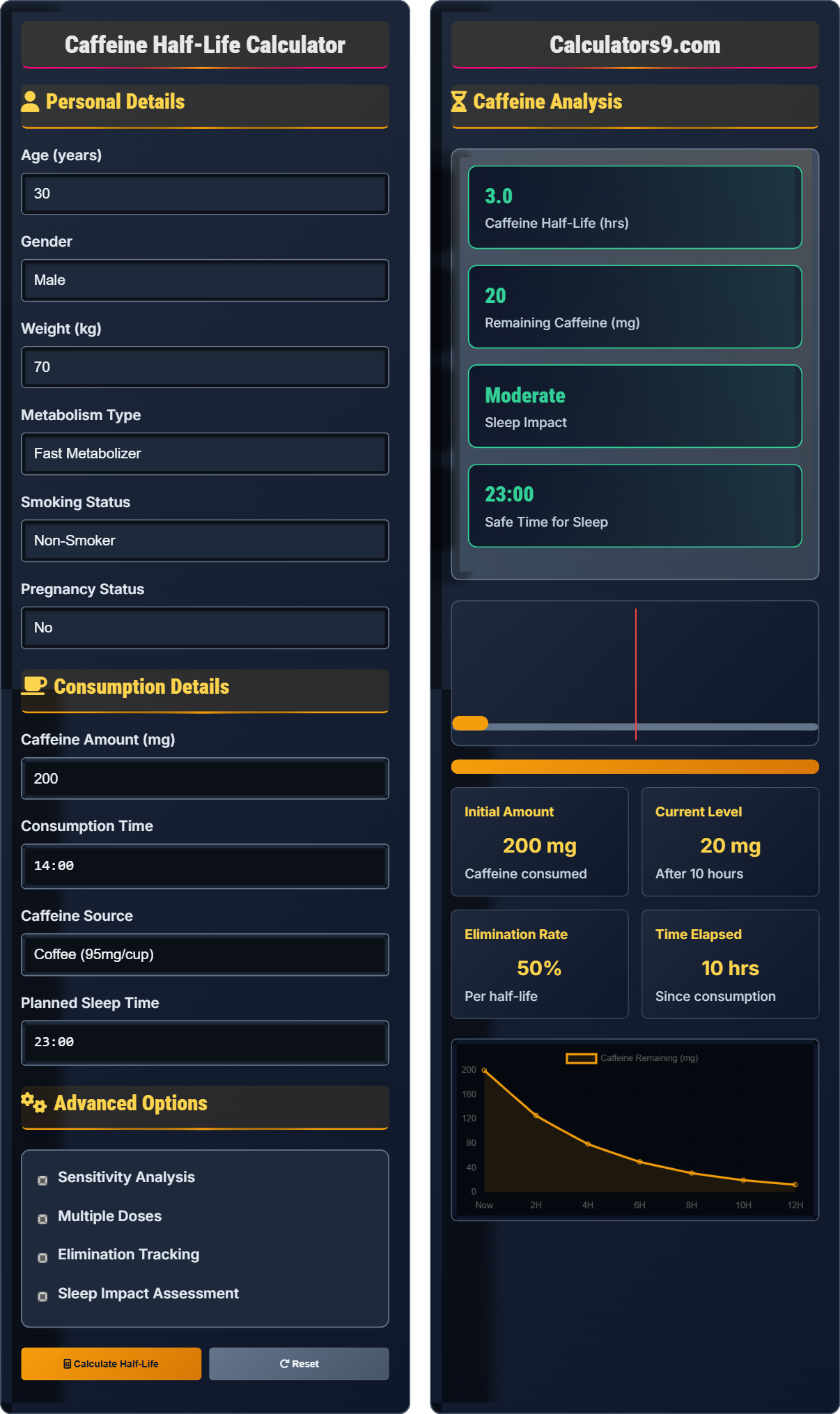
Caffeine Analysis
Initial Amount
Current Level
Elimination Rate
Time Elapsed
| Time | Caffeine (mg) | Percent | Impact |
|---|
| Factor | Value | Effect | Impact |
|---|
Caffeine Timeline
Comprehensive Caffeine Health Guide
Caffeine half-life is the time it takes for half of the caffeine in your body to be metabolized and eliminated. The average half-life is 4-6 hours, but it varies significantly based on genetics, age, medications, and other factors. Understanding your caffeine half-life helps determine optimal consumption timing to avoid sleep disruption.
The caffeine elimination calculation:
Where:
- \(C(t)\) = Caffeine concentration at time t
- \(C_0\) = Initial caffeine intake
- \(t\) = Time elapsed since consumption
- \(HL\) = Half-life of caffeine
Caffeine half-life varies based on multiple factors:
- Age: Increases with age
- Smoking: Reduces half-life
- Pregnancy: Increases half-life
- Medications: Can alter metabolism
- Genetics: CYP1A2 enzyme variants
- Safe Limit: 400mg per day
- Sleep Timing: Stop 6+ hours before bed
- Pregnancy: Limit to 200mg/day
- Children: Avoid caffeine
- Medications: Check interactions
Caffeine Half-Life Fundamentals
Time for half of caffeine to be eliminated from body.
\( C(t) = C_0 \times \left(\frac{1}{2}\right)^{\frac{t}{HL}} \)
Where C=concentration, t=time, HL=half-life.
- Average half-life: 4-6 hours
- Varies by individual
- Affects sleep quality
Safe Consumption
400mg daily for healthy adults.
- Stop 6+ hours before sleep
- Know your sensitivity
- Track total daily intake
- Consider timing effects
- Individual sensitivity varies
- Effects last longer than expected
- Can interact with medications
- Regular assessment recommended
Caffeine Half-Life Learning Quiz
What is the correct definition of caffeine half-life?
The answer is B) Time for half to be eliminated. Caffeine half-life is the time required for the body to metabolize and eliminate half of the consumed caffeine. It's a pharmacokinetic measure that helps predict how long caffeine will remain active in the system.
Remember that half-life means half of the substance is eliminated, not all of it. After one half-life, 50% remains; after two half-lives, 25% remains; after three, 12.5% remains. This exponential decay pattern continues until the substance is completely eliminated.
Half-Life: Time for 50% elimination
Pharmacokinetics: Drug movement in body
Exponential Decay: Rate proportional to amount
• Half-life = 50% elimination time
• Follows exponential decay pattern
• Remains active after half-life
• Remember: 50% after 1 half-life
• 25% after 2 half-lives
• 12.5% after 3 half-lives
• Thinking all caffeine is eliminated after half-life
• Confusing half-life with duration of effects
• Not understanding exponential decay
If someone consumes 200mg of caffeine with a 5-hour half-life, how much caffeine remains after 10 hours? How many half-lives have passed?
Step 1: Calculate number of half-lives
Time elapsed = 10 hours
Half-life = 5 hours
Number of half-lives = 10 ÷ 5 = 2
Step 2: Apply half-life formula
Remaining = Initial × (1/2)^(number of half-lives)
Remaining = 200 × (1/2)^2 = 200 × 0.25 = 50mg
Therefore, 50mg remains after 10 hours (2 half-lives).
This demonstrates the exponential decay of caffeine. After one half-life (5 hours), 100mg remains. After two half-lives (10 hours), 50mg remains. The amount decreases by half with each successive half-life period, following the formula C(t) = C₀ × (1/2)^(t/HL).
Exponential Decay: Proportional to current amount
Half-Life Formula: C(t) = C₀ × (1/2)^(t/HL)
Pharmacokinetic: Drug elimination process
• C(t) = C₀ × (1/2)^(t/HL)
• Amount halves each half-life
• Exponential decay pattern
• Divide time by half-life
• Raise 1/2 to that power
• Multiply by initial amount
• Not dividing time by half-life
• Forgetting exponential nature
• Linear instead of exponential decay
A person with a 6-hour caffeine half-life drinks coffee containing 100mg of caffeine at 4:00 PM. They want to sleep at 10:00 PM. How much caffeine will remain when they go to sleep? Is this likely to affect their sleep? (Consider that 10mg+ can affect sleep in sensitive individuals)
Step 1: Calculate time elapsed
From 4:00 PM to 10:00 PM = 6 hours
Step 2: Calculate number of half-lives
Half-life = 6 hours
Number of half-lives = 6 ÷ 6 = 1
Step 3: Calculate remaining caffeine
Remaining = 100 × (1/2)^1 = 100 × 0.5 = 50mg
Step 4: Assess sleep impact
50mg exceeds the 10mg threshold for sleep interference
Therefore, 50mg remains, likely to affect sleep.
This demonstrates the practical application of half-life calculations for sleep planning. The person will have 50mg of caffeine remaining at bedtime, which is well above the threshold that can affect sleep in sensitive individuals. This explains why consuming caffeine 6 hours before bed can still impact sleep quality.
Sleep Interference: Caffeine disrupting sleep
Sensitive Individuals: Those affected by small amounts
Threshold Effect: Minimum amount causing effect
• Stop caffeine 6+ hours before sleep
• Plan caffeine timing around sleep
• Know your sensitivity level
• Consider half-life for timing
• Not considering half-life for sleep timing
• Underestimating caffeine duration
• Ignoring individual sensitivity
A person takes 100mg caffeine at 8:00 AM and another 100mg at 2:00 PM. With a 5-hour half-life, how much total caffeine remains at 8:00 PM? Consider both doses and their respective elimination times.
Step 1: Calculate first dose remaining
Time from 8:00 AM to 8:00 PM = 12 hours
Half-lives = 12 ÷ 5 = 2.4
Remaining = 100 × (1/2)^2.4 = 100 × 0.19 = 19mg
Step 2: Calculate second dose remaining
Time from 2:00 PM to 8:00 PM = 6 hours
Half-lives = 6 ÷ 5 = 1.2
Remaining = 100 × (1/2)^1.2 = 100 × 0.44 = 44mg
Step 3: Calculate total
Total = 19 + 44 = 63mg
Therefore, 63mg total caffeine remains at 8:00 PM.
This demonstrates how multiple caffeine doses accumulate and are eliminated independently. Each dose follows its own elimination timeline based on when it was consumed. The total caffeine at any time is the sum of all remaining amounts from each dose, calculated separately using the half-life formula.
Accumulation: Multiple doses adding up
Independent Elimination: Each dose follows own timeline
Superposition: Total = sum of individual effects
• Calculate each dose separately
• Sum all remaining amounts
• Each dose has independent timeline
• Track each dose separately
• Calculate elapsed time for each
• Sum all remaining amounts
• Treating all doses as one
• Not calculating separate timelines
• Forgetting to sum individual amounts
Which combination of factors would most likely result in the longest caffeine half-life?
The answer is A) Pregnancy, older age, slow metabolism. These factors all increase caffeine half-life: pregnancy significantly extends half-life (sometimes to 15+ hours), older age naturally increases half-life, and slow metabolism means longer elimination time. This combination would result in the longest duration of caffeine effects.
Caffeine half-life is influenced by multiple physiological factors. Pregnancy hormones can dramatically extend half-life, age-related changes in liver function affect metabolism, and genetic variations in the CYP1A2 enzyme determine metabolic rate. Understanding these factors helps predict individual responses to caffeine.
CYP1A2 Enzyme: Primary caffeine metabolizer
Pharmacogenetics: Genetic drug response
Physiological Factors: Body characteristics affecting drugs
• Pregnancy significantly increases half-life
• Age affects metabolism rate
• Genetics determine metabolic capacity
• Consider individual factors
• Adjust timing based on physiology
• Monitor personal response
• Assuming everyone has same half-life
• Not considering pregnancy effects
• Ignoring age-related changes
FAQ
Q: How long before bed should I stop drinking caffeine?
A: The general recommendation is to stop caffeine intake at least 6 hours before bedtime. This accounts for the average 5-hour half-life of caffeine. The formula for caffeine remaining is: \( C(t) = C_0 \times \left(\frac{1}{2}\right)^{\frac{t}{HL}} \).
For example, if you go to bed at 10 PM, avoid caffeine after 4 PM. However, individual sensitivity varies significantly. Some people may need to stop 8-10 hours before bed. The calculation is: \( Safe\ Time = Bedtime - (HL \times 2) \), where 2 half-lives ensures only 25% of caffeine remains.
Q: Does caffeine tolerance develop over time?
A: Yes, caffeine tolerance develops with regular consumption. The body increases adenosine receptor production, requiring more caffeine to achieve the same effect. Tolerance typically develops over 7-12 days of regular consumption.
The relationship follows: \( Effectiveness = \frac{Initial\ Effect}{1 + T \times C} \), where \( T \) is tolerance factor and \( C \) is consumption level. Regular consumers may need 200-400mg to achieve effects that 100mg provided initially. However, tolerance is reversible with abstinence.