Deep Sleep Percentage Calculator
Sleep quality • Recovery metrics
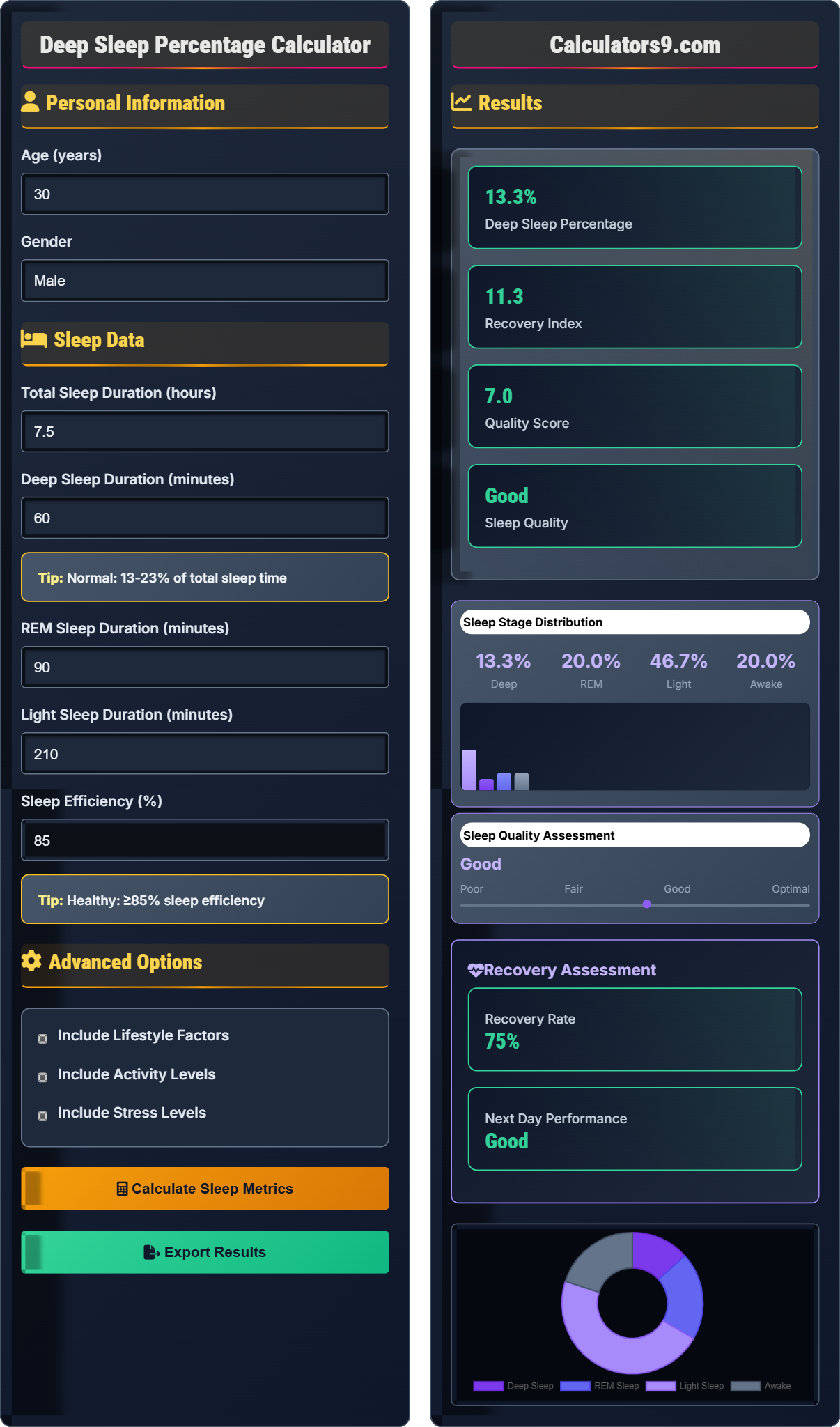
Deep Sleep Percentage: \( \text{DSP} = \frac{\text{Deep Sleep Duration (min)}}{\text{Total Sleep Duration (min)}} \times 100 \)
Recovery Index: \( \text{RI} = \text{DSP} \times \text{Sleep Efficiency} \times \text{Sleep Quality Factor} \)
Where:
- \( \text{Deep Sleep Duration} \) in minutes
- \( \text{Total Sleep Duration} \) in minutes
- \( \text{Sleep Efficiency} = \frac{\text{Sleep Time}}{\text{Time in Bed}} \)
- \( \text{Quality Factor} \) accounts for interruptions and awakenings
Healthy adults should aim for 13-23% deep sleep. DSP varies by age: 20-25% for young adults, 10-15% for elderly.
Example: 7.5 hours total sleep with 60 minutes deep sleep:
\( \text{DSP} = \frac{60}{450} \times 100 = 13.3\% \)
\( \text{Recovery Index} = 13.3 \times 0.85 \times 0.90 = 10.2 \) (out of 100)
Personal Information
Sleep Data
Advanced Options
Results
| Sleep Stage | Duration | Percentage | Quality |
|---|
Understanding Deep Sleep
Deep sleep, also known as slow-wave sleep (SWS) or stage 3 non-REM sleep, is the most restorative phase of sleep. During this stage, brain waves slow down significantly, and the body undergoes critical repair and regeneration processes. Deep sleep is essential for physical recovery, immune function, memory consolidation, and hormonal regulation.
Key metrics for assessing deep sleep quality:
Healthy ranges by age group:
- Young Adults (18-30): 15-20% of total sleep
- Middle Age (30-60): 12-15% of total sleep
- Older Adults (60+): 8-12% of total sleep
Several factors influence deep sleep duration and quality:
- Age: Natural decline with aging
- Exercise: Regular physical activity increases deep sleep
- Stress: High stress reduces deep sleep
- Diet: Late eating can disrupt deep sleep
- Environment: Temperature, noise, and light affect quality
- Consistent Schedule: Go to bed and wake up at same times
- Physical Activity: Regular exercise promotes deeper sleep
- Temperature Control: Cool bedroom temperature (65-68°F)
- Stress Management: Meditation and relaxation techniques
- Dietary Considerations: Avoid late-night eating and caffeine
Sleep Stages
Restorative phase of non-REM sleep.
Light, Deep, REM, and Awake stages.
- Deep sleep is most restorative
- Percentage decreases with age
- Quality over quantity matters
Improvement Strategies
Optimize sleep for better recovery.
- Consistent sleep schedule
- Regular exercise
- Stress management
- Optimal sleep environment
- Individual variation exists
- Consistency is key
- Progress takes time
- Professional guidance recommended
Deep Sleep Learning Quiz
What is the primary function of deep sleep?
The answer is B) Physical recovery and tissue repair. Deep sleep is characterized by slow brain waves and is when the body performs critical repair functions, including tissue growth, muscle repair, and immune system strengthening.
Deep sleep (stage 3 non-REM sleep) is the most restorative sleep stage. During this phase, the body releases growth hormone, repairs tissues, builds bone and muscle, and strengthens the immune system. This is why getting adequate deep sleep is crucial for physical recovery, especially after exercise or illness.
Deep Sleep: Stage 3 non-REM sleep with slow brain waves
Slow-Wave Sleep: Alternative name for deep sleep
Growth Hormone: Released during deep sleep for repair
• Deep sleep is most restorative stage
• Physical repair occurs during deep sleep
• Immune system strengthens during this phase
• Deep sleep is crucial for physical recovery
• Exercise promotes deep sleep
• Consistent sleep schedule helps
• Confusing deep sleep with REM sleep
• Not understanding repair functions
• Undervaluing deep sleep importance
Calculate the deep sleep percentage for a person who slept 7.5 hours total with 60 minutes of deep sleep. Show your work.
Step 1: Convert total sleep to minutes: 7.5 hours × 60 = 450 minutes
Step 2: Apply formula: \( \text{DSP} = \frac{\text{Deep Sleep Duration}}{\text{Total Sleep Duration}} \times 100 \)
Step 3: Substitute values: \( \text{DSP} = \frac{60}{450} \times 100 \)
Step 4: Calculate: \( \text{DSP} = 0.133 \times 100 = 13.3\% \)
Therefore, the deep sleep percentage is 13.3%.
This calculation demonstrates the basic formula for determining deep sleep percentage. The 13.3% result falls within the healthy range for adults (13-23%). This percentage indicates good sleep quality, as it meets the minimum threshold for restorative sleep.
DSP: Deep Sleep Percentage
Healthy Range: 13-23% of total sleep time
Restorative Sleep: Sleep that provides recovery benefits
• Convert hours to minutes for calculation
• Divide deep sleep by total sleep
• Multiply by 100 for percentage
• Always convert to same time units
• Remember: 1 hour = 60 minutes
• Healthy adults: 13-23% DSP
• Mixing hours and minutes in calculation
• Forgetting to multiply by 100
• Not understanding healthy ranges
A 25-year-old has 18% deep sleep, while a 65-year-old has 10% deep sleep. Both slept 7.5 hours. Calculate the difference in deep sleep duration and explain the significance.
Step 1: Calculate 25-year-old's deep sleep: 18% of 450 minutes = 0.18 × 450 = 81 minutes
Step 2: Calculate 65-year-old's deep sleep: 10% of 450 minutes = 0.10 × 450 = 45 minutes
Step 3: Calculate difference: 81 - 45 = 36 minutes less deep sleep
Significance: The older adult gets 36 fewer minutes of the most restorative sleep phase, which may affect recovery, immune function, and cognitive performance.
This example illustrates the natural age-related decline in deep sleep. The 36-minute difference represents a significant reduction in the most restorative sleep phase. While older adults may adapt to less deep sleep, this decline can impact their recovery, immune function, and overall health. Understanding these changes helps set realistic sleep expectations by age.
Age-Related Decline: Natural decrease with aging
Restorative Sleep: Sleep that provides recovery benefits
Sleep Architecture: Distribution of sleep stages
• Deep sleep naturally declines with age
• Older adults may need more total sleep
• Quality becomes more important than quantity
• Older adults: Focus on sleep quality
• Exercise can help preserve deep sleep
• Consistent schedule supports sleep
• Expecting same sleep patterns at all ages
• Not accounting for age-related changes
• Overlooking quality over quantity
A person normally gets 15% deep sleep (6.5 hours total sleep). After starting a regular exercise program, their deep sleep increases to 18% while maintaining the same total sleep time. Calculate the improvement in deep sleep minutes and discuss the health implications.
Step 1: Calculate original deep sleep: 15% of 390 minutes = 0.15 × 390 = 58.5 minutes
Step 2: Calculate new deep sleep: 18% of 390 minutes = 0.18 × 390 = 70.2 minutes
Step 3: Calculate improvement: 70.2 - 58.5 = 11.7 minutes more deep sleep
Health Implications: The additional 11.7 minutes of deep sleep enhances physical recovery, immune function, and memory consolidation. This improvement can lead to better athletic performance, faster recovery from exercise, and improved overall health.
This demonstrates the positive feedback loop between exercise and sleep quality. Regular physical activity increases the drive for deep sleep, which in turn improves recovery from exercise. The additional 11.7 minutes of deep sleep represents a 20% increase in the most restorative sleep phase, which can have significant health benefits over time.
Sleep Drive: Pressure for sleep that increases with wakefulness
Physical Recovery: Repair processes during sleep
Exercise-Sleep Cycle: Beneficial relationship
• Exercise increases deep sleep demand
• More deep sleep = better recovery
• Consistent exercise improves sleep quality
• Regular exercise promotes deep sleep
• Morning exercise may be optimal
• Avoid intense exercise before bed
• Exercising too close to bedtime
• Not recognizing exercise-sleep connection
• Overtraining affecting sleep
Which factor has the strongest positive correlation with increased deep sleep percentage?
The answer is B) Regular physical exercise. Numerous studies have demonstrated that regular physical activity significantly increases deep sleep duration and percentage. Exercise creates a greater need for the restorative processes that occur during deep sleep.
Physical exercise is one of the most powerful modulators of deep sleep. The relationship works through several mechanisms: exercise increases core body temperature, which subsequently drops during sleep initiation, promoting deeper sleep. Additionally, physical exertion increases the metabolic demand for restorative processes that occur during deep sleep.
Sleep Pressure: Accumulation of need for sleep
Metabolic Demand: Need for recovery processes
Thermoregulation: Body temperature control
• Exercise increases deep sleep
• Consistency is key
• Timing matters for sleep
• Regular exercise promotes deep sleep
• Morning/evening exercise timing
• Consistency over intensity
• Exercising too close to bedtime
• Not recognizing exercise benefits
• Overtraining affecting sleep
FAQ
Q: How does deep sleep percentage affect athletic performance and recovery?
A: Deep sleep is critical for athletic performance and recovery:
Physical Recovery: During deep sleep, the body releases growth hormone, which stimulates tissue repair, muscle growth, and protein synthesis. Athletes with higher deep sleep percentages experience faster recovery from training sessions.
Performance Enhancement: Adequate deep sleep improves reaction time, decision-making, and motor skills. Studies show that athletes with 15-20% deep sleep perform significantly better than those with lower percentages.
Immune Function: Intense training can suppress immunity, but quality deep sleep helps maintain immune function, reducing illness risk during competition periods.
Energy Restoration: Deep sleep restores cellular energy stores and replenishes glycogen in muscles and liver, preparing the body for subsequent training sessions.
For optimal athletic performance, athletes should aim for 15-20% deep sleep as part of 7-9 hours of total sleep.
Q: Can I increase my deep sleep percentage naturally?
A: Yes, several evidence-based strategies can increase deep sleep naturally:
Physical Activity: Regular moderate exercise, especially in the morning or afternoon, increases deep sleep duration. However, avoid intense exercise within 3-4 hours of bedtime.
Temperature Control: Keep your bedroom cool (65-68°F). A drop in core body temperature initiates sleep onset and promotes deeper sleep stages.
Consistent Schedule: Going to bed and waking up at the same times daily helps regulate your circadian rhythm and improves sleep architecture.
Pre-Sleep Routine: Engaging in relaxing activities like reading, meditation, or gentle stretching 1-2 hours before bed can prepare your body for deep sleep.
Dietary Considerations: Avoid large meals, caffeine, and alcohol 3-4 hours before bedtime. Consider a light snack with tryptophan (like turkey or milk) if hungry.
These natural approaches can increase deep sleep percentage by 10-20% in most people within 2-4 weeks of consistent implementation.