Foam Roll Duration Calculator
Recovery tracking • Myofascial release
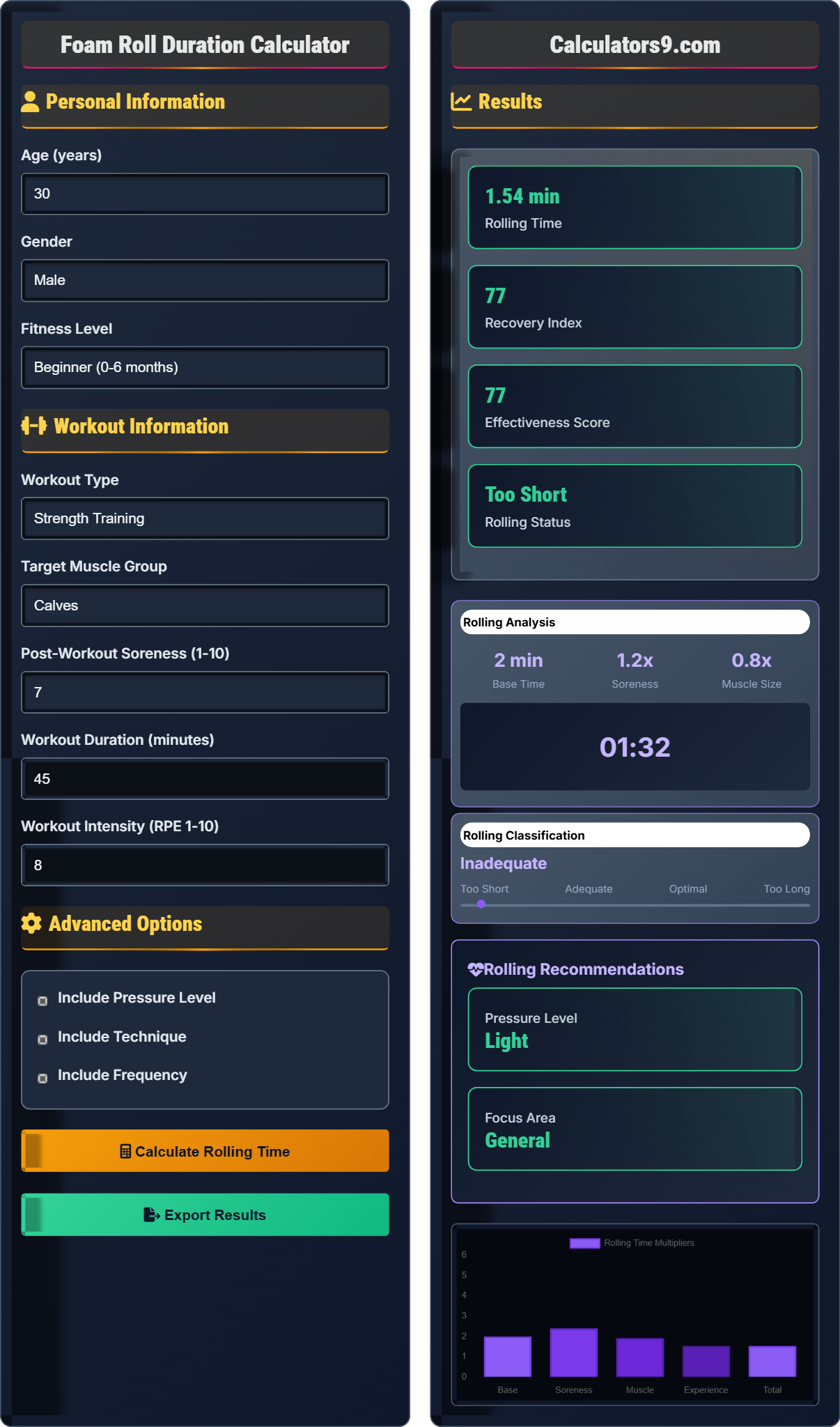
Rolling Time: \( \text{RT} = \text{Base Time} \times \text{Intensity Factor} \times \text{Muscle Factor} \times \text{Experience Factor} \)
Recovery Index: \( \text{RI} = \frac{\text{Actual Time}}{\text{Optimal Time}} \times 100 \)
Effectiveness Score: \( \text{ES} = \text{Recovery Index} \times \text{Pressure Factor} \times \text{Technique Factor} \)
Where:
- \( \text{Base Time: } 1-2 \text{ minutes per muscle group} \)
- \( \text{Intensity Factor: } 0.8-1.5 \text{ (based on soreness)} \)
- \( \text{Muscle Factor: } 1.0-2.0 \text{ (based on muscle size)} \)
- \( \text{Experience Factor: } 0.7-1.3 \text{ (based on familiarity)} \)
Optimal rolling time varies by muscle group and condition. Smaller muscles need 1-2 minutes while larger muscles need 3-5 minutes.
Example: 45-minute leg workout, Soreness 8/10, Large muscle group:
\( \text{RT} = 3 \times 1.3 \times 1.5 \times 1.0 = 5.85 \text{ minutes} \)
\( \text{Effectiveness Score} = 100 \times 0.9 \times 0.8 = 72 \) (good effectiveness)
Personal Information
Workout Information
Advanced Options
Results
| Factor | Value | Multiplier | Impact |
|---|
Understanding Foam Rolling
Foam rolling is a form of self-myofascial release that helps reduce muscle tightness, soreness, and inflammation. It involves applying pressure to specific trigger points to break up fascial adhesions and promote blood flow to muscles.
Key factors affecting optimal rolling time:
Typical rolling times by muscle group:
- Small Muscles: Calves, forearms (1-2 minutes)
- Medium Muscles: Hamstrings, shoulders (2-3 minutes)
- Large Muscles: Quadriceps, back (3-5 minutes)
- Problem Areas: 30-60 seconds per trigger point
Effective foam rolling leads to:
- Improved Flexibility: Reduced muscle tension and increased range of motion
- Enhanced Recovery: Reduced muscle soreness and faster healing
- Injury Prevention: Reduced muscle imbalances and adhesions
- Better Circulation: Increased blood flow to muscles
- Pain Relief: Release of trigger points and muscle tension
- Consistent Pressure: Apply steady, moderate pressure
- Slow Movements: Roll slowly to allow tissue to respond
- Focus on Trigger Points: Spend extra time on tender spots
- Proper Timing: Before or after workouts as needed
- Consistent Practice: Regular sessions for best results
Rolling Metrics
Optimal duration for effective myofascial release.
Base time × soreness × muscle size × experience factors.
- Higher soreness = longer time
- Larger muscles = longer time
- Consistent tracking is essential
Optimization Strategies
Optimize rolling for better recovery.
- Consistent pressure
- Proper technique
- Focus on trigger points
- Regular practice
- Individual variation exists
- Consistency is key
- Progress takes time
- Professional guidance recommended
Foam Rolling Learning Quiz
What is the primary purpose of foam rolling?
The answer is B) To perform myofascial release. Foam rolling helps break up fascial adhesions and reduce muscle tension, promoting recovery and flexibility.
Foam rolling is a form of self-massage that targets the fascia (connective tissue surrounding muscles). It helps release muscle tightness, reduce soreness, and improve circulation, which aids in recovery and performance.
Foam Rolling: Self-massage technique using a foam cylinder
Myofascial Release: Technique to release muscle tightness
Fascia: Connective tissue surrounding muscles
• Releases muscle tension
• Improves circulation
• Aids recovery
• Apply steady pressure
• Roll slowly
• Focus on tender spots
• Rolling too fast
• Using too much pressure
• Not targeting trigger points
Calculate the rolling time for quadriceps after a high-intensity leg workout (soreness 8/10, large muscle group, beginner experience). Show your work.
Step 1: Identify base time for quadriceps: 4 minutes
Step 2: Apply the rolling formula: \( \text{RT} = \text{Base} \times \text{Soreness} \times \text{Muscle Size} \times \text{Experience} \)
Step 3: Soreness factor for 8/10: 1.3
Step 4: Muscle size factor for large: 1.2
Step 5: Experience factor for beginner: 0.8
Step 6: Calculate: \( \text{RT} = 4 \times 1.3 \times 1.2 \times 0.8 = 4.99 \) minutes
Therefore, the rolling time is approximately 5 minutes.
This calculation demonstrates how multiple factors combine to determine optimal rolling time. The high soreness and large muscle size increase the base time, while beginner experience reduces it to prevent injury.
Rolling Time (RT): Total time needed for effective rolling
Soreness Factor: Multiplier based on post-workout sorenessBase Time: Standard time for muscle group
• Multiply all factors together
• Higher soreness = longer time
• Larger muscles = longer time
• Adjust for experience level
• Consider muscle size
• Factor in soreness level
• Adding instead of multiplying factors
• Not considering experience level
• Ignoring muscle size differences
A person has severe muscle soreness (9/10) after a marathon but is an experienced roller (factor 1.1). How should they adjust their rolling time compared to a beginner with similar soreness?
Step 1: Calculate beginner time: \( 3 \times 1.4 \times 1.0 \times 0.8 = 3.36 \) minutes
Step 2: Calculate experienced roller time: \( 3 \times 1.4 \times 1.0 \times 1.1 = 4.62 \) minutes
Step 3: The experienced roller can handle 4.62 - 3.36 = 1.26 more minutes
Step 4: Experienced users can tolerate longer sessions due to better tolerance and technique
Conclusion: Experienced rollers can handle longer sessions safely.
This example demonstrates how experience level affects rolling capacity. Experienced users have better tolerance for pressure and understand proper technique, allowing them to safely extend rolling time compared to beginners.
Experience Factor: Adjustment based on rolling experience
Pressure Tolerance: Ability to handle rolling pressure
Technique Proficiency: Skill in proper rolling methods
• Experience allows longer sessions
• Beginners need shorter durations
• Technique improves effectiveness
• Start with shorter sessions
• Build tolerance gradually
• Learn proper technique
• Treating all users equally
• Not considering experience level
• Ignoring technique differences
A person plans to roll their hamstrings (base 3 min), back (base 4 min), and calves (base 2 min) in one session. Calculate the total rolling time and recommend an optimal sequence.
Step 1: Hamstring rolling: \( 3 \times 1.0 \times 1.0 \times 1.0 = 3 \) minutes
Step 2: Back rolling: \( 4 \times 1.0 \times 1.2 \times 1.0 = 4.8 \) minutes
Step 3: Calf rolling: \( 2 \times 1.0 \times 0.8 \times 1.0 = 1.6 \) minutes
Step 4: Total time: \( 3 + 4.8 + 1.6 = 9.4 \) minutes
Step 5: Recommended sequence: Calves → Hamstrings → Back (smallest to largest)
Optimal schedule: 10-minute session focusing on problem areas last.
When rolling multiple muscle groups, it's efficient to start with smaller muscles and progress to larger ones. This allows for better focus on problem areas at the end when you're warmed up.
Rolling Sequence: Order of muscle group treatment
Multi-Muscle Session: Rolling multiple areas in one session
Session Duration: Total time for rolling session
• Add times for total session
• Start with smaller muscles
• Focus on problem areas last
• Plan session duration
• Consider muscle size progression
• Allow for transitions
• Not calculating total session time
• Rolling largest muscles first
• Ignoring transition time
Which factor has the most significant impact on foam rolling effectiveness?
The answer is B) Proper technique. Correct form and method are crucial for effective myofascial release and preventing injury.
While rolling time and pressure matter, proper technique ensures you target the right areas, apply appropriate pressure, and avoid injury. Good technique maximizes benefits while minimizing risks.
Proper Technique: Correct form and method
Myofascial Release: Targeted tissue manipulation
Rolling Effectiveness: Degree of benefit achieved
• Technique is most important
• Proper form prevents injury
• Method affects effectiveness
• Learn proper form first
• Focus on technique over time
• Practice correct method
• Prioritizing time over technique
• Rolling too fast
• Not learning proper form
FAQ
Q: How often should I foam roll for optimal recovery?
A: For optimal recovery:
Daily Rolling: 5-10 minutes focusing on problem areas. This helps maintain muscle flexibility and prevents adhesion buildup.
Post-Workout: 10-15 minutes targeting worked muscle groups. This helps reduce immediate post-exercise soreness and promotes recovery.
Pre-Workout: 5-10 minutes for warm-up and activation. This can improve range of motion and prepare muscles for exercise.
Problem Areas: Spend extra time (30-60 seconds per trigger point) on tight or problematic areas.
Consistency is more important than duration - daily short sessions are better than infrequent long sessions.
Q: What are signs that I'm foam rolling too much or too little?
A: Signs of over-rolling include:
Physical Symptoms: Bruising, skin irritation, increased pain, muscle weakness, prolonged soreness lasting more than 24-48 hours.
Performance Issues: Decreased strength or power output, reduced flexibility immediately after rolling.
Signs of under-rolling: Persistent muscle tightness, frequent muscle knots, limited range of motion, chronic soreness, recurring injuries.
Optimal Rolling: Should feel slightly uncomfortable but not painful, muscles should feel looser afterward, and you should experience improved mobility.
If you experience pain during rolling, reduce pressure or duration. The goal is to find the "good hurt" - some discomfort is normal, but sharp pain is not.