HRV Daily Monitor
Heart rate variability • Recovery metrics
HRV (SDNN): \( \text{SDNN} = \sqrt{\frac{\sum(x_i - \bar{x})^2}{N-1}} \)
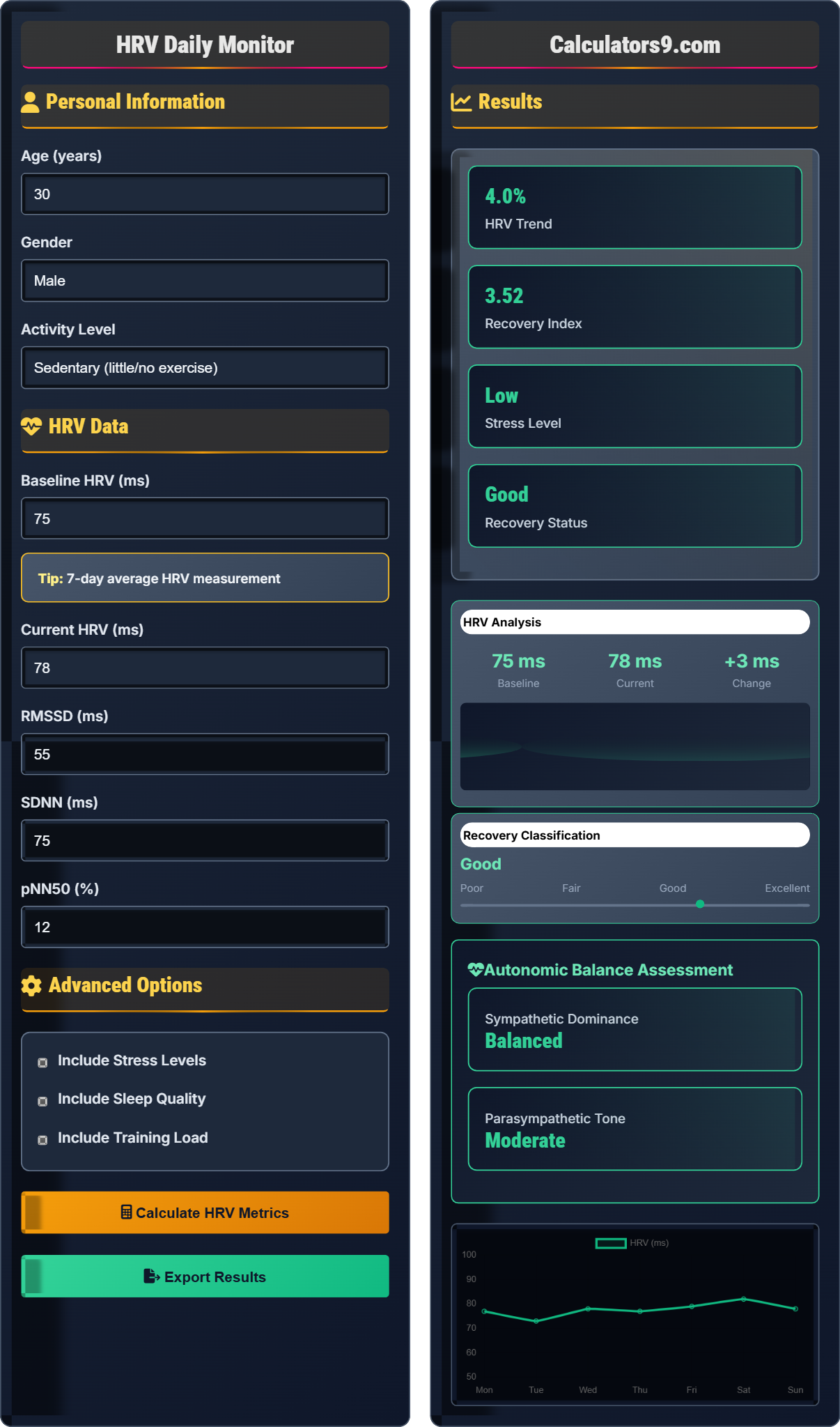
HRV Trend: \( \text{Trend} = \frac{\text{Current HRV} - \text{Baseline HRV}}{\text{Baseline HRV}} \times 100 \)
Recovery Index: \( \text{RI} = \text{HRV Trend} \times \text{Stress Factor} \times \text{Recovery Factor} \)
Where:
- \( \text{SDNN: } \text{Standard deviation of NN intervals} \)
- \( \text{Normal HRV: } 50-100 \text{ ms for adults} \)
- \( \text{Athletic HRV: } 70-100+ \text{ ms} \)
- \( \text{Baseline HRV: } \text{7-day average} \)
Higher HRV indicates better autonomic nervous system balance, recovery, and resilience. Lower HRV suggests stress, fatigue, or overtraining.
Example: Baseline HRV 75 ms, Current HRV 78 ms:
\( \text{Trend} = \frac{78 - 75}{75} \times 100 = 4\% \) (improvement)
\( \text{Recovery Index} = 4 \times 0.9 \times 1.1 = 3.96 \) (positive adaptation)
Personal Information
HRV Data
Advanced Options
Results
| Parameter | Value | Reference | Status |
|---|
Understanding Heart Rate Variability
Heart Rate Variability (HRV) measures the variation in time between consecutive heartbeats. It's an indicator of autonomic nervous system function and overall health. Higher HRV indicates better adaptability to stress and improved recovery capacity, while lower HRV suggests stress, fatigue, or overtraining.
Key HRV measurements:
Normal ranges by category:
- Excellent: 90-100+ ms (elite athletes)
- Good: 70-90 ms (fit individuals)
- Average: 50-70 ms (general population)
- Below Average: 30-50 ms (poor fitness)
- Poor: <30 ms (significant stress/illness)
HRV trends can indicate various health conditions:
- Increasing HRV: Improved fitness, better recovery, reduced stress
- Decreasing HRV: Overtraining, illness, high stress, poor sleep
- Consistent HRV: Stable training and recovery balance
- High Variability: Good autonomic flexibility
- Consistent Sleep Schedule: 7-9 hours of quality sleep nightly
- Stress Management: Meditation, breathing exercises, yoga
- Proper Training Balance: Mix of intense and easy sessions
- Recovery Techniques: Massage, saunas, stretching
- Consistent Monitoring: Track trends to identify patterns
HRV Metrics
Variation in time between heartbeats.
Time interval between consecutive R-waves.
- Higher HRV = better health
- Track trends, not single values
- Consistent measurement time
Improvement Strategies
Optimize HRV for better recovery.
- Quality sleep
- Stress management
- Proper training balance
- Recovery techniques
- Individual variation exists
- Consistency is key
- Progress takes time
- Professional guidance recommended
HRV Learning Quiz
What does a higher HRV typically indicate about autonomic nervous system balance?
The answer is B) Better autonomic flexibility. Higher HRV indicates that the autonomic nervous system can effectively adapt to different situations, showing a good balance between sympathetic and parasympathetic activity.
HRV reflects the dynamic interplay between the sympathetic nervous system (fight-or-flight) and parasympathetic nervous system (rest-and-digest). Higher HRV indicates that the body can efficiently shift between these states as needed, which is a sign of good health and resilience.
HRV: Heart Rate Variability - beat-to-beat variation
Sympathetic Nervous System: Stress response system
Parasympathetic System: Recovery system
• Higher HRV = better flexibility
• Good balance = higher HRV
• Flexibility = better health
• Higher HRV indicates better health
• Flexibility means adaptability
• Track trends over time
• Confusing HRV with heart rate
• Not understanding autonomic balance
• Ignoring measurement conditions
Calculate the HRV trend for someone whose baseline HRV was 72 ms and current HRV is 78 ms. Show your work.
Step 1: Apply the HRV trend formula: \( \text{Trend} = \frac{\text{Current HRV} - \text{Baseline HRV}}{\text{Baseline HRV}} \times 100 \)
Step 2: Substitute values: \( \text{Trend} = \frac{78 - 72}{72} \times 100 \)
Step 3: Calculate: \( \text{Trend} = \frac{6}{72} \times 100 = 8.33\% \)
Step 4: Interpretation: +8.33% indicates an 8.33% improvement in HRV.
Therefore, the HRV trend is +8.3% (improvement).
This calculation shows how to quantify changes in HRV. The positive value indicates improvement (higher HRV), while negative values would indicate deterioration. An 8.3% improvement is significant and suggests positive adaptations from training or recovery.
HRV Trend: Percentage change in heart rate variability
Baseline HRV: Reference HRV for comparison
Autonomic Adaptation: Nervous system response
• Subtract baseline from current
• Divide by baseline value
• Multiply by 100 for percentage
• Use 7-day average as baseline
• Positive trend = improvement
• Negative trend = concern
• Dividing by current instead of baseline
• Forgetting to multiply by 100
• Not using consistent measurement conditions
An athlete's HRV has been declining from 85 ms to 62 ms over the past 2 weeks despite maintaining the same training load. What might this indicate and what should they do?
Step 1: Identify the change: 85 ms - 62 ms = 23 ms decrease
Step 2: Calculate percentage change: (23/85) × 100 = 27.1% decrease
Step 3: Interpret the pattern: Significant drop in HRV despite consistent training
Step 4: Conclusion: This pattern strongly suggests overreaching, inadequate recovery, or possible illness.
Recommended actions: Reduce training intensity, prioritize sleep, consider medical evaluation, implement active recovery days.
This scenario demonstrates a classic sign of overreaching. When the body is under excessive stress without adequate recovery, the sympathetic nervous system becomes dominant, leading to reduced HRV. This is often one of the earliest warning signs of overreaching or overtraining syndrome.
Overreaching: Temporary overtraining with proper recovery
Sympathetic Dominance: Stress response system activation
Recovery Monitoring: Tracking HRV for training load
• Dropping HRV = possible overreaching
• Monitor trends, not single values
• Recovery is as important as training
• Track HRV daily
• Look for patterns over weeks
• Adjust training based on trends
• Ignoring HRV trends
• Pushing through low HRV
• Not considering recovery
A person starts a recovery-focused program with an HRV of 58 ms. After 4 weeks of prioritizing sleep, stress management, and easy training, their HRV increases to 72 ms. Calculate the improvement and explain the physiological adaptations responsible.
Step 1: Calculate absolute change: 72 ms - 58 ms = 14 ms increase
Step 2: Calculate percentage improvement: (14/58) × 100 = 24.1% improvement
Step 3: Physiological adaptations:
- Parasympathetic activation: Improved vagal tone and recovery
- Stress reduction: Lower cortisol and sympathetic activity
- Better sleep: Enhanced recovery processes
- Reduced inflammation: Better overall health markers
The 24.1% improvement indicates significant positive autonomic adaptations.
This example shows how focused recovery efforts lead to measurable autonomic improvements. The 24.1% increase in HRV represents substantial improvements in nervous system balance. This reflects better stress resilience and recovery capacity, which supports long-term health and performance.
Parasympathetic Activation: Recovery system engagement
Vagal Tone: Vagus nerve activity affecting HRV
Autonomic Adaptation: Nervous system response to training
• Recovery-focused = HRV improvements
• Higher HRV = better resilience
• Changes occur over weeks
• Prioritize recovery for HRV
• Consistency is key for adaptations
• Patience needed for changes
• Expecting immediate changes
• Not tracking consistently
• Overtraining for quick results
Which factor has the most immediate impact on HRV?
The answer is B) Previous night's sleep quality. Poor sleep significantly impacts the autonomic nervous system, reducing HRV the following day. Sleep quality has an immediate effect on parasympathetic activity.
Sleep quality directly affects autonomic nervous system balance. Poor sleep activates sympathetic nervous system activity and reduces parasympathetic tone, leading to lower HRV. This effect is often noticeable within hours of a poor night's sleep, making sleep one of the most immediate influences on HRV.
Sympathetic Nervous System: Stress response system
Parasympathetic System: Recovery system
Autonomic Balance: Sympathetic vs parasympathetic
• Sleep affects HRV immediately
• Parasympathetic dominance = higher HRV
• Recovery is essential
• Prioritize quality sleep
• Track sleep alongside HRV
• Notice immediate effects
• Ignoring sleep quality
• Not connecting sleep to HRV
• Focusing only on exercise
FAQ
Q: How should I use HRV trends to adjust my training program?
A: Use HRV trends as a guide for training intensity:
Increasing HRV (improvement): Indicates positive adaptation and readiness for increased load. Consider adding intensity or volume.
Stable HRV: Suggests current training load is appropriate. Maintain current program while monitoring for continued adaptation.
Decreasing HRV (-5-10%): Potential sign of accumulated stress. Reduce training intensity, increase recovery, prioritize sleep and nutrition.
Significant Decrease (-10%+): Strong indicator of overreaching, illness, or excessive stress. Implement rest days, reduce volume/intensity, consider medical evaluation.
Always look at trends over 3-7 days rather than single measurements. Combine HRV data with perceived exertion, motivation levels, and performance metrics for comprehensive training guidance.
Q: What's the best way to measure HRV accurately?
A: For accurate HRV measurement:
Timing: Measure immediately upon waking, while still lying in bed. This ensures you're in a true resting state before any activity affects your autonomic nervous system.
Consistency: Measure at the same time daily, in the same position, and record consistently for meaningful trends.
Conditions: Ensure you haven't exercised, eaten, drunk caffeine, or experienced stress in the past 2-3 hours. Empty bladder beforehand to avoid any stress response.
Device: Use a chest strap heart rate monitor for highest accuracy, though quality wrist-based devices can provide reliable readings.
Protocol: Remain still and relaxed for 2-5 minutes during measurement. Avoid talking or moving during the reading.
Take measurements for 7 consecutive days to establish a reliable baseline average.