Muscle Recovery Timer
Recovery tracking • Fitness metrics
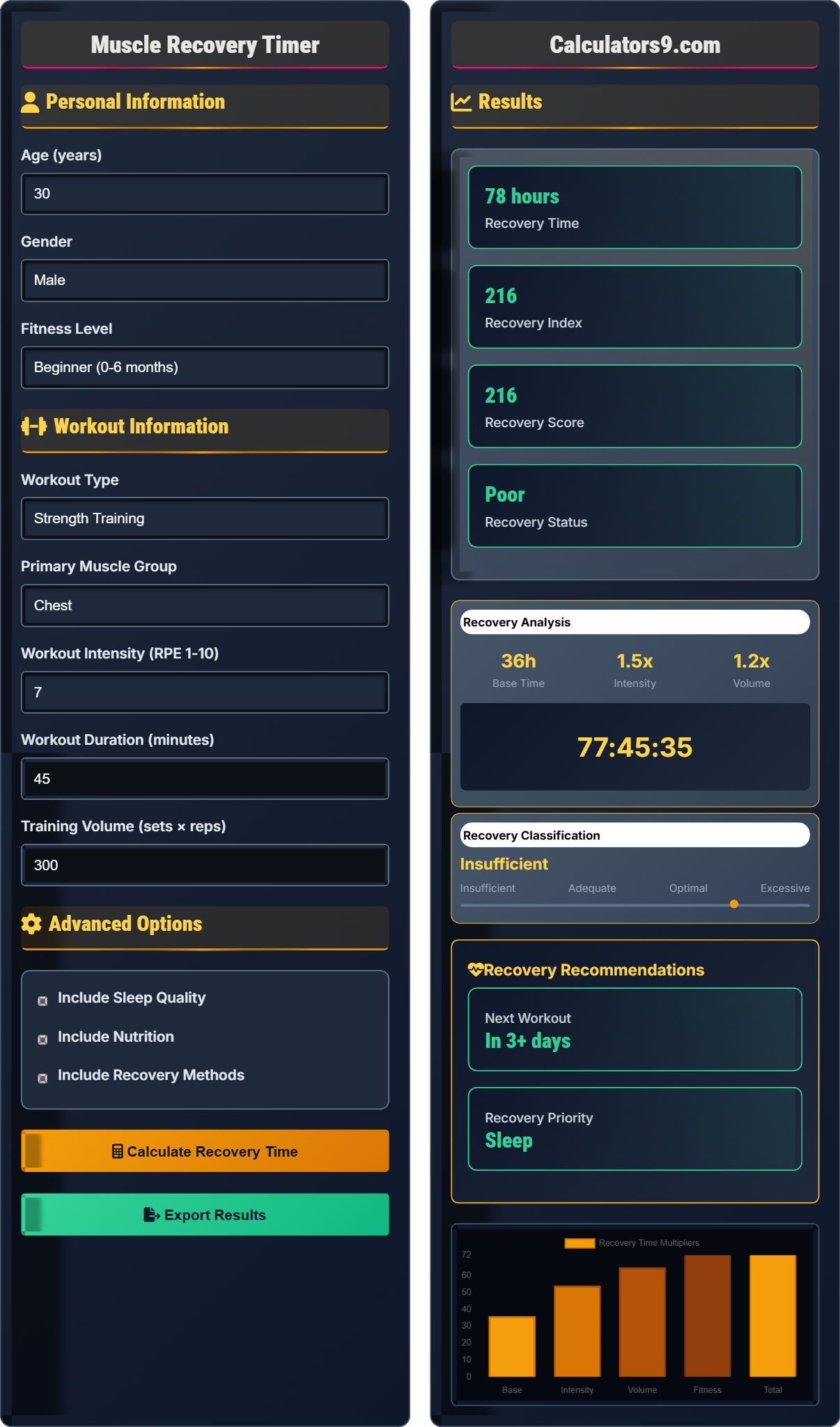
Recovery Time: \( \text{RT} = \text{Base Recovery} \times \text{Intensity Factor} \times \text{Volume Factor} \times \text{Fitness Factor} \)
Recovery Index: \( \text{RI} = \frac{\text{Actual Recovery}}{\text{Estimated Recovery}} \times 100 \)
Recovery Score: \( \text{RS} = \text{Recovery Index} \times \text{Sleep Quality} \times \text{Nutrition Factor} \)
Where:
- \( \text{Base Recovery: } 24-48 \text{ hours for trained muscles} \)
- \( \text{Intensity Factor: } 1.0-3.0 \text{ (based on RPE)} \)
- \( \text{Volume Factor: } 1.0-2.0 \text{ (based on sets/reps)} \)
- \( \text{Fitness Factor: } 0.8-1.2 \text{ (based on training experience)} \)
Recovery time varies by muscle group and training intensity. Smaller muscles recover faster (1-2 days) while larger muscles take longer (2-3 days).
Example: 45-minute leg workout (RPE 8), Volume factor 1.5, Fitness factor 1.0:
\( \text{RT} = 48 \times 2.0 \times 1.5 \times 1.0 = 144 \text{ hours (6 days)} \)
\( \text{Recovery Score} = 100 \times 0.8 \times 0.9 = 72 \) (good recovery)
Personal Information
Workout Information
Advanced Options
Results
| Factor | Value | Multiplier | Impact |
|---|
Understanding Muscle Recovery
Muscle recovery is the process by which muscles repair and rebuild after exercise. During recovery, microscopic tears in muscle fibers heal, leading to muscle growth and adaptation. Proper recovery is essential for performance improvement, injury prevention, and overall health.
Key factors affecting recovery time:
Typical recovery times by muscle group:
- Small Muscles: Arms, shoulders (1-2 days)
- Medium Muscles: Chest, back (2-3 days)
- Large Muscles: Legs (3-4 days)
- Core: 1-2 days
Proper recovery leads to:
- Muscle Growth: Microtears repair and strengthen
- Performance Improvement: Adaptation to training stress
- Injury Prevention: Reduced fatigue and wear
- Energy Restoration: ATP and glycogen replenishment
- Hormone Balance: Optimal testosterone/cortisol ratio
- Prioritize Sleep: 7-9 hours of quality sleep nightly
- Proper Nutrition: Adequate protein and calories
- Active Recovery: Light movement on rest days
- Hydration: Maintain proper fluid balance
- Consistent Monitoring: Track recovery patterns
Recovery Metrics
Time needed for muscle repair and adaptation.
Base time × intensity × volume × fitness factors.
- Higher intensity = longer recovery
- More volume = longer recovery
- Consistent tracking is essential
Optimization Strategies
Optimize recovery for better performance.
- Prioritize quality sleep
- Proper nutrition
- Active recovery
- Recovery methods
- Individual variation exists
- Consistency is key
- Progress takes time
- Professional guidance recommended
Muscle Recovery Learning Quiz
What is the primary purpose of muscle recovery after exercise?
The answer is B) To repair and rebuild muscle tissue. Muscle recovery involves repairing microscopic tears in muscle fibers caused by exercise, leading to muscle growth and adaptation.
During exercise, especially resistance training, microscopic tears occur in muscle fibers. Recovery is the process where the body repairs these tears, making the muscle stronger and more resilient. This adaptation is essential for muscle growth and improved performance.
Muscle Recovery: Process of repairing and rebuilding muscle tissue
Microscopic Tears: Small damage to muscle fibers during exercise
Adaptation: Body's response to training stress
• Recovery enables muscle growth
• Damage is repaired during rest
• Adaptation occurs during recovery
• Recovery is when muscles grow
• Damage is repaired during rest
• Adaptation happens during recovery
• Thinking more exercise = more growth
• Not understanding repair process
• Ignoring recovery importance
Calculate the recovery time for a 60-minute leg workout with RPE 8, volume factor 1.5, and fitness factor 1.0. Show your work.
Step 1: Identify base recovery time for legs: 48 hours
Step 2: Apply the recovery formula: \( \text{RT} = \text{Base} \times \text{Intensity} \times \text{Volume} \times \text{Fitness} \)
Step 3: For RPE 8, intensity factor is approximately 2.0
Step 4: Substitute values: \( \text{RT} = 48 \times 2.0 \times 1.5 \times 1.0 \)
Step 5: Calculate: \( \text{RT} = 144 \text{ hours} \) or 6 days
Therefore, the recovery time is 6 days.
This calculation demonstrates how different factors multiply together to determine recovery time. The high intensity (RPE 8) and volume (1.5x) significantly extend the base recovery time from 2 days to 6 days, showing why intense leg workouts require longer recovery periods.
Recovery Time (RT): Total time needed for muscle recovery
RPE: Rate of Perceived Exertion scale (1-10)Base Recovery: Standard time for muscle group
• Multiply all factors together
• Higher RPE = longer recovery
• More volume = longer recovery
• High-intensity = more recovery
• Larger muscles need more time
• Volume affects recovery significantly
• Adding instead of multiplying factors
• Not considering muscle group size
• Ignoring training intensity impact
A person trains legs with high intensity (RPE 9) and high volume (factor 2.0) but has excellent sleep (9 hours, quality 9/10) and nutrition (protein 2.2g/kg). How might this affect their recovery time compared to someone with poor recovery habits?
Step 1: Calculate base recovery with high intensity/volume: \( 48 \times 2.5 \times 2.0 = 240 \text{ hours} \)
Step 2: Apply recovery enhancement factors: Excellent sleep and nutrition may reduce recovery time by 20-30%
Step 3: Adjusted recovery: \( 240 \times 0.7 = 168 \text{ hours} \) or 7 days
Step 4: Poor recovery habits might extend time to 10+ days
Conclusion: Good recovery habits can significantly reduce recovery time even with intense training.
This example demonstrates how recovery habits can offset the effects of intense training. While the workout demands 10 days of recovery in ideal conditions, good sleep and nutrition reduce this to 7 days. Poor recovery habits would extend it further, showing the importance of recovery practices.
Recovery Enhancement: Factors that accelerate recovery
Recovery Acceleration: Reducing required recovery time
Recovery Optimization: Maximizing recovery efficiency
• Good habits accelerate recovery
• Poor habits extend recovery
• Recovery is as important as training
• Optimize recovery for better results
• Quality sleep is crucial
• Proper nutrition accelerates recovery
• Focusing only on training intensity
• Neglecting recovery practices
• Not considering recovery acceleration
A person does a 45-minute arm workout (RPE 6, volume factor 1.2) followed by a 30-minute shoulder workout (RPE 7, volume factor 1.1) on the same day. Calculate the total recovery time needed and explain how to plan their workout schedule.
Step 1: Arm workout recovery: \( 24 \times 1.5 \times 1.2 = 43.2 \text{ hours} \)
Step 2: Shoulder workout recovery: \( 24 \times 1.8 \times 1.1 = 47.5 \text{ hours} \)
Step 3: Combined recovery: The higher value (47.5 hours) determines the minimum recovery needed
Step 4: Workout schedule: Shoulders and arms should not be trained again for at least 2 days
Optimal schedule: Next shoulder/arm workout on day 3 after this session.
When multiple muscle groups are trained in one session, the longest recovery time needed determines when the session can be repeated. In this case, the shoulders require slightly more recovery than arms, so the shoulder recovery time governs the schedule.
Combined Recovery: Recovery time when multiple muscles trained
Training Schedule: Planning workouts around recovery
Recovery Period: Time needed for full recovery
• Use the longest recovery time
• Plan around recovery needs
• Allow adequate recovery
• Plan schedules around recovery
• Consider cumulative training stress
• Allow for the longest recovery time
• Averaging recovery times instead of using maximum
• Not considering cumulative stress
• Training muscles too soon
Which factor has the most significant impact on reducing muscle recovery time?
The answer is B) Sleep quality and duration. Quality sleep (7-9 hours) is when most muscle repair and growth hormone release occurs, making it the most critical factor for recovery.
During deep sleep, the body releases growth hormone and performs most muscle repair processes. Poor sleep can double recovery time, while quality sleep can reduce it by 20-30%. This makes sleep the most important recovery factor after training.
Growth Hormone: Released during deep sleep, aids recovery
Deep Sleep: Phase when most repair occurs
Recovery Factor: Element that affects recovery time
• Sleep is most critical for recovery
• 7-9 hours of quality sleep needed
• Poor sleep extends recovery significantly
• Prioritize 7-9 hours of sleep
• Quality is as important as quantity
• Sleep is when muscles grow
• Not prioritizing sleep
• Thinking training is more important
• Ignoring sleep quality
FAQ
Q: How should I use recovery time calculations to plan my training schedule?
A: Use recovery calculations to plan your training schedule:
Single Muscle Groups: Wait until recovery time has passed before training the same muscles again. For example, if legs need 72 hours to recover, don't train legs again for 3 days.
Split Training: Train non-overlapping muscle groups on consecutive days. If arms need 24 hours and legs need 72 hours, you could train legs on Monday and arms on Tuesday.
Volume Management: Adjust training volume based on recovery capacity. If you're recovering slowly, reduce volume rather than frequency.
Progressive Overload: Only increase intensity or volume when you've fully recovered from the previous session.
Always err on the side of caution - it's better to wait an extra day than to train before full recovery.
Q: What are signs that I need more recovery time?
A: Signs you need more recovery time include:
Performance Decline: Decreased strength, endurance, or power output during workouts. If you can't lift the same weight or complete the same reps, you may be under-recovered.
Physical Symptoms: Persistent muscle soreness beyond 48-72 hours, joint pain, increased injury frequency, elevated resting heart rate.
Mental Symptoms: Decreased motivation, irritability, difficulty concentrating, feeling unusually fatigued or exhausted.
Sleep Issues: Difficulty falling asleep, restless sleep, or feeling unrefreshed in the morning.
Appetite Changes: Loss of appetite or cravings for unhealthy foods, which can indicate elevated stress hormones.
If you experience these symptoms, consider extending your recovery periods and evaluating your overall training load.