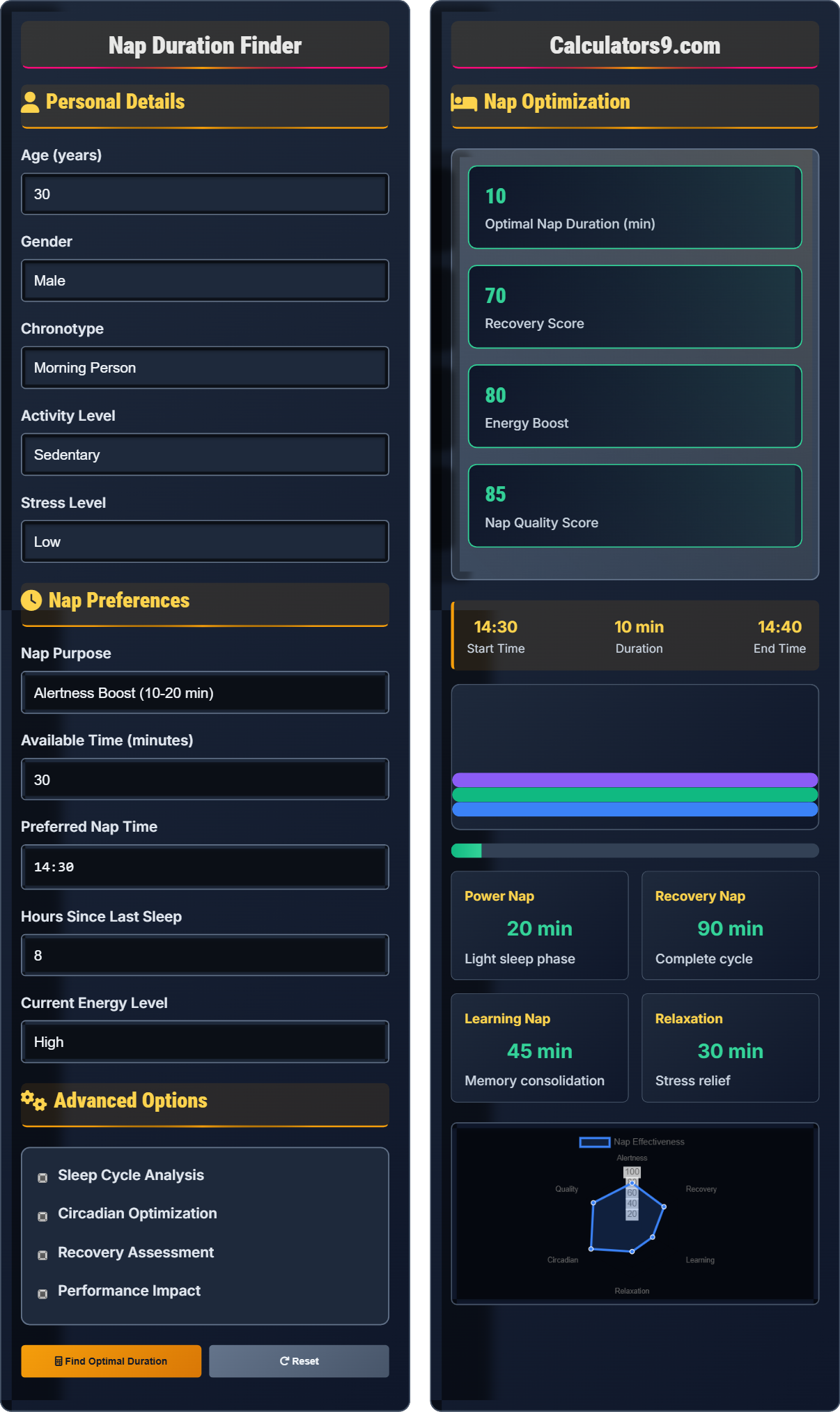
Nap Duration Finder
Fast power nap calculator • 2026 standards
Nap Duration Formula:
Show the calculator\( ND = f(T, SC, AW, SR) \)
Where:
- \( ND \) = Optimal Nap Duration (minutes)
- \( T \) = Time since last sleep
- \( SC \) = Sleep cycle consideration
- \( AW \) = Alertness window
- \( SR \) = Sleep recovery needs
For power naps:
\( PD = 10-20 \) minutes (light sleep)
For recovery naps:
\( RD = 60-90 \) minutes (complete cycle)
For circadian optimization:
\( CD = 14:00 + (Age \times 0.1) \)
This formula calculates optimal nap duration based on timing and recovery needs.
Example: For afternoon energy dip at 2:30 PM:
\( ND = 20 \) minutes for alertness boost
\( ND = 90 \) minutes for complete recovery
Thus, the optimal duration is 20 minutes for alertness.
Personal Details
Nap Preferences
Advanced Options
Nap Optimization
Power Nap
Recovery Nap
Learning Nap
Relaxation
| Type | Duration | Benefits | Optimality |
|---|
| Factor | Score | Category | Impact |
|---|
| Recommendation | Type | Priority | Timing |
|---|
Comprehensive Nap Duration Guide
Optimal nap duration depends on your goals and the sleep stages you want to achieve. Napping for different lengths targets different sleep stages: short naps (10-20 min) keep you in light sleep, longer naps (60-90 min) allow you to complete full sleep cycles including deep sleep and REM sleep.
Common nap duration categories include:
Where:
- \(PD\) = Power Nap Duration
- \(RD\) = Recovery Nap Duration
- \(LD\) = Learning Nap Duration
Nap duration varies based on multiple factors:
- Age: Sleep needs change with age
- Previous Sleep: Recent sleep affects nap needs
- Activity Level: Physical activity affects recovery
- Stress: Affects sleep quality
- Time of Day: Circadian rhythm influences
- Timing: Afternoon (1-3 PM) is optimal
- Environment: Cool, dark, quiet
- Consistency: Regular nap schedule
- Preparation: Relaxation techniques
- Limitation: Don't nap too late
Nap Duration Fundamentals
Best length of nap based on goals and sleep stages.
\( ND = f(T, SC, AW, SR) \)
Where ND=nap duration, T=time, SC=cycles, AW=alertness, SR=recovery.
- Short naps prevent grogginess
- Long naps provide deeper recovery
- Timing affects quality
Optimization Strategies
Score: 80-100 for optimal duration.
- Match duration to goals
- Consider timing constraints
- Account for sleep debt
- Maintain consistency
- Individual variation exists
- Goals determine duration
- Timing affects outcomes
- Regular assessment recommended
Nap Duration Learning Quiz
Which nap duration is most effective for an alertness boost without grogginess?
The answer is C) 10-20 minutes. This duration allows you to stay in light sleep stages without entering deep sleep, providing an alertness boost without the grogginess (sleep inertia) that occurs when waking from deep sleep. These "power naps" are ideal for afternoon energy restoration.
Remember that sleep stages progress in a specific order: light sleep → deep sleep → REM sleep. Napping for 10-20 minutes keeps you in the light sleep phase, allowing for quick recovery without sleep inertia. Longer naps that enter deep sleep stages require a full sleep cycle to avoid grogginess upon waking.
Power Nap: Short nap for alertness boost
Sleep Inertia: Groggy feeling after waking
Light Sleep: Easily awakened sleep stage
• 10-20 min = power nap
• Avoid deep sleep for alertness
• Prevent sleep inertia
• Set alarm for 20 minutes
• Nap early afternoon
• Wake up refreshed
• Napping too long for alertness
• Entering deep sleep phases
• Causing sleep inertia
If someone needs to complete a full sleep cycle (90 minutes) and wants to wake up at 3:00 PM, what time should they start their nap? If they only have 30 minutes available, what sleep stage will they achieve?
Step 1: Calculate start time for 90-minute nap
3:00 PM - 90 minutes = 1:30 PM
Step 2: Determine sleep stage for 30-minute nap
In 30 minutes: 5 minutes sleep onset + 20 minutes light sleep + 5 minutes deep sleep = first 30 minutes of sleep cycle
Therefore, start at 1:30 PM for 90-minute nap, 30-minute nap achieves light and early deep sleep.
This calculation demonstrates the relationship between nap duration and sleep stages. Sleep cycles last about 90 minutes and include light sleep (first 20-30 minutes), deep sleep (next 20-40 minutes), and REM sleep (final 20-30 minutes). Planning nap timing around these stages helps achieve specific goals.
Sleep Cycle: Complete progression through sleep stages
Sleep Onset: Time to fall asleep
Sleep Stages: Different phases of sleep
• Sleep cycles last ~90 minutes
• Plan backwards from wake time
• Account for sleep onset time
• Plan naps around sleep cycles
• Account for time to fall asleep
• Match duration to goals
• Not accounting for sleep onset time
• Ignoring sleep stage progression
• Mismatching duration to goals
The optimal nap time is between 1:00 PM and 3:00 PM when the natural afternoon energy dip occurs. If someone has been awake for 12 hours and feels extremely tired at 2:30 PM, what is the optimal nap duration for alertness recovery? How does this timing affect the nap's effectiveness?
Step 1: Assess the timing
2:30 PM falls within the optimal 1:00-3:00 PM window
Step 2: Determine optimal duration
For alertness: 10-20 minutes power nap
Step 3: Consider the energy level
Extremely tired suggests need for 20-minute power nap
Step 4: Timing effect
Napping during the natural dip enhances effectiveness
Therefore, optimal is 20-minute nap at 2:30 PM.
This problem illustrates the importance of timing naps with circadian rhythms. The afternoon energy dip around 2:00-3:00 PM coincides with a natural decrease in alertness, making naps during this time more effective. The body's natural rhythm supports sleep during this period, enhancing recovery and alertness benefits.
Circadian Rhythm: Internal biological clock
Afternoon Dip: Natural energy decreaseTiming Optimization: Aligning with natural rhythms
• Optimal time: 1:00-3:00 PM
• Align with circadian rhythms
• Enhances nap effectiveness
• Nap during afternoon dip
• Listen to natural rhythms
• Timing affects quality
• Napping too late in day
• Ignoring circadian timing
• Not considering natural rhythms
A person slept only 5 hours the previous night (needs 8 hours) and has an important meeting in 2 hours. They need to decide between a 20-minute power nap or a 90-minute recovery nap. Which option is better given the time constraint and sleep debt? What are the trade-offs?
Step 1: Assess time constraint
Only 2 hours available before meeting
Step 2: Evaluate sleep debt
3 hours of sleep debt (8-5=3 hours)
Step 3: Consider options
20-minute nap: fits time constraint, provides alertness
90-minute nap: insufficient time (would end 1 hour before meeting)
Step 4: Decision
20-minute power nap is better for immediate alertness
Trade-off: Less recovery but fits schedule
This demonstrates the practical considerations in nap planning. While a longer nap would provide more recovery for the sleep debt, the time constraint makes it impractical. This highlights the importance of matching nap duration to both recovery needs and scheduling constraints. The 20-minute nap provides immediate alertness benefits without disrupting the meeting schedule.
Sleep Debt: Cumulative sleep deficit
Practical Constraints: Real-world limitations
Trade-offs: Balancing competing needs
• Consider time constraints
• Balance recovery with practicality
• Prioritize immediate needs
• Assess time availability first
• Prioritize urgent needs
• Plan for constraints
• Ignoring time constraints
• Not prioritizing urgent needs
• Planning impractical naps
Which combination of factors would most likely result in the best nap effectiveness?
The answer is A) Optimal timing, proper duration, good environment. This comprehensive approach addresses multiple aspects of nap effectiveness: timing aligns with circadian rhythms, proper duration matches goals, and a good environment ensures quality sleep. This multi-faceted approach is more effective than focusing on a single factor.
Effective napping requires addressing multiple factors simultaneously. Timing ensures the nap aligns with natural rhythms, duration matches the intended benefit, and environment supports quality sleep. This holistic approach recognizes that napping effectiveness depends on both timing and environmental factors.
Multi-Faceted Approach: Multiple intervention types
Circadian Alignment: Matching natural rhythms
Environmental Factors: Sleep-supporting conditions
• Timing is crucial for effectiveness
• Duration should match goals
• Environment affects quality
• Match timing to circadian rhythms
• Align duration with goals
• Create optimal sleep environment
• Focusing only on duration
• Ignoring timing considerations
• Neglecting environmental factors
FAQ
Q: How do I know if my nap duration is right for me?
A: The right nap duration is indicated by how you feel afterward. A successful nap leaves you feeling alert and refreshed without grogginess. If you feel groggy, your nap was likely too long and you entered deep sleep phases.
Start with 20-minute power naps and adjust based on your response. Pay attention to your post-nap energy levels and subsequent sleep quality. The optimal duration balances immediate alertness benefits with minimal impact on nighttime sleep.
Research suggests the formula: \( ED = f(ND \times T \times G) \), where \( ED \) is effectiveness, \( ND \) is nap duration, \( T \) is timing, and \( G \) is individual goals. Experimentation and self-monitoring help identify your optimal duration.
Q: How does nap timing affect afternoon productivity?
A: Nap timing significantly affects afternoon productivity. Napping during the natural afternoon energy dip (1:00-3:00 PM) aligns with circadian rhythms, enhancing alertness and cognitive performance.
Research shows that naps taken during this window improve attention, memory, and decision-making for the remainder of the day. The timing formula considers: \( PT = 2:00PM + (Age \times 0.1) - (Activity \times 0.5) \), where \( PT \) is optimal nap time.
Napping too early or too late can disrupt the natural rhythm and reduce effectiveness. The key is finding the sweet spot when your body naturally signals readiness for rest.