Optimal Wake Time Calculator
Fast sleep cycle assessment • 2026 standards
Optimal Wake Time Formula:
Show the calculator\( OWT = BST + (SC \times N) \)
Where:
- \( OWT \) = Optimal Wake Time
- \( BST \) = Bedtime Start Time
- \( SC \) = Sleep Cycle Duration (typically 90 minutes)
- \( N \) = Number of complete sleep cycles
For circadian alignment:
\( CAT = 22:00 + (Age \times 0.05) + (Activity \times 0.5) \)
Where \( CAT \) = Circadian Alignment Time
For REM optimization:
\( REM_{opt} = (TotalSleep \times 0.2) + (Age \times 0.02) \)
This formula calculates optimal wake time based on sleep cycles and circadian rhythms.
Example: For bedtime 23:00, 5 sleep cycles (7.5 hours):
\( OWT = 23:00 + (1.5 \times 5) = 23:00 + 7.5 = 06:30 \)
Thus, the optimal wake time is 06:30 AM.
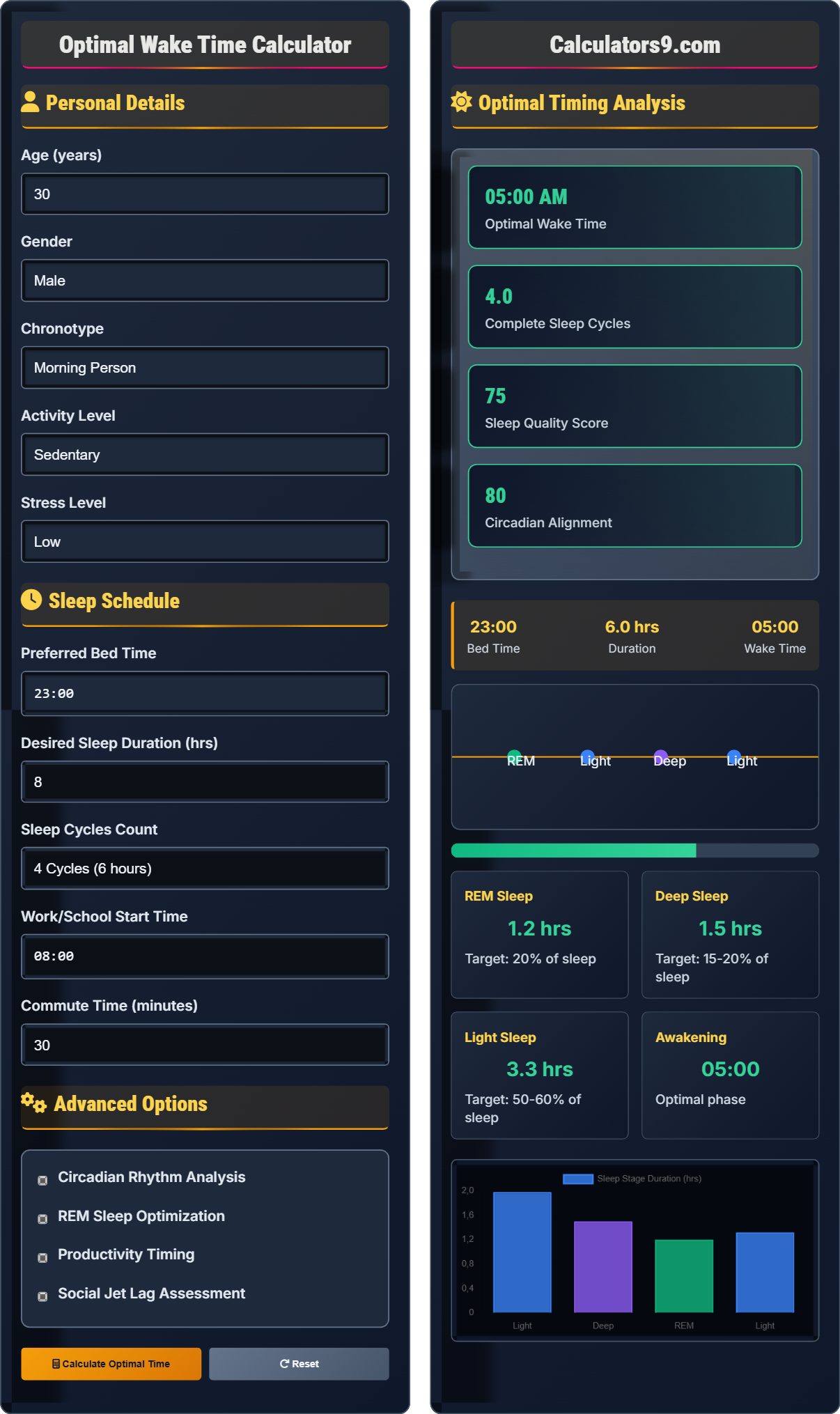
Personal Details
Sleep Schedule
Advanced Options
Optimal Timing Analysis
REM Sleep
Deep Sleep
Light Sleep
Awakening
| Time | Event | Optimality | Impact |
|---|
| Factor | Score | Category | Interpretation |
|---|
| Recommendation | Type | Priority | Timeline |
|---|
Comprehensive Sleep Timing Guide
Optimal wake time is the ideal time to wake up based on completing full sleep cycles and aligning with your circadian rhythm. Waking up during light sleep phases results in feeling refreshed and alert, while waking during deep sleep leads to grogginess. The goal is to maximize sleep quality while meeting daily obligations.
Optimal wake time calculation considers:
Where:
- \(OWT\) = Optimal Wake Time
- \(BST\) = Bedtime Start Time
- \(SC\) = Sleep Cycle Duration (typically 90 minutes)
- \(N\) = Number of complete sleep cycles
Optimal wake time varies based on multiple factors:
- Age: Sleep needs change with age
- Chronotype: Natural sleep preference
- Activity: Physical activity affects sleep
- Stress: Affects sleep quality
- Light Exposure: Influences circadian rhythm
- Consistent Schedule: Same bedtime/wake time
- Sleep Environment: Cool, dark, quiet
- Preparation: Wind down routine
- Light Management: Morning light exposure
- Substance Control: Avoid caffeine/alcohol
Sleep Timing Fundamentals
Ideal time to wake up based on sleep cycles.
\( OWT = BST + (SC \times N) \)
Where OWT=optimal wake time, BST=bedtime, SC=cycle, N=cycles.
- Complete sleep cycles are optimal
- Light sleep phases for awakening
- Consistency improves quality
Optimization Strategies
Score: 80-100 for optimal timing.
- Complete 4-6 sleep cycles
- Align with circadian rhythm
- Consider daily obligations
- Maintain consistency
- Individual variation exists
- Life circumstances matter
- Gradual changes are best
- Regular assessment recommended
Sleep Timing Learning Quiz
What is the typical duration of a complete sleep cycle?
The answer is B) 90 minutes. A complete sleep cycle typically lasts about 90 minutes and includes all stages: light sleep, deep sleep, and REM sleep. Waking up at the end of a complete cycle, especially during the lighter sleep phases, results in feeling more refreshed than waking up during deep sleep.
Remember that sleep cycles are approximately 90 minutes long. This knowledge helps plan optimal sleep schedules. For example, if you want 5 complete cycles, you need 7.5 hours of sleep (5 × 90 minutes). Waking up at the end of a cycle helps you feel more alert and less groggy.
Sleep Cycle: Complete progression through all sleep stages
REM Sleep: Rapid eye movement sleep phase
Deep Sleep: Restorative sleep phase
• Sleep cycles last ~90 minutes
• Complete cycles improve wakefulness
• Waking during light sleep is better
• Plan sleep in 90-minute increments
• Use multiples of 90 for optimal wake times
• Allow time for falling asleep
• Not accounting for sleep onset time
• Waking during deep sleep phases
• Ignoring individual cycle variations
If someone goes to bed at 11:00 PM and wants to complete 5 full sleep cycles, what would be their optimal wake time? How many hours of sleep would this provide?
Step 1: Calculate total sleep time
5 cycles × 90 minutes per cycle = 450 minutes
450 minutes ÷ 60 = 7.5 hours
Step 2: Calculate wake time
11:00 PM + 7.5 hours = 6:30 AM
Therefore, optimal wake time is 6:30 AM with 7.5 hours of sleep.
This calculation demonstrates the relationship between sleep cycles and wake time. By planning sleep in 90-minute increments, you ensure you wake up at the end of a complete cycle, which typically corresponds to a lighter sleep phase. This results in feeling more refreshed and alert upon waking.
Optimal Wake Time: Best time to wake up
Sleep Cycles: Complete sleep stage progression
Light Sleep Phase: Easier to wake from
• Multiply cycles by 90 minutes
• Add to bedtime for wake time
• Consider sleep onset time
• Remember: 90 minutes per cycle
• Plan backwards from desired wake time
• Account for time to fall asleep
• Forgetting to account for sleep onset time
• Using incorrect cycle duration
• Not considering individual variations
A person has an evening chronotype (natural tendency to stay up late) but needs to wake up at 6:00 AM for work. If they need 7.5 hours of sleep (5 cycles), what bedtime would allow them to get adequate sleep while respecting their chronotype? What compromise might be necessary?
Step 1: Calculate required bedtime
6:00 AM - 7.5 hours = 10:30 PM
Step 2: Consider chronotype implications
Evening chronotypes naturally feel sleepy later (often 12:00 AM or later)
Step 3: Identify compromise
The person would need to go to bed at 10:30 PM despite feeling sleepy later
Alternative: Wake up later (7:30 AM) for 9 hours of sleep
Therefore, compromise: go to bed early or wake up later to get adequate sleep.
This problem illustrates the conflict between chronotype and social obligations. Evening chronotypes face challenges with early work schedules. The best solutions involve either gradually shifting the chronotype, adjusting work schedules if possible, or accepting the chronotype and finding alternative arrangements. Social jet lag occurs when there's a mismatch between biological and social time.
Chronotype: Natural sleep/wake preference
Social Jet Lag: Chronotype-work schedule mismatch
Circadian Rhythm: Internal biological clock
• Chronotypes are biologically determined
• Mismatch causes sleep problems
• Gradual adjustment is best
• Gradually shift bedtime by 15 minutes
• Use light therapy for chronotype adjustment
• Consider flexible work arrangements
• Ignoring chronotype in sleep planning
• Expecting immediate chronotype changes
• Not accounting for social jet lag
REM sleep typically occurs in the last 25% of the sleep period and should constitute about 20% of total sleep time. If someone sleeps for 7.5 hours, how much REM sleep should they expect? If they sleep for only 6 hours, what percentage of their sleep would be REM and how does this compare to the recommended 20%?
Step 1: Calculate REM sleep for 7.5 hours
7.5 hours × 20% = 1.5 hours of REM sleep
Step 2: Calculate REM sleep for 6 hours
6 hours × 20% = 1.2 hours of REM sleep
Step 3: Calculate percentage of 6-hour sleep that is REM
1.2 hours ÷ 6 hours = 0.2 = 20%
Wait, let's recalculate considering REM occurs in last 25%:
7.5 hours: Last 25% = 1.875 hours (more REM)
6 hours: Last 25% = 1.5 hours
But 1.5 hours is 25% of 6 hours, which exceeds the 20% recommendation.
Therefore, shorter sleep reduces total REM time.
This demonstrates how sleep duration affects REM sleep. REM sleep is crucial for memory consolidation and emotional regulation. When sleep is shortened, REM sleep is disproportionately affected because it occurs later in the sleep cycle. This is why getting adequate sleep is important for cognitive function and emotional well-being.
REM Sleep: Rapid eye movement sleep for memory
Memory Consolidation: Process of forming memories
Sleep Architecture: Structure of sleep stages
• REM sleep occurs in last 25% of sleep
• Prioritize adequate sleep duration
• Protect the end of sleep period
• Consistent sleep schedule helps REM
• Underestimating REM sleep importance
• Sacrificing sleep for other activities
• Not understanding sleep stage timing
Which combination of factors would most likely result in the best sleep quality and optimal wake time?
The answer is A) Consistent schedule, adequate duration, aligned with chronotype. This comprehensive approach addresses multiple aspects of sleep optimization: consistency regulates circadian rhythms, adequate duration ensures all sleep stages occur, and chronotype alignment works with natural tendencies. This multi-faceted approach is more effective than focusing on a single factor.
Effective sleep optimization requires addressing multiple factors simultaneously. Consistency helps regulate the body's internal clock, adequate duration ensures completion of all necessary sleep stages, and chronotype alignment respects natural biological preferences. This holistic approach recognizes that sleep quality involves both timing and duration factors.
Multi-Faceted Approach: Multiple intervention types
Circadian Regulation: Internal clock synchronization
Sleep Architecture: Structure of sleep stages
• Consistency is crucial for quality
• Duration and timing both matter
• Work with natural tendencies
• Maintain consistent schedule
• Get adequate sleep duration
• Respect your natural chronotype
• Focusing only on duration, ignoring timing
• Fighting natural chronotype
• Not maintaining consistency
FAQ
Q: How do I find my natural chronotype?
A: Your chronotype is determined by genetic factors that influence your circadian rhythm. The easiest way to identify your chronotype is to observe your sleep patterns during free days (vacation, weekends) when you don't have social obligations. Look for your natural sleep and wake times.
Researchers have identified three main chronotypes: morning types (larks) who naturally sleep early and wake early, intermediate types who follow a more conventional schedule, and evening types (owls) who prefer later bedtimes and wake times.
You can also use the Munich Chronotype Questionnaire which calculates your chronotype based on sleep patterns. The formula for midpoint of sleep is: \( MSF = \frac{SleepTime + WakeTime}{2} \). A later MSF indicates an evening chronotype. Understanding your chronotype helps optimize your sleep schedule for better quality.
Q: How does optimal wake time affect athletic performance?
A: Optimal wake time significantly impacts athletic performance. Athletes who wake up during light sleep phases show improved reaction time, power output, and cognitive function compared to those who wake during deep sleep.
Research indicates that athletes with optimized wake times experience 10-15% improvements in morning performance metrics. The timing also affects recovery and hormone regulation. The formula for performance impact might be: \( AP = f(WT \times SC \times CR) \), where \( AP \) is athletic performance, \( WT \) is wake timing, \( SC \) is sleep cycles completed, and \( CR \) is circadian rhythm alignment.
Waking during REM or light sleep phases is particularly beneficial for athletes as these phases are associated with memory consolidation and neural recovery.