REM Cycle Estimator
Sleep quality calculator • Recovery optimization
REM Sleep Cycle Formula:
Show the calculatorREM cycles occur every 90-120 minutes during sleep, with duration increasing throughout the night. The average adult experiences 4-6 REM cycles per night.
Key Statistics:
- First REM cycle: ~10 minutes (after ~90 minutes of falling asleep)
- Subsequent REM cycles: 20-25 minutes each
- Total REM sleep: 20-25% of total sleep time
- Optimal sleep duration: 7-9 hours for adults
- Peak REM activity: During the last third of sleep
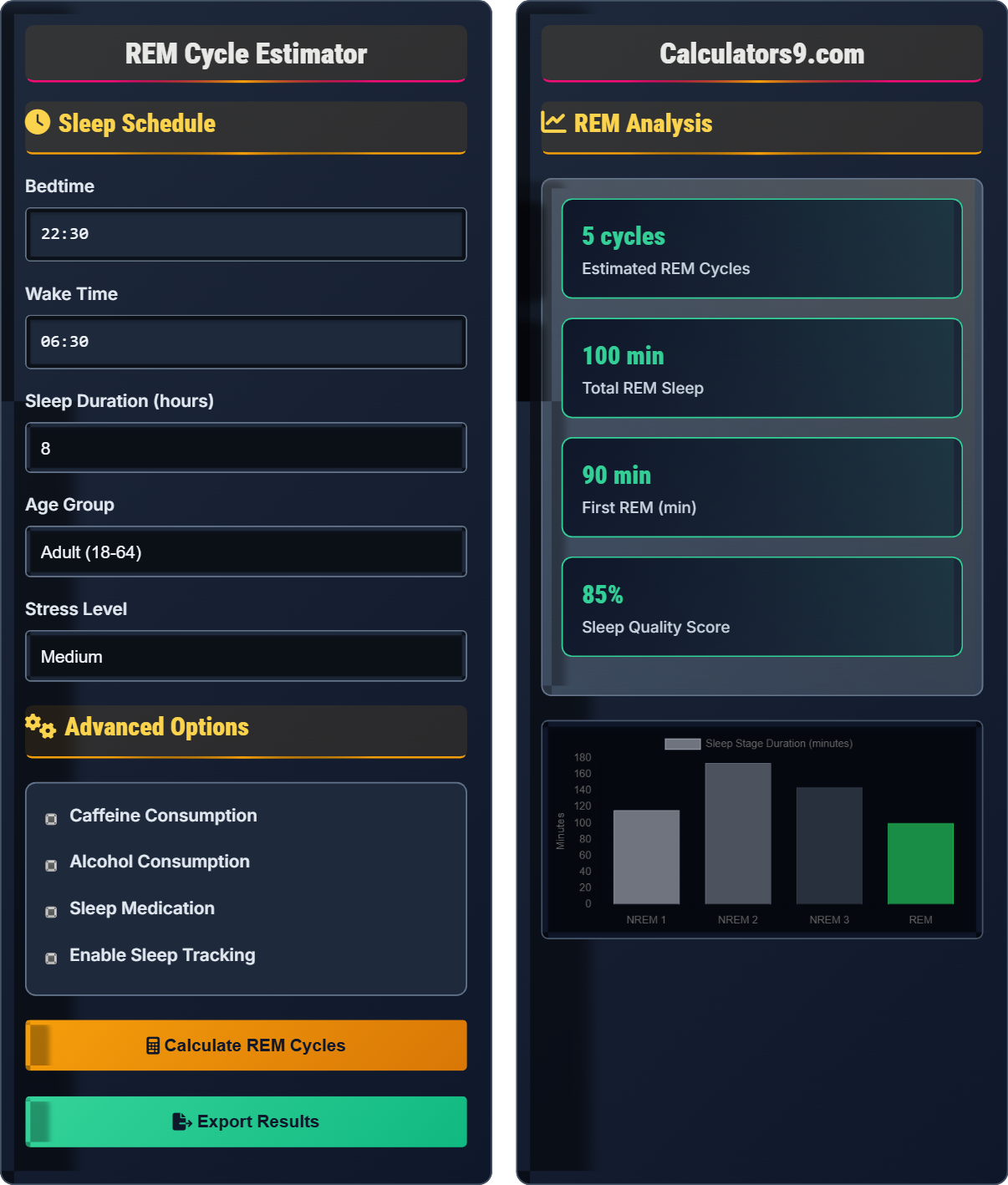
This calculator estimates your REM sleep timing based on your sleep schedule and provides personalized recommendations for optimal recovery.
Sleep Schedule
Advanced Options
REM Analysis
| Cycle | Start Time | Duration | End Time |
|---|
| Stage | % of Sleep | Minutes | Recommendation |
|---|
Comprehensive Sleep Recovery Guide
REM (Rapid Eye Movement) sleep is a distinctive stage of mammalian sleep characterized by random eye movement, increased respiration rate, and temporary paralysis of limb muscles. It's the stage associated with vivid dreaming and is crucial for cognitive functions including memory consolidation, emotional regulation, and brain development.
REM sleep occurs cyclically throughout the night, typically every 90-120 minutes. Here are the key characteristics:
Subsequent REM: 20-25 minutes
Total REM: 20-25% of sleep
Peak REM: Last third of sleep
REM sleep provides numerous recovery benefits:
- Memory Consolidation: Processes and stores memories from the day
- Emotional Regulation: Helps process emotions and reduce stress
- Brain Development: Essential for neural plasticity and learning
- Immune Function: Supports immune system restoration
- Cognitive Performance: Enhances creativity and problem-solving abilities
- Consistent Schedule: Go to bed and wake up at the same time daily
- Temperature Control: Keep bedroom cool (65-68°F)
- Light Management: Avoid blue light 1-2 hours before bed
- Limit Stimulants: Avoid caffeine 6+ hours before bedtime
- Relaxation Techniques: Practice meditation or deep breathing
Sleep Science
Distinctive sleep stage with rapid eye movement, brain activity, and dreaming.
Cycles every 90-120 minutes, increasing in duration throughout the night.
First cycle ~10 min, subsequent cycles 20-25 min each.
- REM sleep increases in duration throughout the night
- Optimal sleep requires 7-9 hours for adults
- REM deprivation affects cognitive performance
Recovery Strategies
Pattern of sleep stages throughout the night, affecting recovery quality.
- Maintain consistent sleep schedule
- Create optimal sleep environment
- Reduce stress before bedtime
- Limit alcohol and caffeine
- REM sleep peaks in last third of sleep
- Age affects sleep architecture
- Stress impacts REM duration
- Medications alter sleep stages
Sleep Recovery Learning Quiz
Which of the following is a characteristic of REM sleep?
The answer is B) Rapid eye movement. REM sleep is characterized by rapid eye movement, increased brain activity similar to wakefulness, and temporary paralysis of limb muscles. The name "REM" comes directly from the rapid eye movements that occur during this stage.
REM sleep is one of the four stages of sleep and is distinguished by its unique characteristics. The rapid eye movements give this stage its name. During REM sleep, brain activity increases significantly, approaching wakefulness levels, which is why this is when most vivid dreams occur. The temporary paralysis of muscles prevents us from acting out our dreams.
REM Sleep: Rapid Eye Movement sleep, the stage associated with dreaming
Sleep Paralysis: Temporary inability to move during REM sleep
Brain Waves: Electrical activity patterns in the brain during sleep
• REM sleep occurs cyclically every 90-120 minutes
• REM sleep increases in duration throughout the night
• REM deprivation impairs cognitive function and memory
• Remember REM = Rapid Eye Movement
• Use "Rapid Eye Movement" to recall the acronym
• Confusing REM sleep with deep sleep stages
• Thinking REM sleep is when the brain is inactive
If someone falls asleep at 10:30 PM and wakes up at 6:30 AM, and their first REM cycle begins after 90 minutes of sleep, how many REM cycles might they experience during the night? Assume each REM cycle lasts 20 minutes and occurs every 90 minutes.
Step 1: Calculate total sleep time = 8 hours (from 10:30 PM to 6:30 AM)
Step 2: First REM cycle starts after 90 minutes
Step 3: Remaining sleep time after first REM = 8 hours - 1.5 hours = 6.5 hours = 390 minutes
Step 4: Number of REM cycle intervals in remaining time = 390 ÷ 90 = 4.33
Step 5: Since we can't have partial cycles, we get 4 more REM cycles
Step 6: Total REM cycles = 1 (first) + 4 (subsequent) = 5 cycles
This problem demonstrates how REM cycles are distributed throughout the night. REM sleep doesn't begin immediately upon falling asleep; there's typically a latency period. After the first REM cycle, subsequent cycles occur at regular intervals. However, in reality, REM cycles become longer as the night progresses, which makes this a simplified model.
REM Latency: Time from sleep onset to first REM episode
Sleep Cycle: Period of non-REM and REM sleep (90-120 min)
REM Density: Frequency and intensity of REM sleep episodes
• First REM cycle occurs after 70-120 minutes of sleep
• REM cycles increase in duration throughout the night
• Total REM sleep represents 20-25% of total sleep time
• Remember: REM cycles are about 90 minutes apart
• The last third of sleep contains more REM sleep
• Forgetting that REM sleep doesn't begin immediately
• Assuming all REM cycles are equal in duration
• Not accounting for the 90-minute cycle pattern
Sarah normally gets 8 hours of sleep with 5 REM cycles totaling 120 minutes of REM sleep. She starts drinking alcohol 3 hours before bed, which reduces her REM sleep by 25%. How much REM sleep does she now get, and what percentage of her total sleep is REM sleep?
Step 1: Calculate reduced REM sleep = Original REM × (1 - 0.25) = 120 × 0.75 = 90 minutes
Step 2: Calculate percentage of total sleep = (New REM / Total sleep) × 100 = (90 / 480) × 100 = 18.75%
Therefore, Sarah now gets 90 minutes of REM sleep, which is 18.75% of her total sleep time.
This example illustrates how alcohol consumption affects sleep architecture. Alcohol initially helps with falling asleep but significantly disrupts the normal sleep cycle, particularly reducing REM sleep. This disruption can impact cognitive function, memory consolidation, and emotional regulation, even if total sleep time remains unchanged.
Sleep Architecture: Distribution of sleep stages throughout the night
REM Suppression: Reduction in REM sleep duration or frequency
Sleep Fragmentation: Disruption of continuous sleep patterns
• Alcohol reduces REM sleep by 10-40%
• Caffeine delays REM sleep onset
• Stress increases REM sleep fragmentation
• Avoid alcohol 3+ hours before bed
• Limit caffeine intake in the afternoon/evening
• Underestimating alcohol's impact on sleep quality
• Confusing total sleep time with sleep quality
• Not accounting for individual variations in alcohol effects
John, a 25-year-old, typically gets 8 hours of sleep with 5 REM cycles totaling 120 minutes. As he ages to 65, his sleep efficiency decreases by 15% and REM sleep decreases by 20%. If he maintains the same 8-hour sleep schedule, how does his REM sleep change? Calculate the new REM duration and explain the implications for cognitive function.
Step 1: Calculate new REM duration = Original REM × (1 - 0.20) = 120 × 0.80 = 96 minutes
Step 2: Calculate effective sleep time = Total time × (1 - 0.15) = 480 × 0.85 = 408 minutes
Step 3: New percentage of REM = (96 / 408) × 100 = 23.5%
Therefore, John's REM sleep decreases from 120 to 96 minutes, representing about 23.5% of his effective sleep time.
This demonstrates age-related changes in sleep architecture. As people age, they typically experience decreased sleep efficiency and altered sleep stage distribution. While total REM percentage may remain similar, the quality and continuity of REM sleep often decline, potentially impacting cognitive functions like memory consolidation and emotional regulation.
Sleep Efficiency: Percentage of time in bed spent sleeping
Age-Related Sleep Changes: Natural alterations in sleep patterns with agingCognitive Function: Mental processes affected by sleep quality
• REM sleep decreases with age (10-15% reduction)
• Sleep efficiency declines with age (10-20% reduction)
• Older adults need same total sleep but may get less quality sleep
• Maintain consistent sleep schedule regardless of age
• Focus on sleep environment optimization as you age
• Consider shorter naps to preserve nighttime sleep quality
• Assuming older adults need less sleep than younger adults
• Not recognizing that sleep quality changes with age
• Overlooking the importance of REM sleep for seniors
Which of the following is the MOST likely immediate effect of REM sleep deprivation?
The answer is B) Memory consolidation problems. REM sleep is critical for consolidating procedural memories (skills and habits) and emotional memories. Deprivation of REM sleep specifically impairs these cognitive functions, while other sleep stages handle different aspects of recovery.
REM sleep plays a specialized role in memory processing, particularly for procedural memories (how to perform tasks) and emotional memories. During REM sleep, the brain replays and consolidates information from the day, transferring it from temporary to long-term storage. Without adequate REM sleep, this process is disrupted, leading to difficulties with learning and memory retention.
Memory Consolidation: Process of stabilizing memories after acquisition
Procedural Memory: Memory for skills and habits learned
Declarative Memory: Memory for facts and events
• REM sleep is crucial for procedural memory consolidation
• REM deprivation causes rebound REM sleep
• Cognitive performance deteriorates with REM loss
• Get full 7-9 hours to ensure adequate REM sleep
• Avoid sleep disruption during REM-rich periods (morning)
• Recognize that REM rebound occurs after deprivation
• Thinking all sleep stages contribute equally to memory
• Not understanding the specific role of REM sleep
• Assuming REM deprivation has no cognitive impact
FAQ
Q: How does REM sleep affect athletic recovery?
A: REM sleep is crucial for athletic recovery, though its effects differ from those of deep sleep. While deep sleep primarily handles physical recovery through growth hormone release, REM sleep supports cognitive aspects of performance:
- Motor Skill Consolidation: REM sleep helps solidify new movement patterns and technical skills learned during training.
- Reaction Time: Adequate REM sleep maintains quick decision-making abilities crucial in sports.
- Stress Processing: REM sleep helps process the psychological stress of intense training.
Research shows that athletes with insufficient REM sleep exhibit decreased performance in tasks requiring fine motor control and strategic thinking, even when deep sleep appears adequate.
Q: Can I optimize my sleep schedule to maximize REM sleep?
A: Yes, you can optimize your sleep schedule to maximize REM sleep through several evidence-based strategies:
- Get Full Night's Sleep: REM sleep increases in duration during the last third of sleep, so 7-9 hours maximizes REM time.
- Consistent Schedule: Going to bed and waking up at the same time daily optimizes sleep architecture.
- Avoid Evening Stimulants: Caffeine and alcohol disrupt REM sleep cycles.
- Optimal Environment: Cool, dark room promotes uninterrupted sleep cycles.
By maintaining a consistent 8-hour sleep schedule with optimal conditions, you can achieve the maximum amount of REM sleep your brain requires for cognitive recovery and emotional regulation.