Sauna Session Logger
Recovery tracking • Heat therapy
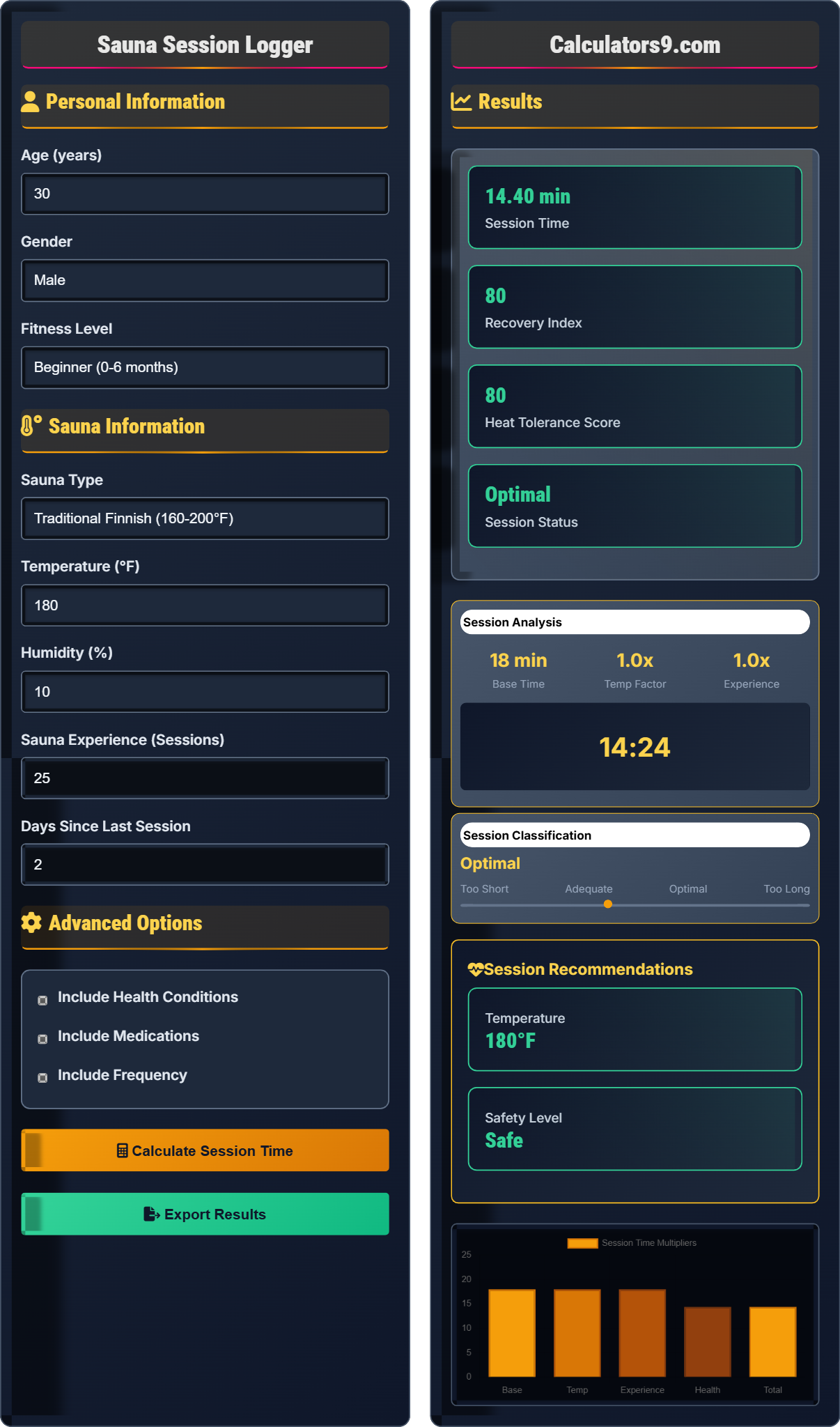
Session Time: \( \text{ST} = \text{Base Time} \times \text{Temperature Factor} \times \text{Experience Factor} \times \text{Health Factor} \)
Recovery Index: \( \text{RI} = \frac{\text{Actual Time}}{\text{Optimal Time}} \times 100 \)
Heat Tolerance Score: \( \text{HTS} = \text{Recovery Index} \times \text{Temperature Factor} \times \text{Adaptation Factor} \)
Where:
- \( \text{Base Time: } 15-20 \text{ minutes for traditional saunas} \)
- \( \text{Temperature Factor: } 0.7-1.3 \text{ (based on temperature)} \)
- \( \text{Experience Factor: } 0.8-1.2 \text{ (based on sauna experience)} \)
- \( \text{Health Factor: } 0.5-1.1 \text{ (based on health conditions)} \)
Optimal sauna sessions vary by type and individual tolerance. Traditional saunas (160-200°F) typically need 15-20 minutes, while infrared saunas (120-140°F) require 20-30 minutes.
Example: Traditional sauna at 180°F, intermediate experience, good health:
\( \text{ST} = 18 \times 1.1 \times 1.0 \times 1.0 = 19.8 \text{ minutes} \)
\( \text{Heat Tolerance Score} = 100 \times 1.1 \times 0.9 = 99 \) (excellent tolerance)
Personal Information
Sauna Information
Advanced Options
Results
| Factor | Value | Multiplier | Impact |
|---|
Understanding Sauna Therapy
Sauna therapy involves controlled exposure to heat to promote sweating, improve circulation, and enhance recovery. It triggers heat shock proteins, increases heart rate, and mimics the cardiovascular effects of exercise. Regular sauna use has been linked to improved cardiovascular health, muscle recovery, and longevity.
Key factors affecting optimal session time:
Typical session times by type:
- Traditional: 15-20 minutes (160-200°F)
- Infrared: 20-30 minutes (120-140°F)
- Steam Room: 10-15 minutes (100-120°F)
- Turkish Bath: 15-20 minutes (100-120°F)
- Portable: 15-25 minutes (140-160°F)
Effective sauna therapy leads to:
- Improved Circulation: Vasodilation increases blood flow and oxygen delivery
- Enhanced Recovery: Heat shock proteins aid muscle repair and reduce inflammation
- Detoxification: Sweating eliminates toxins and metabolic waste
- Stress Relief: Promotes relaxation and reduces cortisol levels
- Cardiovascular Health: Mimics exercise effects and improves heart health
- Gradual Exposure: Start with shorter sessions and build tolerance gradually
- Proper Hydration: Drink plenty of water before and after sessions
- Consistent Protocol: Same duration and temperature for tracking
- Listen to Body: Stop if experiencing dizziness, nausea, or excessive discomfort
- Recovery Period: Allow cooling time between sessions
Session Metrics
Optimal duration for effective heat exposure.
Base time × temperature × experience × health factors.
- Higher temperature = shorter time
- More experience = longer time
- Consistent tracking is essential
Optimization Strategies
Optimize sauna for better recovery.
- Proper hydration
- Consistent protocol
- Gradual progression
- Combine with other methods
- Individual variation exists
- Consistency is key
- Progress takes time
- Professional guidance recommended
Sauna Therapy Learning Quiz
What is the primary mechanism by which sauna therapy promotes muscle recovery?
The answer is B) Heat shock proteins and improved circulation. Sauna therapy triggers heat shock proteins that aid in muscle repair and increases blood flow for better nutrient delivery.
Sauna therapy works by exposing the body to heat stress, which triggers the production of heat shock proteins. These proteins help repair damaged proteins and protect cells. The heat also causes vasodilation, improving blood circulation and oxygen delivery to muscles.
Sauna Therapy: Controlled heat exposure for recovery
Heat Shock Proteins: Proteins that repair cellular damage
Vasodilation: Widening of blood vessels
• Promotes protein repair
• Improves blood flow
• Triggers protective mechanisms
• Start with shorter sessions
• Stay hydrated
• Cool down gradually
• Overheating too quickly
• Not hydrating properly
• Ignoring health conditions
Calculate the session time for a traditional sauna at 190°F for an intermediate user with good health. Show your work.
Step 1: Identify base time for traditional sauna: 18 minutes
Step 2: Apply the session formula: \( \text{ST} = \text{Base} \times \text{Temperature} \times \text{Experience} \times \text{Health} \)
Step 3: Temperature factor for 190°F: 1.2 (hotter than standard)
Step 4: Experience factor for intermediate: 1.0
Step 5: Health factor for good health: 1.0
Step 6: Calculate: \( \text{ST} = 18 \times 1.2 \times 1.0 \times 1.0 = 21.6 \) minutes
Therefore, the session time is approximately 22 minutes.
This calculation demonstrates how temperature affects session duration. The higher temperature (190°F vs standard 180°F) increases the base time, while intermediate experience and good health maintain the multipliers at standard levels.
Session Time (ST): Total time needed for effective heat therapy
Temperature Factor: Multiplier based on sauna temperature
Base Time: Standard time for sauna type
• Multiply all factors together
• Higher temperature = shorter time
• Experience affects tolerance
• Adjust for temperature first
• Consider experience level
• Factor in health status
• Adding instead of multiplying factors
• Not considering temperature effects
• Ignoring health conditions
A person has cardiovascular issues and is new to saunas. They want to try an infrared sauna at 130°F. How should they adjust their session time compared to a healthy person with similar experience level?
Step 1: Calculate standard time: \( 22 \times 0.9 \times 1.0 \times 1.0 = 19.8 \) minutes
Step 2: Apply health condition adjustment: Reduce by 50% for cardiovascular issues
Step 3: Apply experience adjustment: Reduce by 40% for beginner
Step 4: Calculate safe time: \( 19.8 \times 0.5 \times 0.6 = 5.94 \) minutes
Step 5: The person with cardiovascular issues should use approximately 6 minutes
Conclusion: Health conditions significantly reduce safe session time.
This example demonstrates the importance of health considerations in sauna therapy. People with cardiovascular conditions should significantly reduce exposure time to avoid dangerous physiological responses to heat stress.
Health Adjustment: Modification based on medical conditions
Safety Factor: Reduction for at-risk individuals
Therapy Safety: Protecting from adverse effects
• Health conditions require shorter sessions
• Beginners need reduced exposure
• Safety always comes first
• Consult healthcare provider first
• Start conservatively
• Monitor body response
• Not considering health conditions
• Ignoring safety protocols
• Using same time for everyone
A person plans to use sauna 4 times per week versus once per week. Calculate how this affects their optimal session time and explain the reasoning.
Step 1: Calculate once-weekly session: \( 18 \times 1.1 \times 1.0 \times 1.0 = 19.8 \) minutes
Step 2: Calculate 4x weekly session: \( 18 \times 1.1 \times 1.0 \times 0.8 = 15.84 \) minutes
Step 3: Difference: \( 19.8 - 15.84 = 3.96 \) minutes
Step 4: More frequent sessions require shorter individual durations to prevent overexposure
Reasoning: Regular exposure builds heat tolerance but requires reduced per-session time to avoid cumulative stress.
When doing sauna more frequently, each individual session should be shorter to prevent cumulative stress on the body. The body adapts to regular heat exposure, but excessive frequency can lead to overstimulation of the cardiovascular system.
Frequency Adjustment: Modifying time based on session frequency
Cumulative Exposure: Total heat stress over time
Adaptive Response: Body's reaction to regular heat
• More frequent = shorter sessions
• Prevent cumulative stress
• Allow for recovery between sessions
• Balance frequency and duration
• Monitor recovery
• Adjust based on response
• Keeping same time for all frequencies
• Not considering cumulative effects
• Overdoing frequency
How does temperature affect the optimal duration of sauna sessions?
The answer is D) Higher temperature = shorter duration. As temperature increases, the body's stress response increases, requiring shorter exposure times for safety.
Higher temperatures cause more dramatic physiological responses, including increased heart rate and blood pressure. To prevent dangerous reactions, exposure time must be reduced as temperature increases.
Temperature Response: Physiological reaction to heat
Stress Response: Body's reaction to temperature shock
Safety Protocol: Guidelines for safe exposure
• Hotter = shorter time
• Temperature affects safety
• Physiological response matters
• Adjust time for temperature
• Start conservatively
• Monitor physiological response
• Keeping same time for all temperatures
• Not adjusting for safety
• Ignoring physiological responses
FAQ
Q: How often should I use sauna for optimal recovery?
A: For optimal recovery:
Post-Workout: After intense training sessions, especially high-intensity or long-duration workouts. 2-3 times per week is often optimal.
Acute Recovery: Within 30 minutes post-workout for maximum heat shock protein activation.
Chronic Use: 2-4 times per week maximum to avoid desensitization and maintain effectiveness.
Active Recovery Days: Light heat therapy can help maintain circulation and reduce stiffness.
Consistency is important, but avoid daily use as the body can adapt and reduce effectiveness.
Q: What are signs that I'm using sauna too much or too little?
A: Signs of overuse include:
Physical Symptoms: Excessive fatigue, dizziness, dehydration, headaches, or elevated resting heart rate.
Systemic Effects: Disrupted sleep patterns, increased irritability, or prolonged recovery times.
Performance Issues: Reduced strength, power output, or decreased motivation.
Signs of underuse: Persistent muscle soreness lasting 3+ days, limited flexibility, chronic stiffness, slower recovery times.
Optimal Response: Improved recovery within 24-48 hours, maintained performance levels, and enhanced sleep quality.
Always listen to your body and adjust accordingly.