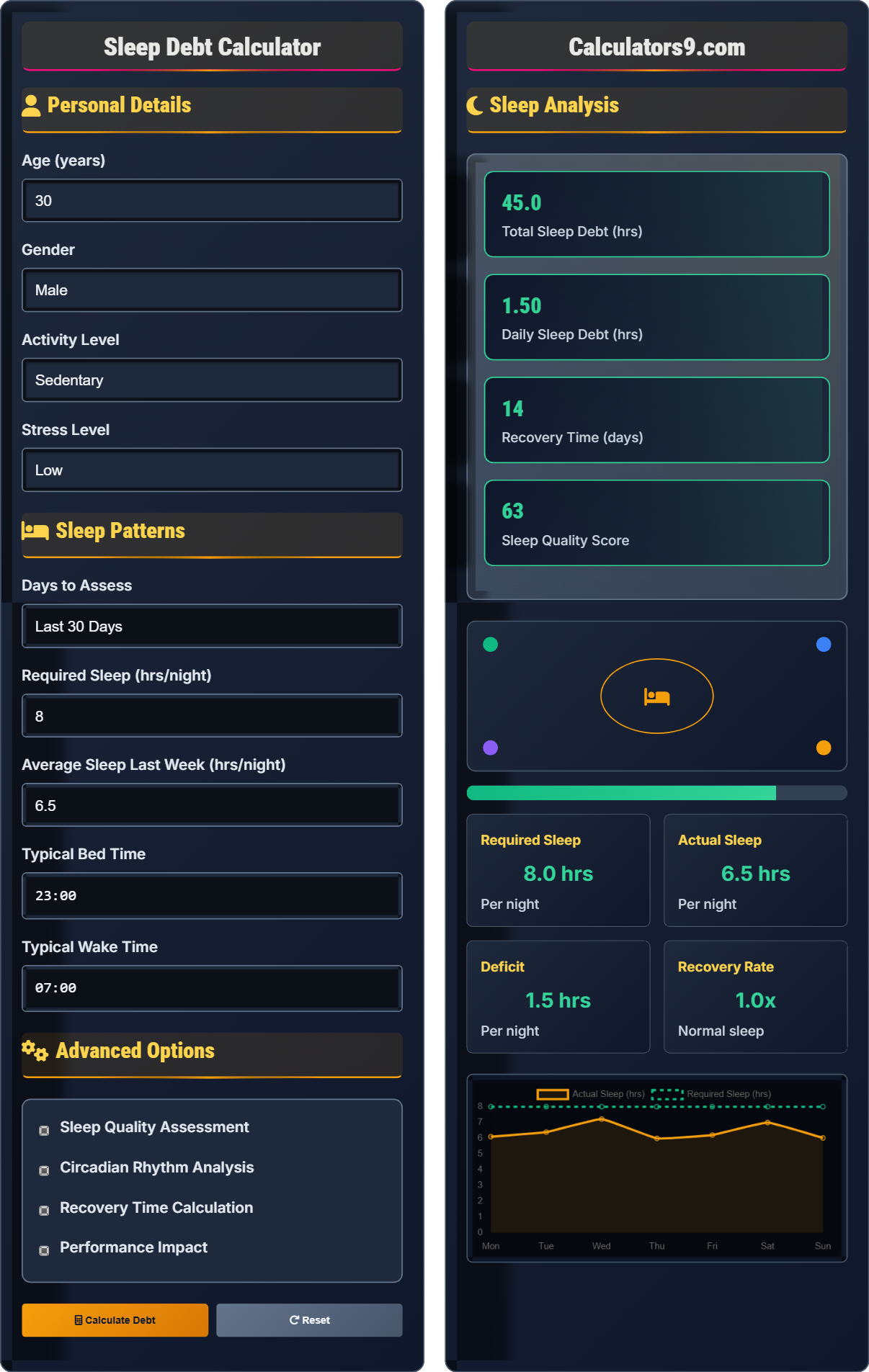
Sleep Debt Calculator
Fast recovery assessment • 2026 standards
Sleep Debt Formula:
Show the calculator\( SD = \sum_{i=1}^{n} (R_i - A_i) \)
Where:
- \( SD \) = Sleep Debt (hours)
- \( R_i \) = Required sleep for day i
- \( A_i \) = Actual sleep for day i
- \( n \) = Number of days in assessment period
For recovery calculation:
\( RC = \frac{SD}{R} \times D \)
Where \( RC \) = Recovery time, \( R \) = Recovery rate, \( D \) = Days
For circadian efficiency:
\( CE = \frac{TS}{TT} \times 100 \)
Where \( TS \) = Total sleep time, \( TT \) = Time in bed
This formula calculates cumulative sleep debt and recovery requirements.
Example: For 5 days with required 8 hours but getting 6, 7, 6, 8, 7 hours:
\( SD = (8-6) + (8-7) + (8-6) + (8-8) + (8-7) = 2+1+2+0+1 = 6 \) hours
Thus, the sleep debt is 6 hours.
Personal Details
Sleep Patterns
Advanced Options
Sleep Analysis
Required Sleep
Actual Sleep
Deficit
Recovery Rate
| Period | Required | Actual | Deficit | Status |
|---|
| Factor | Score | Impact | Recommendation |
|---|
| Strategy | Type | Effectiveness | Timeline |
|---|
Comprehensive Sleep Health Guide
Sleep debt is the cumulative amount of sleep lost over time when you don't get the amount of sleep your body needs. It occurs when you consistently get less sleep than required for optimal functioning. Unlike a bank account, sleep debt cannot be easily "paid back" and can have significant impacts on cognitive performance, mood, and health.
Sleep debt is calculated by comparing required sleep to actual sleep:
Where:
- \(SD\) = Sleep Debt in hours
- \(R_i\) = Required sleep for day i
- \(A_i\) = Actual sleep for day i
- \(n\) = Number of days in assessment period
Sleep debt varies based on multiple factors:
- Age: Sleep needs change with age
- Stress: High stress increases sleep needs
- Activity: Physical activity affects sleep
- Health: Illness increases sleep requirements
- Lifestyle: Work schedule, habits
- Consistent Schedule: Same bedtime/wake time
- Extended Sleep: Extra hours initially
- Power Naps: 20-minute strategic naps
- Sleep Hygiene: Optimal sleep environment
- Patience: Recovery takes time
Sleep Debt Fundamentals
Cumulative amount of sleep lost over time.
\( SD = \sum_{i=1}^{n} (R_i - A_i) \)
Where SD=sleep debt, R=required, A=actual, n=days.
- Sleep debt accumulates over time
- Cannot be fully recovered in one night
- Affects cognitive performance
Recovery Strategies
Debt: 0-2 hours is acceptable.
- Consistent sleep schedule
- Extended sleep nights
- Strategic napping
- Improved sleep hygiene
- Recovery takes time
- Consistency is key
- Small deficits accumulate
- Regular assessment recommended
Sleep Health Learning Quiz
Which of the following correctly describes how sleep debt accumulates?
The answer is B) It accumulates cumulatively over time. Sleep debt accumulates day after day when you consistently get less sleep than your body needs. Even small deficits (1-2 hours) can accumulate over weeks and months, leading to significant cognitive and health impacts. The debt doesn't reset automatically each night.
Think of sleep debt like a financial account - small overdrafts accumulate over time. If you need 8 hours but consistently get 6, you're accumulating a 2-hour debt each night. Over a week, that's 14 hours of accumulated debt. The body doesn't simply reset this debt each night; it builds up until properly addressed.
Sleep Debt: Cumulative sleep deficit
Cumulative: Building up over time
Accumulation: Progressive increase
• Sleep debt accumulates daily
• Small deficits compound over time
• Doesn't reset automatically
• Track sleep consistently
• Don't ignore small deficits
• Prevention is easier than recovery
• Believing one good night fixes everything
• Ignoring small nightly deficits
• Not understanding cumulative nature
If a person needs 8 hours of sleep per night but gets 6, 7, 6, 8, 7, 6, 6 hours over 7 consecutive nights, what is their total sleep debt? What is the daily average deficit?
Step 1: Calculate daily deficits
Day 1: 8 - 6 = 2 hours
Day 2: 8 - 7 = 1 hour
Day 3: 8 - 6 = 2 hours
Day 4: 8 - 8 = 0 hours
Day 5: 8 - 7 = 1 hour
Day 6: 8 - 6 = 2 hours
Day 7: 8 - 6 = 2 hours
Step 2: Total debt = 2+1+2+0+1+2+2 = 10 hours
Step 3: Daily average = 10 ÷ 7 = 1.4 hours
Therefore, total debt is 10 hours, daily average is 1.4 hours.
This calculation demonstrates how sleep debt accumulates even with some "good" nights. Despite having one perfect night (Day 4), the accumulated debt from the other nights totals 10 hours. This shows that a single good night doesn't eliminate accumulated debt. The daily average of 1.4 hours indicates a chronic pattern of undersleeping.
Total Debt: Cumulative sleep deficit
Daily Average: Deficit per day over period
Chronic Pattern: Consistent behavior over time
• Add all daily deficits
• Divide by number of days for average
• One good night doesn't eliminate debt
• Calculate daily deficits first
• Add all deficits for total
• Find average for pattern recognition
• Forgetting to include days with zero deficit
• Not dividing by total number of days
• Assuming good nights cancel bad ones
A person has accumulated 14 hours of sleep debt. Research shows that sleep debt recovery occurs at a rate of 1.5 hours of debt reduction per hour of extra sleep. If they add 2 hours of sleep each night to their normal schedule, how many days will it take to recover from the sleep debt?
Step 1: Calculate debt reduction per night
Recovery rate = 1.5 hours of debt reduction per extra hour of sleep
Extra sleep per night = 2 hours
Debt reduction per night = 2 × 1.5 = 3 hours
Step 2: Calculate recovery time
Total debt = 14 hours
Recovery rate = 3 hours per night
Days needed = 14 ÷ 3 = 4.67 ≈ 5 days
Therefore, it will take approximately 5 days to recover.
This problem demonstrates the concept of accelerated recovery. By sleeping 2 hours extra each night, the person achieves a 3-hour debt reduction per night (due to the 1.5x recovery rate). This is more efficient than sleeping just the required amount, which would only maintain the current state. The recovery rate multiplier makes catching up more feasible.
Recovery Rate: Speed of debt reduction
Accelerated Recovery: Faster than 1:1 reduction
Extra Sleep: Above normal requirements
• Recovery rate can exceed 1:1
• Extra sleep accelerates recovery
• Calculate per-night reduction first
• Calculate daily reduction rate
• Use division for time calculation
• Round up for practical purposes
• Not accounting for recovery rate multiplier
• Assuming 1:1 recovery ratio
• Forgetting to round up days
Research indicates that each hour of sleep debt reduces cognitive performance by approximately 2%. If a person has a 12-hour sleep debt, what is the approximate reduction in cognitive performance? If their normal performance level is 100%, what would be their current performance level? How much sleep debt would result in a 20% performance reduction?
Step 1: Calculate performance reduction for 12-hour debt
Reduction = 12 hours × 2% per hour = 24%
Step 2: Calculate current performance level
Current performance = 100% - 24% = 76%
Step 3: Calculate debt for 20% reduction
Sleep debt = 20% ÷ 2% per hour = 10 hours
Therefore, 12-hour debt causes 24% reduction (76% performance), and 10-hour debt causes 20% reduction.
This demonstrates the quantifiable impact of sleep debt on cognitive function. The 2% per hour rule shows how sleep deprivation creates measurable performance decrements. A 24% performance reduction is significant and would noticeably impact daily activities, decision-making, and safety. This linear relationship helps quantify the cost of sleep debt.
Cognitive Performance: Mental function capacity
Performance Reduction: Decrease in function
Linear Relationship: Proportional change
• Performance impact is quantifiable
• Linear relationship with debt
• Even small debts have impact
• Multiply hours by percentage rate
• Subtract from baseline performance
• Use division for reverse calculation
• Adding instead of subtracting for performance
• Not understanding the linear relationship
• Forgetting to convert percentages
Which combination of factors would most likely result in the fastest recovery from sleep debt?
The answer is A) Consistent schedule, extended sleep, good hygiene. This comprehensive approach addresses multiple aspects of recovery: consistency helps regulate circadian rhythms, extended sleep provides the extra time needed to repay debt, and good hygiene optimizes sleep quality. This multi-modal approach is more effective than isolated interventions.
Effective sleep debt recovery requires addressing multiple factors simultaneously. Consistency regulates the body's internal clock, extended sleep provides the time needed to repay accumulated debt, and good hygiene ensures the sleep obtained is of high quality. This holistic approach recognizes that sleep debt involves both quantity and quality factors.
Multi-Modal Approach: Multiple intervention types
Circadian Regulation: Internal clock synchronization
Sleep Hygiene: Sleep-promoting practices
• Consistency is crucial for recovery
• Quantity and quality both matter
• Multi-factor approaches are most effective
• Maintain consistent schedule
• Add extra sleep gradually
• Optimize sleep environment
• Believing weekend catch-up is sufficient
• Focusing only on quantity, ignoring quality
• Not maintaining consistency
FAQ
Q: How much sleep debt can I safely accumulate before it affects my performance?
A: Research shows that cognitive performance begins to decline with as little as 1-2 hours of accumulated sleep debt. After 4-6 hours of debt, performance decrements become noticeable and measurable. Most studies indicate that 10+ hours of debt significantly impairs cognitive function, reaction time, and decision-making.
The relationship between sleep debt and performance is approximately linear: each hour of debt reduces performance by about 2%. Therefore, a 5-hour debt could reduce performance by 10%. The formula might be expressed as: \( P = P_0 - (SD \times R) \), where \( P \) is current performance, \( P_0 \) is baseline performance, \( SD \) is sleep debt, and \( R \) is the rate of decline (typically 2% per hour).
Q: How does sleep debt affect athletic performance?
A: Sleep debt significantly impacts athletic performance in multiple ways. Studies show that athletes with sleep debt experience decreased reaction time, reduced endurance, impaired decision-making, and increased injury risk.
Research indicates that athletes need 8-10 hours of sleep for optimal recovery, compared to 7-9 hours for non-athletes. Sleep debt of just 2-3 hours can reduce performance by 10-15%. The recovery formula for athletes might be: \( PR = f(SD \times I \times R) \), where \( PR \) is performance reduction, \( SD \) is sleep debt, \( I \) is intensity of training, and \( R \) is recovery capacity. Athletes require more sleep due to increased recovery demands.