Sleep Efficiency Tracker
Fast sleep quality calculator • 2026 standards
Sleep Efficiency Formula:
Show the calculator\( SE = \frac{Total\ Sleep\ Time}{Time\ in\ Bed} \times 100 \)
Where:
- \( SE \) = Sleep Efficiency (%)
- \( Total\ Sleep\ Time \) = Actual sleep time (minutes)
- \( Time\ in\ Bed \) = Total time spent in bed (minutes)
For sleep quality assessment:
\( SQ = \frac{SE \times SD}{100} \)
Where \( SQ \) = Sleep Quality, \( SD \) = Sleep Duration
For sleep architecture efficiency:
\( SAE = \frac{REM\ \% + Deep\ Sleep\ \%}{2} \)
This formula calculates sleep efficiency as a percentage of time spent sleeping versus time in bed.
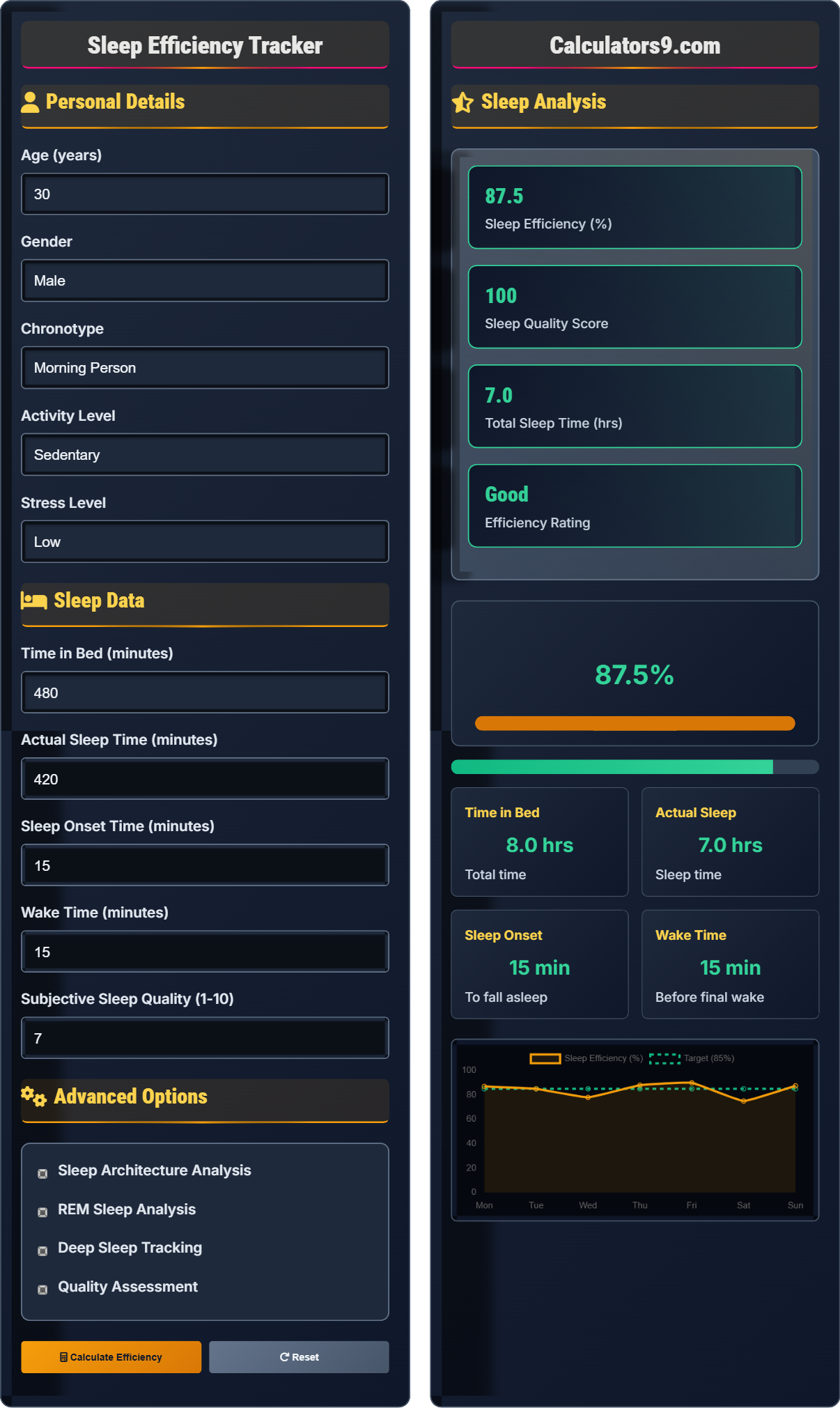
Example: If in bed for 480 minutes (8 hours) and slept for 420 minutes (7 hours):
\( SE = \frac{420}{480} \times 100 = 87.5\% \)
Thus, the sleep efficiency is 87.5%.
Personal Details
Sleep Data
Advanced Options
Sleep Analysis
Time in Bed
Actual Sleep
Sleep Onset
Wake Time
| Metric | Value | Target | Status |
|---|
| Factor | Score | Category | Recommendation |
|---|
Sleep History
Comprehensive Sleep Efficiency Guide
Sleep efficiency is the percentage of time spent sleeping while in bed. It's calculated as total sleep time divided by time in bed, multiplied by 100. High sleep efficiency (>85%) indicates good sleep quality, while low efficiency (<75%) suggests sleep problems or poor sleep hygiene.
The sleep efficiency calculation:
Where:
- \(SE\) = Sleep Efficiency percentage
- \(Total\ Sleep\ Time\) = Actual time spent sleeping
- \(Time\ in\ Bed\) = Total time spent in bed
Sleep efficiency varies based on multiple factors:
- Age: Sleep efficiency decreases with age
- Stress: High stress reduces efficiency
- Environment: Noise, light affect sleep
- Health: Medical conditions impact sleep
- Habits: Sleep hygiene practices
- Consistent Schedule: Same bedtime/wake time
- Sleep Environment: Cool, dark, quiet
- Preparation: Wind down routine
- Limit Disruptions: Reduce awakenings
- Manage Stress: Relaxation techniques
Sleep Efficiency Fundamentals
Percentage of time spent sleeping while in bed.
\( SE = \frac{Total\ Sleep\ Time}{Time\ in\ Bed} \times 100 \)
Where SE=efficiency, TST=total sleep time, TIB=time in bed.
- 85%+ is considered good
- 90%+ is excellent
- Below 75% indicates problems
Optimization Strategies
Score: 85-100 for excellent efficiency.
- Reduce time to fall asleep
- Minimize nighttime awakenings
- Establish consistent schedule
- Improve sleep environment
- Individual variation exists
- Age affects efficiency
- Health conditions matter
- Regular tracking recommended
Sleep Efficiency Learning Quiz
What is the correct definition of sleep efficiency?
The answer is B) Total sleep time divided by time in bed. Sleep efficiency is calculated as the percentage of time spent sleeping while in bed. The formula is: Sleep Efficiency = (Total Sleep Time ÷ Time in Bed) × 100. This metric indicates how efficiently you use your time in bed for actual sleep.
Remember that sleep efficiency measures the quality of your sleep opportunity. If you spend 8 hours in bed but only sleep for 6 hours, your efficiency is 75% (6÷8×100). High efficiency means you're falling asleep quickly and staying asleep, while low efficiency indicates problems like difficulty falling asleep or frequent awakenings.
Sleep Efficiency: Percentage of time sleeping while in bed
Time in Bed: Total time from lights out to final wake
Total Sleep Time: Actual time spent sleeping
• SE = (TST ÷ TIB) × 100
• High SE indicates good sleep quality
• Low SE suggests sleep problems
• Calculate daily for consistency
• Track over time for patterns
• Aim for 85%+ efficiency
• Confusing TST with TIB
• Forgetting to multiply by 100
• Not accounting for awakenings
If someone spends 480 minutes in bed (8 hours) and actually sleeps for 420 minutes (7 hours), what is their sleep efficiency percentage? Is this considered good or poor sleep efficiency?
Step 1: Apply the formula
Sleep Efficiency = (Total Sleep Time ÷ Time in Bed) × 100
SE = (420 ÷ 480) × 100
SE = 0.875 × 100 = 87.5%
Step 2: Determine rating
87.5% falls in the 85-89% range, which is considered "Good"
Therefore, sleep efficiency is 87.5% and rated as Good.
This calculation demonstrates the basic sleep efficiency formula. The person spent 60 minutes awake in bed (480 - 420 = 60), which represents 12.5% of their time in bed. This is within acceptable limits for good sleep efficiency. Sleep efficiency ratings are standardized: >90% = Excellent, 85-89% = Good, 75-84% = Fair, <75% = Poor.
Total Sleep Time (TST): Actual time spent sleeping
Time in Bed (TIB): Total time from lights out to final wake
Sleep Efficiency Rating: Quality classification
• SE = (TST ÷ TIB) × 100
• 85%+ is considered good
• Below 75% indicates problems
• Calculate using minutes for accuracy
• Track weekly averages
• Aim for 85%+ consistently
• Dividing TIB by TST instead of TST by TIB
• Forgetting to multiply by 100
• Not accounting for time awake in bed
A person spends 8 hours (480 minutes) in bed but takes 30 minutes to fall asleep and wakes up for 15 minutes during the night. What is their total sleep time and sleep efficiency? How does the sleep onset time affect their efficiency?
Step 1: Calculate total time awake in bed
Sleep onset = 30 minutes
Nighttime awakening = 15 minutes
Total awake time = 30 + 15 = 45 minutes
Step 2: Calculate total sleep time
TST = Time in bed - Total awake time
TST = 480 - 45 = 435 minutes
Step 3: Calculate sleep efficiency
SE = (435 ÷ 480) × 100 = 90.6%
Step 4: Assess impact
Longer sleep onset (30 min) reduces efficiency by 6.25% compared to immediate sleep
Therefore, TST is 7.25 hours, SE is 90.6% (Excellent).
This problem demonstrates how sleep onset time significantly impacts sleep efficiency. The person takes 30 minutes to fall asleep, which directly reduces their sleep efficiency. In this case, the efficiency is still excellent (90.6%), but if sleep onset took longer (e.g., 60 minutes), efficiency would drop to 87.5%. This shows the importance of good sleep hygiene for falling asleep quickly.
Sleep Onset: Time to fall asleep
Time Awake in Bed: Periods not sleeping
Efficiency Impact: Reduction due to awake time
• Longer onset = lower efficiency
• Minimize awake time in bed
• Efficient sleep requires quick onset
• Establish consistent bedtime routine
• Optimize sleep environment
• Address sleep onset issues
• Not accounting for sleep onset time
• Forgetting nighttime awakenings
• Ignoring time to fall asleep
A person tracks their sleep for 7 days with these efficiencies: 85%, 92%, 78%, 88%, 90%, 75%, 82%. What is their weekly average sleep efficiency? How does this compare to the clinical threshold for good sleep efficiency?
Step 1: Calculate weekly average
Sum = 85 + 92 + 78 + 88 + 90 + 75 + 82 = 590
Average = 590 ÷ 7 = 84.3%
Step 2: Compare to threshold
Clinical threshold for good efficiency = 85%
Weekly average = 84.3%
Step 3: Interpretation
Weekly average is slightly below the 85% threshold
Two nights (78%, 75%) are below 80% (poor efficiency)
Therefore, weekly average is 84.3% (just below good threshold).
This example shows why tracking sleep efficiency over time is important. While some nights show excellent efficiency (92%, 90%), the weekly average reveals a pattern that's just below the optimal threshold. This approach helps identify consistent sleep issues that might not be apparent from single-night measurements. The two nights with poor efficiency (75%, 78%) significantly impact the overall average.
Weekly Average: Mean efficiency over 7 days
Clinical Threshold: Standard for good sleep
Pattern Recognition: Identifying trends over time
• Track over multiple days
• Calculate weekly and monthly averages
• Identify consistent problem nights
• Track alongside sleep diary
• Relying on single-night measurements
• Not identifying problematic patterns
• Ignoring weekly trends
Which combination of factors would most likely result in the highest sleep efficiency?
The answer is A) Consistent schedule, good sleep hygiene, stress management. This comprehensive approach addresses multiple aspects of sleep quality: consistent schedule regulates circadian rhythms, good sleep hygiene optimizes sleep environment and habits, and stress management reduces sleep-disrupting factors. This multi-faceted approach is more effective than focusing on a single factor.
High sleep efficiency requires addressing multiple factors simultaneously. Consistency helps regulate the body's internal clock, good sleep hygiene creates optimal conditions for sleep, and stress management reduces factors that interfere with sleep. This holistic approach recognizes that sleep efficiency depends on both environmental and behavioral factors.
Multi-Faceted Approach: Multiple intervention types
Sleep Hygiene: Sleep-promoting practices
Circadian Regulation: Internal clock synchronization
• Consistency is crucial for efficiency
• Multiple factors affect sleep
• Holistic approach is most effective
• Maintain consistent sleep schedule
• Optimize sleep environment
• Manage stress levels
• Focusing only on sleep duration
• Ignoring sleep environment
• Not addressing stress factors
FAQ
Q: What is a good sleep efficiency score?
A: A good sleep efficiency score is 85% or higher. Sleep efficiency is calculated as: \( SE = \frac{Total\ Sleep\ Time}{Time\ in\ Bed} \times 100 \). Here are the standard classifications:
- Excellent: 90-100% - Very high quality sleep
- Good: 85-89% - Acceptable sleep quality
- Fair: 75-84% - Some sleep issues present
- Poor: <75% - Significant sleep problems
Most healthy adults achieve 85-95% efficiency. The formula for clinical assessment is: \( SE_{clinical} = \frac{TST}{TIB} \times 100 \), where TST is total sleep time and TIB is time in bed. Consistent scores below 85% may indicate sleep disorders or poor sleep hygiene.
Q: How can I improve my sleep efficiency if it's currently low?
A: Improving sleep efficiency involves several strategies focused on reducing time awake in bed. The key formula is: \( SE_{improved} = f(CS \times SH \times E \times S) \), where CS is consistent schedule, SH is sleep hygiene, E is environment, and S is stress management.
Primary strategies include:
- Consistent Schedule: Same bedtime/wake time daily
- Sleep Hygiene: Limit screen time before bed
- Environment: Cool, dark, quiet bedroom
- Stimulus Control: Only use bed for sleep/intimacy
Research shows that implementing these techniques can improve efficiency by 10-20%. The goal is to minimize the time between going to bed and falling asleep, and reduce nighttime awakenings.