Blood Pressure Calculator
Hypertension risk • Cardiovascular assessment • Treatment guidance
Blood Pressure Classification:
Show CalculatorNormal: SBP < 120 mmHg AND DBP < 80 mmHg
Elevated: SBP 120-129 mmHg AND DBP < 80 mmHg
Hypertension Stage 1: SBP 130-139 mmHg OR DBP 80-89 mmHg
Hypertension Stage 2: SBP ≥ 140 mmHg OR DBP ≥ 90 mmHg
Hypertensive Crisis: SBP > 180 mmHg OR DBP > 120 mmHg
The American Heart Association (AHA) 2017 guidelines define normal blood pressure as less than 120/80 mmHg. Elevated blood pressure ranges from 120-129 systolic with less than 80 diastolic.
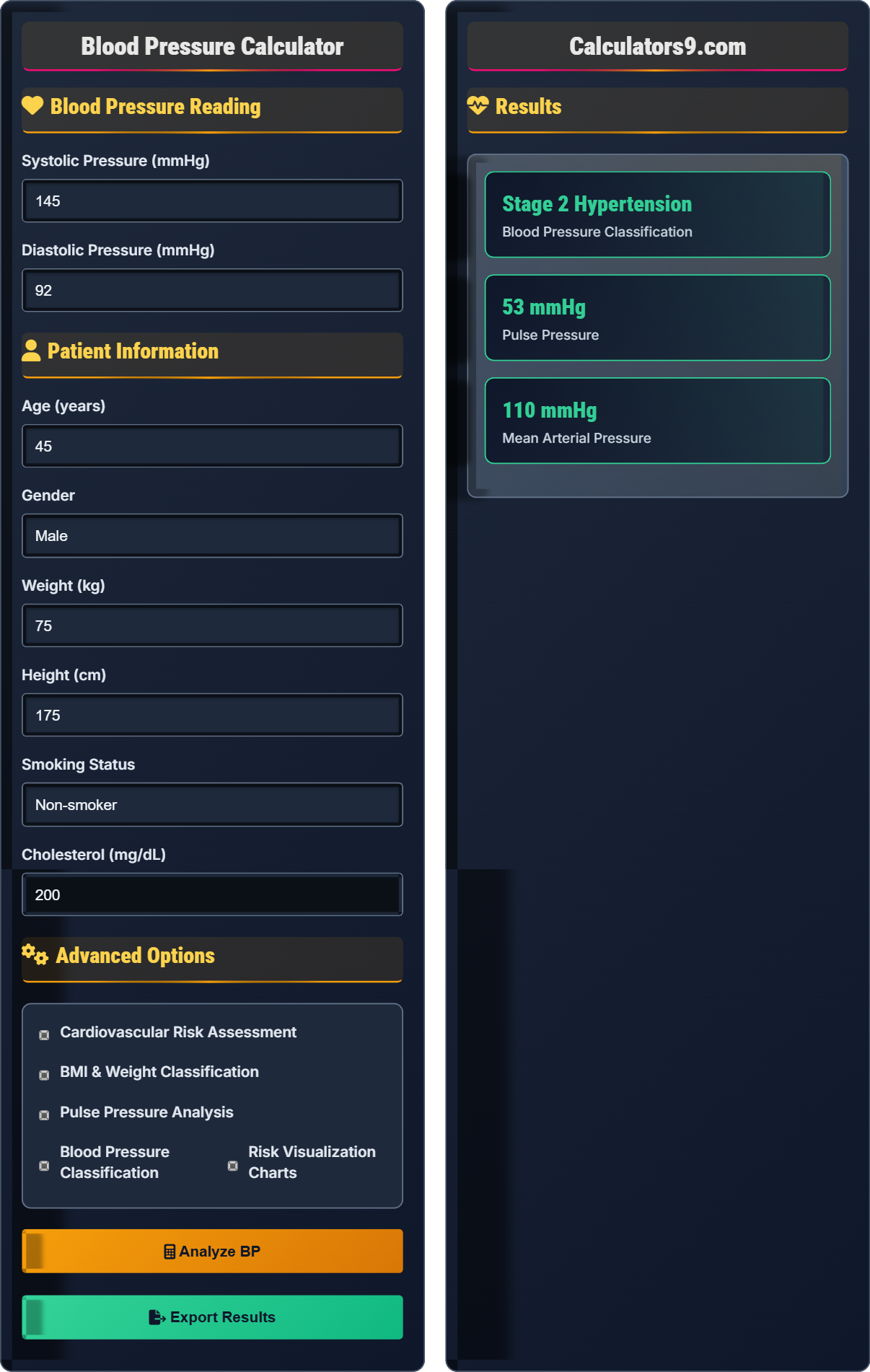
Example: A reading of 145/92 mmHg would be classified as Stage 2 Hypertension because the systolic pressure exceeds 140 mmHg.
Blood Pressure Reading
Patient Information
Advanced Options
Results
Blood Pressure Fundamentals
Blood pressure is the force of blood pushing against the walls of arteries as the heart pumps blood. It's measured in millimeters of mercury (mmHg) and recorded as systolic pressure over diastolic pressure (e.g., 120/80 mmHg).
- Systolic Pressure: Top number, pressure when heart beats
- Diastolic Pressure: Bottom number, pressure when heart rests
- Mean Arterial Pressure: Average pressure during cardiac cycle
- Pulse Pressure: Difference between systolic and diastolic
- Normal: <120/<80 mmHg
- Elevated: 120-129/<80 mmHg
- Stage 1: 130-139/80-89 mmHg
- Stage 2: ≥140/≥90 mmHg
- Crisis: >180/>120 mmHg
Health Implications
Hypertension increases risk of heart disease, stroke, kidney disease, and other serious health conditions. It's often called the "silent killer" because it typically has no symptoms until complications develop.
- Age (risk increases with age)
- Family history
- Smoking
- High cholesterol
- Obesity
- Sedentary lifestyle
- Regular monitoring
- Healthy diet (DASH)
- Regular exercise
- Medication if prescribed
- Stress management
Blood Pressure Learning Quiz
According to AHA 2017 guidelines, what classification applies to a blood pressure reading of 135/85 mmHg?
The answer is C) Stage 1 Hypertension. According to AHA 2017 guidelines, Stage 1 Hypertension is defined as systolic pressure 130-139 mmHg OR diastolic pressure 80-89 mmHg. Since 135 falls within the 130-139 range and 85 falls within the 80-89 range, this reading qualifies as Stage 1 Hypertension.
It's important to understand that blood pressure classification uses the "OR" condition - if either systolic or diastolic pressure meets the criteria, the classification applies. So a reading of 135/85 qualifies as Stage 1 because the systolic pressure is 135 (within 130-139) OR the diastolic pressure is 85 (within 80-89). This is different from requiring both conditions to be met simultaneously.
Systolic Pressure: Maximum pressure when heart contracts
Diastolic Pressure: Minimum pressure when heart relaxes
Hypertension: Persistently elevated blood pressure
• Stage 1: SBP 130-139 OR DBP 80-89
• Stage 2: SBP ≥140 OR DBP ≥90
• "OR" means either condition triggers classification
• Remember: "130s and 80s = Stage 1"
• Either number determines classification, not both
• Use "138" as a memory aid (130-139 range)
• Requiring both systolic AND diastolic to meet criteria
• Confusing the threshold values
• Not understanding the "OR" condition
Calculate the mean arterial pressure (MAP) for a patient with blood pressure 140/90 mmHg. Explain the clinical significance of MAP and how it relates to organ perfusion.
Mean Arterial Pressure (MAP) formula:
MAP = Diastolic Pressure + 1/3(Systolic Pressure - Diastolic Pressure)
Step 1: Calculate pulse pressure
Pulse Pressure = 140 - 90 = 50 mmHg
Step 2: Calculate MAP
MAP = 90 + 1/3(50) = 90 + 16.67 = 106.67 mmHg
Step 3: Round to nearest whole number
MAP ≈ 107 mmHg
Clinical Significance: MAP represents the average pressure in the arteries during a cardiac cycle. It's the driving force for perfusion of vital organs. Normal MAP ranges from 70-110 mmHg. Values below 60 mmHg indicate inadequate organ perfusion, while consistently elevated values suggest hypertension.
MAP is crucial because it reflects the pressure available to perfuse organs throughout the cardiac cycle. Unlike systolic or diastolic pressure alone, MAP accounts for the entire cardiac cycle. The formula accounts for the fact that the heart spends more time in diastole (about 2/3 of the cycle) than systole (1/3 of the cycle), which is why diastolic pressure gets weighted more heavily in the calculation.
Mean Arterial Pressure (MAP): Average arterial pressure during cardiac cycle
Pulse Pressure: Difference between systolic and diastolic pressures
Organ Perfusion: Blood flow to organs for oxygen/nutrient delivery
• MAP = DP + 1/3(PP) where PP = SP - DP
• Normal MAP: 70-110 mmHg
• Critical threshold: MAP < 60 mmHg (inadequate perfusion)
• MAP ≈ DP + 1/3(SP-DP)
• Remember: MAP must be >60 for adequate organ perfusion
• MAP is more clinically relevant than individual readings
• Confusing MAP with systolic or diastolic pressure
• Forgetting to divide pulse pressure by 3
• Not understanding the clinical significance of MAP
A 55-year-old patient presents with a blood pressure reading of 195/118 mmHg and complains of severe headache and blurred vision. What is the classification of this reading? What immediate actions should be taken? How does this differ from a hypertensive urgency?
Classification: This reading of 195/118 mmHg qualifies as a Hypertensive Crisis because both systolic (195 > 180) and diastolic (118 > 120) pressures exceed the crisis thresholds.
Immediate Actions:
- Assess for signs of end-organ damage
- Check for neurological symptoms
- Monitor for chest pain or dyspnea
- Seek immediate medical attention
- Avoid rapid BP reduction
Difference from Urgency: A hypertensive emergency involves acute end-organ damage (stroke, MI, encephalopathy), requiring immediate treatment. Hypertensive urgency has severely elevated BP without end-organ damage, allowing for gradual reduction over hours to days.
Therefore, this patient requires immediate emergency evaluation due to the combination of extremely elevated BP and symptoms suggesting possible end-organ involvement.
Understanding the distinction between hypertensive emergency and urgency is crucial for appropriate management. The presence of symptoms like severe headache, chest pain, or altered mental status suggests end-organ damage, indicating an emergency. Rapid BP reduction in emergencies can cause dangerous drops in perfusion to vital organs, so controlled reduction is essential.
Hypertensive Emergency: Severely elevated BP with end-organ damage
Hypertensive Urgency: Severely elevated BP without end-organ damage
End-Organ Damage: Injury to vital organs from high BP
• Crisis: SBP >180 OR DBP >120 mmHg
• Emergency: Crisis + end-organ damage
• Urgency: Crisis without end-organ damage
• "AEIOU" for emergency symptoms: Altered mental status, Encephalopathy, Ischemia, Organ failure, Urgency
• Always assess for symptoms in high BP readings
• Gradual reduction preferred over rapid lowering
• Treating all high BP readings the same way
• Not assessing for end-organ damage symptoms
• Attempting rapid BP reduction in emergencies
A 60-year-old male smoker with diabetes and a cholesterol level of 240 mg/dL has a blood pressure of 148/94 mmHg. Using the Framingham risk model concepts, calculate his estimated 10-year cardiovascular risk and determine appropriate management strategies.
Risk Factor Assessment:
- Age 60 (high risk factor)
- Male gender (risk factor)
- Smoking (major risk factor)
- Diabetes (major risk factor)
- High cholesterol (risk factor)
- Stage 2 hypertension (SBP 148, DBP 94)
Estimated Risk Calculation:
Based on multiple risk factors including Stage 2 hypertension, smoking, diabetes, and age, this patient's 10-year cardiovascular risk is estimated at 20-25%, placing him in the high-risk category.
Management Strategies:
- Lifestyle modifications (diet, exercise, smoking cessation)
- Antihypertensive medication (likely dual therapy)
- Statins for cholesterol management
- Diabetes management optimization
- Aspirin therapy consideration
Therefore, aggressive management targeting BP <130/80 mmHg is recommended given the high cardiovascular risk profile.
This example demonstrates how hypertension doesn't exist in isolation - it's part of a constellation of cardiovascular risk factors. The presence of diabetes makes this patient particularly high-risk, as diabetes is considered a "coronary artery disease equivalent." The management approach must address all modifiable risk factors simultaneously for optimal outcomes.
Framingham Risk Score: Algorithm to predict cardiovascular events
Coronary Artery Disease Equivalent: Conditions conferring same risk as CAD
Global Risk Assessment: Evaluating all cardiovascular risk factors together
• Multiple risk factors multiply cardiovascular risk
• Diabetes increases cardiovascular risk significantly
• High-risk patients need aggressive BP targets
• Count risk factors: Age, sex, smoking, cholesterol, BP, diabetes
• High-risk patients: BP <130/80 mmHg target
• Address all modifiable risk factors simultaneously
• Managing hypertension in isolation without considering other risk factors
• Not recognizing diabetes as a major risk multiplier
• Setting inappropriate BP targets for high-risk patients
What does an increased pulse pressure (difference between systolic and diastolic pressure) typically indicate?
The answer is B) Stiff arteries or aortic regurgitation. Increased pulse pressure (typically >60 mmHg) usually indicates arterial stiffness, which occurs with aging, atherosclerosis, or aortic regurgitation. It can also result from increased stroke volume. This is different from decreased pulse pressure, which might indicate poor cardiac output or aortic stenosis.
Pulse pressure reflects the compliance of the arterial system. When arteries become stiff (common with age or atherosclerosis), they don't expand as much during systole, causing systolic pressure to rise more dramatically. During diastole, stiff arteries don't recoil as effectively, potentially allowing diastolic pressure to fall. This creates a wider gap between systolic and diastolic pressures.
Pulse Pressure: Difference between systolic and diastolic pressures
Arterial Compliance: Ability of arteries to expand and contract
Aortic Regurgitation: Backward flow through aortic valve
• Normal pulse pressure: 40-60 mmHg
• Wide pulse pressure: >60 mmHg (stiff arteries)
• Narrow pulse pressure: <25 mmHg (poor cardiac output)
• PP = Systolic - Diastolic
• Think of arteries as rubber bands: stiff = wide PP
• Consider underlying causes of abnormal PP
• Not calculating pulse pressure from BP readings
• Misinterpreting the clinical significance of wide/narrow PP
• Not considering pulse pressure in overall assessment
FAQ
Q: What's the difference between systolic and diastolic pressure?
A: Blood pressure consists of two measurements:
- Systolic Pressure (top number): The maximum pressure when your heart beats and pumps blood through your arteries.
- Diastolic Pressure (bottom number): The minimum pressure when your heart relaxes between beats.
Think of it like water pressure in a garden hose: systolic is when you squeeze the trigger (maximum pressure), and diastolic is when you release it (minimum pressure). Both numbers are important for cardiovascular health assessment.
Q: How do I interpret a blood pressure reading of 135/85 mmHg?
A: According to the American Heart Association 2017 guidelines:
With a reading of 135/85 mmHg:
- Systolic pressure (135) falls within the Stage 1 hypertension range (130-139)
- Diastolic pressure (85) falls within the Stage 1 hypertension range (80-89)
- This classifies as Stage 1 Hypertension
Under AHA guidelines, this is defined as Stage 1 Hypertension because either number meeting the criteria (130-139 systolic OR 80-89 diastolic) is sufficient for classification. This patient should consider lifestyle modifications and discuss medication with their healthcare provider.