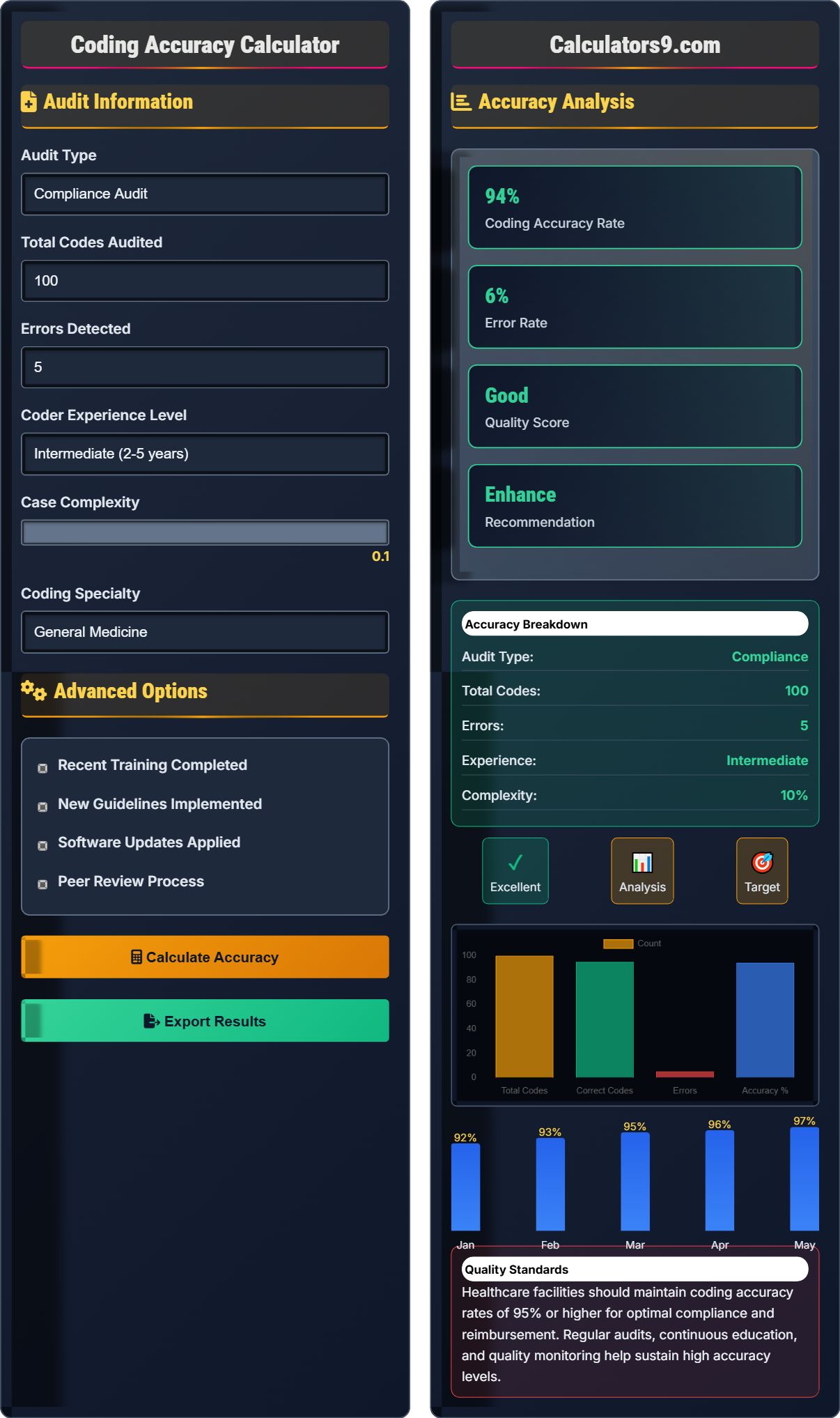
Coding Accuracy Calculator
Healthcare operations tool • 2026 edition
Accuracy Formula:
Show the calculator\( CA = \frac{TC - EC}{TC} \times 100 \times (1 + EF) \times (1 - CF) \times (1 + TF) \)
Where:
- \( CA \) = Coding Accuracy (%)
- \( TC \) = Total Codes Audited
- \( EC \) = Errors Detected
- \( EF \) = Education Factor (training effectiveness)
- \( CF \) = Complexity Factor (case difficulty)
- \( TF \) = Training Factor (recent training impact)
This formula calculates coding accuracy based on audit results and operational factors. Healthcare facilities aim for 95%+ accuracy to ensure compliance and optimal reimbursement. Accuracy varies by specialty and coding complexity.
Example: For an audit of \( TC = 200 \) codes with \( EC = 12 \) errors, education factor of 0.05 (5% improvement), complexity factor of 0.1 (10% difficulty), and training factor of 0.08 (8% improvement):
\( CA = \frac{200 - 12}{200} \times 100 \times (1 + 0.05) \times (1 - 0.1) \times (1 + 0.08) = 94 \times 1.05 \times 0.9 \times 1.08 = 96.2\% \)
Thus, the adjusted coding accuracy would be 96.2%.
Audit Information
Advanced Options
Accuracy Analysis
Healthcare facilities should maintain coding accuracy rates of 95% or higher for optimal compliance and reimbursement. Regular audits, continuous education, and quality monitoring help sustain high accuracy levels.
Coding Accuracy Framework
Medical coding accuracy is critical for healthcare compliance, reimbursement, and quality reporting. The industry standard for coding accuracy is 95% or higher. Regular auditing and quality assurance programs help maintain these standards while ensuring proper documentation and billing practices.
The standard healthcare coding accuracy calculation uses the following formula:
Where:
- \(CA\) = Coding Accuracy
- \(TC\) = Total Codes Audited
- \(EC\) = Errors Detected
- \(EF\) = Education Factor
- \(CF\) = Complexity Factor
- \(TF\) = Training Factor
Healthcare facilities track various metrics related to coding quality:
- Overall Accuracy: Percentage of correct codes
- Error Types: Specific coding errors by category
- Reimbursement Impact: Financial effect of coding errors
- Compliance Risk: Potential audit findings
- Training Needs: Areas requiring education
- Productivity: Codes per hour while maintaining quality
- Regular Auditing: Ongoing review of coded records
- Continuous Education: Ongoing training and updates
- Technology Integration: CDI and automated tools
- Peer Review: Collaborative quality checks
- Feedback Systems: Timely correction communication
- Performance Monitoring: Regular quality metrics review
Accuracy Framework
Education, experience, and complexity determine coding accuracy rates.
\(CA = \frac{TC - EC}{TC} \times 100 \times (1 + EF) \times (1 - CF) \times (1 + TF)\)
Where CA=accuracy, TC=total codes, EC=errors detected, EF=education factor, CF=complexity factor, TF=training factor.
- Target accuracy: 95%+
- Novice coders: 85-90%
- Experienced coders: 95%+
Accuracy Analysis
Experience, training, and specialty knowledge influence coding accuracy.
- Count total codes audited
- Identify coding errors
- Apply adjustment factors
- Calculate accuracy rate
- Complexity reduces accuracy
- Training improves accuracy
- Experience builds proficiency
Coding Accuracy Learning Quiz
What is the industry standard for medical coding accuracy in healthcare facilities?
The answer is C) 95% or higher. The industry standard for medical coding accuracy is 95% or higher. This standard ensures compliance with regulatory requirements and maintains optimal reimbursement rates.
Healthcare facilities must maintain high coding accuracy to ensure proper reimbursement, avoid compliance issues, and maintain quality metrics. The 95% threshold is considered the minimum acceptable standard, with many facilities aiming for 97-98% accuracy to provide a buffer for variations.
Coding Accuracy: Percentage of correctly assigned codes
Industry Standard: Minimum acceptable performance level
Regulatory Compliance: Meeting healthcare requirements
• Target: 95%+ accuracy
• Novice: 85-90% acceptable
• Experienced: 95%+ expected
• Regular auditing maintains standards
• Continuous education improves accuracy
• Peer review helps catch errors
• Accepting low accuracy rates
• Not tracking accuracy trends
• Insufficient training programs
Calculate the coding accuracy for an audit of 200 codes with 8 errors detected, education factor of 0.05 (5% improvement), complexity factor of 0.1 (10% difficulty), and training factor of 0.08 (8% improvement). Show your work.
Using the accuracy formula: \(CA = \frac{TC - EC}{TC} \times 100 \times (1 + EF) \times (1 - CF) \times (1 + TF)\)
Given:
- TC = 200 (total codes)
- EC = 8 (errors detected)
- EF = 0.05 (education factor)
- CF = 0.10 (complexity factor)
- TF = 0.08 (training factor)
Step 1: Calculate base accuracy
Base accuracy = (200 - 8) / 200 × 100 = 192 / 200 × 100 = 96%
Step 2: Apply factors
CA = 96 × (1 + 0.05) × (1 - 0.10) × (1 + 0.08)
= 96 × 1.05 × 0.90 × 1.08
= 96 × 1.0206 = 97.98%
The adjusted coding accuracy is 98.0%.
This calculation demonstrates how multiple factors can adjust base accuracy. The education and training factors improve accuracy, while the complexity factor reduces it. The combined effect results in a final accuracy rate that reflects the operational context. Understanding these factors helps facilities interpret their audit results more accurately.
Base Accuracy: Raw accuracy calculation
Education Factor (EF): Improvement from training
Complexity Factor (CF): Difficulty impact on accuracy
• Base accuracy = (correct/total) × 100
• Add 1 to positive factors
• Subtract from 1 for complexity factors
• Calculate base accuracy first
• Apply factors sequentially
• Round to one decimal place
• Forgetting to multiply by 100
• Misapplying complexity factor
• Not following order of operations
A hospital audits 500 codes monthly and finds an average of 25 errors. If they implement a new training program that improves accuracy by 8% and the complexity of cases increases by 5%, calculate the new expected accuracy rate. Also calculate the number of errors this would represent.
Step 1: Calculate current accuracy
Current accuracy = (500 - 25) / 500 × 100 = 475 / 500 × 100 = 95%
Step 2: Apply factors
Training improvement factor = 1 + 0.08 = 1.08
Complexity increase factor = 1 - 0.05 = 0.95
Step 3: Calculate new accuracy
New accuracy = 95 × 1.08 × 0.95 = 95 × 1.026 = 97.47%
Step 4: Calculate new error count
New errors = 500 × (1 - 0.9747) = 500 × 0.0253 = 12.65 ≈ 13 errors
The new expected accuracy rate is 97.5% with approximately 13 errors.
This example shows how improvements in one area can offset challenges in another. The training program increases accuracy by 8%, but increased complexity reduces it by 5%. The net effect is still positive, resulting in higher overall accuracy. This demonstrates the importance of comprehensive quality improvement approaches.
Audit Impact: Effect of changes on coding accuracy
Quality Improvement: Systematic enhancement efforts
Net Effect: Combined impact of multiple factors
• Calculate current state first
• Apply all relevant factors
• Convert accuracy back to error counts
• Track both percentages and actual numbers
• Consider multiple simultaneous factors
• Calculate financial impact of changes
• Only considering positive factors
• Not accounting for complexity changes
• Forgetting to convert back to error counts
A medical group spends $50,000 on coding training for their team. Before training, their accuracy rate was 92% with 1000 codes processed monthly. After training, accuracy improves to 96%. If each coding error costs $25 in administrative costs and potential revenue loss, calculate the monthly savings from the improved accuracy. How long will it take to recoup the training investment?
Step 1: Calculate errors before training
Before errors = 1000 × (1 - 0.92) = 1000 × 0.08 = 80 errors
Step 2: Calculate errors after training
After errors = 1000 × (1 - 0.96) = 1000 × 0.04 = 40 errors
Step 3: Calculate monthly error reduction
Error reduction = 80 - 40 = 40 fewer errors/month
Step 4: Calculate monthly savings
Monthly savings = 40 × $25 = $1,000
Step 5: Calculate payback period
Payback period = $50,000 ÷ $1,000 = 50 months
The training investment will be recouped in 50 months, with ongoing monthly savings of $1,000.
This demonstrates the financial justification for coding training investments. While the payback period of 50 months is long, the ongoing monthly savings of $1,000 provide continuous value. The analysis also doesn't account for additional benefits like compliance improvements and reduced audit risk, which add further value to the training investment.
Return on Investment (ROI): Financial benefit relative to cost
Administrative Costs: Expenses from coding errors
Payback Period: Time to recoup investment
• Calculate errors before and after
• Include all relevant costs
• Consider ongoing benefits
• Include compliance and risk benefits
• Consider long-term impact
• Track actual results vs. projections
• Only counting direct cost savings
• Not considering ongoing benefits
• Forgetting to include all cost factors
How does a 3% improvement in coding accuracy from 92% to 95% affect a facility processing 10,000 codes monthly?
The answer is B) Reduces errors by 300. At 92% accuracy: 10,000 × 0.08 = 800 errors. At 95% accuracy: 10,000 × 0.05 = 500 errors. Difference: 800 - 500 = 300 fewer errors.
This example shows how seemingly small percentage improvements in accuracy can result in significant absolute reductions in errors, especially at large volumes. A 3% improvement at 10,000 codes per month results in 300 fewer errors monthly, which translates to substantial cost savings and compliance improvements.
Percentage Improvement: Relative change in accuracy
Absolute Improvement: Actual number of errors reduced
Volume Impact: How volume affects absolute changes
• Small percentage changes = large absolute changes at high volume
• Accuracy improvements compound over time
• Calculate both relative and absolute impacts
• Always calculate absolute impact at your volume
• Consider cumulative effects over time
• Communicate impact in both percentages and numbers
• Focusing only on percentage changes
• Not considering volume impact
• Underestimating cumulative benefits
Healthcare Operations FAQ
Q: How does coding accuracy affect reimbursement rates?
A: Coding accuracy directly impacts reimbursement through several mechanisms. Using our accuracy formula: \(CA = \frac{TC - EC}{TC} \times 100 \times (1 + EF) \times (1 - CF) \times (1 + TF)\), when accuracy decreases (errors increase), the following occurs:
• Undercoding: Missed reimbursement for services provided
• Overcoding: Potential compliance violations and clawbacks
• Denials: Claims rejected due to coding errors
For example, with 1000 codes at 92% accuracy (80 errors), if each error results in $50 in denied revenue: Total loss = 80 × $50 = $4,000. At 95% accuracy (50 errors): Total loss = 50 × $50 = $2,500. The 3% accuracy improvement saves $1,500 in potential revenue loss.
Q: What's the relationship between coder experience and accuracy rates?
A: There's a strong positive correlation between coder experience and accuracy. The experience factor in our formula reflects this relationship:
• Novice (0-2 years): Typically 85-90% accuracy
• Intermediate (2-5 years): Typically 90-95% accuracy
• Experienced (5+ years): Typically 95-97% accuracy
• Expert (10+ years): Typically 97-99% accuracy
For a novice coder with 88% accuracy processing 500 codes monthly: Errors = 500 × 0.12 = 60 errors. For an experienced coder with 96% accuracy: Errors = 500 × 0.04 = 20 errors. The experienced coder makes 40 fewer errors monthly, demonstrating the value of experience.