Telehealth Savings Calculator
Healthcare operations tool • 2026 edition
Telehealth Savings Formula:
Show the calculator\( TS = (FC + SC + TC) - (CI + UI + MI) - (FC \times RT) \)
Where:
- \( TS \) = Telehealth Savings ($)
- \( FC \) = Facility Cost Savings (space, utilities, cleaning)
- \( SC \) = Staff Cost Savings (reduced overhead)
- \( TC \) = Travel Cost Savings (patient travel reduction)
- \( CI \) = Capital Investment (technology infrastructure)
- \( UI \) = Usage Investment (software, licensing)
- \( MI \) = Maintenance Investment (ongoing costs)
- \( RT \) = Return Factor (investment payback rate)
This formula calculates net telehealth savings based on cost reductions and investment requirements. Healthcare facilities typically achieve 15-30% cost savings through telehealth implementation, with ROI usually realized within 12-18 months.
Example: For a facility with \( FC = \$200,000 \), \( SC = \$150,000 \), \( TC = \$50,000 \), \( CI = \$100,000 \), \( UI = \$30,000 \), \( MI = \$20,000 \), and \( RT = 0.08 \) (8% return factor):
\( TS = (200,000 + 150,000 + 50,000) - (100,000 + 30,000 + 20,000) - (100,000 \times 0.08) = 400,000 - 150,000 - 8,000 = \$242,000 \)
Thus, the net telehealth savings would be $242,000.
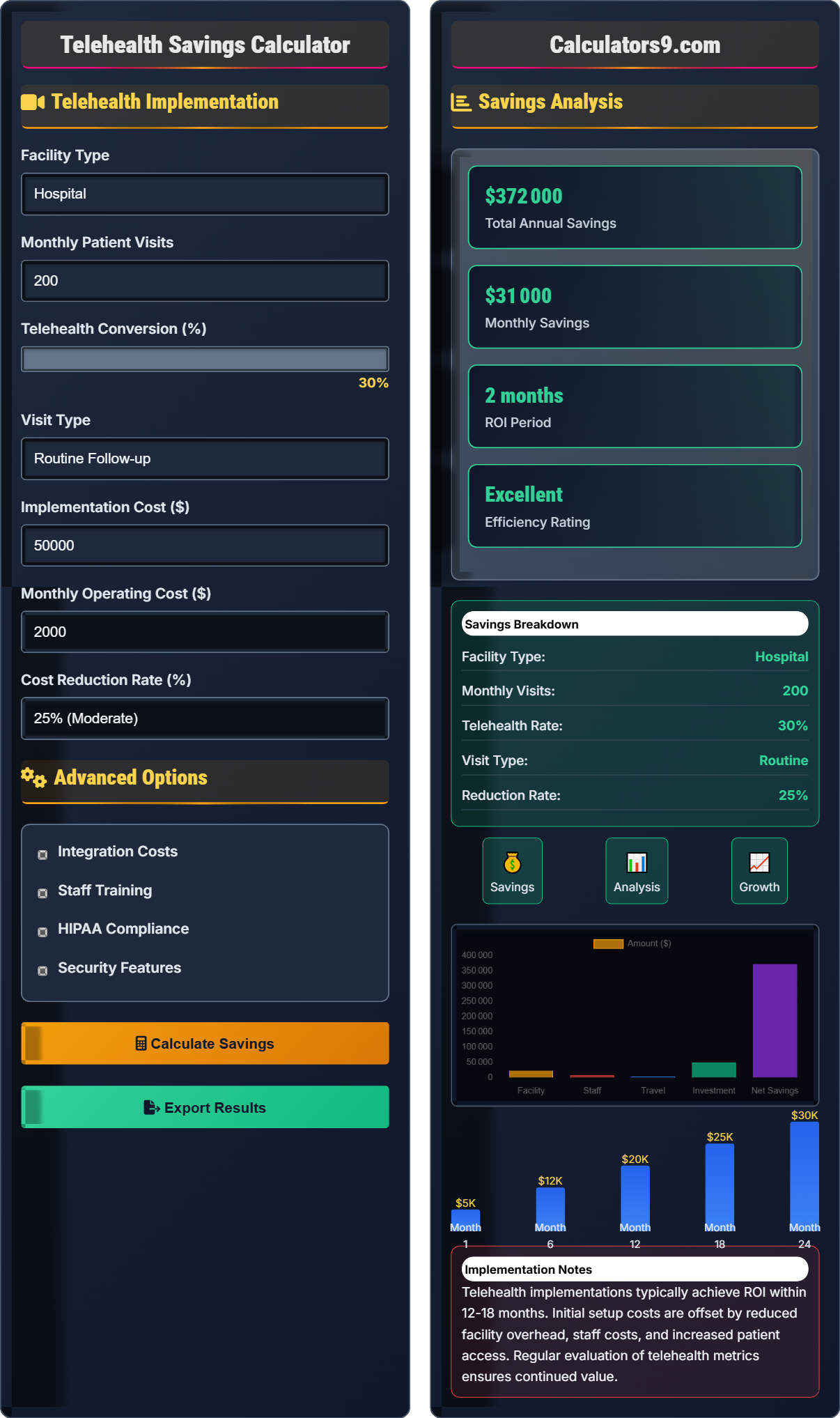
Telehealth Implementation
Advanced Options
Savings Analysis
Telehealth implementations typically achieve ROI within 12-18 months. Initial setup costs are offset by reduced facility overhead, staff costs, and increased patient access. Regular evaluation of telehealth metrics ensures continued value.
Telehealth Savings Framework
Telehealth implementation offers significant cost savings through reduced facility overhead, staff costs, and travel expenses. Healthcare facilities can achieve 15-30% cost reductions while maintaining quality care. The investment typically pays for itself within 12-18 months through operational efficiencies.
The standard telehealth savings calculation uses the following formula:
Where:
- \(TS\) = Total Savings
- \(FC\) = Facility Cost Savings
- \(SC\) = Staff Cost Savings
- \(TC\) = Travel Cost Savings
- \(CI\) = Capital Investment
- \(UI\) = Usage Investment
- \(MI\) = Maintenance Investment
- \(RT\) = Return Factor
Healthcare facilities track various metrics related to telehealth savings:
- Facility Overhead: 20-40% reduction in space costs
- Staff Costs: 10-25% reduction in administrative overhead
- Travel Costs: 80-90% reduction in patient travel expenses
- Equipment: Shared resources across multiple locations
- Utilities: Reduced consumption with fewer visits
- Supply Chain: Lower consumption of disposables
- Phased Rollout: Gradual implementation to minimize disruption
- Staff Training: Comprehensive education on new workflows
- Technology Integration: Seamless connection with existing systems
- Security Compliance: HIPAA-compliant platforms and processes
- Quality Assurance: Regular monitoring of care quality
- Patient Education: Clear instructions for virtual visits
Savings Framework
Facility, staff, and travel costs determine telehealth savings potential.
\(TS = (FC + SC + TC) - (CI + UI + MI) - (FC \times RT)\)
Where TS=total savings, FC=facility costs, SC=staff costs, TC=travel costs, CI=capital investment, UI=usage investment, MI=maintenance investment, RT=return factor.
- Typical savings: 15-30%
- ROI period: 12-18 months
- Facility cost reduction: 20-40%
Savings Analysis
Implementation costs, conversion rates, and operational efficiency influence savings.
- Calculate current operational costs
- Estimate telehealth implementation costs
- Project cost reductions
- Calculate net savings and ROI
- Higher conversion rates = greater savings
- Lower implementation costs = faster ROI
- Continued monitoring is essential
Telehealth Savings Learning Quiz
What is the typical return on investment (ROI) period for telehealth implementations?
The answer is B) 12-18 months. Healthcare facilities typically realize ROI from telehealth implementations within 12-18 months. This period accounts for initial setup costs, staff training, and patient adoption, after which operational savings begin to exceed implementation costs.
The 12-18 month ROI period is based on industry data showing that telehealth implementations achieve cost savings through reduced facility overhead, staff costs, and improved efficiency. The initial investment in technology and training is typically offset by these operational savings within this timeframe.
Return on Investment (ROI): Financial benefit relative to cost
Payback Period: Time to recoup initial investment
Implementation Costs: One-time setup expenses
• Typical ROI: 12-18 months
• Includes setup and training time
• Based on operational savings
• Plan for 12-18 month payback period
• Budget for ongoing operational costs
• Monitor savings metrics regularly
• Expecting immediate returns
• Underestimating implementation costs
• Not accounting for training period
Calculate the net telehealth savings for a facility with facility cost savings of $150,000, staff cost savings of $80,000, travel cost savings of $30,000, capital investment of $75,000, usage investment of $20,000, maintenance investment of $15,000, and return factor of 0.05 (5%). Show your work.
Using the savings formula: \(TS = (FC + SC + TC) - (CI + UI + MI) - (FC \times RT)\)
Given:
- FC = $150,000 (facility cost savings)
- SC = $80,000 (staff cost savings)
- TC = $30,000 (travel cost savings)
- CI = $75,000 (capital investment)
- UI = $20,000 (usage investment)
- MI = $15,000 (maintenance investment)
- RT = 0.05 (return factor)
Step 1: Calculate total cost savings
Total savings = FC + SC + TC = $150,000 + $80,000 + $30,000 = $260,000
Step 2: Calculate total investments
Total investments = CI + UI + MI = $75,000 + $20,000 + $15,000 = $110,000
Step 3: Calculate return adjustment
Return adjustment = FC × RT = $150,000 × 0.05 = $7,500
Step 4: Calculate net savings
TS = $260,000 - $110,000 - $7,500 = $142,500
The net telehealth savings would be $142,500.
This calculation demonstrates how multiple cost categories contribute to overall savings, while various investments reduce the net benefit. The return factor accounts for opportunity costs or alternative investments. The formula ensures all relevant costs and benefits are considered in the analysis.
Facility Cost Savings (FC): Reduced space and overhead expenses
Staff Cost Savings (SC): Lower administrative overhead
Capital Investment (CI): One-time setup costs
• Add all savings components
• Subtract all investment costs
• Apply return factor to savings
• Calculate components separately
• Verify all cost categories
• Include ongoing operational costs
• Forgetting to subtract investments
• Not applying return factor
• Missing ongoing operational costs
A rural health clinic has 300 monthly visits with 40% conversion to telehealth. Facility costs are reduced by $2,000/month per converted visit, staff costs by $500/month per converted visit, and travel costs by $200/month per converted visit. If the implementation cost is $80,000 with monthly operating costs of $1,500, calculate the annual net savings.
Step 1: Calculate converted visits per month
Converted visits = 300 × 0.40 = 120 visits/month
Step 2: Calculate monthly savings per converted visit
Monthly savings per visit = $2,000 + $500 + $200 = $2,700
Step 3: Calculate total monthly savings
Total monthly savings = 120 × $2,700 = $324,000
Step 4: Calculate annual savings
Annual savings = $324,000 × 12 = $3,888,000
Step 5: Calculate annual operating costs
Annual operating costs = $1,500 × 12 = $18,000
Step 6: Calculate net annual savings
Net annual savings = $3,888,000 - $80,000 - $18,000 = $3,790,000
The annual net savings would be $3,790,000.
This example demonstrates how conversion rates significantly impact savings potential. With 40% of visits converted to telehealth, the clinic realizes substantial savings in facility, staff, and travel costs. Rural clinics often see higher savings due to reduced travel distances and facility requirements.
Conversion Rate: Percentage of visits moved to telehealth
Rural Healthcare: Facilities in underserved areas
Operational Savings: Reduced ongoing expenses• Calculate conversion first
• Apply savings per converted visit
• Include all implementation costs
• Higher conversion rates = greater savings
• Rural facilities often see higher savings
• Calculate monthly and annual figures
• Not accounting for conversion rate
• Forgetting ongoing operational costs
• Miscalculating monthly vs. annual figures
A hospital invests $200,000 in telehealth technology with $3,000 monthly operating costs. The system generates $8,000 in monthly savings. Calculate the payback period in months and determine the ROI after 2 years. Also calculate the net present value assuming a 10% discount rate.
Step 1: Calculate net monthly savings
Net monthly savings = $8,000 - $3,000 = $5,000
Step 2: Calculate payback period
Payback period = $200,000 ÷ $5,000 = 40 months
Step 3: Calculate total savings after 2 years (24 months)
Total savings = $5,000 × 24 = $120,000
Step 4: Calculate ROI after 2 years
ROI = ($120,000 ÷ $200,000) × 100 = 60%
Step 5: Calculate NPV
NPV = -$200,000 + Σ[$5,000/(1.10)^(t/12)] for t=1 to 24
Using monthly discount rate of (1.10)^(1/12) - 1 = 0.7974%
NPV = -$200,000 + $5,000 × [(1 - (1.007974)^-24) / 0.007974]
NPV = -$200,000 + $5,000 × 22.197 = -$200,000 + $110,985 = -$89,015
Payback: 40 months, ROI after 2 years: 60%, NPV: -$89,015
This demonstrates how different financial metrics provide various perspectives on investment value. The payback period shows when the investment is recovered, ROI shows percentage return, and NPV accounts for the time value of money. The negative NPV indicates the investment may not be profitable at a 10% discount rate.
Payback Period: Time to recover initial investment
Net Present Value (NPV): Present value of future cash flows
Discount Rate: Rate to account for time value of money
• Calculate net monthly cash flow
• Consider time value of money
• Use appropriate discount rate
• Use multiple financial metrics
• Consider different discount rates
• Calculate both simple and discounted returns
• Not accounting for ongoing costs
• Forgetting time value of money
• Using incorrect discount rates
Which factor typically provides the greatest cost reduction in telehealth implementations?
The answer is B) Facility overhead reduction. Facility overhead typically provides the greatest cost reduction in telehealth implementations, often achieving 20-40% savings in space, utilities, cleaning, and maintenance costs. This is followed by travel cost reduction and staff cost reduction.
Facility overhead represents the largest recurring cost for most healthcare facilities. By converting visits to telehealth, facilities can reduce physical space requirements, utilities, cleaning services, and maintenance costs. These savings often exceed those from other categories, making facility overhead reduction the primary driver of telehealth savings.
Facility Overhead: Costs of physical space and operations
Operational Efficiency: Cost-effective resource utilization
Recurring Costs: Ongoing expenses over time
• Facility overhead is largest cost component
• Telehealth reduces physical space needs
• Multiple cost categories contribute to savings
• Focus on largest cost components first
• Calculate savings by category
• Consider space optimization opportunities
• Underestimating facility cost savings
• Not considering space optimization
• Focusing only on staff costs
Healthcare Operations FAQ
Q: How does telehealth implementation affect staff costs?
A: Telehealth implementation affects staff costs through the staff cost savings factor \( SC \) in our formula: \( TS = (FC + SC + TC) - (CI + UI + MI) - (FC \times RT) \).
Positive impacts:
• Reduced administrative overhead (10-25% savings)
• Lower facility maintenance costs
• Decreased housekeeping and security requirements
• Reduced utility costs per visit
Negative impacts:
• Technology training requirements
• Technical support needs
• Potential staff redeployment costs
For a facility with 200 monthly visits converting 30% to telehealth:
\( SC = 200 \times 0.30 \times \$500 = \$30,000/month \) in staff cost savings
This represents significant ongoing savings while maintaining quality care.
Q: What's the relationship between telehealth conversion rate and savings?
A: The relationship between telehealth conversion rate and savings is directly proportional. Higher conversion rates lead to greater savings across all categories (FC, SC, TC). The conversion rate multiplies the per-visit savings:
For 200 visits with $2,000 facility savings per visit:
• 20% conversion: 40 visits × $2,000 = $80,000 in facility savings
• 40% conversion: 80 visits × $2,000 = $160,000 in facility savings
• 60% conversion: 120 visits × $2,000 = $240,000 in facility savings
As conversion rate doubles from 20% to 40%, savings double. This demonstrates the importance of maximizing appropriate visit conversions to telehealth while maintaining quality care standards.