Mid-Parental Height Calculator
Child development growth estimator • 2026 standards
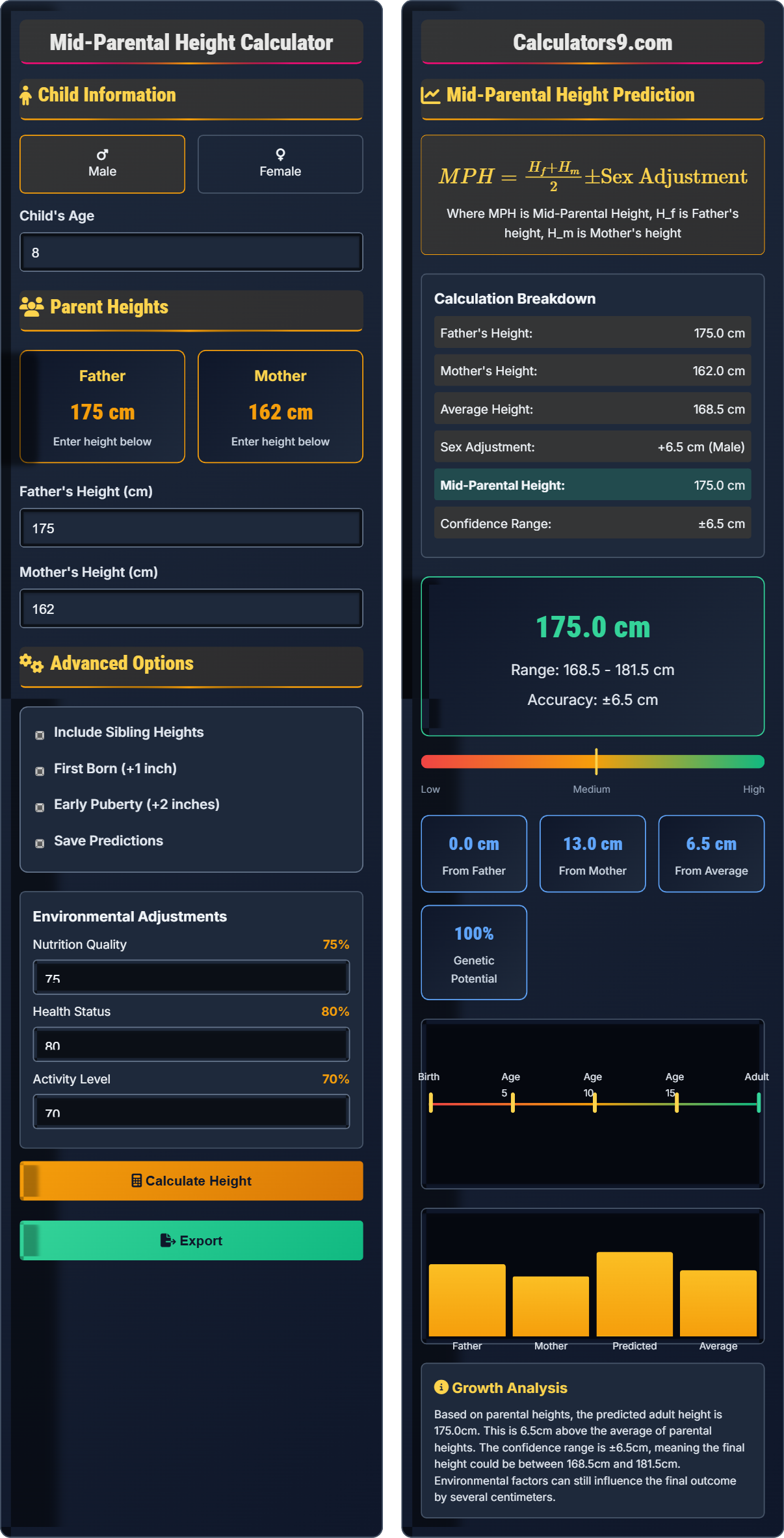
Mid-Parental Height Formula:
Show the calculator\( MPH = \frac{H_f + H_m}{2} \pm \text{Sex Adjustment} \)
Where:
- \( MPH \) = Mid-Parental Height
- \( H_f \) = Father's height
- \( H_m \) = Mother's height
- Sex Adjustment = +6.5cm for males, -6.5cm for females
Alternative Formula:
- Traditional: \( MPH = \frac{H_f + H_m}{2} \pm 2.5 \text{ inches} \)
Confidence Interval:
- Typical accuracy: ±5-8 cm (±2-3 inches)
- Range: \( MPH \pm 6.5cm \)
Additional Factors:
- Number of siblings (larger families may have smaller heights)
- Birth order (first-borns may be slightly taller)
- Environmental factors (nutrition, health, activity)
This formula estimates adult height based on parental heights with typical accuracy of ±2-3 inches.
Child Information
Parent Heights
Advanced Options
Environmental Adjustments
Mid-Parental Height Prediction
Calculation Breakdown
Growth Analysis
Mid-Parental Height Fundamentals
Mid-parental height is a genetic prediction method that estimates a child's adult height by averaging the parents' heights and applying a gender-specific adjustment. It accounts for 60-80% of height determination.
\(MPH = \frac{H_f + H_m}{2} \pm \text{Sex Adjustment}\)
Where MPH is mid-parental height, H_f is father's height, H_m is mother's height, with ±6.5cm adjustment.
- Genetics (primary factor: 60-80% of height)
- Environmental factors (20-40% of height)
- Number of siblings (family size effect)
- Birth order (first-born effect)
- Puberty timing (early/late bloomers)
Development Analysis
Mid-parental height has typical accuracy of ±2-3 inches (±5-8 cm). Environmental factors, nutrition, health, and activity levels can influence final height by up to 10% beyond genetic potential.
- Optimize nutrition with adequate protein and calcium
- Maintain regular physical activity
- Ensure adequate sleep for growth hormone production
- Monitor and address any health concerns promptly
- Track growth patterns consistently
- Helps identify potential growth disorders
- Guides pediatric care decisions
- Monitors developmental milestones
- Assesses genetic potential achievement
- Identifies need for specialist referral
Mid-Parental Height Learning Quiz
What is the standard sex adjustment used in mid-parental height calculations?
The answer is B) +6.5cm for males, -6.5cm for females. The standard mid-parental height formula applies a +6.5cm adjustment for males and -6.5cm adjustment for females to account for average biological differences in adult height.
The sex adjustment in mid-parental height calculations compensates for the average difference in adult height between males and females. On average, males are about 13cm taller than females, so the adjustment accounts for half of this difference (6.5cm) since the calculation starts with the average of both parents' heights.
Mid-Parental Height (MPH): Estimated adult height based on parental heights
Sex Adjustment: Correction factor for gender-specific height differences
Genetic Potential: Maximum height achievable under optimal conditions
• Males receive +6.5cm adjustment
• Females receive -6.5cm adjustment
• Adjustment accounts for biological differences
• Remember: Add for males, subtract for females
• Adjustment is ±6.5cm or ±2.5 inches
• The adjustment is applied to the average of parental heights
• Applying the wrong direction of adjustment
• Forgetting to apply the sex adjustment
• Using incorrect adjustment values
A 9-year-old girl has a father who is 180cm tall and a mother who is 165cm tall. Calculate her mid-parental height using the standard formula.
Using the formula: \(MPH = \frac{H_f + H_m}{2} \pm \text{Sex Adjustment}\)
Given:
- Father's height: 180cm
- Mother's height: 165cm
- Sex adjustment for female: -6.5cm
Step 1: Calculate average = (180 + 165) / 2 = 172.5cm
Step 2: Apply sex adjustment = 172.5 - 6.5 = 166.0cm
Step 3: Typical confidence range = ±6.5cm
Therefore, mid-parental height is 166.0cm with a range of 159.5cm to 172.5cm.
This calculation demonstrates how parental heights combine to predict a child's genetic potential. The mid-parental height provides a baseline estimate that accounts for 60-80% of height determination. The confidence range acknowledges that environmental factors can influence the final outcome by several centimeters.
Centimeter (cm): Metric unit of length (1 inch = 2.54cm)
Confidence Range: Expected variation around the predicted value
Genetic Contribution: Proportion of height determined by genes
• Average parental heights first
• Then apply sex adjustment
• Typical accuracy range is ±6.5cm
• Always calculate the average first
• Apply the correct sign for sex adjustment
• Remember the confidence range for interpretation
• Adding sex adjustment before averaging
• Using the wrong sign for sex adjustment
• Forgetting to include the confidence range
Research shows that each additional sibling may reduce predicted height by 0.5cm. If a family has 4 children and the mid-parental height is calculated as 172cm, what would be the adjusted prediction considering family size?
Step 1: Calculate family size reduction = (Number of children - 1) × 0.5cm
Family size reduction = (4 - 1) × 0.5cm = 3 × 0.5cm = 1.5cm
Step 2: Apply reduction to mid-parental height = 172cm - 1.5cm = 170.5cm
Step 3: New confidence range = 170.5cm ± 6.5cm = 164cm to 177cm
Therefore, the adjusted mid-parental height considering family size is 170.5cm.
This example demonstrates how family size can influence height predictions beyond the basic mid-parental calculation. The family size effect suggests that resources may be distributed among siblings, potentially impacting individual growth. This is one of several environmental factors that can modify genetic predictions.
Family Size Effect: Impact of number of siblings on individual height
Resource Distribution: How family resources are shared among children
Environmental Modification: How surroundings affect genetic potential
• Each additional sibling may reduce height by ~0.5cm
• Apply adjustment after basic calculation
• Consider multiple environmental factors
• Calculate basic mid-parental height first
• Apply environmental adjustments afterward
• Consider other environmental factors together
• Including the child being predicted in the count
• Applying the adjustment incorrectly
• Overemphasizing family size effect
Studies suggest that first-born children may be 0.5-1cm taller than later-born siblings due to resource allocation. If the mid-parental height for a family is 170cm and the child is the first-born, what would be the adjusted prediction including birth order effect?
Step 1: Determine birth order adjustment = First-born advantage = +0.75cm (average of 0.5-1cm)
Step 2: Apply to mid-parental height = 170cm + 0.75cm = 170.75cm
Step 3: Calculate final range = 170.75cm ± 6.5cm = 164.25cm to 177.25cm
Step 4: Calculate percentage of genetic potential = (170.75/170) × 100 = 100.4%
Therefore, the first-born's adjusted prediction is 170.8cm, representing 100.4% of basic genetic potential.
This calculation demonstrates the birth order effect, where first-born children may have slight advantages in height due to receiving more resources during critical growth periods. This effect, while modest, is consistent across multiple studies and represents another environmental factor that can influence height beyond genetic predictions.
Birth Order Effect: Impact of birth sequence on individual characteristics
Resource Allocation: How family resources are distributed by birth order
Critical Growth Periods: Times when nutrition significantly impacts development
• First-borns may have slight height advantage
• Effect is typically 0.5-1cm
• Combine with other environmental factors
• Consider birth order alongside other factors
• Effects are modest but consistent
• Combine multiple environmental adjustments
• Overestimating the impact of birth order
• Not considering other environmental factors
• Applying the adjustment incorrectly
Which of the following factors has the LEAST impact on the accuracy of mid-parental height predictions?
The answer is C) Grandparents' heights. While grandparents' heights can provide additional genetic information, the standard mid-parental height formula primarily relies on the parents' heights. The child's gender is essential for the sex adjustment, the parents' actual heights are the core inputs, and the child's current height can indicate growth patterns.
The mid-parental height formula is designed to be a simple yet effective prediction tool using the most direct genetic information available - the parents' heights. While extended family heights can provide additional context, they don't significantly improve the accuracy of the basic formula. The primary inputs remain parental heights and child gender.
Primary Inputs: Essential variables for the calculation
Secondary Factors: Additional information that may refine predictions
Prediction Accuracy: How closely predictions match actual outcomes
• Parents' heights are the primary input
• Child's gender determines the adjustment
• Grandparents' heights are supplementary
• Focus on accurate parental height measurements
• Ensure correct gender adjustment
• Use additional factors for refinement only
• Prioritizing extended family heights over parents'
• Forgetting the gender adjustment
• Overcomplicating with too many factors
FAQ
Q: How accurate is the mid-parental height calculation?
A: The mid-parental height formula is typically accurate within ±2-3 inches (±5-8cm) for about 95% of children. The formula \(MPH = \frac{H_f + H_m}{2} \pm \text{Sex Adjustment}\) accounts for 60-80% of height determination.
Factors affecting accuracy:
1. Environmental factors (20-40% of height) - nutrition, health, activity
2. Genetic variations - not all height genes come from parents
3. Puberty timing - early/late bloomers may deviate
4. Measurement accuracy - precise parental heights are crucial
Q: Can I grow taller than my mid-parental height predicts?
A: Yes, it's possible to exceed your mid-parental height prediction. The formula \(MPH = \frac{H_f + H_m}{2} \pm \text{Sex Adjustment}\) represents genetic potential, but environmental factors can enhance growth:
• Optimal nutrition - especially protein, calcium, vitamins
• Regular physical activity - stimulates growth hormone
• Adequate sleep - peak growth hormone release
• Good health management - prevents growth interference
Environmental factors can contribute up to 10% beyond genetic potential, allowing some children to surpass their mid-parental prediction.