Camping Gear Weight Calculator
Optimize pack weight & distribution • Outdoor planning tool
Camping Gear Weight Formula:
Show CalculatorPack weight calculations:
- Total Pack Weight = Base Weight + Food Weight + Water Weight
- Base Weight = Sum of all non-food, non-water gear
- Food Weight = Days × Daily Food Requirement
- Water Weight = Volume × 8.34 lbs/gallon
Recommended pack weight should be 15-20% of body weight for backpacking.
For a 150 lb person: 150 × 0.20 = 30 lbs maximum pack weight
Base weight should ideally be under 20 lbs for lightweight backpacking.
Weight Distribution: Heavy items near center of pack, light items at top/bottom.
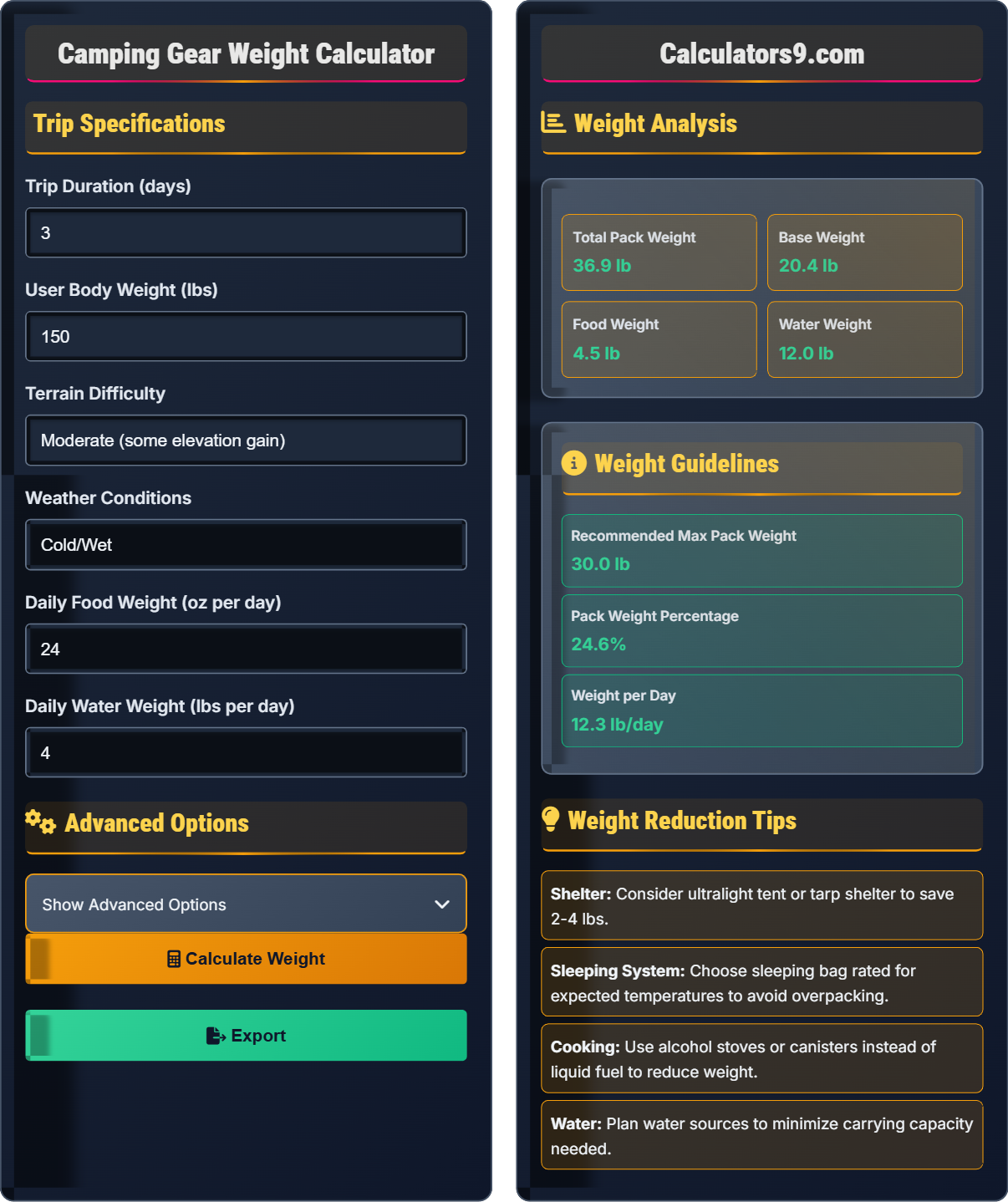
Trip Specifications
Advanced Options
Weight Analysis
Weight Guidelines
Weight Reduction Tips
Shelter: Consider ultralight tent or tarp shelter to save 2-4 lbs.
Sleeping System: Choose sleeping bag rated for expected temperatures to avoid overpacking.
Cooking: Use alcohol stoves or canisters instead of liquid fuel to reduce weight.
Water: Plan water sources to minimize carrying capacity needed.
Camping Weight Fundamentals
Base weight refers to the total weight of your backpacking gear excluding consumables like food, water, and fuel. This includes your backpack, shelter, sleeping system, clothing, cooking gear, and other essentials. Lighter base weight reduces fatigue and increases mobility during extended trips.
Accurate weight calculation involves summing all gear categories: shelter, sleep system, pack, clothing, cooking gear, navigation tools, and emergency items. Add consumables (food and water) based on trip duration. The total should not exceed 20% of your body weight for comfort and safety.
- Keep pack weight under 20% of body weight
- Aim for under 20 lbs base weight for lightweight backpacking
- Heavier items should be packed near the center of the pack
- Minimize redundancy in gear functions
Gear Categories
Key categories include shelter (tent, tarp, bivy), sleep system (sleeping bag, pad), pack, clothing, cooking system, water treatment, navigation, and emergency items. Each category contributes to the overall pack weight and should be optimized for the specific trip requirements.
- Choose multi-purpose items when possible
- Verify weather conditions to avoid overpacking
- Share gear among group members
- Invest in lightweight alternatives gradually
- Practice packing efficiently
- Weigh everything before departure
- Track weight changes over time
- Balance weight reduction with safety
- Consider trip-specific requirements
Camping Gear Weight Quiz
What is the recommended maximum pack weight as a percentage of body weight for backpacking?
The answer is B) 15-20%. The recommended maximum pack weight for backpacking is 15-20% of your body weight. For example, a 150 lb person should carry no more than 22.5-30 lbs. Exceeding this limit can lead to fatigue, injury, and reduced enjoyment of the outdoor experience.
This weight guideline is based on ergonomic research and outdoor experience. Carrying more than 20% of body weight significantly increases the risk of injury and fatigue. The recommendation accounts for different fitness levels and trip conditions. Beginners should aim for the lower end (15%) while experienced hikers might occasionally exceed 20% for exceptional circumstances.
Base Weight: Total gear weight excluding consumables
Consumables: Food, water, and fuel
Carrying Capacity: Maximum safe weight to carry
• Pack weight ≤ 20% of body weight
• Aim for under 20 lbs base weight
• Consider terrain and trip duration
• Weigh everything before departure
• Share group gear when possible
• Choose multi-purpose items
• Packing more than needed
• Not accounting for water weight
• Ignoring weight guidelines
Calculate the total pack weight for a 4-day backpacking trip. The hiker weighs 160 lbs. Base weight is 18 lbs, daily food weight is 1.5 lbs, and daily water weight is 3 lbs. What percentage of body weight is this?
Step 1: Calculate consumables
Food weight = 1.5 lbs/day × 4 days = 6 lbs
Water weight = 3 lbs/day × 4 days = 12 lbs
Step 2: Calculate total pack weight
Total pack weight = Base weight + Food + Water
Total pack weight = 18 + 6 + 12 = 36 lbs
Step 3: Calculate percentage of body weight
Percentage = (Pack weight ÷ Body weight) × 100
Percentage = (36 ÷ 160) × 100 = 22.5%
Step 4: Evaluate appropriateness
22.5% exceeds the recommended 20% maximum, suggesting this load may be too heavy for comfort.
Therefore, the total pack weight is 36 lbs, which is 22.5% of body weight, exceeding the recommended maximum.
This calculation demonstrates the importance of including all consumables in weight planning. Water and food can quickly add significant weight to a pack. For a 4-day trip, 18 lbs of base weight plus 18 lbs of consumables results in a heavy pack. Strategies to reduce this might include resupplying food or planning water sources to reduce carrying capacity.
Consumables: Items consumed during trip (food, water, fuel)
Base Weight: Non-consumable gear
Carrying Percentage: Pack weight as % of body weight
• Include all consumables in calculations
• Keep pack weight ≤ 20% of body weight
• Plan water sources to reduce carrying weight
• Plan resupply points for long trips
• Use water purification to reduce carrying weight
• Pack lightweight, calorie-dense foods
• Forgetting to include water weight
• Not accounting for all consumables
• Overpacking food for safety
You're planning a 5-day mountain backpacking trip with a 150 lb body weight limit. Your current gear weighs 22 lbs base weight. You need 1.2 lbs of food per day and 4 lbs of water per day. What's your total pack weight and percentage of body weight? How could you reduce the weight to meet the 20% guideline?
Step 1: Calculate consumables for 5 days
Food weight = 1.2 lbs/day × 5 days = 6 lbs
Water weight = 4 lbs/day × 5 days = 20 lbs
Step 2: Calculate total pack weight
Total pack weight = Base weight + Food + Water
Total pack weight = 22 + 6 + 20 = 48 lbs
Step 3: Calculate percentage of body weight
Percentage = (48 ÷ 150) × 100 = 32%
Step 4: Evaluate and suggest reductions
32% significantly exceeds the 20% recommendation. To meet 20% (30 lbs max):
Current excess = 48 - 30 = 18 lbs to reduce
Reduction strategies:
- Reduce base weight by 8 lbs (aim for 14 lbs): ultralight shelter (-2 lbs), lighter sleeping bag (-2 lbs), lighter pack (-1 lb), eliminate unnecessary items (-3 lbs)
- Reduce water carrying by 5 lbs: plan water sources and carry 3 lbs/day instead of 4 lbs/day
- Reduce food by 5 lbs: bring 0.7 lbs/day instead of 1.2 lbs/day
Therefore, your current pack weighs 48 lbs (32% of body weight). To meet the 20% guideline, reduce total weight to 30 lbs through gear optimization and strategic planning.
This problem demonstrates the challenge of balancing safety and comfort with weight considerations. Mountain environments often require more gear and water, making weight management critical. The solution shows how both equipment choices and trip planning (water sources, resupply) can impact total weight.
Ultralight Backpacking: Minimizing pack weight below 10 lbs base
Water Planning: Strategizing water sources along route
Caloric Density: Calories per unit weight of food
• Total pack weight ≤ 20% of body weight
• Plan water sources to reduce carrying weight
• Optimize base weight through gear selection
• Invest in lightweight shelter first
• Plan water sources carefully
• Bring calorie-dense foods
• Not planning water sources
• Bringing too much food "just in case"
• Overpacking for weather contingencies
You have a 35 lb pack for a weekend trip with the following items: 4 lb tent, 2.5 lb sleeping bag, 1.5 lb sleeping pad, 3 lb backpack, 2 lb cooking system, 1.5 lb water filter, 8 lb food (2 days), and 10.5 lbs water (2 days). Where should you pack these items for optimal weight distribution?
Step 1: Categorize items by weight and frequency of access
Heavy items: tent (4 lb), water (10.5 lb), food (8 lb)
Medium items: cooking system (2 lb), sleeping bag (2.5 lb)
Light items: sleeping pad (1.5 lb), water filter (1.5 lb)
Frequently accessed: water filter, snacks in food
Step 2: Apply weight distribution principles
Center of pack (closest to back): Heavy items that don't need frequent access
- Main compartment (center): tent, majority of food
- Side pockets: water bottles (balanced)
Upper pack (shoulder strap level): Medium-weight items
- Top compartment: sleeping bag, cooking system
Lower pack: Light items or those needed at camp
- Bottom compartment: sleeping pad
External attachment: Frequently used items
- Waist belt pocket: water filter, snacks
- External straps: tent poles if separate
Step 3: Verify balance
Ensure weight is balanced left-to-right and that the pack's center of gravity stays close to your body for efficient hiking.
Therefore, pack heavy items (tent, food) in the center of the pack near your back, water in balanced side pockets, sleeping bag and cooking gear in the upper portion, and sleeping pad in the lower portion.
Proper weight distribution is crucial for comfort and efficiency. The pack's center of gravity should remain close to your body's center of gravity. Heavy items near your back reduce leverage and strain on your shoulders. Balancing weight side-to-side prevents awkward swaying during hiking.
Center of Gravity: Balance point of the loaded pack
Weight Distribution: Placement of items for optimal balance
Leverage: Mechanical advantage created by weight distance
• Heavy items near pack center/back
• Balanced weight side-to-side
• Frequently accessed items in easy reach
• Pack as you would carry
• Test pack balance before trip
• Adjust as needed during hike
• Packing heavy items at top/bottom
• Unbalanced weight distribution
• Forgetting accessibility needs
Which of the following is considered part of base weight?
The answer is C) Backpack itself. Base weight includes all non-consumable gear: backpack, shelter, sleeping system, clothing, cooking equipment, navigation tools, etc. Consumables like food, water, and fuel are not part of base weight but are added to calculate total pack weight.
Base weight is a fundamental concept in backpacking that helps categorize gear for planning purposes. It represents the permanent equipment that doesn't get consumed during the trip. Understanding this distinction helps in comparing gear options and tracking improvements in gear selection over time.
Base Weight: Non-consumable gear weight
Consumables: Items used up during trip
Equipment Weight: Permanent gear items
• Base weight excludes food/water/fuel
• Base weight is consistent regardless of trip length
• Focus on reducing base weight for long-term gains
• Track base weight over time
• Invest in lightweight base items
• Share group gear to reduce individual weight
• Including consumables in base weight
• Not distinguishing between base and total weight
• Focusing only on consumables for weight reduction
FAQ
Q: How do I calculate the right pack weight for my body size?
A: The general rule is that your pack weight should not exceed 20% of your body weight. Here's how to calculate it:
Formula: Maximum Pack Weight = Body Weight × 0.20
For example, if you weigh 150 lbs: 150 × 0.20 = 30 lbs maximum pack weight
Components to include:
- Base weight: Backpack, shelter, sleeping system, clothing, cooking gear (non-consumables)
- Food weight: Typically 1.5-2 lbs per day for most hikers
- Water weight: 8.34 lbs per gallon (1 lb per pint)
- Fuel weight: For cooking (if applicable)
Adjustments:
- Beginners should aim for 15% or less to build endurance
- Experienced hikers might occasionally go up to 25% for special circumstances
- Consider fitness level, terrain difficulty, and trip duration
Remember to account for all items including toiletries, first aid kit, navigation tools, and emergency items.
Q: What's the difference between base weight, pack weight, and total weight?
A: These terms describe different ways of categorizing your gear weight:
Base Weight: The total weight of all non-consumable gear. This includes your backpack, shelter, sleeping system, clothing, cooking equipment, footwear, and personal items that don't get consumed during the trip. Base weight remains constant regardless of trip length.
Consumables: Items that are used up during the trip, including food, water, fuel, and toilet paper. The weight of consumables varies based on trip duration.
Pack Weight: Base weight + consumables (food and water for the trip). This is the weight you'll carry on your back.
Total Weight: Pack weight + any gear carried externally (items attached to pack, worn as clothing, etc.).
Examples:
For a 3-day trip with 18 lbs base weight:
- Food (3 days × 1.5 lbs/day) = 4.5 lbs
- Water (3 days × 2 lbs/day) = 6 lbs
- Pack Weight = 18 + 4.5 + 6 = 28.5 lbs
- If wearing a 1 lb jacket: Total Weight = 28.5 + 1 = 29.5 lbs
Base weight is the most important metric for long-term gear optimization, as it represents the minimum weight you'll carry regardless of trip length.