Fishing Line Strength Calculator
Determine breaking point & safety limits • Angler's planning tool
Fishing Line Strength Formula:
Show Calculator\( \text{Breaking Strength} = k \times d^2 \)
Where:
- d = line diameter (in millimeters or inches)
- k = material constant (varies by line type)
- Breaking Strength = force required to break the line (in pounds or kg)
For monofilament: k ≈ 1500-2000 (for lb test per mm²)
For fluorocarbon: k ≈ 1800-2200 (higher density and strength)
For braided line: k ≈ 3000-4000 (highest strength-to-diameter ratio)
Safety Factor: Always use 1/3 to 1/2 of breaking strength for safe loads
Example: For 0.25mm monofilament with k=1800:
Breaking strength = 1800 × (0.25)² = 1800 × 0.0625 = 112.5 lb test
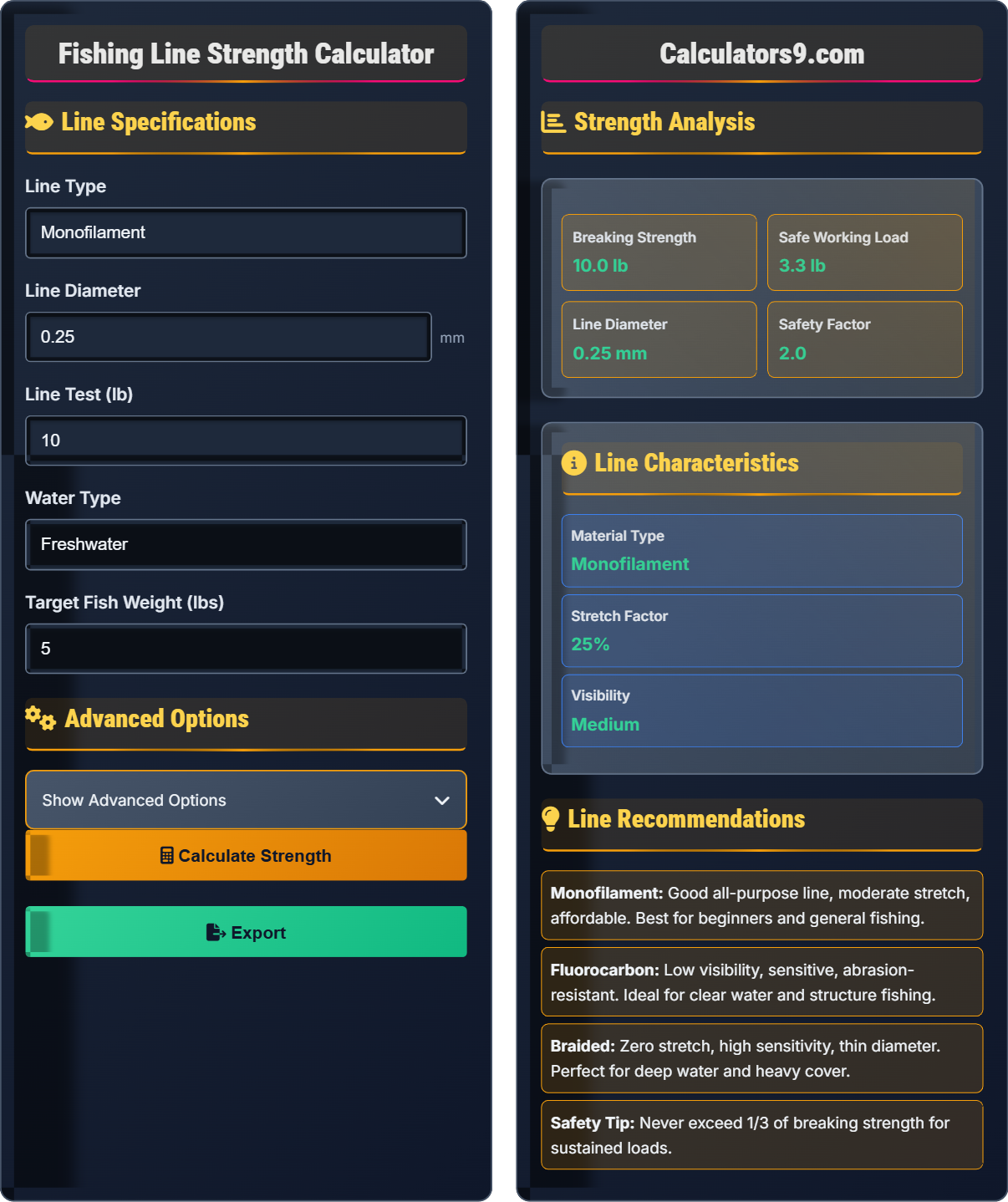
Line Specifications
Advanced Options
Strength Analysis
Line Characteristics
Line Recommendations
Monofilament: Good all-purpose line, moderate stretch, affordable. Best for beginners and general fishing.
Fluorocarbon: Low visibility, sensitive, abrasion-resistant. Ideal for clear water and structure fishing.
Braided: Zero stretch, high sensitivity, thin diameter. Perfect for deep water and heavy cover.
Safety Tip: Never exceed 1/3 of breaking strength for sustained loads.
Fishing Line Fundamentals
Fishing line strength refers to the breaking point of the line, measured in pounds (lb) or kilograms (kg). It indicates the maximum weight or force the line can withstand before breaking. The line test rating represents the minimum breaking strength under controlled laboratory conditions.
Fishing line strength is primarily determined by diameter and material composition. The relationship is roughly quadratic: doubling the diameter quadruples the strength. Different materials have different strength characteristics due to molecular structure and manufacturing processes.
- Never exceed 1/3 of breaking strength for sustained loads
- Knots reduce line strength by 10-20%
- Environmental factors degrade line performance
- Thicker lines are stronger but less sensitive
Line Types
Monofilament is the most common line type, offering good stretch and forgiveness. Fluorocarbon provides low visibility and sensitivity. Braided lines offer maximum strength in minimal diameter. Each type has specific applications based on fishing conditions and target species.
- Consider target fish size and fighting strength
- Evaluate fishing environment (structure, vegetation)
- Factor in visibility requirements
- Assess sensitivity needs
- Budget for line replacement
- Replace line annually or when damaged
- Match line strength to rod action
- Consider knot strength in calculations
- Factor in environmental stressors
Fishing Line Strength Quiz
What does the "test" rating of fishing line indicate?
The answer is B) The minimum breaking strength under controlled conditions. The test rating (e.g., 10 lb test) indicates the minimum weight required to break the line in laboratory conditions. However, this is not a safe working load—anglers should never attempt to hold weights equal to the test rating due to dynamic forces, knots, and environmental factors.
The test rating is a standardized measure of line strength, but it doesn't represent a safe working load. In real fishing situations, dynamic forces from casting, fighting fish, and snags can create loads several times the static weight. Additionally, knots reduce line strength by 10-20%, and environmental factors like UV exposure and abrasion further weaken the line. A general rule is to use no more than 1/3 of the test rating for sustained loads.
Test Rating: Minimum breaking strength under controlled conditions
Safe Working Load: Recommended maximum load for routine use
Dynamic Forces: Loads created by acceleration and movement
• Test rating ≠ safe working load
• Use 1/3 to 1/2 of test rating for safety
• Knots reduce line strength
• Choose line strength 2-3x target fish weight
• Test knots before fishing
• Replace line regularly
• Equating test rating with safe working load
• Not accounting for knot strength loss
• Using line beyond its capacity
If a 0.30mm diameter monofilament line has a test rating of 12 lb, what would be the approximate test rating of a 0.20mm diameter line of the same material? Use the square relationship between diameter and strength.
Step 1: Establish the relationship
Strength ∝ Diameter²
For the 0.30mm line: Strength₁ = k × (0.30)² = k × 0.09 = 12 lb
Therefore: k = 12 ÷ 0.09 = 133.3
Step 2: Calculate strength for 0.20mm line
Strength₂ = k × (0.20)² = 133.3 × 0.04 = 5.33 lb
Step 3: Verify using ratio method
(Strength₂ ÷ Strength₁) = (Diameter₂² ÷ Diameter₁²)
Strength₂ = 12 × (0.20² ÷ 0.30²) = 12 × (0.04 ÷ 0.09) = 12 × 0.444 = 5.33 lb
Therefore, the 0.20mm line would have approximately 5.3 lb test strength.
This problem demonstrates the quadratic relationship between line diameter and strength. When diameter is reduced by a factor of 2/3 (from 0.30mm to 0.20mm), the strength is reduced by a factor of (2/3)² = 4/9 ≈ 0.444. This relationship is fundamental to understanding how line specifications affect performance. Thicker lines are stronger but also more visible to fish and less sensitive.
Proportional Relationship: How strength changes with diameter
Quadratic Function: Strength ∝ Diameter²
Material Constant: k value for specific line type
• Strength ∝ Diameter²
• Halve diameter → quarter strength
• Double diameter → quadruple strength
• Remember: diameter² relationship
• Thicker lines = stronger but less sensitive
• Thinner lines = more sensitive but weaker
• Assuming linear relationship instead of quadratic
• Forgetting to square the diameter values
• Not accounting for material differences
You have 15 lb test line and want to target fish weighing up to 8 lbs. What safety factor are you using, and is this appropriate? Calculate the recommended safe working load for your line.
Step 1: Calculate the safety factor
Safety Factor = Breaking Strength ÷ Working Load
Safety Factor = 15 lb ÷ 8 lb = 1.875
Step 2: Evaluate appropriateness
A safety factor of 1.875 is below the recommended minimum of 3.0 for fishing lines. This provides insufficient margin for dynamic forces during casting and fighting fish.
Step 3: Calculate recommended safe working load
Safe Working Load = Breaking Strength ÷ Recommended Safety Factor
Safe Working Load = 15 lb ÷ 3.0 = 5.0 lb
Step 4: Recommend appropriate line
To safely target 8 lb fish, you would need: 8 lb × 3 = 24 lb test line
Therefore, your current setup has a safety factor of 1.875, which is inadequate. The recommended safe working load for 15 lb test line is 5.0 lb, and you should use at least 24 lb test line for 8 lb fish.
This problem highlights the importance of safety factors in fishing. Dynamic forces during casting and fighting fish can easily exceed the static weight of the fish. The recommended safety factor of 3.0 provides adequate margin for these forces. Using a lower safety factor risks line failure and lost fish.
Safety Factor: Ratio of breaking strength to working load
Dynamic Forces: Loads created by acceleration and movement
Safe Working Load: Maximum recommended load for routine use
• Minimum safety factor = 3.0 for fishing
• Dynamic forces exceed static weight
• Always consider peak loads
• Choose line strength 2-3x target fish weight
• Consider largest fish in area
• Factor in fishing technique
• Using test rating as safe working load
• Not accounting for dynamic forces
• Ignoring safety factor recommendations
You're using 20 lb test line tied with a Palomar knot (95% efficiency). What is the effective breaking strength at the knot? If you're targeting 10 lb fish, what safety factor do you have at the knot?
Step 1: Calculate effective strength at knot
Knot Efficiency = 95% = 0.95
Effective Strength = Original Strength × Knot Efficiency
Effective Strength = 20 lb × 0.95 = 19 lb
Step 2: Calculate safety factor for 10 lb fish
Safety Factor = Effective Strength ÷ Working Load
Safety Factor = 19 lb ÷ 10 lb = 1.9
Step 3: Evaluate adequacy
A safety factor of 1.9 is below the recommended minimum of 3.0, even with the high-efficiency Palomar knot.
Step 4: Calculate required line strength
To achieve safety factor of 3.0 with 10 lb fish:
Required Strength at Knot = 10 lb × 3.0 = 30 lb
Required Original Strength = 30 lb ÷ 0.95 = 31.6 lb
Therefore, the effective strength at the knot is 19 lb, giving a safety factor of 1.9 for 10 lb fish, which is inadequate. You'd need approximately 32 lb test line.
This problem demonstrates how knots significantly affect line strength. Even with a high-efficiency knot like the Palomar, there's still a 5% strength loss. When calculating safe loads, always consider the weakest point in your system, which is typically the knot. This is why it's important to tie knots properly and consider knot strength in your line selection.
Knot Efficiency: Percentage of original strength retained at knot
Weak Point: Lowest strength point in fishing systemSystem Strength: Strength of weakest component
• Knots reduce line strength
• System strength = weakest component
• Consider knot strength in calculations
• Learn efficient knots like Palomar
• Test knots before use
• Consider leader materials
• Ignoring knot strength in calculations
• Using weak knots for heavy fish
• Not testing knot security
Which of the following statements about different line types is TRUE?
The answer is C) Monofilament has moderate stretch and forgiveness. Monofilament lines typically have 20-25% stretch, providing good shock absorption and forgiveness when fighting fish. This stretch helps prevent line breakage during sudden pulls but reduces sensitivity compared to other line types.
Each line type has distinct characteristics that make it suitable for specific applications. Monofilament's moderate stretch provides a good balance of shock absorption and sensitivity. Braided lines have virtually zero stretch, providing excellent sensitivity but requiring careful hook setting. Fluorocarbon has low stretch and low visibility, making it ideal for clear water situations.
Stretch Factor: Percentage elongation under load
Sensitivity: Ability to transmit vibrations
Forgiveness: Shock absorption capability
• Monofilament: 20-25% stretch
• Braided: 0-2% stretch
• Fluorocarbon: 5-10% stretch
• Use monofilament for beginners
• Choose braided for sensitivity
• Select fluorocarbon for clear water
• Using wrong line type for conditions
• Not understanding stretch characteristics
• Ignoring visibility factors
FAQ
Q: How do I calculate the safe working load for my fishing line?
A: The safe working load is calculated by dividing the line's breaking strength by a safety factor. The formula is:
Safe Working Load = Breaking Strength ÷ Safety Factor
For fishing applications, a safety factor of 3.0 is recommended. This accounts for:
- Dynamic forces during casting and fighting fish
- Stress concentration at knots
- Environmental degradation (UV, abrasion)
- Manufacturing variations
For example, if you have 15 lb test line:
Safe Working Load = 15 ÷ 3.0 = 5.0 lb
This means you should not routinely hold loads exceeding 5.0 lbs. For targeting fish, choose line strength 2-3 times the expected maximum weight to account for sudden strikes and head-shaking.
Q: How do different line types affect strength and performance?
A: Different line types have distinct strength and performance characteristics:
Monofilament: Made from a single strand of nylon, it has 20-25% stretch, providing shock absorption and forgiveness. It's economical and good for beginners, but has higher visibility underwater and degrades faster with UV exposure.
Fluorocarbon: Has low stretch (5-10%) and very low visibility underwater due to its refractive index matching water. It's denser than water (sinks), more abrasion-resistant than mono, but more expensive.
Braided: Made from woven fibers, it has virtually zero stretch (0-2%), maximum sensitivity, and the smallest diameter for a given strength. However, it's highly visible and floats, making it less suitable for sight-sensitive fish.
Strength Comparison: For the same diameter, braided lines are strongest, followed by fluorocarbon, then monofilament. However, stretch and sensitivity also factor into performance.