Gardening Plant Spacing Calculator
Optimize your garden layout • Plant planning tool
Plant Spacing Formulas:
Show CalculatorPlant spacing calculations:
- Plants per row = Garden length ÷ Spacing
- Rows per bed = Garden width ÷ Row spacing
- Total plants = Plants per row × Rows per bed
- Required area = (Spacing × Row spacing) × Total plants
For square spacing: Area per plant = Spacing²
For triangular spacing: Area per plant = (Spacing² × √3)/2
Example: For a 10×8 foot garden with 12-inch (1 foot) spacing:
Plants per row = 10 ÷ 1 = 10 plants
Rows per bed = 8 ÷ 1 = 8 rows
Total plants = 10 × 8 = 80 plants
Each plant needs 1 square foot of growing space.
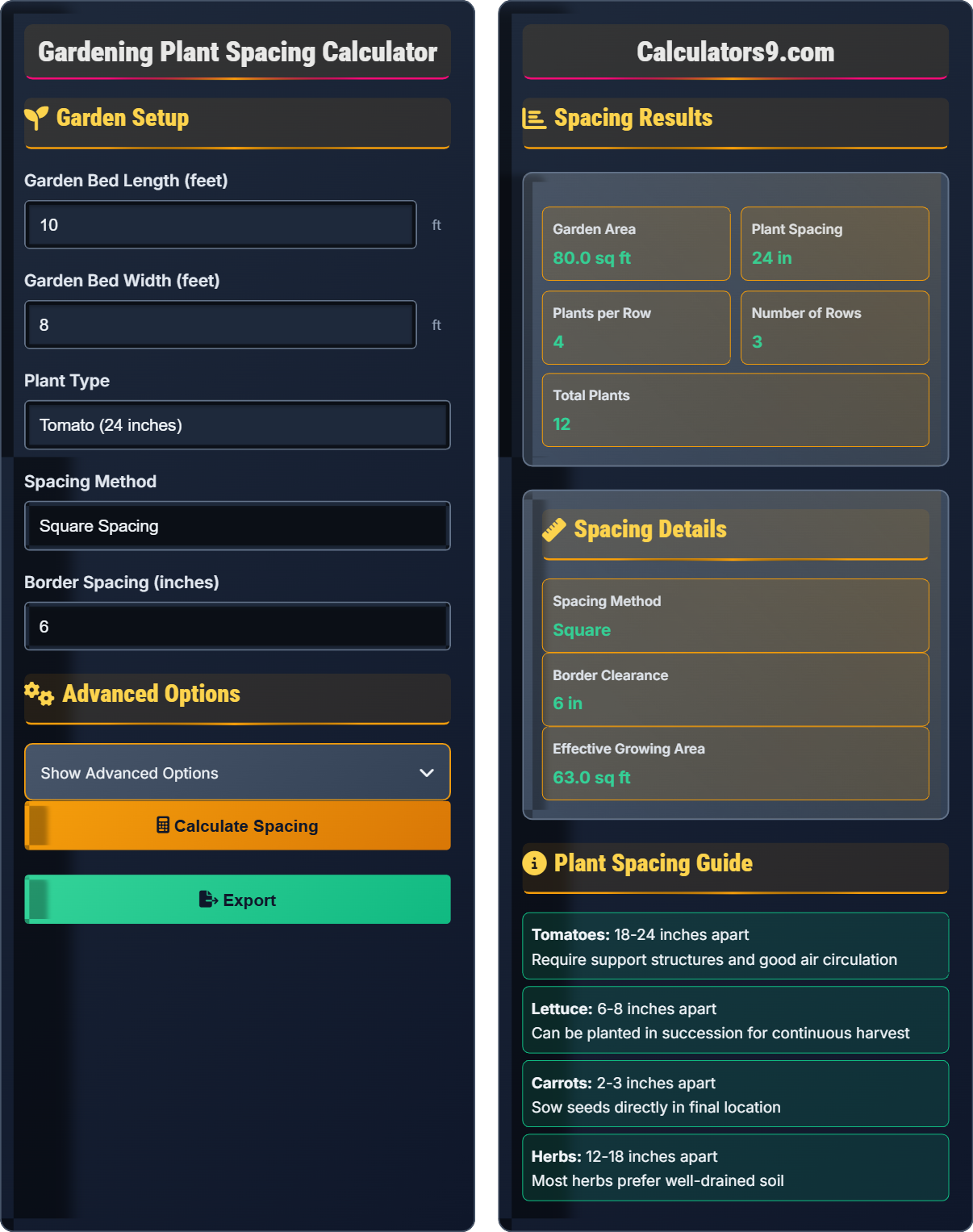
Garden Setup
Advanced Options
Spacing Results
Spacing Details
Plant Spacing Guide
Tomatoes: 18-24 inches apart
Require support structures and good air circulation
Lettuce: 6-8 inches apart
Can be planted in succession for continuous harvest
Carrots: 2-3 inches apart
Sow seeds directly in final location
Herbs: 12-18 inches apart
Most herbs prefer well-drained soil
Gardening Fundamentals
Proper plant spacing ensures adequate access to sunlight, water, nutrients, and air circulation. Correct spacing prevents competition between plants, reduces disease transmission, and maximizes yield. Overcrowding leads to stunted growth and increased pest problems.
There are three main spacing methods: Square spacing (equal distance between plants and rows), Triangular spacing (staggered rows for more plants in the same area), and Rectangular spacing (different distances between plants and rows). Each method optimizes different aspects of garden efficiency.
- Follow seed packet spacing recommendations
- Consider mature plant size, not seedling size
- Allow for air circulation to prevent diseases
- Plan for easy access to harvest
Plant Categories
Different plant types have varying spacing needs: Root vegetables like carrots need 2-3 inches, leafy greens like lettuce need 6-8 inches, and vining plants like tomatoes need 18-24 inches. Tall plants should be positioned to avoid shading shorter crops.
- Research specific plant spacing requirements
- Sketch your garden layout before planting
- Consider companion planting benefits
- Plan succession plantings for continuous harvest
- Leave pathways for access and maintenance
- Measure twice, plant once
- Start with a garden plan
- Consider plant height when positioning
- Allow for growth and expansion
Gardening Plant Spacing Quiz
Why is proper plant spacing important in gardening?
The answer is B) To ensure adequate access to resources and air circulation. Proper plant spacing is crucial for plant health because it ensures each plant has access to sufficient sunlight, water, and nutrients without competing with neighbors. Adequate spacing also promotes air circulation, which reduces the risk of fungal diseases and pest problems. Overcrowding leads to stunted growth, increased disease susceptibility, and lower yields.
Plant spacing is fundamental to successful gardening because plants need space to develop properly. Each plant requires a certain amount of root space to absorb nutrients and water, and adequate above-ground space to access sunlight. Proper spacing also allows beneficial insects and air to move freely, which helps control pests and diseases. The spacing requirements are based on the mature size of plants, not their seedling size.
Resource Competition: When plants compete for water, nutrients, and sunlight
Air Circulation: Movement of air around plants to prevent moisture buildup
Disease Prevention: Reducing conditions favorable to pathogens
• Follow seed packet spacing recommendations
• Consider mature plant size, not seedling size
• Allow for air circulation to prevent diseases
• Mark spacing on the ground before planting
• Use a spacing stick or ruler for accuracy
• Plan for plant growth over the season
• Planting too closely to maximize plant count
• Not accounting for plant growth during season
• Ignoring spacing recommendations for "better yields"
Calculate how many tomato plants can fit in a 12×6 foot garden bed if tomatoes require 24 inches (2 feet) of spacing in all directions. How many plants would fit using triangular spacing instead of square spacing?
Step 1: Calculate for square spacing
Plants per row = Garden length ÷ Spacing
Plants per row = 12 feet ÷ 2 feet = 6 plants
Number of rows = Garden width ÷ Spacing
Number of rows = 6 feet ÷ 2 feet = 3 rows
Total plants (square) = 6 × 3 = 18 plants
Step 2: Calculate for triangular spacing
In triangular spacing, rows are offset, allowing more plants per row in alternating rows
Plants in odd rows = 6 plants
Plants in even rows = 5 plants (due to offset)
Number of odd rows = 2 (rows 1 and 3)
Number of even rows = 1 (row 2)
Total plants (triangular) = (2 × 6) + (1 × 5) = 12 + 5 = 17 plants
Actually, triangular spacing increases plant density. More accurately:
Row spacing in triangular = 2 feet × (√3/2) ≈ 1.73 feet
Number of rows = 6 ÷ 1.73 ≈ 3.47, so 3 rows
Plants per row alternate between 6 and 5 plants
Total = 6 + 5 + 6 = 17 plants
Triangular spacing typically allows about 15% more plants than square spacing.
This calculation demonstrates the difference between square and triangular spacing. Square spacing arranges plants in a grid pattern, while triangular spacing offsets alternating rows, allowing more plants to fit in the same area. The triangular pattern follows the geometric principle that equilateral triangles provide optimal space utilization. However, triangular spacing can make cultivation and harvesting more challenging.
Square Spacing: Plants arranged in a rectangular grid pattern
Triangular Spacing: Staggered rows for maximum plant density
Plant Density: Number of plants per unit area
• Square spacing: plants = (length ÷ spacing) × (width ÷ spacing)
• Triangular spacing: approximately 15% more plants
• Consider practical access for maintenance
• Square spacing is easier to maintain
• Triangular spacing maximizes plant count
• Consider crop type when choosing spacing method
• Not adjusting row spacing in triangular pattern
• Forgetting that triangular spacing is more complex to maintain
• Calculating triangular spacing incorrectly
You want to plant lettuce in a 10×4 foot raised bed. Lettuce requires 6 inches (0.5 feet) of spacing. You also want to leave a 1-foot border around the entire bed. How many lettuce plants can you fit, and what percentage of the bed will be planted?
Step 1: Calculate effective growing area
Original bed = 10 feet × 4 feet = 40 square feet
After 1-foot border on all sides:
Effective length = 10 - (1 + 1) = 8 feet
Effective width = 4 - (1 + 1) = 2 feet
Effective area = 8 × 2 = 16 square feet
Step 2: Calculate number of plants
Plants per row = 8 feet ÷ 0.5 feet = 16 plants
Number of rows = 2 feet ÷ 0.5 feet = 4 rows
Total plants = 16 × 4 = 64 plants
Step 3: Calculate percentage planted
Planted area = 64 plants × (0.5 × 0.5) = 64 × 0.25 = 16 square feet
Percentage of original bed = (16 ÷ 40) × 100 = 40%
Therefore, you can fit 64 lettuce plants, and 40% of the original bed will be planted (excluding borders).
This problem demonstrates the importance of accounting for borders when planning gardens. Borders provide access for maintenance and harvesting, and they also serve as pathways for beneficial insects. The calculation shows how the effective growing area is reduced when borders are included, which directly impacts the number of plants that can be grown. This is an important consideration for maximizing garden productivity.
Effective Growing Area: Space available for planting after accounting for borders
Plant Density: Number of plants per unit area
Border Space: Unplanted area around the perimeter for access
• Always account for borders in space calculations
• Border space is essential for garden maintenance
• Calculate effective growing area before plant count
• Plan borders before determining plant count
• Consider 1-2 foot borders for easy access
• Mark borders physically before planting
• Calculating plant count for entire bed without borders
• Forgetting that borders reduce effective growing space
• Not accounting for access paths in design
You have a 12×8 foot garden bed and want to plant tomatoes (24-inch spacing), peppers (18-inch spacing), and lettuce (6-inch spacing). How would you arrange these plants to maximize space utilization while following proper spacing? Calculate the number of each plant you can grow.
Step 1: Convert spacing to feet
Tomatoes: 24 inches = 2 feet
Peppers: 18 inches = 1.5 feet
Lettuce: 6 inches = 0.5 feet
Step 2: Plan the layout strategically
Position tall plants (tomatoes) on the north side to avoid shading shorter plants
Place medium plants (peppers) in the middle
Plant lettuce along the south edge where it gets morning sun
Step 3: Calculate space allocation
Allocate 4 feet width for tomatoes (north side)
Allocate 2 feet width for peppers (middle)
Allocate 2 feet width for lettuce (south side)
Tomatoes: (12 ÷ 2) × (4 ÷ 2) = 6 × 2 = 12 plants
Peppers: (12 ÷ 1.5) × (2 ÷ 1.5) = 8 × 1.33 ≈ 8 plants (round down)
Lettuce: (12 ÷ 0.5) × (2 ÷ 0.5) = 24 × 4 = 96 plants
Step 4: Verify total space
Tomato area: 12 × (2 × 2) = 48 sq ft
Pepper area: 8 × (1.5 × 1.5) = 18 sq ft
Lettuce area: 96 × (0.5 × 0.5) = 24 sq ft
Total planted area: 48 + 18 + 24 = 90 sq ft
Bed area: 12 × 8 = 96 sq ft
Therefore, you can grow 12 tomatoes, 8 peppers, and 96 lettuce plants.
This problem demonstrates companion planting and spatial planning. Different plants have different spacing requirements and environmental preferences. Strategic placement considers factors like height (to prevent shading), nutrient requirements, and companion benefits. The solution shows how to partition the garden space based on plant needs while maintaining proper spacing for each type.
Companion Planting: Growing compatible plants together
Vertical Stratification: Arranging plants by height to optimize light
Spatial Planning: Efficient allocation of garden space
• Place taller plants on the north side
• Group plants with similar spacing requirements
• Consider companion planting benefits
• Plan garden layout on paper first
• Consider succession planting for continuous harvest
• Leave pathways between plant groups
• Not considering plant height in positioning
• Mixing incompatible plants
• Not leaving adequate space for maintenance
Which spacing method allows for the maximum number of plants in a given area?
The answer is B) Triangular spacing. Triangular spacing allows for approximately 15% more plants in the same area compared to square spacing. This is because the staggered rows in triangular spacing utilize space more efficiently, allowing plants to be placed closer together while maintaining adequate growing space. The pattern follows the geometric principle that equilateral triangles provide optimal space utilization.
Triangular spacing creates an offset pattern where plants in one row are positioned between plants in adjacent rows. This geometric arrangement allows for more plants per unit area while maintaining the same distance between plants. However, triangular spacing can make cultivation, weeding, and harvesting more challenging compared to square spacing. The choice between spacing methods depends on the specific crop and management preferences.
Square Spacing: Plants arranged in a grid pattern
Triangular Spacing: Staggered rows for maximum density
Plant Density: Number of plants per unit area
• Triangular spacing: ~15% more plants than square
• Square spacing: easier to manage
• Consider crop type when choosing method
• Use triangular spacing for dense crops like lettuce
• Use square spacing for crops needing maintenance
• Plan spacing method before planting
• Using triangular spacing for crops requiring maintenance access
• Not accounting for different spacing requirements
• Confusing spacing methods in calculations
FAQ
Q: How do I determine the right spacing for different plants?
A: Determining proper plant spacing involves several factors:
Seed Packet Information: Always start with the spacing recommendations on seed packets or plant tags. These are based on optimal growing conditions for that specific variety.
Mature Plant Size: Spacing should be based on how large the plant will grow, not its current size. A small seedling may only be an inch across, but the mature plant might spread 2 feet.
Plant Category: Different plant types have different spacing needs:
- Root vegetables (carrots, radishes): 2-4 inches
- Leafy greens (lettuce, spinach): 6-8 inches
- Herbs: 12-18 inches
- Vining plants (tomatoes, squash): 18-36 inches
Environmental Factors: In rich, fertile soil with good irrigation, plants may grow larger and need more space. In poor conditions, they might stay smaller.
Intended Use: For continuous harvest of leafy greens, you might plant more densely and harvest young plants, or use succession planting.
Q: What's the difference between square and triangular plant spacing?
A: Square and triangular spacing differ in their geometric arrangement and efficiency:
Square Spacing: Plants are arranged in a rectangular grid pattern with equal spacing between plants and rows. For example, if spacing is 12 inches, each plant is 12 inches from the next plant in both directions. This method is easier to navigate for cultivation, weeding, and harvesting.
Triangular Spacing: Also called hexagonal or offset spacing, plants in alternating rows are shifted halfway between plants in adjacent rows. This creates a triangular pattern of plants. The distance between plants in the same row is the same as square spacing, but the row spacing is reduced by a factor of √3/2 ≈ 0.866.
Mathematical Advantage: Triangular spacing allows approximately 15% more plants per unit area than square spacing while maintaining the same distance between adjacent plants. For a 10×10 foot plot with 12-inch spacing:
Square spacing: 10 plants per row × 10 rows = 100 plants
Triangular spacing: 10 plants in odd rows × 9 rows (with 5 plants in even rows) ≈ 95 plants, but with tighter row spacing you can fit more rows, potentially reaching 115 plants.
Trade-offs: While triangular spacing maximizes plant density, it can make cultivation and harvesting more difficult due to the irregular pattern.