Deck Material Calculator
Estimate materials for DIY projects • 2026 edition
Deck Material Formula:
Show the calculator\( \text{Lumber Needed (bd ft)} = \frac{\text{Deck Area (sq ft)} \times \text{Coverage Factor}}{12} \)
Where:
- \( \text{Deck Area} \) = Length × Width of deck in square feet
- \( \text{Coverage Factor} \) = Amount of lumber needed per square foot (typically 1.2-1.5 for framing)
- \( \text{Lumber Needed} \) = Total board feet of lumber required
This formula calculates the amount of lumber needed based on deck area and construction requirements.
Example: For a 12 ft × 10 ft deck (120 sq ft) with a coverage factor of 1.3:
Lumber needed: \( \frac{120 \times 1.3}{12} = 13 \) board feet
Thus, approximately 13 board feet of lumber would be needed for this deck.
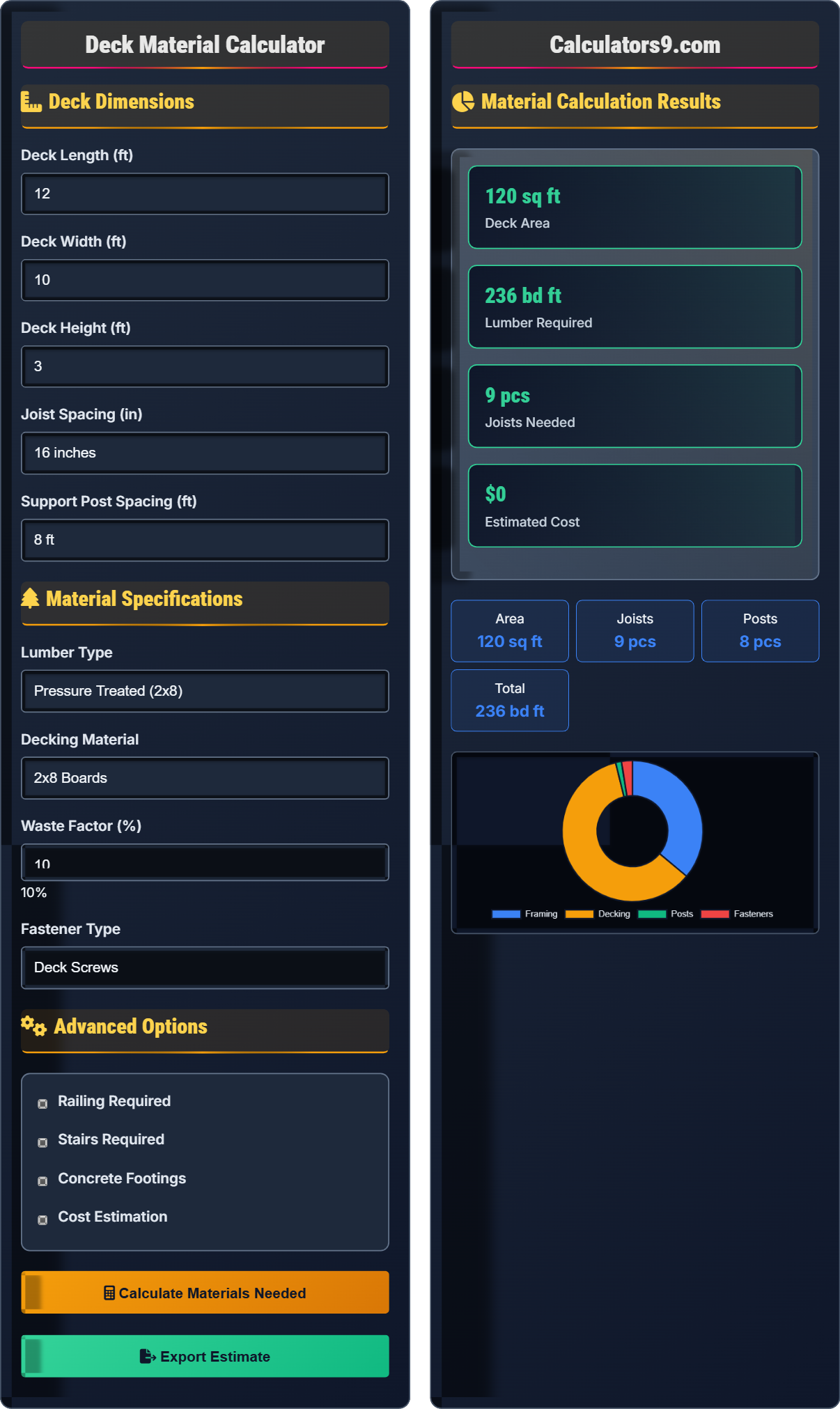
Deck Dimensions
Material Specifications
Advanced Options
Material Calculation Results
- Circular saw or miter saw
- Power drill with bits
- Hammer
- Tape measure
- Speed square
- Level
- Safety glasses
- Work gloves
Deck Building Guide
Standard deck construction uses 2x8 joists spaced 16" apart, 2x10 beams, and 4x4 posts. Pressure-treated lumber is recommended for outdoor applications.
Calculate joists needed: (Deck Width ÷ Joist Spacing) + 1. Add beams, posts, and decking based on span requirements and local codes.
- Follow local building codes
- Use pressure-treated lumber
- Proper joist spacing
- Secure anchoring
Material Types
Pressure Treated: Economical, weather-resistant. Cedar: Natural, insect-resistant. Composite: Low-maintenance, durable. Redwood: Premium, beautiful.
- Budget considerations
- Maintenance requirements
- Local climate
- Desired appearance
- Span limitations
- Load requirements
- Fastener compatibility
- Expansion gaps
Deck Building Quiz
What is the most common joist spacing for residential decks?
The answer is B) 16 inches. The most common joist spacing for residential decks is 16 inches on center. This spacing provides adequate support for standard decking materials while maintaining structural integrity.
Joist spacing is critical for deck safety and stability. 16 inches on center is the standard for most residential applications because it balances structural requirements with material efficiency. Closer spacing (12") provides more support but uses more material, while wider spacing (24") uses less material but requires stronger joists.
Joist Spacing: Distance between centers of adjacent joists
On Center: Measurement from center to center
Structural Integrity: Ability to support loads safely
• Standard spacing: 16 inches
• Maximum spacing: 24 inches
• Depends on decking material
• 12" for heavy loads
• 16" for standard use
• 24" for light-duty decks
• Spacing too far apart
• Not following local codes
• Ignoring decking material requirements
Calculate the number of joists needed for a 12 ft wide deck with joists spaced 16 inches on center. Show your work.
Step 1: Convert deck width to inches
Deck width = 12 ft × 12 in/ft = 144 inches
Step 2: Apply the joist calculation formula
Number of joists = (Deck width ÷ Joist spacing) + 1
Number of joists = (144 ÷ 16) + 1
Number of joists = 9 + 1 = 10
Step 3: Verify the calculation
9 spaces × 16 inches = 144 inches
Plus 1 joist at the beginning = 10 total joists
Step 4: Consider the beam
Plus 1 beam joist = 11 total joists
Therefore, 11 joists are needed for this deck (including the beam joist).
This calculation demonstrates the standard formula for determining joist count. The "+1" accounts for the joist at the starting point. The beam joist is often counted separately as it supports the ends of the other joists. Always round up if the division doesn't result in a whole number.
Joist: Horizontal structural member supporting decking
On Center: Measured from center to center
Beam Joist: Joist that supports other joists
• Formula: (Width ÷ Spacing) + 1
• Always round up if remainder exists
• Include beam joist in total
• Convert to same units first
• Count beam joist separately
• Verify with spacing diagram
• Forgetting the +1 in the formula
• Not converting units properly
• Missing the beam joist
Sarah is building a 10 ft × 12 ft deck with 2x8 joists spaced 16 inches on center. She's using 2x8 decking boards running perpendicular to the joists. Calculate the total board feet needed for joists and decking, including a 10% waste factor.
Step 1: Calculate joists needed
Deck width = 10 ft = 120 inches
Joists = (120 ÷ 16) + 1 = 7.5 + 1 = 8.5 → 9 joists
Plus 1 beam joist = 10 total joists
Each joist length = 12 ft
Joist board feet = 10 joists × 12 ft × 8 in ÷ 12 = 80 bd ft
Step 2: Calculate decking needed
Decking runs perpendicular to joists
Decking length = 10 ft
Spacing between decking = 0.25 in (typical)
Number of decking boards = (12 ft × 12 in/ft) ÷ (8 in + 0.25 in) = 144 ÷ 8.25 = 17.5 → 18 boards
Decking board feet = 18 boards × 10 ft × 8 in ÷ 12 = 120 bd ft
Step 3: Calculate total before waste
Total board feet = 80 + 120 = 200 bd ft
Step 4: Apply waste factor
With 10% waste = 200 × 1.10 = 220 bd ft
Therefore, Sarah needs 220 board feet of lumber for her deck project.
This problem combines multiple calculations: joist count, decking count, and board feet calculation. The board feet formula is: length × width × thickness ÷ 12. Always consider waste factor for cuts and potential defects.
Board Feet: Volume measurement (length × width × thickness ÷ 12)
Perpendicular: Running at right angles
Waste Factor: Additional material for cuts and defects
• Board feet = (L × W × T) ÷ 12
• Account for spacing between boards
• Include waste factor in final calculation
• Always round joist count up
• Consider spacing in decking count
• Add 10-15% waste factor
• Forgetting beam joist in count
• Not accounting for spacing in decking
• Incorrect board feet calculation
Mike is building a 16 ft × 12 ft deck. Local building codes require support posts spaced no more than 8 feet apart. Calculate the number of 4x4 posts needed and the total linear feet of post material if the deck height is 4 feet.
Step 1: Determine post spacing requirements
Maximum spacing = 8 ft
Deck length = 16 ft
Posts along length = (16 ÷ 8) + 1 = 2 + 1 = 3 posts
Deck width = 12 ft
Posts along width = (12 ÷ 8) + 1 = 1.5 + 1 = 2.5 → 3 posts
Step 2: Calculate total posts
Corner posts = 4
Intermediate posts along length = (3 - 2) × 2 = 2
Intermediate posts along width = (3 - 2) × 2 = 2
Total posts = 4 + 2 + 2 = 8 posts
Step 3: Calculate total linear feet
Post height = 4 ft
Total linear feet = 8 posts × 4 ft = 32 linear feet
Step 4: Verify spacing
Along length: 16 ft ÷ (3 - 1) = 8 ft spacing ✓
Along width: 12 ft ÷ (3 - 1) = 6 ft spacing ✓
Therefore, Mike needs 8 posts totaling 32 linear feet of 4x4 lumber.
This problem demonstrates calculating support posts for deck framing. Posts are typically placed at corners and spaced evenly along the sides. The spacing requirement ensures adequate support for the deck structure.
Support Post: Vertical member supporting deck structure
Linear Feet: Total length of materialBuilding Code: Legal construction requirements
• Follow local building codes
• Maximum spacing: typically 8 ft
• Include corner and intermediate posts
• Always check local codes
• Consider 6 ft spacing for extra strength
• Use 4x4 or 6x6 posts as required
• Not following code requirements
• Incorrect post count calculation
• Forgetting corner posts
Which decking material provides the best durability with minimal maintenance?
The answer is C) Composite decking. Composite decking is made from recycled plastic and wood fibers, providing excellent durability with virtually no maintenance requirements like staining or sealing.
Decking material selection involves balancing cost, durability, and maintenance. Composite decking offers superior longevity and requires minimal upkeep compared to wood alternatives. However, it typically costs more upfront than wood options.
Composite Decking: Man-made material from wood/plastic
Durability: Resistance to weather and wear
Maintenance: Ongoing care requirements
• Composite: Low maintenance
• Wood: Requires sealing/staining
• Consider lifecycle costs
• Composite: Higher initial cost
• Wood: Lower initial cost
• Consider total lifecycle cost
• Only considering upfront cost
• Not factoring in maintenance
• Ignoring climate considerations
FAQ
Q: How do I calculate the number of deck boards needed?
A: Calculate deck boards using this formula:
- Deck width in inches: Length × 12
- Board coverage: Board width + gap
- Boards needed: (Deck width ÷ Board coverage) + 1
For a 10 ft wide deck with 5.5" boards and 0.25" gaps: (120 ÷ 5.75) + 1 = 21.04 → 22 boards.
Q: Do I need permits for building a deck?
A: Permit requirements vary by location:
- Attached decks: Almost always require permits
- Detached decks: May not require permits if under certain size/height
- Typical thresholds: 30 sq ft or 30" height
- Always check: Local building department
When in doubt, obtain a permit to ensure code compliance and safety.