Fertilizer Calculator
Estimate fertilizer for DIY projects • 2026 edition
Fertilizer Calculation Formula:
Show the calculator\( \text{Fertilizer Needed (lbs)} = \frac{\text{Total Area (sq ft)} \times \text{Application Rate (lbs/1000 sq ft)}}{1000} \)
Where:
- \( \text{Total Area} \) = Combined area to be fertilized
- \( \text{Application Rate} \) = Recommended rate from fertilizer package (typically 5-10 lbs per 1000 sq ft)
- \( \text{Fertilizer Needed} \) = Amount of fertilizer required in pounds
This formula calculates the amount of fertilizer needed based on area and application rate.
Example: For a lawn area of 1500 sq ft, using a fertilizer with 8 lbs/1000 sq ft application rate:
Fertilizer needed: \( \frac{1500 \times 8}{1000} = \frac{12000}{1000} = 12 \) lbs
Thus, 12 pounds of fertilizer would be needed for this application.
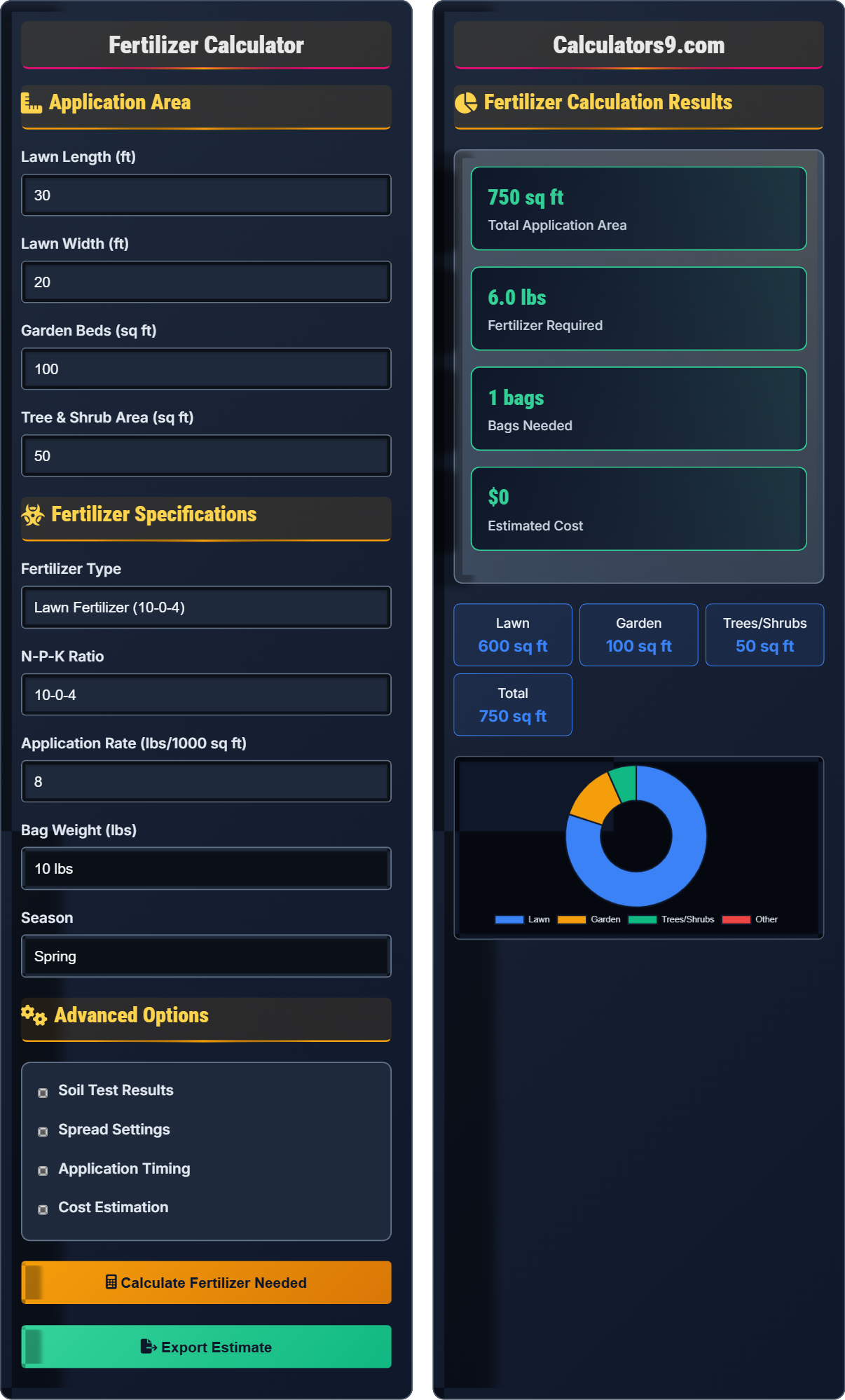
Application Area
Fertilizer Specifications
Advanced Options
Fertilizer Calculation Results
- Rotary spreader or drop spreader
- Protective gloves
- Safety glasses
- Measuring tape
- Marking flags or chalk
- Calibration tools
- Water for cleaning
Fertilizer Application Guide
Nitrogen (N) promotes green growth, Phosphorus (P) supports root development, Potassium (K) enhances disease resistance. Different plants need different ratios.
Fertilizer Needed = (Total Area × Application Rate) ÷ 1000. Always follow package directions and avoid over-application.
- Test soil before fertilizing
- Follow application rates
- Water after application
- Apply during appropriate seasons
Fertilizer Types
Lawn: High nitrogen for green growth. Garden: Balanced nutrients. Flower: Phosphorus for blooms. Tree/Shrub: Balanced with micronutrients. Organic: Slow-release nutrients.
- Plant type and needs
- Soil conditions
- Season timing
- Weather conditions
- Soil pH affects nutrient uptake
- Over-fertilizing causes damage
- Timing affects effectiveness
- Environmental impact
Fertilizer Application Quiz
What do the three numbers in an N-P-K fertilizer ratio represent?
The answer is D) Nitrogen-Phosphorus-Potash (P₂O₅-K₂O). The N-P-K ratio represents Nitrogen (N), Phosphorus as P₂O₅ (phosphate), and Potassium as K₂O (potash). These are the standardized forms used in fertilizer labeling, not the pure elements.
The N-P-K rating system uses specific chemical compounds rather than pure elements. Nitrogen is listed as-is, Phosphorus is listed as P₂O₅ (phosphate), and Potassium is listed as K₂O (potash). This standardization helps consumers compare products and understand nutrient content.
N-P-K Rating: Standard fertilizer analysis system
Nitrogen (N): Promotes leafy green growth
Phosphorus (P₂O₅): Supports root development
Potassium (K₂O): Enhances disease resistance
• N-P-K uses standardized chemical forms
• P₂O₅ represents phosphorus content
• K₂O represents potassium content
• N promotes green growth
• P supports roots and flowers
• K enhances overall plant health
• Thinking N-P-K represents pure elements
• Confusing P with pure phosphorus
• Not understanding standardized forms
Calculate the fertilizer needed for a 2000 sq ft lawn using a 15-5-10 fertilizer with an application rate of 6 lbs per 1000 sq ft. Show your work.
Step 1: Identify the known values
- Total area = 2000 sq ft
- Application rate = 6 lbs per 1000 sq ft
Step 2: Apply the fertilizer calculation formula
Fertilizer needed = (Total area × Application rate) ÷ 1000
Fertilizer needed = (2000 × 6) ÷ 1000
Fertilizer needed = 12000 ÷ 1000
Fertilizer needed = 12 lbs
Step 3: Calculate actual nutrients applied
Nitrogen: 12 lbs × 0.15 = 1.8 lbs N
Phosphorus: 12 lbs × 0.05 = 0.6 lbs P₂O₅
Potassium: 12 lbs × 0.10 = 1.2 lbs K₂O
Therefore, 12 pounds of 15-5-10 fertilizer are needed, providing 1.8 lbs of nitrogen, 0.6 lbs of phosphate, and 1.2 lbs of potash.
This calculation demonstrates the standard fertilizer formula and shows how to determine actual nutrient amounts. The formula (area × rate) ÷ 1000 gives the total fertilizer needed. Multiplying by the N-P-K percentages reveals the actual nutrient content applied to the lawn.
Application Rate: Amount of fertilizer per unit area
Nutrient Content: Actual amounts of N, P, K applied
Standard Formula: (Area × Rate) ÷ 1000
• Use the standard fertilizer formula
• Follow package application rates
• Calculate actual nutrient content
• Always follow package directions
• Calculate actual nutrient content
• Round up to bag sizes for practicality
• Not using the standard formula
• Ignoring package application rates
• Forgetting to calculate actual nutrients
Sarah needs to fertilize her property which includes: a lawn area of 1500 sq ft, garden beds totaling 200 sq ft, and a tree area of 100 sq ft. She plans to use 10-10-10 fertilizer for gardens and trees at 5 lbs/1000 sq ft, and 16-4-8 fertilizer for the lawn at 7 lbs/1000 sq ft. Calculate the total fertilizer needed.
Step 1: Calculate lawn fertilizer
Lawn area = 1500 sq ft
Application rate = 7 lbs/1000 sq ft
Lawn fertilizer = (1500 × 7) ÷ 1000 = 10.5 lbs of 16-4-8 fertilizer
Step 2: Calculate garden/tree fertilizer
Garden + tree area = 200 + 100 = 300 sq ft
Application rate = 5 lbs/1000 sq ft
Garden/tree fertilizer = (300 × 5) ÷ 1000 = 1.5 lbs of 10-10-10 fertilizer
Step 3: Calculate total fertilizer
Total fertilizer = 10.5 lbs + 1.5 lbs = 12 lbs
Step 4: Calculate actual nutrients applied
Lawn nitrogen: 10.5 × 0.16 = 1.68 lbs
Garden nitrogen: 1.5 × 0.10 = 0.15 lbs
Total nitrogen applied = 1.83 lbs
Therefore, Sarah needs 10.5 lbs of 16-4-8 fertilizer for the lawn and 1.5 lbs of 10-10-10 fertilizer for gardens and trees, totaling 12 lbs of fertilizer.
This problem demonstrates calculating fertilizer for different areas with different needs. Each area requires specific fertilizer types and rates based on plant requirements. The calculation shows how to handle multiple fertilizer types and application rates for a comprehensive property.
Differential Application: Using different fertilizers for different areas
Site-Specific Needs: Varying fertilizer requirements
Total Nutrient Input: Sum of all nutrients applied
• Use appropriate fertilizer for each area
• Follow specific application rates
• Calculate for each area separately
• Match fertilizer to plant needs
• Calculate each area separately
• Keep fertilizer types separate
• Using same fertilizer for all areas
• Not considering plant-specific needs
• Mixing application rates incorrectly
Mike has a 2500 sq ft lawn and wants to follow a seasonal fertilization program using 22-0-14 fertilizer at 8 lbs/1000 sq ft. He plans to fertilize in April, June, September, and November. Calculate the total fertilizer needed for the year and the actual nitrogen applied each application.
Step 1: Calculate fertilizer per application
Lawn area = 2500 sq ft
Application rate = 8 lbs/1000 sq ft
Fertilizer per application = (2500 × 8) ÷ 1000 = 20 lbs
Step 2: Calculate nitrogen per application
Nitrogen percentage = 22%
Nitrogen per application = 20 lbs × 0.22 = 4.4 lbs N
Step 3: Calculate annual fertilizer needs
Applications per year = 4
Total fertilizer = 20 lbs × 4 = 80 lbs
Total nitrogen = 4.4 lbs × 4 = 17.6 lbs N
Step 4: Verify annual nitrogen recommendation
Typical recommendation = 1-2 lbs N per 1000 sq ft per year
For 2500 sq ft = 2.5-5 lbs N per year
Mike's program = 17.6 lbs N per year
This exceeds recommendations (17.6 ÷ 2.5 = 7.04x recommended rate)
Therefore, Mike needs 80 lbs of fertilizer annually, but this provides 7 times the recommended nitrogen rate. He should consider reducing applications or using a lower-nitrogen fertilizer.
This example shows the importance of calculating total annual nutrient input. While the per-application rate may seem reasonable, the cumulative annual application can exceed plant needs and potentially cause environmental harm. Balancing seasonal applications with annual recommendations is crucial.
Annual Program: Total fertilizer applications per year
Nitrogen Load: Total nitrogen applied annually
Environmental Impact: Effects of excess fertilizer
• Calculate total annual nutrient input
• Follow recommended annual rates
• Consider environmental impact
• Limit annual nitrogen to 1-2 lbs/1000 sq ft
• Adjust programs based on soil tests
• Consider slow-release alternatives
• Not calculating annual totals
• Exceeding recommended rates
• Ignoring environmental impact
When is the best time to fertilize cool-season grasses like Kentucky Bluegrass and Fescue?
The answer is C) Spring and Fall. Cool-season grasses have their peak growth periods in spring and fall when temperatures are cooler. Fertilizing during these active growth periods maximizes nutrient uptake and utilization.
Fertilizing timing should align with plant growth patterns. Cool-season grasses grow most actively in spring and fall when temperatures are moderate. Fertilizing during these periods provides nutrients when plants can utilize them most effectively for growth and storage.
Cool-Season Grasses: Grow best in cooler temperatures
Active Growth Periods: Times of maximum nutrient uptake
Fertilization Timing: Synchronizing application with growth
• Match fertilization to growth periods
• Cool-season: Spring and fall
• Warm-season: Late spring and summer
• Cool-season: April, September, November
• Warm-season: May, July, September
• Avoid fertilizing during stress periods
• Fertilizing during dormant periods
• Not considering grass type
• Applying during heat stress
FAQ
Q: How do I calibrate my fertilizer spreader?
A: Calibrate your spreader using these steps:
- Mark a test area: 100 sq ft (10×10 ft)
- Weigh fertilizer: Determine how much to apply per 1000 sq ft
- Calculate test amount: Divide by 10 (for 100 sq ft)
- Test spread: Fill spreader and mark setting
- Adjust setting: Until correct amount is applied
Always test your spreader before large applications to ensure even distribution.
Q: How long should I wait before mowing after fertilizing?
A: Wait at least 24-48 hours after fertilizing before mowing:
- Liquid fertilizer: Wait 24 hours minimum
- Granular fertilizer: Wait 24-48 hours
- Slow-release: Wait 48 hours minimum
This allows the fertilizer to dissolve and be absorbed by the grass blades and roots.