Flooring Calculator
Estimate flooring materials for DIY projects • 2026 edition
Flooring Material Formula:
Show the calculator\( \text{Materials Needed} = \frac{\text{Total Area (sq ft)} \times (1 + \text{Waste Factor})}{\text{Coverage per Unit}} \)
Where:
- \( \text{Total Area} \) = Combined floor area to be covered
- \( \text{Waste Factor} \) = Additional percentage for cuts, errors, and future repairs (typically 10-15%)
- \( \text{Coverage per Unit} \) = Area covered by one unit of material (e.g., box of tiles, plank)
- \( \text{Materials Needed} \) = Amount of material required
This formula calculates the amount of flooring material needed based on area and waste considerations.
Example: For a room with 200 sq ft area, using tiles that cover 10 sq ft per box, with 10% waste factor:
Materials needed: \( \frac{200 \times (1 + 0.10)}{10} = \frac{200 \times 1.10}{10} = \frac{220}{10} = 22 \) boxes
Thus, 22 boxes would be needed for this project.
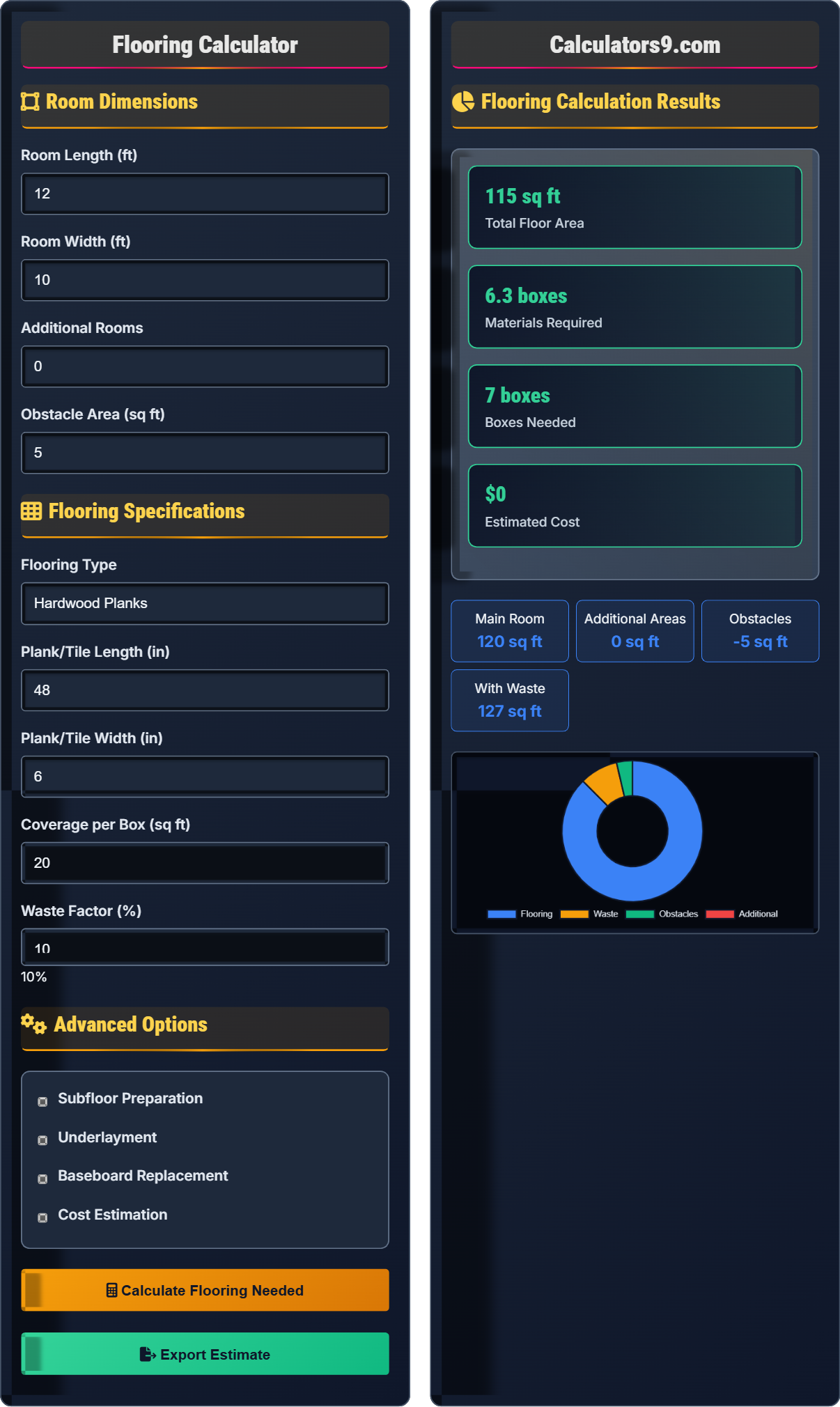
Room Dimensions
Flooring Specifications
Advanced Options
Flooring Calculation Results
- Measuring tape
- Utility knife
- Chalk line
- Square
- Mallet
- Spacers
- Drill
- Saw (circular or miter)
Flooring Project Guide
Standard flooring boxes contain 20-25 sq ft coverage. Always add 10-15% waste factor for cuts, errors, and future repairs. Measure carefully to avoid shortages.
Total Area = (Length × Width) + Additional Areas - Obstacles. Then multiply by (1 + Waste Factor) to get required material area.
- Measure twice, order once
- Always add waste factor
- Check subfloor condition
- Acclimate materials before install
Flooring Types
Hardwood: Durable, classic look. Laminate: Affordable, scratch-resistant. Tile: Water-resistant, durable. Vinyl: Flexible, waterproof. Carpet: Soft, comfortable.
- Room layout complexity
- Pattern requirements
- Subfloor condition
- Expansion needs
- Foot traffic level
- Moisture exposure
- Style preferences
- Budget constraints
Flooring Calculation Quiz
What is the recommended waste factor percentage when calculating flooring materials?
The answer is C) 10-15%. The recommended waste factor for flooring projects is 10-15% to account for cuts, errors, damaged planks, and future repairs. This ensures you have enough material to complete the project without running short.
The waste factor is crucial in flooring calculations because it accounts for real-world installation realities. During installation, planks or tiles need to be cut to fit around obstacles, corners, and edges. Some materials may be damaged during installation or need replacement later. Having extra material ensures project completion without delays.
Waste Factor: Additional percentage added to material calculations
Installation Waste: Materials unusable due to cutting and fitting
Future Repairs: Extra material reserved for replacements
• Always add waste factor to calculations
• 10-15% is standard recommendation
• More complex layouts may need higher factor
• Complex patterns need higher waste factor
• Diagonal installations require more waste
• Always round up to whole boxes
• Not accounting for waste factor
• Ordering exact calculated amount
• Forgetting about future repairs
Calculate the flooring needed for a room that is 15 ft by 12 ft. The flooring comes in boxes that cover 22 sq ft each. Include a 12% waste factor. Show your work.
Step 1: Calculate room area
Room area = Length × Width = 15 × 12 = 180 sq ft
Step 2: Apply waste factor
Total area with waste = 180 × (1 + 0.12) = 180 × 1.12 = 201.6 sq ft
Step 3: Calculate number of boxes needed
Boxes needed = Total area ÷ Coverage per box = 201.6 ÷ 22 = 9.16 boxes
Step 4: Round up to whole boxes
Since you can't buy partial boxes, round up to 10 boxes
Therefore, 10 boxes of flooring are needed for this project.
This calculation demonstrates the standard process for flooring estimation. First, calculate the basic area, then apply the waste factor, divide by coverage per unit, and round up to whole units. The rounding step is crucial because you cannot purchase fractional boxes of flooring material.
Basic Area: Length times width of room
Waste Factor Application: Multiplying area by (1 + percentage)Rounding Up: Increasing to next whole number
• Calculate area first
• Apply waste factor to total
• Round up to whole units
• Always round up when calculating boxes
• Check actual coverage on packaging
• Verify measurements before ordering
• Forgetting to apply waste factor
• Rounding down instead of up
• Using incorrect coverage values
Sarah is installing flooring in her kitchen (12 ft × 10 ft) and breakfast nook (8 ft × 6 ft). There's a kitchen island that takes up 15 sq ft. The flooring covers 20 sq ft per box and she wants to add 15% waste factor. Calculate how many boxes she needs to buy.
Step 1: Calculate kitchen area
Kitchen area = 12 × 10 = 120 sq ft
Step 2: Calculate breakfast nook area
Breakfast nook area = 8 × 6 = 48 sq ft
Step 3: Calculate total area
Total area = 120 + 48 = 168 sq ft
Step 4: Subtract obstacle area
Net area = 168 - 15 = 153 sq ft
Step 5: Apply waste factor
Area with waste = 153 × (1 + 0.15) = 153 × 1.15 = 175.95 sq ft
Step 6: Calculate boxes needed
Boxes needed = 175.95 ÷ 20 = 8.8 boxes
Step 7: Round up to whole boxes
Round up to 9 boxes
Therefore, Sarah needs to buy 9 boxes of flooring.
This problem demonstrates handling multiple areas and obstacles. The key steps are: calculate each area separately, sum them, subtract obstacles, apply waste factor, divide by coverage, and round up. This systematic approach ensures accurate calculations for complex layouts.
Multi-Area Calculation: Adding separate room areas together
Obstacle Subtraction: Removing fixed object areas
Systematic Approach: Following steps in order
• Calculate each area separately
• Subtract obstacles from total
• Apply waste factor to net area
• Sketch the layout to visualize areas
• Measure all rooms individually
• Account for all obstacles
• Forgetting to subtract obstacles
• Not applying waste factor to net area
• Adding waste factor before subtracting obstacles
Mike is installing hardwood flooring in a 14 ft × 12 ft living room with a fireplace that takes up 10 sq ft. He plans to install the planks diagonally, which increases waste by 15-20% more than the standard 10% waste factor. The flooring covers 18 sq ft per box. Calculate how many boxes he needs with the increased waste factor.
Step 1: Calculate room area
Room area = 14 × 12 = 168 sq ft
Step 2: Subtract obstacle area
Net area = 168 - 10 = 158 sq ft
Step 3: Calculate total waste factor
Standard waste = 10%
Diagonal waste addition = 15-20%
Total waste factor = 10% + 17.5% (average of 15-20%) = 27.5%
Step 4: Apply total waste factor
Area with waste = 158 × (1 + 0.275) = 158 × 1.275 = 201.45 sq ft
Step 5: Calculate boxes needed
Boxes needed = 201.45 ÷ 18 = 11.19 boxes
Step 6: Round up to whole boxes
Round up to 12 boxes
Therefore, Mike needs to buy 12 boxes of flooring for diagonal installation.
This example shows how installation patterns affect waste calculations. Diagonal installations create more waste because of the increased number of cuts and the geometric inefficiency of fitting rectangular planks at angles. The waste factor must be adjusted accordingly to ensure sufficient material.
Pattern Complexity: How installation method affects waste
Geometric Efficiency: How well materials fit in a pattern
Diagonal Waste: Extra material needed for angled installation
• Diagonal installations need higher waste factor
• Complex patterns increase waste
• Always account for installation method
• Diagonal patterns need 15-20% additional waste
• Herringbone patterns need 20-25% additional waste
• Consider pattern before final calculations
• Using standard waste factor for complex patterns
• Not accounting for installation method
• Underestimating waste for diagonal layouts
Why is it important to consider subfloor condition when calculating flooring materials?
The answer is B) Poor subfloors may require additional materials like underlayment. Subfloor condition is crucial because uneven, damaged, or moisture-prone subfloors require additional materials like underlayment, self-leveling compound, or moisture barriers that weren't initially calculated in the flooring estimate.
Subfloor condition directly impacts the success of flooring installation and may require additional materials beyond the basic flooring calculation. A poor subfloor can cause issues like creaking, uneven surfaces, or premature wear of the finished floor. Identifying subfloor issues beforehand allows for proper material planning and budgeting.
Subfloor: Structural base layer beneath finished flooring
Underlayment: Layer between subfloor and finished flooring
Self-Leveling Compound: Material to smooth uneven subfloors
• Inspect subfloor before calculating
• Plan for additional materials if needed
• Level subfloors before installation
• Check for levelness with a 4ft level
• Test for moisture issues
• Plan for underlayment when needed
• Not inspecting subfloor condition
• Forgetting about underlayment needs
• Installing over poor subfloors
FAQ
Q: How do I measure a room with irregular shapes for flooring?
A: For irregular-shaped rooms, divide the space into simpler geometric shapes:
- Rectangular sections: Measure length × width
- Triangular sections: Measure base × height ÷ 2
- L-shaped rooms: Divide into rectangles
- Round areas: Use πr² for circular sections
Add all sections together for total area. Always add extra for complex layouts - consider 15-20% waste factor for irregular shapes.
Q: Should I acclimate flooring materials before installation?
A: Yes, acclimatizing flooring materials is essential:
- Hardwood: 48-72 hours in room
- Laminate: 48 hours in room
- Tile: Less critical but still recommended
- Vinyl: 24-48 hours depending on type
Acclimation allows materials to adjust to room temperature and humidity, preventing expansion/contraction issues after installation.