Garden Bed Volume Calculator
Estimate soil volume for DIY projects • 2026 edition
Garden Bed Volume Formula:
Show the calculator\( \text{Volume (cu ft)} = \frac{\text{Length (ft)} \times \text{Width (ft)} \times \text{Depth (ft)}}{1} \)
Where:
- \( \text{Length} \) = Length of garden bed in feet
- \( \text{Width} \) = Width of garden bed in feet
- \( \text{Depth} \) = Desired soil depth in feet (typically 6-12 inches)
- \( \text{Volume} \) = Total volume of soil needed in cubic feet
This formula calculates the volume of soil needed to fill a rectangular garden bed.
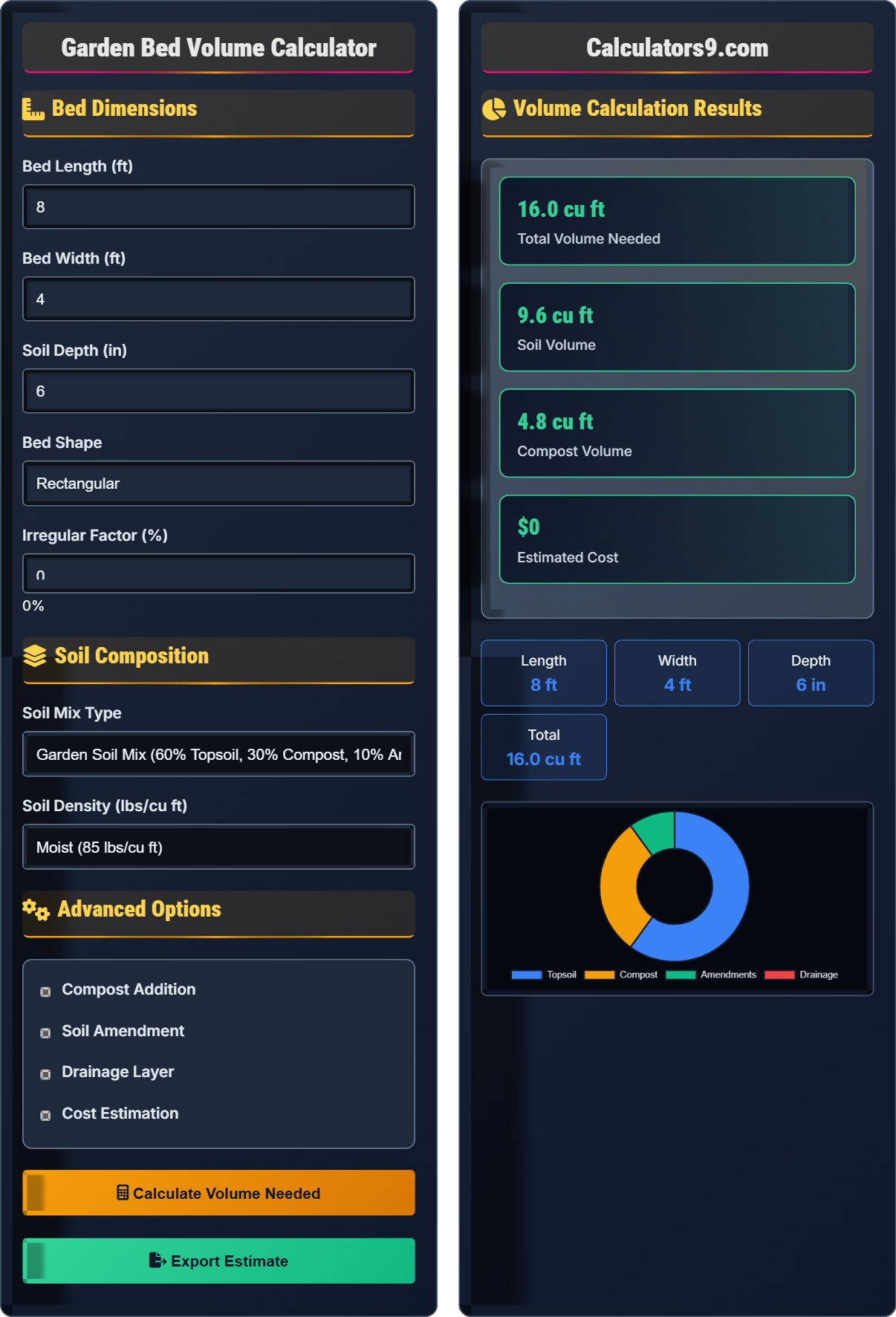
Example: For a bed that is 8 ft long, 4 ft wide, and 0.5 ft (6 inches) deep:
Volume: \( 8 \times 4 \times 0.5 = 16 \) cubic feet
Thus, 16 cubic feet of soil would be needed to fill this garden bed.
Bed Dimensions
Soil Composition
Advanced Options
Volume Calculation Results
- 2 cu ft bags: 8 bags needed
- 3 cu ft bags: 6 bags needed
- 4 cu ft bags: 4 bags needed
- 5 cu ft bags: 3 bags needed
Garden Bed Construction Guide
A good garden soil mix contains 60% topsoil, 30% compost, and 10% amendments like perlite or vermiculite. This provides nutrients, drainage, and structure.
Volume = Length × Width × Depth. For circular beds: Volume = π × r² × Depth. Always convert all measurements to the same unit.
- Measure accurately
- Account for settling
- Plan for additions
- Consider drainage
Soil Mixes
Topsoil: Pure soil for basic filling. Garden Mix: Balanced nutrients. Potting Mix: Light, well-draining. Custom: Tailored to plant needs.
- Plant type requirements
- Drainage needs
- Nutrient content
- pH level
- Root depth requirements
- Water retention
- Aeration needs
- Seasonal changes
Garden Bed Volume Quiz
What is the recommended minimum depth for a vegetable garden bed?
The answer is D) 12 inches. For vegetables, a minimum depth of 12 inches is recommended to allow adequate root development. Root vegetables especially need deeper soil to develop properly.
Root depth is crucial for plant health and productivity. Shallow beds limit root development, which affects nutrient uptake and water absorption. Deep beds allow roots to access nutrients and moisture from deeper soil layers, especially during dry periods.
Root Zone: Depth where most roots develop
Root Development: Growth of plant root system
Soil Depth: Vertical measurement of soil
• Vegetables: Minimum 12 inches
• Flowers: 6-8 inches
• Herbs: 6-8 inches
• Root vegetables: 12-18 inches
• Leafy greens: 6-8 inches
• Tomatoes: 18-24 inches
• Making beds too shallow
• Not considering root depth
• Forgetting about settling
Calculate the volume of soil needed for a rectangular garden bed that is 10 ft long, 5 ft wide, and 8 inches deep. Show your work.
Step 1: Convert all measurements to the same unit (feet)
Length = 10 ft
Width = 5 ft
Depth = 8 inches = 8 ÷ 12 = 0.667 ft
Step 2: Apply the volume formula
Volume = Length × Width × Depth
Volume = 10 × 5 × 0.667
Volume = 33.33 cubic feet
Step 3: Convert to practical measurements
33.33 cu ft ÷ 2 cu ft per bag = 16.67 bags
Round up to 17 bags of 2 cu ft soil
Therefore, 33.33 cubic feet of soil is needed for this garden bed.
This calculation demonstrates the importance of unit conversion in volume calculations. All measurements must be in the same unit before multiplying. Converting inches to feet (divide by 12) allows proper volume calculation in cubic feet.
Unit Conversion: Changing measurements to same unit
Cubic Feet: Volume measurement (ft³)
Practical Packaging: Standard bag sizes
• Convert all measurements to same unit
• Inches to feet: divide by 12
• Round up to practical amounts
• Common bag sizes: 2, 3, 4 cu ft
• Always round up for soil
• Account for settling (add 5-10%)
• Mixing different units
• Forgetting to convert inches to feet
• Not rounding up to practical amounts
Sarah is creating a circular flower bed with a diameter of 6 feet and wants to fill it to a depth of 10 inches with a soil mix that's 70% topsoil and 30% compost. Calculate the total volume needed and the amount of each component.
Step 1: Calculate the radius
Radius = Diameter ÷ 2 = 6 ÷ 2 = 3 feet
Step 2: Convert depth to feet
Depth = 10 inches = 10 ÷ 12 = 0.833 ft
Step 3: Apply circular volume formula
Volume = π × r² × Depth
Volume = 3.14159 × 3² × 0.833
Volume = 3.14159 × 9 × 0.833
Volume = 23.56 cubic feet
Step 4: Calculate soil components
Topsoil = 23.56 × 0.70 = 16.49 cu ft
Compost = 23.56 × 0.30 = 7.07 cu ft
Step 5: Round to practical amounts
Topsoil: 17 cu ft
Compost: 8 cu ft
Therefore, Sarah needs 24 cubic feet of soil mix, consisting of 17 cu ft of topsoil and 8 cu ft of compost.
This problem demonstrates calculating volume for non-rectangular shapes. Circular beds use the formula V = π × r² × h. The calculation shows how to determine individual components of a soil mix based on percentages.
Circular Volume: V = π × r² × h
Soil Mix Components: Percentages of ingredients
Practical Rounding: Adjusting to usable amounts
• Use π × r² × h for circles
• Calculate each component separately
• Round to practical measurements
• π ≈ 3.14 for calculations
• Radius = diameter ÷ 2
• Always verify total equals components
• Using diameter instead of radius
• Not converting units properly
• Forgetting to calculate components
Mike is building a raised bed that's 8 ft × 4 ft × 1 ft deep. He wants to create a custom mix: 50% topsoil, 35% compost, 10% perlite, and 5% vermiculite. Calculate the volume needed for each component and the total weight if the soil density is 85 lbs/cu ft.
Step 1: Calculate total volume
Volume = Length × Width × Depth = 8 × 4 × 1 = 32 cu ft
Step 2: Calculate each component
Topsoil = 32 × 0.50 = 16 cu ft
Compost = 32 × 0.35 = 11.2 cu ft
Perlite = 32 × 0.10 = 3.2 cu ft
Vermiculite = 32 × 0.05 = 1.6 cu ft
Step 3: Verify total volume
16 + 11.2 + 3.2 + 1.6 = 32 cu ft ✓
Step 4: Calculate total weight
Weight = Volume × Density = 32 × 85 = 2,720 lbs
Step 5: Calculate weight of each component
Topsoil weight = 16 × 85 = 1,360 lbs
Compost weight = 11.2 × 85 = 952 lbs
Perlite weight = 3.2 × 85 = 272 lbs
Vermiculite weight = 1.6 × 85 = 136 lbs
Therefore, Mike needs 32 cu ft total: 16 cu ft topsoil, 11.2 cu ft compost, 3.2 cu ft perlite, and 1.6 cu ft vermiculite, weighing a total of 2,720 lbs.
This example shows how to work with custom soil mixes and calculate weights. The key is to calculate each component separately based on percentages, then verify the total equals the original volume. Weight calculations help with transportation planning.
Custom Mix: Tailored soil composition
Soil Density: Weight per unit volume
Transportation Planning: Considering weight for delivery
• Calculate each component separately
• Verify total equals original volume
• Consider weight for logistics
• Common densities: 75-95 lbs/cu ft
• Dry soil is lighter than wet
• Plan for multiple deliveries if heavy
• Not calculating each component separately
• Forgetting to verify totals
• Not considering transportation weight
Which amendment is best for improving drainage in heavy clay soil?
The answer is B) Perlite. Perlite is a lightweight volcanic glass that creates air pockets in soil, significantly improving drainage. It doesn't decompose like organic amendments and maintains its structure permanently.
Soil amendments serve different purposes. Perlite specifically improves drainage by creating permanent air spaces in soil. Other amendments like peat moss and compost improve soil structure but don't provide the same drainage benefits as perlite.
Drainage: Water movement through soil
Soil Amendment: Material added to improve soil
Structure: Physical arrangement of soil particles
• Perlite: Improves drainage
• Compost: Adds nutrients
• Sand: Improves drainage but can compact
• Perlite: 10-20% for drainage
• Compost: 20-30% for nutrients
• Use coarse sand for drainage
• Using fine sand which compacts soil
• Not enough drainage amendment
• Over-amending with heavy materials
FAQ
Q: How do I calculate volume for irregularly shaped garden beds?
A: For irregular shapes, divide the area into simpler geometric shapes:
- Rectangular sections: Length × width × depth
- Circular sections: π × r² × depth
- Triangular sections: (base × height ÷ 2) × depth
- Complex shapes: Approximate with rectangles
Add all volumes together. Consider adding 10-15% extra for irregular shapes.
Q: How much soil settles after filling a new garden bed?
A: Soil typically settles 5-10% after watering and compaction:
- Fresh topsoil: 5-8% settling
- Compost-rich mix: 8-12% settling
- Peat-heavy mix: 10-15% settling
Fill beds slightly above the intended level, then water thoroughly to allow settling before planting.