Grass Seed Calculator
Estimate grass seed for DIY projects • 2026 edition
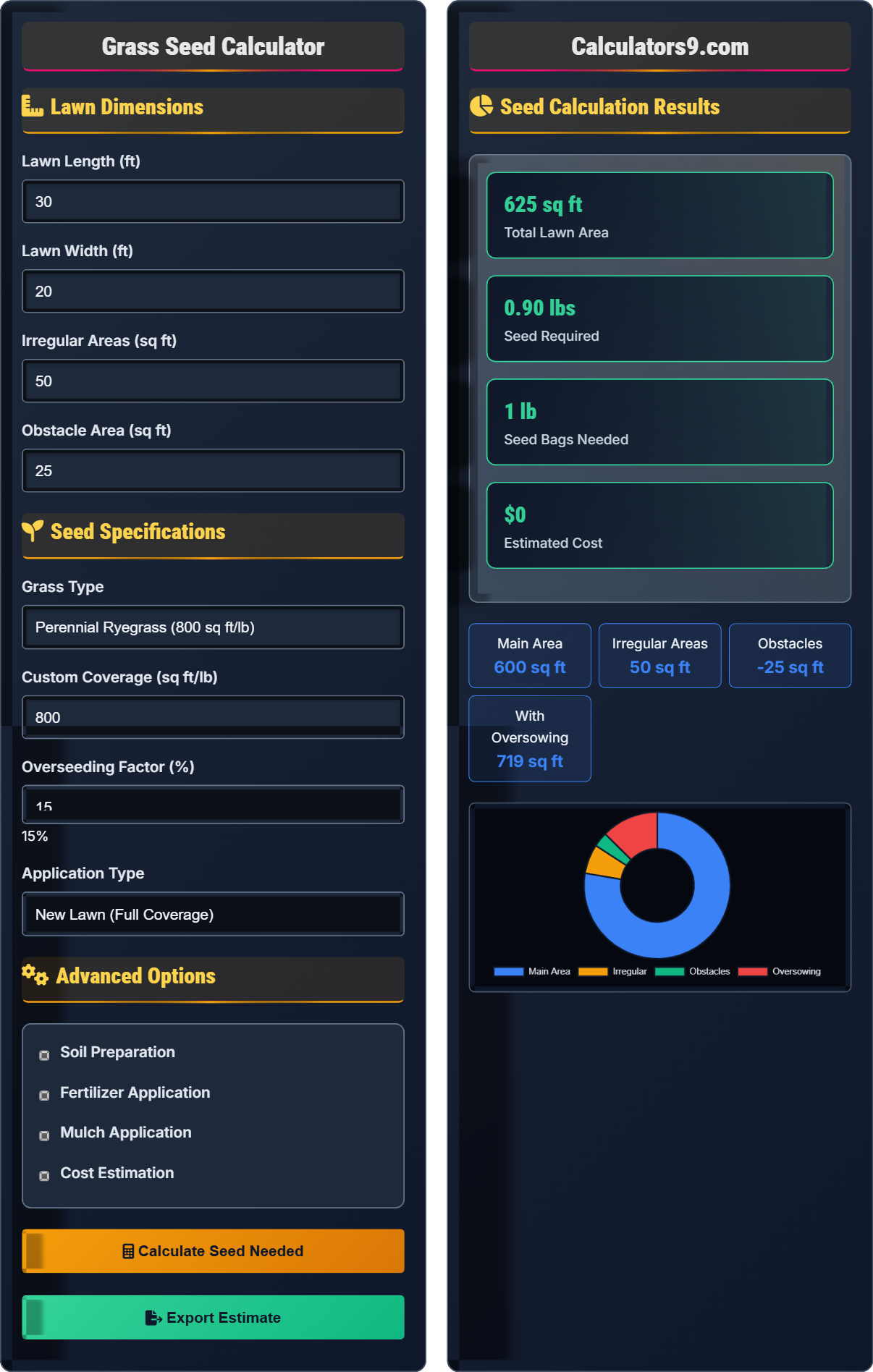
Grass Seed Calculation Formula:
Show the calculator\( \text{Seed Required (lbs)} = \frac{\text{Total Area (sq ft)} \times (1 + \text{Overseeding Factor})}{\text{Coverage per Pound (sq ft)}} \)
Where:
- \( \text{Total Area} \) = Combined lawn area to be seeded
- \( \text{Overseeding Factor} \) = Additional percentage for optimal coverage (typically 10-20%)
- \( \text{Coverage per Pound} \) = Area covered by one pound of seed (varies by grass type)
- \( \text{Seed Required} \) = Amount of grass seed needed in pounds
This formula calculates the amount of grass seed needed based on area and coverage requirements.
Example: For a lawn area of 1000 sq ft, using Kentucky Bluegrass (1000 sq ft/lb coverage), with 15% overseeding factor:
Seed required: \( \frac{1000 \times (1 + 0.15)}{1000} = \frac{1000 \times 1.15}{1000} = 1.15 \) lbs
Thus, 2 pounds would be needed for this project.
Lawn Dimensions
Seed Specifications
Advanced Options
Seed Calculation Results
- Spread or broadcast seeder
- Rake
- Wheelbarrow
- Garden hose
- Sprinkler system
- Soil test kit
- Compost or fertilizer
- Mulch (optional)
Grass Seeding Guide
Different grass types have varying coverage rates: Kentucky Bluegrass (1000 sq ft/lb), Ryegrass (800 sq ft/lb), Fine Fescue (1200 sq ft/lb). Always add 15-20% extra for optimal coverage.
Total Area = (Length × Width) + Irregular Areas - Obstacles. Then multiply by (1 + Oversowing Factor) and divide by coverage rate to get required seed.
- Test soil pH before seeding
- Choose grass type for climate
- Water consistently after seeding
- Wait for germination before mowing
Grass Types
Kentucky Bluegrass: Dense, fine texture. Ryegrass: Fast germination. Fescue: Shade tolerant. Zoysia: Heat resistant. Bermuda: Drought tolerant.
- Climate zone compatibility
- Sun/shade conditions
- Soil type
- Foot traffic level
- Seasonal planting timing
- Water availability
- Maintenance requirements
- Regional climate
Grass Seeding Quiz
Which grass type typically has the highest coverage rate per pound?
The answer is B) Fine Fescue (1200 sq ft/lb). Fine Fescue has the highest coverage rate among common grass types because its seeds are very small and numerous per pound. This means you need less seed per square foot compared to other grass types.
Grass seed coverage rates vary based on seed size and density. Smaller seeds like Fine Fescue provide more coverage per pound, while larger seeds like Zoysia require more seed per square foot. Understanding these differences helps ensure proper seeding rates and successful establishment.
Coverage Rate: Area covered by one pound of seed
Seed Density: Number of seeds per pound
Seeding Rate: Amount of seed per unit area
• Different grass types have different coverage rates
• Smaller seeds provide higher coverage
• Always follow specific product recommendations
• Check seed package for specific coverage rates
• Fine Fescue: 1200 sq ft/lb
• Kentucky Bluegrass: 1000 sq ft/lb
• Using same rate for all grass types
• Not checking specific product coverage
• Assuming all grass seeds are similar
Calculate the grass seed needed for a 25 ft × 30 ft lawn using Kentucky Bluegrass (1000 sq ft/lb coverage). Include a 15% oversowing factor. Show your work.
Step 1: Calculate lawn area
Lawn area = Length × Width = 25 × 30 = 750 sq ft
Step 2: Apply oversowing factor
Area with oversowing = 750 × (1 + 0.15) = 750 × 1.15 = 862.5 sq ft
Step 3: Calculate seed needed
Seed required = Area with oversowing ÷ Coverage rate = 862.5 ÷ 1000 = 0.8625 lbs
Step 4: Round up to practical amount
Round up to 1 lb for practical purchasing
Therefore, 1 pound of Kentucky Bluegrass seed is needed for this project.
This calculation demonstrates the standard process for grass seed estimation. First, calculate the basic area, then apply the oversowing factor to account for optimal coverage, divide by the coverage rate, and round to a practical amount. The oversowing factor ensures good germination and establishment.
Lawn Area: Length times width of lawn
Oversowing Factor: Multiplying area by (1 + percentage)Coverage Rate: Area covered by one pound of seed
• Calculate area first
• Apply oversowing factor to area
• Divide by coverage rate
• Always add 15-20% for oversowing
• Check specific coverage on seed package
• Round up to practical quantities
• Forgetting to apply oversowing factor
• Using incorrect coverage rates
• Not rounding up for practicality
Sarah is seeding her front yard which consists of a main area (20 ft × 30 ft), a side strip (5 ft × 25 ft), and a circular area around a tree (radius 3 ft). She needs to subtract 15 sq ft for a flower bed. She's using Fine Fescue (1200 sq ft/lb) with a 20% oversowing factor. Calculate how many pounds of seed she needs.
Step 1: Calculate main area
Main area = 20 × 30 = 600 sq ft
Step 2: Calculate side strip area
Side strip = 5 × 25 = 125 sq ft
Step 3: Calculate circular area
Circular area = π × r² = 3.14 × 3² = 3.14 × 9 = 28.26 sq ft
Step 4: Calculate total area
Total area = 600 + 125 + 28.26 = 753.26 sq ft
Step 5: Subtract obstacle area
Net area = 753.26 - 15 = 738.26 sq ft
Step 6: Apply oversowing factor
Area with oversowing = 738.26 × (1 + 0.20) = 738.26 × 1.20 = 885.91 sq ft
Step 7: Calculate seed needed
Seed required = 885.91 ÷ 1200 = 0.74 lbs
Step 8: Round up to practical amount
Round up to 1 lb
Therefore, Sarah needs 1 pound of Fine Fescue seed.
This problem demonstrates handling mixed geometric shapes and obstacles. The key steps are: calculate each area separately, sum them, subtract obstacles, apply oversowing factor, divide by coverage rate, and round up. This systematic approach ensures accurate calculations for complex layouts.
Mixed Geometries: Different shaped areas combined
Circular Area: Area = π × radius²
Systematic Approach: Following steps in order
• Calculate each area separately
• Subtract obstacles from total
• Apply oversowing factor to net area
• Break complex shapes into simple ones
• Use π ≈ 3.14 for circle calculations
• Account for all obstacles
• Forgetting to subtract obstacles
• Not applying oversowing factor to net area
• Incorrect circle area calculation
Mike wants to overseed his 400 sq ft existing lawn to fill in thin spots. He's using Perennial Ryegrass (800 sq ft/lb coverage) but for overseeding, the rate is typically half the normal rate. He wants to add a 10% oversowing factor for the overseeding. Calculate how many pounds of seed he needs.
Step 1: Calculate normal seed requirement
Normal requirement = 400 ÷ 800 = 0.5 lbs
Step 2: Adjust for overseeding (half rate)
Overseeding requirement = 0.5 ÷ 2 = 0.25 lbs
Step 3: Apply oversowing factor
Final requirement = 0.25 × (1 + 0.10) = 0.25 × 1.10 = 0.275 lbs
Step 4: Round up to practical amount
Round up to 0.5 lbs (common package size)
Therefore, Mike needs 0.5 pounds of Perennial Ryegrass for overseeding.
Overseeding requires less seed than establishing a new lawn because the existing grass provides a base for the new seed.
This example shows how application type affects seed requirements. Overseeding typically requires about half the seed of establishing a new lawn because the existing grass provides some coverage. The application type is crucial in determining the correct seeding rate for successful establishment.
Overseeding: Adding seed to existing lawn
New Establishment: Creating lawn from scratch
Application Type: Purpose of seeding (new vs. overseed)
• Overseeding needs less seed than new lawns
• Typically half the normal rate
• Adjust rates based on application type
• New lawn: Full seeding rate
• Overseeding: Half seeding rate
• Patch repair: Quarter seeding rate
• Using same rate for all applications
• Not adjusting for overseeding
• Over-seeding thin areas
Which season is best for seeding cool-season grasses like Kentucky Bluegrass and Perennial Ryegrass?
The answer is C) Early Fall. Cool-season grasses like Kentucky Bluegrass and Perennial Ryegrass are best seeded in early fall (August-September) when temperatures are cooler but still warm enough for germination. This timing allows roots to establish before winter.
Timing is crucial for successful grass establishment. Cool-season grasses thrive in cooler temperatures and benefit from fall's combination of warm soil and cooler air. This timing reduces stress from heat and competition from weeds, leading to better establishment and stronger root systems.
Cool-Season Grasses: Thrive in cooler temperatures
Warm-Season Grasses: Thrive in warmer temperaturesGermination: Seed sprouting and establishment
• Cool-season: Early fall planting
• Warm-season: Late spring/early summer
• Timing affects establishment success
• Cool-season: August-September
• Warm-season: April-June
• Soil temp 60-70°F for cool-season
• Seeding cool-season grasses in summer
• Not considering regional climate
• Ignoring soil temperature
FAQ
Q: How do I measure an irregularly shaped lawn for seeding?
A: For irregular-shaped lawns, divide the area into simpler geometric shapes:
- Rectangular sections: Length × width
- Triangular sections: (base × height) ÷ 2
- Circular areas: π × radius²
- Complex shapes: Approximate with rectangles
Add all sections together for total area. Subtract areas for obstacles like flower beds, patios, or walkways.
Q: How long does it take for grass seed to germinate?
A: Germination time varies by grass type and conditions:
- Perennial Ryegrass: 5-10 days
- Kentucky Bluegrass: 14-30 days
- Fine Fescue: 10-14 days
- Zoysia: 14-21 days
Optimal conditions: soil temperature 60-70°F, consistent moisture, and proper seeding depth (1/4 to 1/2 inch).