Lighting Layout Calculator
Estimate lighting for DIY projects • 2026 edition
Lighting Calculation Formula:
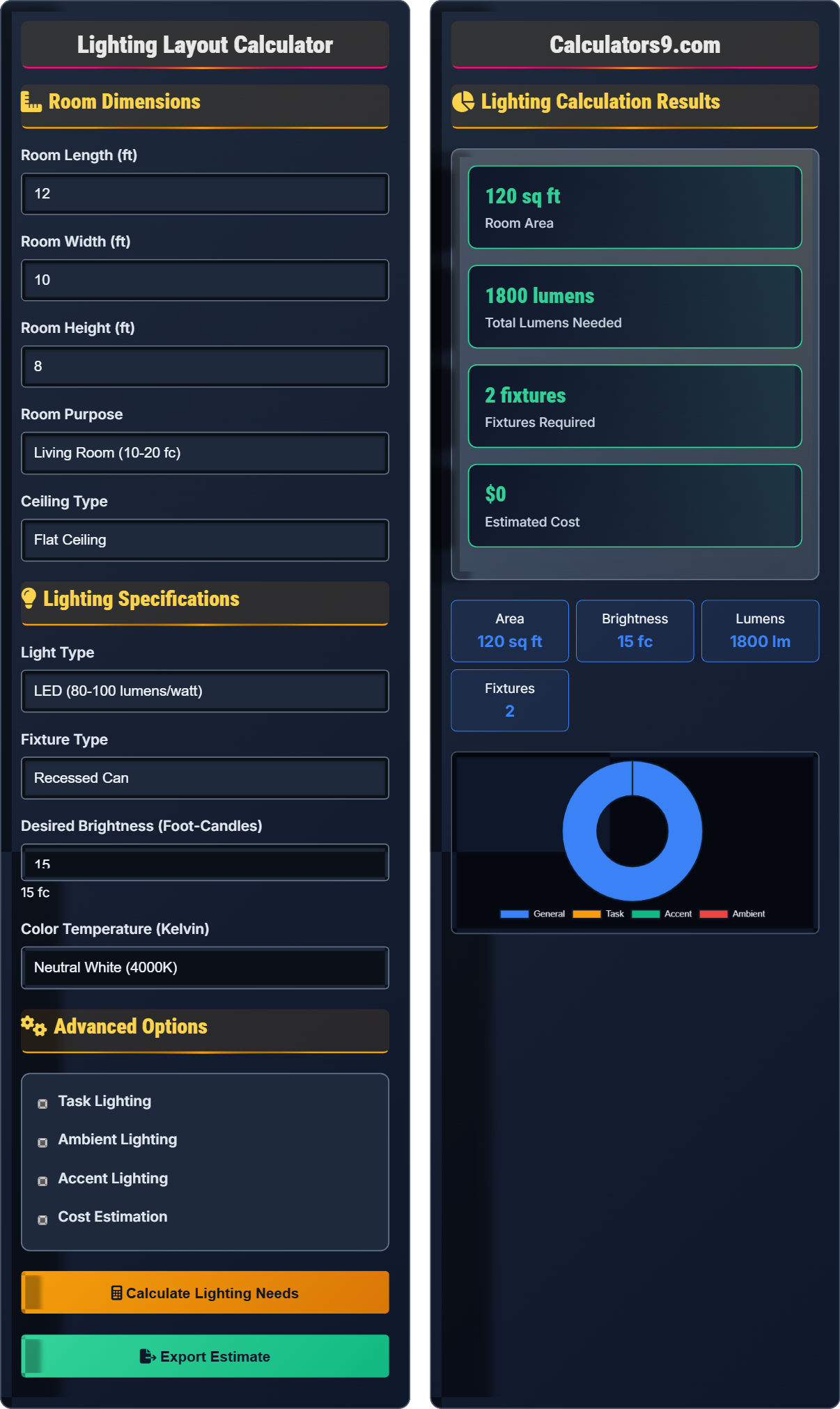
Show the calculator\( \text{Lumens Needed} = \text{Area (sq ft)} \times \text{Foot-Candles per Sq Ft} \)
Where:
- \( \text{Area} \) = Room or space area in square feet
- \( \text{Foot-Candles per Sq Ft} \) = Recommended illumination level (typically 10-20 for general lighting)
- \( \text{Lumens Needed} \) = Total light output required
This formula calculates the total lumens needed for proper illumination of a space.
Example: For a 120 sq ft room requiring 15 foot-candles:
Lumens needed: \( 120 \times 15 = 1,800 \) lumens
Thus, 1,800 lumens would be needed for proper illumination of this room.
Room Dimensions
Lighting Specifications
Advanced Options
Lighting Calculation Results
- Space fixtures evenly throughout the room
- Place task lights directly above work surfaces
- Consider dimmer switches for flexibility
- Plan electrical circuits accordingly
- Follow local electrical codes
- Ensure adequate ceiling support
Lighting Design Guide
Residential lighting typically requires 10-20 foot-candles for general living spaces. Task areas need 50-75 foot-candles. Kitchen counters require 40+ foot-candles.
Lumens Needed = Area × Foot-Candles. Watts = Lumens ÷ Lumens per Watt. Always consider fixture efficiency and room characteristics.
- Layer different lighting types
- Consider room purpose
- Plan for flexibility
- Follow electrical codes
Lighting Types
LED: Energy-efficient, long-life. CFL: Good efficiency, moderate life. Incandescent: Warm light, short life. Halogen: Bright, warm light.
- Energy efficiency
- Color temperature
- Life expectancy
- Dimming capability
- Heat output
- Compatibility
- Cost-effectiveness
- Environmental impact
Lighting Design Quiz
What is the recommended foot-candle level for a kitchen counter?
The answer is C) 30-40 fc. Kitchen counters require 30-40 foot-candles for safe food preparation. This level provides adequate visibility for cooking tasks while avoiding eye strain.
Foot-candle requirements vary by room function and activity. Kitchen counters need higher illumination than general living spaces because food preparation requires good visibility to prevent accidents. The 30-40 fc range ensures safe and effective kitchen operations.
Foot-Candle (fc): Unit of illuminance (lumens per square foot)
Illuminance: Amount of light falling on a surface
Task Lighting: Light focused on specific work areas
• Kitchen counters: 30-40 fc
• Living rooms: 10-20 fc
• Office work: 50-75 fc
• Add 50% for detailed tasks
• Consider age-related vision changes
• Use layered lighting approach
• Using same brightness for all rooms
• Not accounting for task requirements
• Ignoring age-related lighting needs
Calculate the total lumens needed for a 15 ft × 12 ft office that requires 50 foot-candles for computer work. Show your work.
Step 1: Calculate room area
Room area = Length × Width = 15 ft × 12 ft = 180 sq ft
Step 2: Apply the lighting formula
Total lumens = Area × Foot-candles
Total lumens = 180 sq ft × 50 fc = 9,000 lumens
Step 3: Calculate fixture requirements
Assuming LED fixtures producing 1000 lumens each:
Fixtures needed = 9,000 ÷ 1,000 = 9 fixtures
Step 4: Calculate energy consumption
LED efficiency: ~80 lumens per watt
Total watts = 9,000 ÷ 80 = 112.5 watts
Therefore, 9,000 lumens are needed, requiring 9 LED fixtures consuming 112.5 watts total.
This calculation demonstrates the fundamental lighting formula: Lumens = Area × Foot-candles. For offices, 50 fc is the standard for computer work. The calculation also shows how to determine fixture count and energy consumption from the total lumen requirement.
Lumens: Total light output from a source
Foot-Candles: Illumination level at surface
Luminous Efficacy: Light output per unit of power
• Formula: Lumens = Area × Foot-candles
• Office: 50-75 fc for computer work
• Account for fixture efficiency
• Add 20% for safety margin
• Consider fixture spacing
• Plan for future changes
• Using incorrect area calculations
• Not accounting for fixture efficiency
• Ignoring task-specific requirements
Sarah has a 14 ft × 12 ft living room with a 10 ft × 6 ft dining area attached. She wants 15 fc for the living room and 30 fc for the dining area. Using LED fixtures that produce 800 lumens each, calculate the total number of fixtures needed.
Step 1: Calculate living room requirements
Living room area = 14 × 12 = 168 sq ft
Living room lumens = 168 × 15 = 2,520 lumens
Step 2: Calculate dining room requirements
Dining area = 10 × 6 = 60 sq ft
Dining lumens = 60 × 30 = 1,800 lumens
Step 3: Calculate total lumens needed
Total lumens = 2,520 + 1,800 = 4,320 lumens
Step 4: Calculate fixture count
Fixtures needed = 4,320 ÷ 800 = 5.4 → 6 fixtures
Step 5: Suggest fixture distribution
Living room: 4 fixtures (3,200 lumens)
Dining area: 2 fixtures (1,600 lumens)
Therefore, Sarah needs 6 LED fixtures for her combined living/dining space.
This problem demonstrates calculating lighting for multiple zones with different requirements. Each area is calculated separately based on its function, then the totals are combined. The result shows how to distribute fixtures based on zone requirements.
Zone Lighting: Different illumination levels for different areas
Functional Lighting: Light levels based on activity
Fixture Distribution: Placement based on needs
• Calculate each zone separately
• Apply appropriate foot-candles per zone
• Sum total lumens needed
• Plan transition between zones
• Consider shared fixtures
• Account for furniture placement
• Using same foot-candles for all zones
• Not accounting for zone boundaries
• Forgetting to round up fixture count
Mike wants to illuminate a 16 ft × 14 ft workshop with 50 foot-candles. He's comparing LED (85 lm/W) and CFL (65 lm/W) bulbs. Calculate the energy consumption for each type and determine the annual energy savings with LEDs if lights are used 8 hours/day at $0.12/kWh.
Step 1: Calculate total lumens needed
Workshop area = 16 × 14 = 224 sq ft
Total lumens = 224 × 50 = 11,200 lumens
Step 2: Calculate LED energy consumption
LED watts = 11,200 ÷ 85 = 131.8 watts
Step 3: Calculate CFL energy consumption
CFL watts = 11,200 ÷ 65 = 172.3 watts
Step 4: Calculate daily energy use
LED: 131.8 × 8 = 1,054 Wh = 1.054 kWh/day
CFL: 172.3 × 8 = 1,378 Wh = 1.378 kWh/day
Step 5: Calculate annual energy costs
LED: 1.054 × 365 × $0.12 = $46.20/year
CFL: 1.378 × 365 × $0.12 = $60.35/year
Step 6: Calculate annual savings
Savings = $60.35 - $46.20 = $14.15/year
Therefore, using LED bulbs saves $14.15 annually in this workshop.
This example demonstrates the economic benefits of energy-efficient lighting. The calculation shows how luminous efficacy (lumens per watt) directly affects energy consumption and operating costs. Even with the same lumen output, different technologies have significantly different energy costs.
Luminous Efficacy: Light output per unit of power
Energy Consumption: Power usage over time
Operating Costs: Ongoing energy expenses
• Higher efficacy = lower energy use
• Calculate based on actual usage
• Consider long-term costs
• LED: 80-100 lm/W
• CFL: 50-70 lm/W
• Incandescent: 10-17 lm/W
• Not considering energy efficiency
• Ignoring long-term costs
• Focusing only on upfront cost
Which color temperature is best for a bedroom to promote relaxation?
The answer is C) 3000K (Soft White). Warmer color temperatures (2700K-3000K) are best for bedrooms as they promote relaxation and prepare the body for sleep by not suppressing melatonin production.
Color temperature affects circadian rhythms and mood. Warm light (2700K-3000K) is relaxing and suitable for bedrooms and living rooms. Cool light (5000K-6500K) is energizing and better for workspaces. The right color temperature enhances the function of each room.
Color Temperature: Appearance of light source
Circadian Rhythm: Body's natural sleep-wake cycle
Melatonin: Sleep-regulating hormone
• Bedrooms: 2700-3000K
• Workspaces: 4000-5000K
• Task lighting: 5000-6500K
• Warm light for relaxation
• Cool light for concentration
• Consider dimmable options
• Using cool light in bedrooms
• Not considering room function
• Ignoring circadian effects
FAQ
Q: How do I space recessed lights evenly in a room?
A: For even spacing of recessed lights:
- Rule of thumb: Space fixtures at 1/2 the ceiling height apart
- 8 ft ceiling: 4 ft between fixtures
- 10 ft ceiling: 5 ft between fixtures
- Edge distance: Half the spacing distance from walls
For a 12x10 room with 8 ft ceiling: 6 fixtures spaced 4 ft apart.
Q: Do I need an electrician for installing new lighting?
A: Electrical work requirements vary by location:
- New circuits: Always hire a licensed electrician
- Replacing fixtures: May be DIY in some areas
- Adding switches: Often requires professional
- Permits: Check local requirements
When in doubt, hire a professional to ensure safety and code compliance.