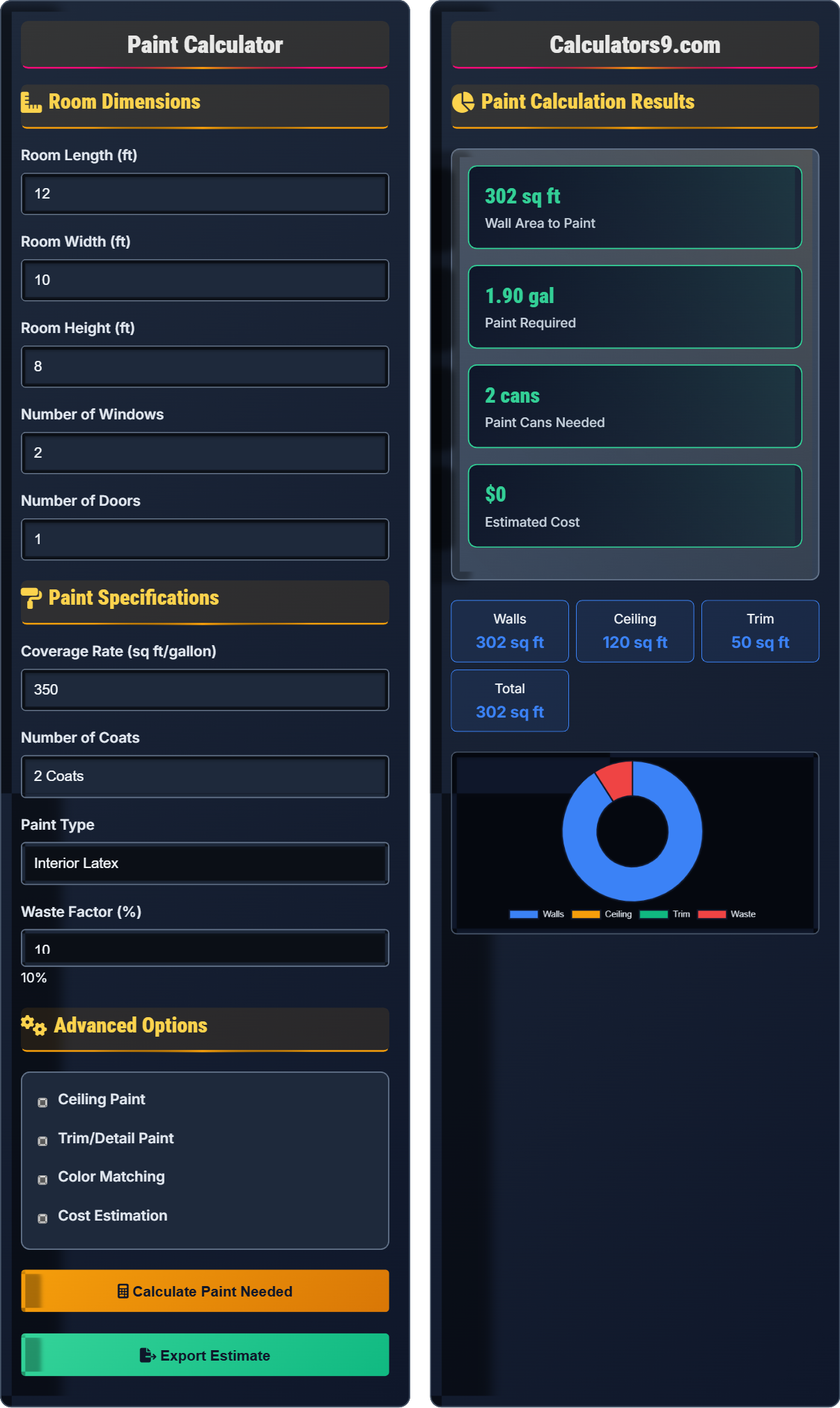
Paint Calculator
Estimate paint quantity for DIY projects • 2026 edition
Paint Coverage Formula:
Show the calculator\( \text{Paint Required (gallons)} = \frac{\text{Total Area (sq ft)}}{\text{Coverage per Gallon (sq ft)} \times \text{Number of Coats}} \)
Where:
- \( \text{Total Area} \) = Combined surface area to be painted
- \( \text{Coverage per Gallon} \) = Paint manufacturer's stated coverage (typically 350 sq ft/gallon)
- \( \text{Number of Coats} \) = Layers of paint required (usually 1-2 coats)
- \( \text{Paint Required} \) = Amount of paint needed in gallons
This formula calculates the amount of paint needed for a given project based on coverage and application requirements.
Example: For a room with 500 sq ft wall area, using paint with 350 sq ft/gallon coverage, applying 2 coats:
Paint required: \( \frac{500}{350 \times 2} = \frac{500}{700} = 0.71 \) gallons
Thus, approximately 1 gallon would be needed for this project.
Room Dimensions
Paint Specifications
Advanced Options
Paint Calculation Results
- Paint rollers (various sizes)
- Paint brushes (angled and detail)
- Paint trays and liners
- Painter's tape
- Drop cloths
- Sandpaper (medium grit)
- Primer (if needed)
- Paint stirrer
- Paint thinner (for cleanup)
- Touch-up brush
- Paint sprayer (optional)
- Extension pole
- Edge guards
- Prepare workspace (cover floors, remove hardware)
- Clean and sand surfaces
- Apply painter's tape
- Prime if needed
- Apply first coat of paint
- Allow drying (2-4 hours)
- Apply second coat if needed
- Remove tape while paint is still slightly tacky
- Clean tools and remove drop cloths
Painting Project Guide
Standard interior latex paint covers 350-400 sq ft per gallon. Actual coverage varies based on surface texture, porosity, and application method.
Wall Area = (Length + Width) × 2 × Height - (Window Area × Count) - (Door Area × Count). Standard windows: 15 sq ft, doors: 20 sq ft.
- Always add waste factor
- Account for multiple coats
- Prime before painting if needed
- Buy enough paint for touch-ups
Paint Selection
Interior: Flat, eggshell, satin, semi-gloss, gloss. Exterior: Acrylic, oil-based, elastomeric. Choose based on location and durability needs.
- Smooth surfaces: Better coverage
- Rough textures: More paint needed
- Dark to light colors: Extra coats
- Primer: Improves coverage
- Surface condition matters
- Color changes affect needs
- Quality affects coverage
- Environmental factors
Paint Calculation Quiz
What is the standard coverage rate for interior latex paint?
The answer is C) 350-400 sq ft/gallon. Standard interior latex paint typically covers 350-400 square feet per gallon under ideal conditions. This is the industry standard that manufacturers use for their coverage estimates.
Understanding standard coverage rates helps with accurate paint estimation. The 350-400 sq ft/gallon range represents ideal conditions with smooth surfaces. Actual coverage may vary based on surface texture, porosity, color changes, and application technique. Always add a waste factor to account for these variables.
Coverage Rate: Amount of surface area covered by one gallon of paint
Industry Standard: Accepted benchmark for paint performance
Actual Coverage: Real-world performance that may vary from standard
• Standard rate is 350-400 sq ft/gallon
• Actual coverage varies by conditions
• Always add waste factor to estimates
• Check manufacturer's specific coverage rate
• Account for surface conditions
• Add 10-15% waste factor to estimates
• Using only manufacturer's optimistic rate
• Not accounting for surface conditions
• Forgetting to add waste factor
Calculate the amount of paint needed for a room that is 12 ft by 15 ft with 8 ft ceilings. The room has 2 windows (15 sq ft each) and 1 door (20 sq ft). Use a coverage rate of 350 sq ft/gallon and plan for 2 coats. Show your work.
Step 1: Calculate wall area
Perimeter = (Length + Width) × 2 = (12 + 15) × 2 = 54 ft
Wall area = Perimeter × Height = 54 × 8 = 432 sq ft
Step 2: Subtract openings
Window area = 2 × 15 = 30 sq ft
Door area = 1 × 20 = 20 sq ft
Total openings = 30 + 20 = 50 sq ft
Net wall area = 432 - 50 = 382 sq ft
Step 3: Account for coats
Total area to cover = 382 × 2 coats = 764 sq ft
Step 4: Calculate paint needed
Paint required = 764 ÷ 350 = 2.18 gallons
Step 5: Add waste factor
With 10% waste: 2.18 × 1.10 = 2.40 gallons
Therefore, approximately 2.5-3 gallons of paint would be needed.
This calculation demonstrates the multi-step process for paint estimation. First, we calculate the gross wall area, then subtract openings, account for multiple coats, and finally add a waste factor. This systematic approach ensures accurate estimates and prevents running out of paint mid-project.
Net Wall Area: Wall area minus openings
Coverage Calculation: Total area divided by coverage rate
Waste Factor: Additional percentage added to account for waste
• Calculate net area (subtract openings)
• Multiply by number of coats needed
• Always add waste factor to estimate
• Standard opening sizes: Windows 15 sq ft, doors 20 sq ft
• Most rooms need 2 coats for good coverage
• Round up to nearest half-gallon for safety
• Forgetting to subtract windows and doors
• Not accounting for multiple coats
• Not adding waste factor to estimate
Sarah is painting her living room which has 4 walls measuring 14 ft × 9 ft each and a ceiling measuring 14 ft × 14 ft. The room has 3 windows (15 sq ft each) and 2 doors (20 sq ft each). If the paint covers 325 sq ft per gallon and she plans to apply 2 coats, how many gallons of paint should she buy? Include a 12% waste factor.
Step 1: Calculate wall area
4 walls × (14 × 9) = 4 × 126 = 504 sq ft
Step 2: Calculate ceiling area
14 × 14 = 196 sq ft
Step 3: Calculate total opening area
(3 × 15) + (2 × 20) = 45 + 40 = 85 sq ft
Step 4: Calculate net area to paint
Walls: 504 - 85 = 419 sq ft
Ceiling: 196 sq ft
Total: 419 + 196 = 615 sq ft
Step 5: Account for 2 coats
615 × 2 = 1,230 sq ft to cover
Step 6: Calculate paint needed
1,230 ÷ 325 = 3.78 gallons
Step 7: Add 12% waste factor
3.78 × 1.12 = 4.23 gallons
Therefore, Sarah should buy 5 gallons of paint.
This problem combines multiple elements: wall and ceiling painting, multiple openings, specific coverage rate, multiple coats, and waste factor. The calculation shows how all these variables interact to determine the final paint requirement. Including ceiling area demonstrates how comprehensive planning leads to accurate estimates.
Net Area: Surface area to be painted after subtracting openings
Comprehensive Estimate: Includes all surfaces and factors
Optimization: Calculating the exact amount needed
• Include all surfaces being painted
• Account for all openings
• Apply waste factor to final estimate
• Measure all surfaces to be painted
• Count all openings accurately
• Round up to nearest whole gallon
• Forgetting to include ceiling area
• Not accounting for all openings
• Applying waste factor too early in calculation
Mike is painting his bedroom from dark blue to white. The room is 10 ft × 12 ft with 8 ft ceilings. It has 1 window (15 sq ft) and 1 door (20 sq ft). Standard coverage is 350 sq ft/gallon, but going from dark to light typically requires 3 coats instead of 2. Calculate the paint needed with a 15% waste factor and explain why more coats are needed.
Step 1: Calculate wall area
Perimeter = (10 + 12) × 2 = 44 ft
Wall area = 44 × 8 = 352 sq ft
Step 2: Subtract openings
Opening area = 15 + 20 = 35 sq ft
Net wall area = 352 - 35 = 317 sq ft
Step 3: Account for 3 coats (dark to light)
Total area to cover = 317 × 3 = 951 sq ft
Step 4: Calculate paint needed
Paint required = 951 ÷ 350 = 2.72 gallons
Step 5: Add 15% waste factor
With waste: 2.72 × 1.15 = 3.13 gallons
Therefore, Mike should buy 4 gallons of paint.
More coats are needed when going from dark to light because the dark color shows through lighter paint, requiring additional layers to achieve full coverage.
This example demonstrates how color changes affect paint requirements. Going from dark to light colors requires more coats because the underlying dark color is difficult to cover completely with lighter paint. The opacity of paint and the contrast between old and new colors determine how many coats are needed for good coverage.
Opacity: Paint's ability to hide underlying color
Coverage: Paint's ability to provide uniform color
Color Contrast: Difference between old and new paint colors
• Dark to light requires more coats
• Color changes affect paint needs
• Always account for coverage requirements
• Consider primer for drastic color changes
• Add extra coats for dark to light transitions
• Test coverage on small area first
• Using same coat count for all color changes
• Not accounting for color contrast effects
• Assuming standard coverage applies to all situations
Which surface condition would require the most paint per gallon of coverage?
The answer is B) Rough, textured concrete. Rough and porous surfaces like textured concrete require more paint because the paint is absorbed into the pores and fills in the texture irregularities. Smooth surfaces allow paint to spread evenly, while rough surfaces need more paint to cover the increased surface area created by texture and absorbency.
Surface condition significantly affects paint coverage. Porous materials like concrete, brick, or unprimed wood absorb more paint, reducing coverage rates. Textured surfaces have greater actual surface area than smooth surfaces, requiring more paint to achieve complete coverage. Primed surfaces provide better coverage than unprimed surfaces.
Porosity: Surface's ability to absorb paint
Surface Area: Actual area to be covered including texture
Paint Absorption: Amount of paint absorbed by surface
• Rough surfaces require more paint
• Porous materials absorb paint
• Prime porous surfaces for better coverage
• Prime porous surfaces before painting
• Add extra paint for rough textures
• Using same estimate for all surface types
• Not accounting for surface porosity
• Forgetting to prime highly absorbent surfaces
FAQ
Q: How do I account for surface texture when estimating paint needs?
A: Surface texture significantly affects paint consumption:
- Smooth surfaces: Standard coverage (350 sq ft/gallon)
- Lightly textured: Reduce coverage by 10-15%
- Heavily textured: Reduce coverage by 25-40%
- Rough concrete: Reduce coverage by 40-60%
For textured surfaces, increase your paint estimate by the appropriate percentage. When in doubt, buy a little extra to ensure you have enough for proper coverage.
Q: Should I buy more paint than calculated for touch-ups?
A: Yes, always keep extra paint for touch-ups:
- Save at least 1 quart for small touch-ups
- Store in original container with lid sealed
- Keep in cool, dry place away from freezing
- Label with room location and date
- Use within 2-3 years for best results
Having extra paint allows for quick repairs and ensures color match for future touch-ups. It's much more cost-effective than trying to find an exact match later.