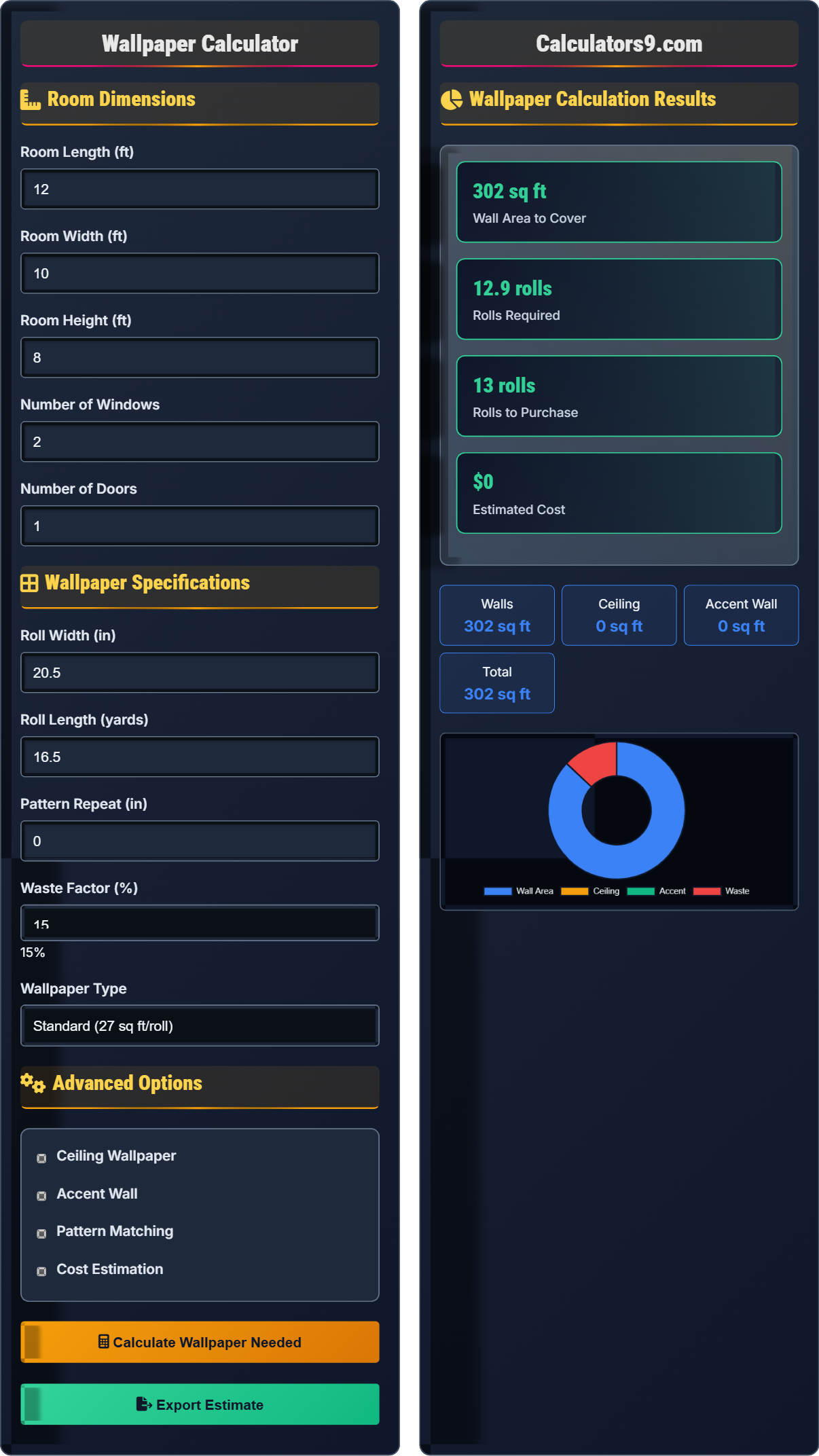
Wallpaper Calculator
Estimate wallpaper rolls for DIY projects • 2026 edition
Wallpaper Calculation Formula:
Show the calculator\( \text{Rolls Needed} = \frac{\text{Total Wall Area (sq ft)} \times (1 + \text{Waste Factor})}{\text{Coverage per Roll (sq ft)}} \)
Where:
- \( \text{Total Wall Area} \) = Combined wall surface area to be covered
- \( \text{Waste Factor} \) = Additional percentage for pattern matching, trimming, and errors (typically 10-20%)
- \( \text{Coverage per Roll} \) = Area covered by one roll of wallpaper (typically 27-36 sq ft)
- \( \text{Rolls Needed} \) = Number of wallpaper rolls required
This formula calculates the number of wallpaper rolls needed based on area and waste considerations.
Example: For a room with 240 sq ft wall area, using wallpaper with 30 sq ft per roll coverage, with 15% waste factor:
Rolls needed: \( \frac{240 \times (1 + 0.15)}{30} = \frac{240 \times 1.15}{30} = \frac{276}{30} = 9.2 \) rolls
Thus, 10 rolls would be needed for this project.
Room Dimensions
Wallpaper Specifications
Advanced Options
Wallpaper Calculation Results
- Measuring tape
- Wallpaper paste
- Brush or roller
- Utility knife
- Straightedge
- Sponge
- Seam roller
- Level
Wallpaper Project Guide
Standard wallpaper rolls cover 27-36 sq ft. Pattern matching increases waste factor. Always add 15-20% extra for pattern matching and trimming.
Wall Area = (Length + Width) × 2 × Height - (Window Area × Count) - (Door Area × Count). Standard windows: 15 sq ft, doors: 20 sq ft.
- Always add waste factor
- Account for pattern repeats
- Prime walls before hanging
- Measure carefully before ordering
Wallpaper Types
Standard: Traditional vinyl. Wide Format: Larger coverage. Premier: High-end materials. Custom: Specialized patterns and textures.
- No repeat: Minimal waste
- Half-drop: Moderate waste
- Large repeat: High waste
- Random match: Moderate waste
- Pattern complexity affects waste
- Wall condition matters
- Room lighting affects appearance
- Quality affects durability
Wallpaper Calculation Quiz
What is the typical coverage area of a standard wallpaper roll?
The answer is B) 27-36 sq ft. Standard wallpaper rolls typically cover 27-36 square feet of wall space. This coverage can vary based on roll dimensions and manufacturer specifications, but 27 sq ft is the most common coverage for standard 20.5-inch wide rolls.
Understanding standard wallpaper roll coverage is essential for accurate calculations. The 27 sq ft coverage is based on a standard roll size of 20.5 inches wide by 16.5 yards long. Different roll sizes (like wide format rolls) will have different coverage areas. Always check the specific roll dimensions on the product packaging.
Roll Coverage: Wall area covered by one wallpaper roll
Standard Roll: Typical size used in calculations
Wall Coverage: Area that needs to be covered
• Standard roll covers 27 sq ft
• Check specific product dimensions
• Wide rolls cover more area
• Always verify roll coverage on packaging
• Wide format rolls cover 36+ sq ft
• Calculate based on actual product specs
• Using incorrect coverage assumptions
• Not checking specific product specs
• Assuming all rolls are the same size
Calculate the wallpaper needed for a room that is 12 ft by 15 ft with 8 ft ceilings. The room has 2 windows (15 sq ft each) and 1 door (20 sq ft). Use standard wallpaper (27 sq ft per roll) and include a 15% waste factor. Show your work.
Step 1: Calculate wall perimeter
Perimeter = (Length + Width) × 2 = (12 + 15) × 2 = 54 ft
Step 2: Calculate gross wall area
Gross wall area = Perimeter × Height = 54 × 8 = 432 sq ft
Step 3: Calculate opening areas to subtract
Window area = 2 × 15 = 30 sq ft
Door area = 1 × 20 = 20 sq ft
Total openings = 30 + 20 = 50 sq ft
Step 4: Calculate net wall area
Net wall area = 432 - 50 = 382 sq ft
Step 5: Apply waste factor
Area with waste = 382 × (1 + 0.15) = 382 × 1.15 = 439.3 sq ft
Step 6: Calculate rolls needed
Rolls needed = 439.3 ÷ 27 = 16.27 rolls
Step 7: Round up to whole rolls
Round up to 17 rolls
Therefore, 17 rolls of wallpaper are needed for this project.
This calculation demonstrates the multi-step process for wallpaper estimation. We calculate the gross wall area, subtract openings, apply the waste factor, divide by roll coverage, and round up. The waste factor accounts for pattern matching, trimming, and potential errors during installation.
Gross Wall Area: Total wall area before subtracting openings
Net Wall Area: Wall area after subtracting openingsWaste Factor: Additional percentage for pattern matching and errors
• Calculate net area (subtract openings)
• Apply waste factor to net area
• Always round up to whole rolls
• Standard windows: 15 sq ft, doors: 20 sq ft
• Add 15-20% for pattern matching
• Round up to ensure enough material
• Forgetting to subtract windows and doors
• Not applying waste factor
• Not rounding up to whole rolls
Sarah is wallpapering her bedroom with a patterned wallpaper that has a 12-inch repeat. The room is 10 ft × 12 ft with 9 ft ceilings. It has 1 window (15 sq ft) and 1 door (20 sq ft). Standard rolls cover 27 sq ft, but patterned wallpaper requires 20% additional waste for matching. Calculate how many rolls she needs to buy.
Step 1: Calculate wall perimeter
Perimeter = (10 + 12) × 2 = 44 ft
Step 2: Calculate gross wall area
Gross wall area = 44 × 9 = 396 sq ft
Step 3: Calculate opening areas
Total openings = 15 + 20 = 35 sq ft
Step 4: Calculate net wall area
Net wall area = 396 - 35 = 361 sq ft
Step 5: Apply higher waste factor for pattern matching
Area with waste = 361 × (1 + 0.20) = 361 × 1.20 = 433.2 sq ft
Step 6: Calculate rolls needed
Rolls needed = 433.2 ÷ 27 = 16.04 rolls
Step 7: Round up to whole rolls
Round up to 17 rolls
Therefore, Sarah needs to buy 17 rolls of patterned wallpaper.
This problem demonstrates how pattern matching significantly affects wallpaper requirements. Patterned wallpapers require more material because installers need to match the design at seams, which creates additional waste. The 20% waste factor accounts for the extra paper needed to align patterns properly.
Pattern Repeat: Distance between identical points in a design
Pattern Matching: Aligning designs at seams
Additional Waste: Extra material for pattern alignment
• Patterned wallpaper needs higher waste factor
• Large pattern repeats require more waste
• Always account for pattern matching
• Simple patterns: 15% waste factor
• Complex patterns: 20-25% waste factor
• Large repeats: 25-30% waste factor
• Using standard waste factor for patterned wallpaper
• Not accounting for pattern matching needs
• Underestimating waste for complex patterns
Mike wants to create an accent wall in his living room using patterned wallpaper. The accent wall is 15 ft wide and 8 ft tall. The wallpaper has a 6-inch pattern repeat and covers 25 sq ft per roll. He plans to add 18% waste factor for pattern matching. Calculate how many rolls he needs for the accent wall.
Step 1: Calculate accent wall area
Accent wall area = Width × Height = 15 × 8 = 120 sq ft
Step 2: Apply waste factor for pattern matching
Area with waste = 120 × (1 + 0.18) = 120 × 1.18 = 141.6 sq ft
Step 3: Calculate rolls needed
Rolls needed = 141.6 ÷ 25 = 5.66 rolls
Step 4: Round up to whole rolls
Round up to 6 rolls
Therefore, Mike needs to buy 6 rolls of wallpaper for his accent wall.
Pattern matching is especially important for accent walls because the pattern continuity is more noticeable in the focal area of the room.
This example focuses on accent walls, which often feature patterned wallpaper. Even though it's a smaller area, pattern matching still requires additional waste. Accent walls are prominent features in rooms, so ensuring proper pattern alignment is crucial for the desired visual effect.
Accent Wall: Featured wall with different treatment
Pattern Continuity: Seamless design flow across seams
Visual Impact: Prominent appearance in room
• Accent walls still need waste factor
• Pattern matching is crucial for visual appeal
• Small areas may still require multiple rolls
• Plan pattern placement on accent walls
• Consider how pattern flows with room layout
• Account for pattern matching even on small areas
• Assuming small areas don't need waste factor
• Not considering pattern flow on accent walls
• Underestimating needs for pattern matching
Which factor has the greatest impact on the waste factor needed for wallpaper installation?
The answer is B) Pattern repeat size. The pattern repeat size has the greatest impact on waste factor because larger patterns require more wallpaper to match the design at seams. A large pattern repeat may require an entire extra drop of wallpaper just to maintain the pattern alignment.
Pattern repeat size directly determines how much extra wallpaper is needed for proper alignment. A small pattern repeat (2-4 inches) might only require 15% extra, while a large pattern repeat (12+ inches) can require 25-30% extra. Wall texture and installer skill matter, but pattern matching is the primary driver of waste in wallpaper projects.
Pattern Repeat: Vertical distance between identical pattern points
Pattern Matching: Aligning design elements at seams
Waste Factor: Additional percentage for installation needs
• Large pattern repeats require more waste
• Pattern matching is primary waste factor
• Always account for pattern requirements
• Small repeats: 15% waste factor
• Medium repeats: 20% waste factor
• Large repeats: 25-30% waste factor
• Not considering pattern repeat impact
• Using same waste factor for all patterns
• Underestimating pattern matching needs
FAQ
Q: How do I account for pattern matching when calculating wallpaper needs?
A: Pattern matching significantly affects wallpaper requirements:
- Small patterns (2-4"): Add 15% waste factor
- Medium patterns (5-8"): Add 20% waste factor
- Large patterns (9-12"): Add 25% waste factor
- Extra-large patterns (12"+): Add 30% waste factor
For patterned wallpaper, measure the repeat distance on the roll label and adjust your calculations accordingly. The larger the pattern repeat, the more waste you'll have.
Q: Should I buy extra rolls for future repairs?
A: Yes, always keep extra wallpaper for repairs:
- Save 1-2 extra rolls for major repairs
- Store in original packaging
- Keep in cool, dry place
- Label with room and date
- Match batch numbers if possible
Having extra wallpaper allows for damage repairs and ensures perfect color/texture matches. It's much more cost-effective than trying to find matching wallpaper later.