Home Insurance Calculator
Fast coverage calculator • 2026 rates
Home Insurance Premium Formula:
Show the calculator\( P = B \times (1 + R_h) \times (1 + R_l) \times (1 + R_c) \times (1 + R_d) \times (1 - D) \)
Where:
- \( P \) = Final Premium
- \( B \) = Base Rate (typically $250-$1,200 annually)
- \( R_h \) = Home Characteristics Factor (age, construction, size)
- \( R_l \) = Location Risk Factor (crime, weather, flood zone)
- \( R_c \) = Construction Quality Factor (materials, features)
- \( R_d \) = Deductible Adjustment Factor (higher deductible = lower premium)
- \( D \) = Discount Factor (security systems, loyalty, etc.)
This formula calculates the comprehensive home insurance premium by multiplying the base rate by various risk multipliers that reflect property characteristics and location.
Example: For a base rate of \( B = \$800 \) with home characteristics \( R_h = 0.25 \), location risk \( R_l = 0.30 \), construction quality \( R_c = 0.10 \), deductible adjustment \( R_d = -0.15 \), and discount factor \( D = 0.10 \):
\( P = 800 \times (1 + 0.25) \times (1 + 0.30) \times (1 + 0.10) \times (1 - 0.15) \times (1 - 0.10) \)
\( P = 800 \times 1.25 \times 1.30 \times 1.10 \times 0.85 \times 0.90 \approx \$1,091 \)
Thus, the annual premium would be approximately $1,091.
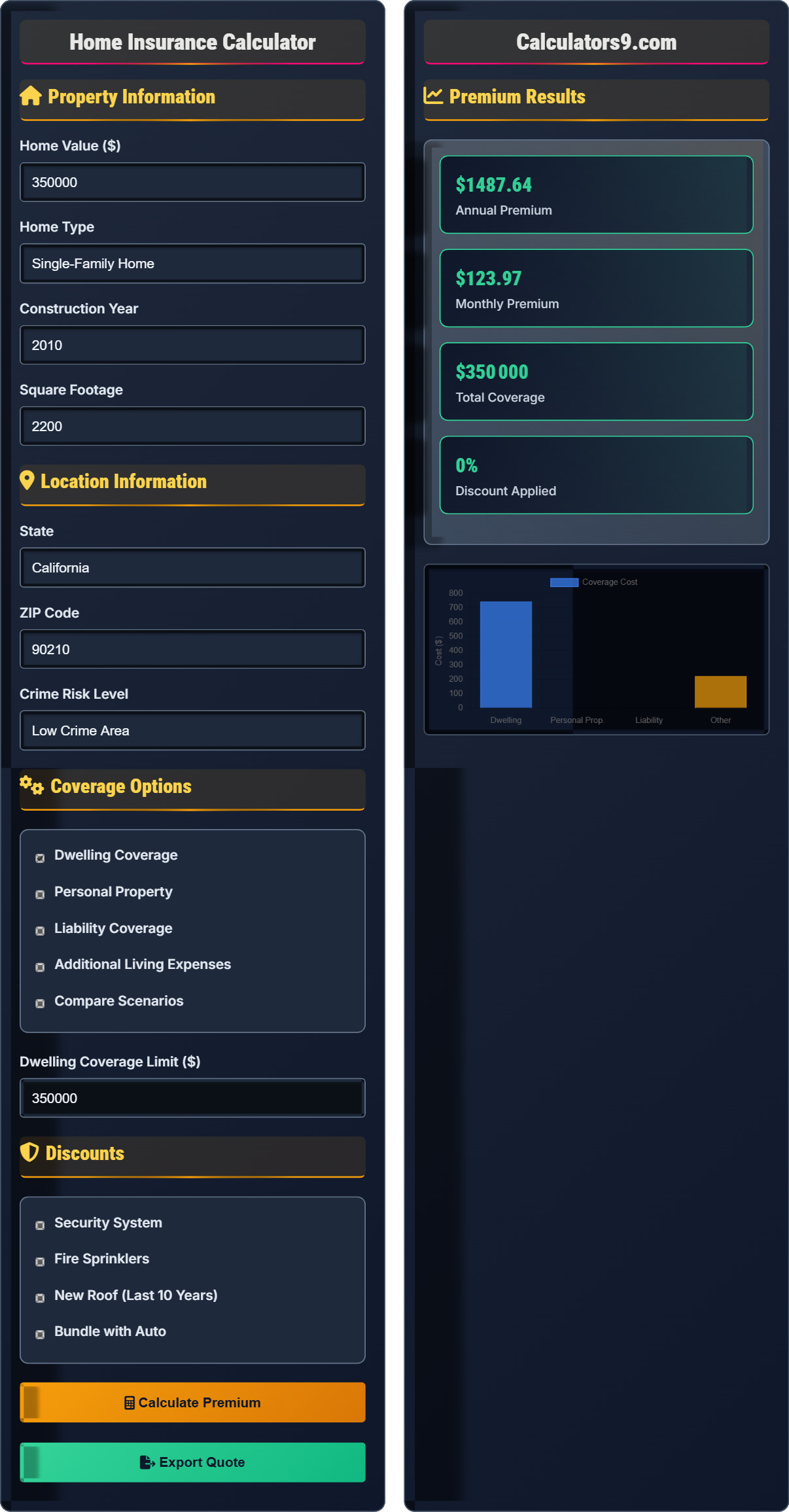
Property Information
Location Information
Coverage Options
Discounts
Premium Results
| Component | Factor | Amount |
|---|
| Coverage Type | Limit | Cost |
|---|
Comprehensive Home Insurance Guide
Home insurance is a contract between you and an insurance company that protects your home and belongings against damage or loss from covered perils like fire, theft, vandalism, and certain weather events. It also provides liability protection if someone is injured on your property.
Home insurance premiums are calculated based on multiple factors:
Where:
- \(P\) = Final Premium
- \(B\) = Base Rate
- \(R_h\) = Home Characteristics Factor
- \(R_l\) = Location Risk Factor
- \(R_c\) = Construction Quality Factor
- \(R_d\) = Deductible Adjustment Factor
- \(D\) = Discount Factor
Your home insurance premium is influenced by several key factors:
- Location: Areas prone to natural disasters or high crime have higher premiums
- Home Age: Older homes may require more repairs and have outdated electrical/plumbing
- Construction Type: Materials and building methods affect risk assessment
- Credit Score: Many insurers use credit history as a risk indicator
- Deductibles: Higher deductibles typically mean lower premiums
- Claims History: Previous claims may increase future premiums
- Install security systems: Can reduce premiums by 5-15%
- Maintain good credit: Improves your insurance score
- Bundle policies: Combine home and auto for multi-policy discounts
- Choose higher deductibles: Reduce premium in exchange for higher out-of-pocket costs
- Improve home safety: Fire sprinklers, smoke detectors, deadbolt locks
- Shop around annually: Compare quotes from multiple insurers
Home Insurance Learning Quiz
Which type of home insurance coverage pays for damage to your personal belongings like furniture and electronics?
The answer is B) Personal Property. Personal property coverage specifically protects your belongings inside the home like furniture, electronics, clothing, and appliances. Dwelling coverage only protects the physical structure of the home itself.
Understanding the difference between dwelling coverage and personal property coverage is fundamental to home insurance literacy. Dwelling coverage protects the house structure, while personal property coverage protects everything inside it. This distinction helps homeowners make informed decisions about coverage limits and understand what would be protected in case of a loss.
Dwelling Coverage: Insurance that protects the physical structure of your home
Personal Property: Insurance that covers your belongings inside the home
Liability Protection: Insurance that covers legal responsibility for injuries to others
• Dwelling coverage only protects the house structure
• Personal property covers items inside the home
• Both types of coverage are typically needed for full protection
• Take inventory photos of personal belongings for claims purposes
• Personal property coverage usually pays actual cash value or replacement cost
• Consider replacement cost coverage over actual cash value
• Confusing dwelling coverage with personal property coverage
• Underestimating the value of personal belongings
• Not understanding the difference between actual cash value and replacement cost
Calculate the estimated annual premium for a $300,000 home with a $800 base rate, located in a moderate-risk area (0.20 multiplier), with a newer construction (0.10 multiplier), average deductible (-0.05 multiplier), and 15% discount (0.15 discount factor). Show your work.
Using the premium formula: \( P = B \times (1 + R_h) \times (1 + R_l) \times (1 + R_c) \times (1 + R_d) \times (1 - D) \)
Given:
- B = $800
- R_l = 0.20 (moderate-risk area)
- R_c = 0.10 (newer construction)
- R_d = -0.05 (average deductible)
- D = 0.15 (15% discount)
Step 1: Calculate the multipliers: (1 + 0.20) = 1.20, (1 + 0.10) = 1.10, (1 - 0.05) = 0.95, (1 - 0.15) = 0.85
Step 2: Calculate P = $800 × 1.20 × 1.10 × 0.95 × 0.85
Step 3: Calculate sequentially: $800 × 1.20 = $960
Step 4: $960 × 1.10 = $1,056
Step 5: $1,056 × 0.95 = $1,003.20
Step 6: $1,003.20 × 0.85 = $852.72
The estimated annual premium is $852.72
This calculation demonstrates how multiple risk factors compound to determine insurance premiums. Each multiplier builds on the previous result, showing how seemingly small percentage adjustments can significantly impact the final premium. The discount factor works differently as a reduction rather than addition, showing how insurers incentivize good behavior.
Base Rate: The starting premium before adjustments
Risk Multiplier: A factor that increases or decreases the base rate
Discount Factor: A reduction in premium for good behavior or features
• Risk multipliers are additive to 1 (e.g., 0.20 becomes 1.20)
• Discount factors are subtractive (e.g., 0.15 becomes 0.85)
• Multipliers compound by multiplication
• Remember to convert percentages to decimals when calculating
• Apply multipliers sequentially for accuracy
• Discounts reduce the final premium amount
• Adding multipliers instead of multiplying them
• Forgetting to convert percentages to decimals
• Applying discounts incorrectly (subtracting from base rate instead of final amount)
Sarah owns a $400,000 home with $200,000 worth of personal belongings. She's considering whether to get replacement cost coverage or actual cash value coverage for her personal property. Her belongings are 5 years old on average. Which option would be better and why? Assume replacement cost coverage costs $100 more annually than actual cash value.
Step 1: Understand the difference between coverage types
Actual Cash Value (ACV): Pays the current market value of items minus depreciation
Replacement Cost: Pays the cost to replace items with new ones of similar kind and quality
Step 2: Calculate potential payout difference
If Sarah's belongings are worth $200,000 new, after 5 years of depreciation, ACV might only pay $120,000 (assuming 40% depreciation)
Replacement cost would pay the full $200,000 to replace the items
Step 3: Calculate break-even point
Extra cost: $100 per year
Potential difference in payout: $80,000 ($200,000 - $120,000)
Break-even would take 800 years ($80,000 ÷ $100), but Sarah only needs this coverage until the next claim
Step 4: Conclusion: Replacement cost is better because it ensures Sarah can fully replace her belongings at today's prices without absorbing depreciation costs.
This example illustrates the importance of understanding coverage types beyond just the premium cost. The decision isn't just about the immediate cost difference but about the financial protection provided in case of a loss. The break-even analysis shows how to quantify the risk, helping students understand that insurance is about managing financial uncertainty rather than just finding the lowest premium.
Actual Cash Value: Current market value minus depreciation
Replacement Cost: Cost to replace item with new one of similar quality
Depreciation: Reduction in value over time due to wear and age
• Actual cash value pays less due to depreciation
• Replacement cost provides full replacement value
• Replacement cost is typically worth the extra premium
• Replacement cost coverage is usually worth the extra premium
• Take photos of valuable items for claims documentation
• Review coverage limits annually as values change
• Choosing ACV to save money without considering the impact of depreciation
• Not understanding how depreciation affects claim payouts
• Underestimating the value of personal belongings
Mike lives in California near wildfire zones with a $500,000 home, while his friend Joe lives in Ohio with a similar $500,000 home. Both have identical homes and security features. Who will likely pay higher premiums and why? Calculate approximate premium differences assuming a base rate of $1,000, with California having 0.50 location risk and Ohio having 0.10 location risk. Both have 0.10 construction risk and 0.10 security discount.
Step 1: Analyze risk factors for Mike (California):
• Location risk: 0.50 (high due to wildfire zones)
• Construction risk: 0.10
• Security discount: -0.10
Step 2: Analyze risk factors for Joe (Ohio):
• Location risk: 0.10 (low for natural disasters)
• Construction risk: 0.10
• Security discount: -0.10
Step 3: Calculate Mike's premium: $1,000 × 1.50 × 1.10 × 0.90 = $1,485
Step 4: Calculate Joe's premium: $1,000 × 1.10 × 1.10 × 0.90 = $1,089
Step 5: Difference: $1,485 - $1,089 = $396
Mike will pay approximately $396 more annually due to higher location risk.
This demonstrates how location dramatically affects home insurance premiums. Natural disaster risks like wildfires, hurricanes, floods, and earthquakes significantly increase premiums in affected areas. The calculation shows how location risk multipliers can have a greater impact than other factors combined, explaining why insurance costs vary so widely across geographic regions.
Location Risk: Risk associated with the geographic area of the property
Natural Disaster Zones: Areas prone to specific types of catastrophic events
Risk Multiplier: A numerical value that adjusts the base premium based on risk
• Location risk is often the largest factor in home insurance premiums
• Natural disaster-prone areas have significantly higher premiums
• Risk multipliers compound multiplicatively
• Research natural disaster risks before buying a home
• Consider additional coverage in high-risk areas
• Shop around as premiums vary significantly between insurers
• Underestimating location risk impact on premiums
• Not researching natural disaster risks in area
• Assuming all insurers charge similar rates in high-risk areas
Which statement about home insurance deductibles is TRUE?
The answer is B) Lower deductibles mean lower out-of-pocket costs in claims. A deductible is the amount you pay out-of-pocket before insurance coverage kicks in. So with a $1,000 deductible, you pay $1,000 and the insurance covers the rest. With a $2,500 deductible, you pay $2,500 before insurance coverage begins.
Understanding the inverse relationship between deductibles and premiums is crucial for insurance planning. Higher deductibles reduce premiums because the insurer bears less risk for smaller claims. However, they increase your financial responsibility in case of a loss. This trade-off requires balancing monthly affordability with emergency preparedness.
Deductible: The amount you pay before insurance coverage begins
Out-of-pocket: Expenses you pay directly, not covered by insurance
Trade-off: The balance between premium savings and increased risk
• Higher deductibles = Lower premiums (and vice versa)
• Deductibles apply to property damage coverage
• Liability coverage typically doesn't have a deductible
• Choose deductible you can afford to pay immediately
• Consider emergency fund when selecting deductible
• Higher deductibles make sense for safe homeowners
• Choosing a deductible too high for your emergency fund
• Confusing deductible with premium
• Thinking deductibles apply to all coverage types
Insurance Basics
Contract protecting against financial loss from home damage or loss.
\( P = B \times (1 + R_h) \times (1 + R_l) \times (1 + R_c) \times (1 + R_d) \times (1 - D) \)
Where P=premium, B=base rate, Rh=home characteristics, Rl=location risk, Rc=construction quality, Rd=deductible adjustment, D=discounts.
- Risk multipliers compound multiplicatively
- Higher deductibles = Lower premiums
- Location risk often dominates other factors
Coverage Types
Protects the physical structure of your home against covered perils.
- Personal Property: Your belongings inside the home
- Liability Protection: Legal responsibility for injuries
- Additional Living Expenses: Temporary living costs
- Medical Payments: Minor medical expenses for guests
- Replacement cost preferred over actual cash value
- Consider local natural disaster risks
- Review coverage limits annually
- Bundle policies for discounts
FAQ
Q: What's the difference between replacement cost and actual cash value coverage?
A: The difference between replacement cost and actual cash value (ACV) coverage lies in how claims are settled:
- Replacement Cost: Pays the full cost to replace damaged property with new items of similar kind and quality, without accounting for depreciation.
- Actual Cash Value: Pays the current market value of the damaged property, which factors in depreciation.
For example, if a 5-year-old TV worth $1,000 new is damaged:
With replacement cost: You receive $1,000 to buy a new TV
With ACV: You receive approximately $400 (accounting for 60% depreciation)
Mathematically, if the replacement cost is \( R \) and depreciation rate is \( d \) per year for \( t \) years, then:
\( ACV = R \times (1 - d \times t) \)
For our example: \( ACV = 1000 \times (1 - 0.12 \times 5) = 1000 \times 0.40 = \$400 \)
Replacement cost coverage typically costs 10-15% more but provides significantly better protection.
Q: How much does location affect home insurance premiums?
A: Location is often the most significant factor affecting home insurance premiums, sometimes more than the value of the home itself. Insurance companies assess:
- Natural disaster risks (hurricanes, earthquakes, floods, wildfires)
- Crime rates in the area
- Proximity to fire stations and hydrants
- Local building costs for reconstruction
For example, a $300,000 home in Miami might have an annual premium of $2,500, while the same home in Des Moines might cost $800 annually—a difference of $1,700 per year!
The location risk factor can range from 0.10 (very low risk) to 0.80 (very high risk). Using our formula where base rate is $800 and location risk is 0.50:
\( Premium = 800 \times (1 + 0.50) = 800 \times 1.50 = \$1,200 \)
That's $600 more than the same home in a low-risk area!