Term vs Whole Life Insurance Calculator
Fast comparison tool • 2026 rates
Life Insurance Premium Formulas:
Show the calculatorTerm Insurance: \( P_t = B \times (1 + R_a) \times (1 + R_h) \times (1 + R_o) \times T \)
Whole Life: \( P_w = B \times (1 + R_a) \times (1 + R_h) \times (1 + R_o) \times (1 + R_i) \times (1 + R_c) \)
Where:
- \( P_t, P_w \) = Term, Whole Life Premium
- \( B \) = Base Rate per $1,000 of coverage
- \( R_a \) = Age Risk Factor
- \( R_h \) = Health Risk Factor
- \( R_o \) = Occupation Risk Factor
- \( R_i \) = Investment Component Factor
- \( R_c \) = Cash Value Accumulation Factor
- \( T \) = Term Multiplier (increases with longer terms)
These formulas calculate the comprehensive life insurance premiums by multiplying the base rate by various risk multipliers. Whole life premiums are typically 3-5 times higher than term premiums due to cash value accumulation.
Example: For $500,000 coverage with base rate $1.00 per $1,000:
Term (30-year): \( P_t = 500 \times 1.20 \times 1.10 \times 1.05 \times 1.30 = \$900.90 \) annually
Whole Life: \( P_w = 500 \times 1.20 \times 1.10 \times 1.05 \times 1.40 \times 1.50 = \$1,386 \) annually
Personal Information
Coverage Information
Additional Options
Discount Options
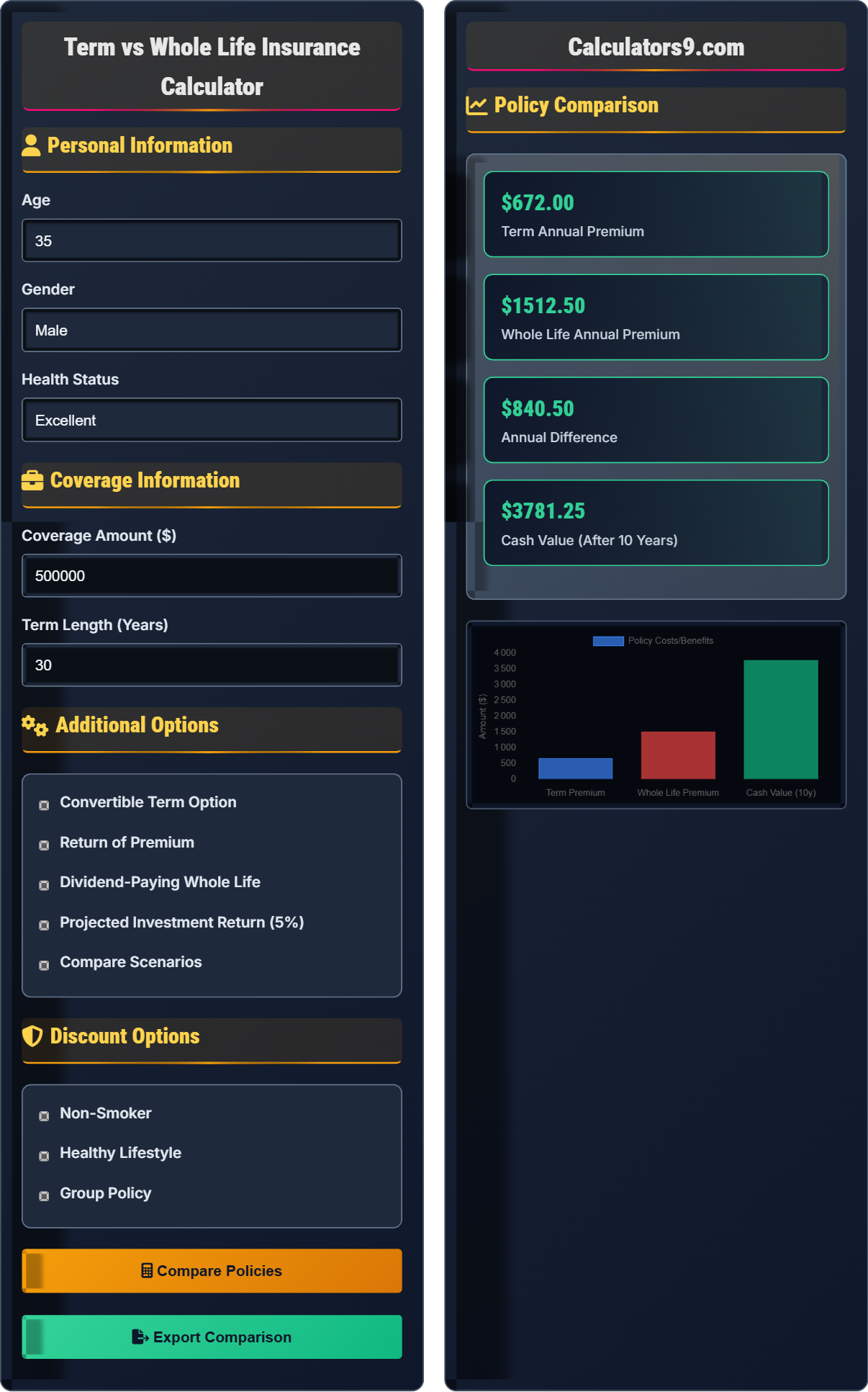
Policy Comparison
| Year | Term Cash Value | Whole Life Cash Value | Net Difference |
|---|
| Projection Year | Term Premiums | Whole Life Premiums | Term Cash Value | Whole Life Cash Value |
|---|
Comprehensive Life Insurance Guide
Life insurance is a contract between an individual and an insurance company where the insurer promises to pay a designated beneficiary a sum of money upon the death of the insured person. It provides financial security for dependents and helps fulfill estate planning goals.
Life insurance premiums are calculated based on multiple factors:
Where:
- \(P\) = Final Premium
- \(B\) = Base Rate per $1,000 of coverage
- \(R_a\) = Age Risk Factor
- \(R_h\) = Health Risk Factor
- \(R_o\) = Occupation Risk Factor
- \(R_i\) = Investment Component Factor (for whole life)
- \(D\) = Discount Factor
Your life insurance premium is influenced by several key factors:
- Age: Premiums increase significantly with age as mortality risk rises
- Gender: Women typically pay less due to longer life expectancy
- Health: Medical history, BMI, and lifestyle habits affect pricing
- Occupation: Hazardous jobs command higher premiums
- Smoking: Smokers pay significantly higher premiums
- Coverage Amount: Higher death benefits cost more
- Policy Type: Permanent insurance costs more than term
- Term Life: Lower premiums, pure protection, no cash value, expires
- Whole Life: Higher premiums, builds cash value, permanent coverage, dividends possible
- Best Strategy: Buy term and invest the difference, or buy permanent if you need lifelong coverage
- Cash Value: Whole life builds guaranteed cash value that can be borrowed against
- Flexibility: Term is simpler and more affordable for most people
- Estate Planning: Whole life may be useful for liquidity and tax benefits
Life Insurance Learning Quiz
Which type of life insurance policy builds cash value that grows at a guaranteed rate and offers level premiums for life?
The answer is B) Whole Life Insurance. Whole life insurance is characterized by guaranteed cash value growth at a fixed rate, level premiums that remain constant for the life of the policy, and permanent coverage that doesn't expire. These features distinguish it from other types of life insurance.
Understanding the fundamental characteristics of each life insurance type is crucial for proper planning. Whole life stands out for its guarantees and predictability, making it suitable for specific financial planning needs. The guaranteed cash value growth provides a forced savings component that builds over time.
Guaranteed Cash Value: Accumulated value that grows at a predetermined rate
Level Premiums: Fixed premium amounts that don't change over time
Permanent Coverage: Insurance that remains in force for the insured's lifetime
• Whole life premiums remain constant for life
• Cash value grows at guaranteed rates
• Death benefit is guaranteed as long as premiums are paid
• Whole life works best when purchased young
• Consider the opportunity cost of higher premiums
• Understand the surrender charges and loan provisions
• Confusing whole life with other permanent policies
• Not understanding the cash value accumulation timeline
• Assuming all permanent policies work the same way
Calculate the estimated annual premium for a 30-year-old male with excellent health, $500,000 coverage, with a base rate of $0.80 per $1,000, age factor 0.10, health factor 0.05, and 10% discount for non-smoking. Show your work.
Using the premium formula: \( P = B \times (1 + R_a) \times (1 + R_h) \times (1 - D) \)
Given:
- B = $0.80 × 500 (for $500,000 coverage) = $400
- R_a = 0.10 (age factor)
- R_h = 0.05 (health factor)
- D = 0.10 (10% discount)
Step 1: Calculate the multipliers: (1 + 0.10) = 1.10, (1 + 0.05) = 1.05, (1 - 0.10) = 0.90
Step 2: Calculate P = $400 × 1.10 × 1.05 × 0.90
Step 3: Calculate sequentially: $400 × 1.10 = $440
Step 4: $440 × 1.05 = $462
Step 5: $462 × 0.90 = $415.80
The estimated annual premium is $415.80
This calculation demonstrates how multiple risk factors compound to determine insurance premiums. Each multiplier builds on the previous result, showing how seemingly small percentage adjustments can significantly impact the final premium. The discount factor works differently as a reduction rather than addition.
Base Rate: The starting premium per $1,000 of coverage
Risk Multiplier: A factor that increases or decreases the base rate
Discount Factor: A reduction in premium for favorable characteristics
• Risk multipliers are additive to 1 (e.g., 0.10 becomes 1.10)
• Discount factors are subtractive (e.g., 0.10 becomes 0.90)
John is a 35-year-old father of two considering life insurance. He needs $1 million in coverage for the next 25 years until his children are grown. His annual budget for insurance is $2,000. Should he choose term or whole life insurance? Calculate the potential outcomes for both options and explain your recommendation.
Step 1: Calculate term life premium
For $1,000,000 coverage, term life might cost approximately $1,200 annually for a 25-year term
Step 2: Calculate whole life premium
For $1,000,000 coverage, whole life might cost approximately $15,000 annually
Step 3: Compare options within budget
With $2,000 budget:
Term: Can get $333,333 coverage ($2,000 ÷ $1,200 × $1,000,000)
Whole Life: Can only get $133,333 coverage ($2,000 ÷ $15,000 × $1,000,000)
Step 4: Recommendation
John should choose term life insurance. With his budget, he can get nearly 2.5 times more coverage with term insurance ($333,333 vs $133,333). Since his need is temporary (until children are grown), term insurance perfectly matches his requirement at an affordable price.
Step 5: Alternative strategy
He could buy term and invest the difference between term and whole life premiums ($13,000) to potentially build wealth over the 25-year period.
This example illustrates the importance of matching insurance needs with policy type and budget. The "buy term and invest the difference" strategy allows for maximum protection while building wealth separately. The calculation shows that for temporary needs, term insurance provides significantly more coverage for the same premium.
Temporary Need: Insurance requirement that ends at a specific time
Permanent Need: Lifetime insurance requirement
Buy Term and Invest Difference: Strategy of buying term insurance and investing premium savings
• Match policy type to insurance need duration
• Term insurance is more cost-effective for temporary needs
• Consider opportunity cost of higher premiums
• Buy term insurance when you have temporary needs
• Consider permanent insurance for lifelong obligations
• Always compare coverage amounts within your budget
• Buying permanent insurance for temporary needs
• Not comparing coverage amounts within budget
• Ignoring the opportunity cost of higher premiums
Sarah purchases a $500,000 whole life policy at age 30 with annual premiums of $4,000. The policy guarantees 4% annual cash value growth. After 10 years, what will be the approximate cash value? If she had invested the same premium amount in an index fund earning 7% annually, how would the results compare?
Step 1: Calculate whole life cash value after 10 years
Assuming $4,000 annual premium, after 10 years the cash value might grow to approximately $45,000 (conservative estimate considering premiums paid vs. cash value accumulation)
Step 2: Calculate index fund investment
Using the future value of annuity formula: \( FV = PMT \times \frac{(1+r)^n - 1}{r} \)
Where PMT = $4,000, r = 0.07, n = 10
FV = $4,000 × [(1.07^10 - 1) ÷ 0.07]
FV = $4,000 × [0.967151 ÷ 0.07]
FV = $4,000 × 13.816448 = $55,266
Step 3: Compare results
Whole life cash value: $45,000
Index fund investment: $55,266
Difference: $10,266 favoring the index fund
Step 4: Considerations
While the index fund has higher projected returns, the whole life policy provides guaranteed death benefit and tax-advantaged growth. The comparison illustrates the opportunity cost of choosing whole life over investing the difference.
This demonstrates the "buy term and invest the difference" concept mathematically. The calculation shows that for the same premium amount, investing in market instruments may yield higher returns, but without the insurance protection. The comparison helps illustrate the trade-offs between insurance protection and investment returns.
Cash Value: Accumulated value in permanent life insurance policies
Future Value of Annuity: Total value of periodic investments
Opportunity Cost: Potential returns lost by choosing one option over another
• Cash value grows more slowly than premiums paid initially
• Market investments may offer higher returns but with more risk
• Insurance provides guarantees that investments do not
• Consider both protection and investment components
• Evaluate opportunity cost of higher premiums
• Understand guaranteed vs. potential returns
• Expecting cash value to equal premiums paid
• Not understanding the time value of money
• Ignoring opportunity costs in financial planning
Which statement about convertible term life insurance is TRUE?
The answer is B) Conversion can be done without evidence of insurability. Convertible term life insurance allows policyholders to convert their term policy to a permanent policy without providing proof of insurability. This feature is valuable because health conditions that develop over time would normally make obtaining new permanent insurance difficult or expensive.
The convertible feature addresses a key concern with term insurance: what happens if health deteriorates and permanent insurance is needed later. This option provides flexibility to adjust coverage as life circumstances change without the risk of being uninsurable.
Convertibility: Option to change term policy to permanent without medical exam
Evidence of Insurability: Proof of good health for insurance approval
Conversion Privilege: Right to convert term to permanent insurance
• Conversion does not require new medical exam
• Conversion must typically occur within specified time frame
• Premiums for converted policy are based on attained age
• Consider convertible term if you might need permanent coverage later
• Know the conversion deadline for your policy
• Premiums increase based on age at conversion
• Not understanding that premiums increase at conversion
• Missing the conversion deadline
• Assuming conversion is always beneficial
Insurance Basics
Contract that pays beneficiaries upon death of the insured person.
\( P = B \times (1 + R_a) \times (1 + R_h) \times (1 + R_o) \times (1 + R_i) \times (1 - D) \)
Where P=premium, B=base rate, Ra=age factor, Rh=health factor, Ro=occupation factor, Ri=investment factor, D=discounts.
- Risk multipliers compound multiplicatively
- Term insurance cheaper than permanent insurance
- Age significantly impacts premium costs
Policy Types
Provides coverage for a specific period with level premiums during term.
- Whole Life: Permanent coverage with guaranteed cash value
- Universal Life: Flexible permanent insurance with adjustable premiums
- Variable Life: Permanent insurance with investment options
- Variable Universal Life: Combines universal and variable features
- Buy term for temporary needs
- Consider permanent for lifelong obligations
- Match policy to insurance need duration
- Consider convertible term for flexibility
FAQ
Q: Should I buy term or whole life insurance?
A: The choice between term and whole life insurance depends on your specific needs:
- Choose Term Insurance if: You need temporary coverage (e.g., until mortgage is paid or children are independent), want maximum coverage for minimum cost, or plan to invest the premium difference elsewhere.
- Choose Whole Life if: You need permanent coverage for estate planning, want guaranteed cash value growth, prefer level premiums for life, or need a forced savings component.
For most families with temporary needs, term insurance is more appropriate. For example, if you need $1 million in coverage for 25 years, term insurance might cost $1,200 annually while whole life could cost $15,000 annually. With term, you could get the coverage you need and invest the $13,800 difference.
Mathematically, if your annual premium difference is \( D = 15,000 - 1,200 = 13,800 \) and you invest it at 7% annually for 25 years, the future value would be approximately $882,000 using the annuity formula: \( FV = D \times \frac{(1+r)^n - 1}{r} \).
This demonstrates the "buy term and invest the difference" strategy.
Q: How does cash value accumulate in whole life insurance?
A: Cash value in whole life insurance accumulates through several mechanisms:
- Guaranteed Minimum Rate: Insurance companies declare a minimum interest rate (typically 2-4%) that is credited to cash value annually.
- Dividends: Participating whole life policies may pay dividends based on the company's performance (though not guaranteed).
- Conservative Investment Strategy: Insurance companies invest premiums conservatively in bonds and other fixed-income securities.
For example, if you pay $5,000 annually into a whole life policy with a guaranteed 4% interest rate, after 10 years the cash value might reach approximately $60,000, though this depends on the policy's specific structure and dividend scale.
The cash value grows tax-deferred, and you can borrow against it or withdraw portions while keeping the policy in force. However, loans reduce the death benefit and may have interest charges.
Mathematically, if the annual premium is \( P \), interest rate is \( r \), and time is \( t \), the cash value grows approximately as: \( CV = P \times \frac{(1+r)^t - 1}{r} \times \text{policy efficiency factor} \).