Crypto Profit Calculator
Bitcoin & altcoin tracker • 2026 portfolio tool
Crypto Profit Calculation Formula:
Show CalculatorThe crypto profit calculation is: Profit/Loss = (Current Price - Purchase Price) × Quantity
For portfolio analysis, we calculate:
- ROI = (Current Value - Total Investment) ÷ Total Investment × 100%
- Unrealized P&L = Current Value - Cost Basis
- Portfolio Allocation = (Asset Value ÷ Total Portfolio Value) × 100%
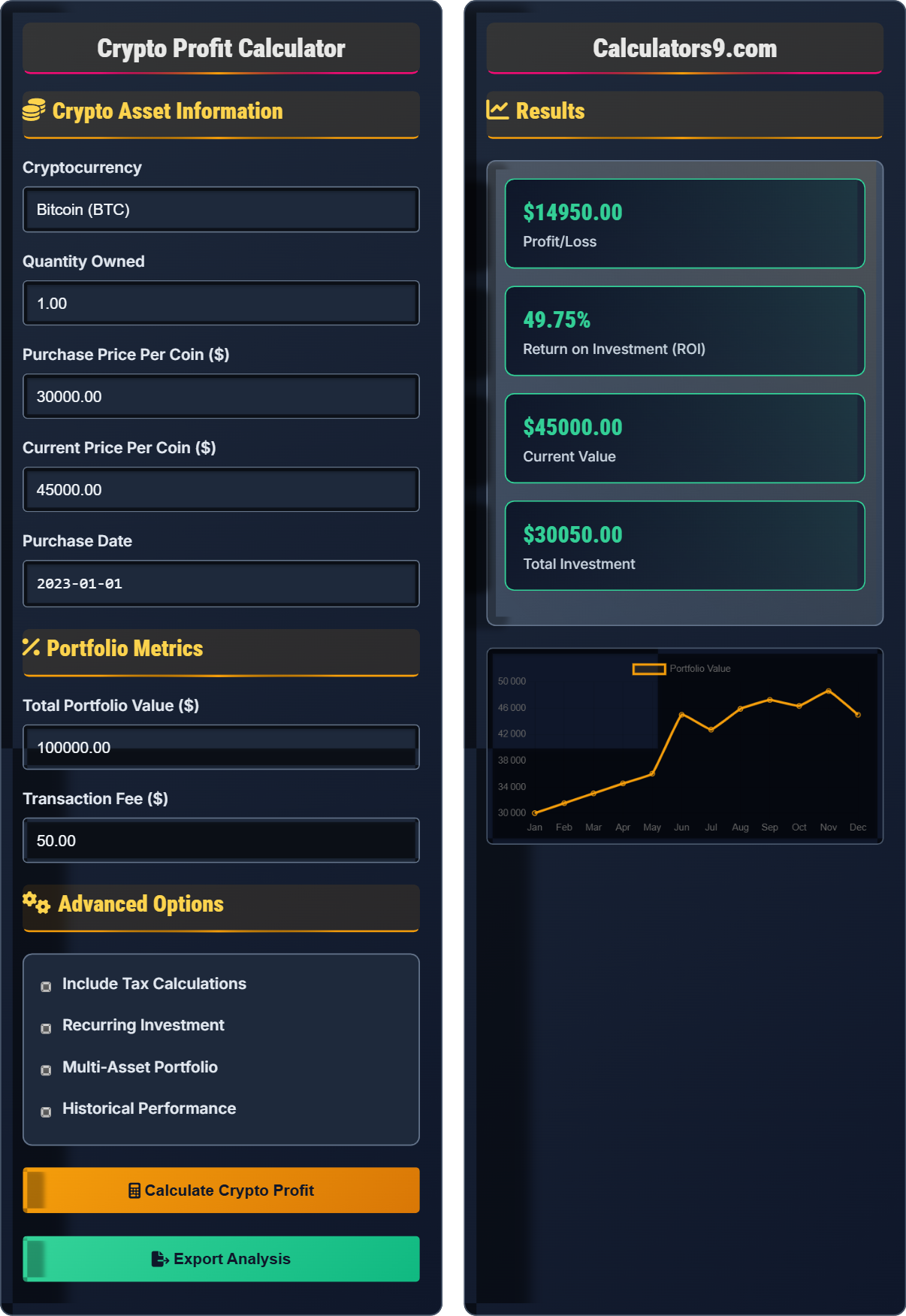
Example: If you bought 1 BTC at $30,000 and current price is $45,000, your profit is ($45,000 - $30,000) × 1 = $15,000, representing a 50% ROI.
Crypto Asset Information
Portfolio Metrics
Advanced Options
Results
| Metric | Value | Description |
|---|---|---|
| Profit/Loss | $15,000.00 | Current value minus investment |
| ROI | 50.00% | Return on investment percentage |
| Investment | $30,000.00 | Original purchase amount |
| Current Value | $45,000.00 | Current market value |
| Hold Time | 12 months | Duration of investment |
| Asset | Allocation | Value |
|---|---|---|
| Bitcoin (BTC) | 45.0% | $45,000.00 |
| Ethereum (ETH) | 25.0% | $25,000.00 |
| Cardano (ADA) | 15.0% | $15,000.00 |
| Others | 15.0% | $15,000.00 |
| Total | 100% | $100,000.00 |
Comprehensive Crypto Investment Guide
Cryptocurrency profit calculation involves comparing your purchase price to the current market price, multiplied by the quantity owned. Unlike traditional investments, crypto markets operate 24/7 and can experience extreme volatility. The profit/loss calculation is straightforward but requires accurate tracking of purchase prices, fees, and quantities.
Key crypto investment metrics are calculated using these formulas:
Where:
- Current Price: Current market value per coin/token
- Purchase Price: Average cost per coin/token
- Quantity: Number of coins/tokens owned
- Current Value: Current price × quantity
- Total Investment: Purchase price × quantity + fees
Key metrics for evaluating crypto portfolio health:
- Sharpe Ratio: Risk-adjusted return measurement
- Maximum Drawdown: Largest peak-to-trough decline
- Volatility: Standard deviation of returns
- Correlation Matrix: Relationship between different assets
- Rebalancing: Regularly adjust allocation to maintain target percentages
- Take Profits: Sell portions when targets are reached
- Stop-Loss Orders: Automatic sell orders at predetermined levels
- Tax Loss Harvesting: Offset gains with losses for tax efficiency
- Position Sizing: Control risk by limiting individual asset exposure
Crypto Basics
Return on Investment: percentage gain or loss relative to investment cost.
\( \text{Profit} = (\text{Current Price} - \text{Purchase Price}) \times \text{Quantity} \)
Where current price is the latest market value.
- Track all transaction fees
- Consider tax implications
- Diversify across assets
Analysis
Unrealized: profits/losses while holding; Realized: after selling.
- Profit/Loss
- ROI percentage
- Time-weighted returns
- Risk-adjusted returns
- Market volatility impact
- Fees and slippage
- Regulatory compliance
- Security considerations
Crypto Investment Learning Quiz
If you bought 2 Bitcoin at $20,000 each and the current price is $25,000, what is your ROI?
The answer is A) 25%. First, calculate total investment: 2 BTC × $20,000 = $40,000. Then calculate current value: 2 BTC × $25,000 = $50,000. Finally, calculate ROI: ($50,000 - $40,000) ÷ $40,000 × 100% = 25%. This represents a 25% return on your original investment.
Understanding ROI calculation is fundamental to crypto investing. The formula (Current Value - Investment) ÷ Investment × 100% provides the percentage return. In this example, the investor doubled their quantity (from 1 to 2 BTC), but the price increase was 25% ($20,000 to $25,000). The ROI calculation takes both factors into account, showing the combined effect of quantity and price changes.
ROI: Return on Investment - percentage gain or loss
Current Value: Market value of holdings
Investment: Original cost basis
• Always use same currency for all values
• Include fees in investment calculation
• ROI can be negative if prices decline
• Use the formula: (Current - Investment) ÷ Investment × 100%
• Track ROI separately for each asset
• Consider time-adjusted returns
• Forgetting to include transaction fees
• Calculating ROI incorrectly
• Not accounting for quantity changes
An investor holds 1 BTC at $40,000, 5 ETH at $2,000 each, and 1000 ADA at $0.50 each. If their total portfolio value is $60,000, calculate the allocation percentage for each asset and determine which asset represents the largest portion of the portfolio.
Calculations:
Bitcoin Value: 1 × $40,000 = $40,000
Ethereum Value: 5 × $2,000 = $10,000
Cardano Value: 1000 × $0.50 = $500
Total Holdings Value: $40,000 + $10,000 + $500 = $50,500
Bitcoin Allocation: ($40,000 ÷ $60,000) × 100% = 66.67%
Ethereum Allocation: ($10,000 ÷ $60,000) × 100% = 16.67%
Cardano Allocation: ($500 ÷ $60,000) × 100% = 0.83%
Conclusion: Bitcoin represents the largest portion of the portfolio at 66.67%, followed by Ethereum at 16.67% and Cardano at 0.83%.
This calculation demonstrates how to determine portfolio allocation percentages. Each asset's value is divided by the total portfolio value to find its percentage. This analysis helps investors understand diversification levels and risk concentration. In this example, the portfolio is heavily concentrated in Bitcoin (66.67%), which increases risk but also potential returns. Diversification across different cryptocurrencies can reduce overall portfolio risk.
Portfolio Allocation: Percentage of total portfolio value in each asset
Diversification: Spreading investments across different assets
Concentration Risk: Risk from overexposure to a single asset
• All allocation percentages should sum to 100%
• Use the formula: (Asset Value ÷ Total Portfolio) × 100%
• Rebalance periodically to maintain targets
• Consider correlation between assets
• Using incorrect total portfolio value
• Forgetting to convert to percentages
• Not accounting for all holdings
FAQ
Q: How do I calculate my crypto profits accurately when I've made multiple purchases at different prices?
A: When you've made multiple purchases, calculate the average cost basis. The formula is:
Average Cost = Total Amount Invested ÷ Total Quantity Purchased
For example, if you bought 1 BTC at $30,000 and then 0.5 BTC at $35,000:
Total Investment = ($30,000 × 1) + ($35,000 × 0.5) = $30,000 + $17,500 = $47,500
Total Quantity = 1 + 0.5 = 1.5 BTC
Average Cost = $47,500 ÷ 1.5 = $31,666.67 per BTC
If the current price is $45,000, your profit per BTC is $45,000 - $31,666.67 = $13,333.33
Total Profit = $13,333.33 × 1.5 = $20,000
ROI = ($20,000 ÷ $47,500) × 100% = 42.11%
This method provides an accurate picture of your returns when averaging into positions over time.
Q: What's the difference between realized and unrealized gains in crypto, and how do they affect taxes?
A: Unrealized gains/losses represent paper profits or losses while holding assets. Realized gains/losses occur when you sell assets. The formulas are:
Unrealized P&L = Current Value - Cost Basis
Realized P&L = Sale Price - Cost Basis
For tax purposes, most jurisdictions only tax realized gains when assets are sold. For example, if you bought 1 BTC at $20,000 and it's now worth $45,000, you have an unrealized gain of $25,000. If you sell it for $45,000, you realize the gain and may owe taxes on the $25,000 profit.
Tax treatment varies by jurisdiction, but generally:
- Short-term (held ≤ 1 year): taxed as ordinary income
- Long-term (held > 1 year): taxed at preferential rates (0%, 15%, or 20% in US)
- Some countries offer tax-loss harvesting opportunities to offset gains with losses.