Rule of 72 Calculator
Compound interest & growth estimator • 2026 portfolio tool
Rule of 72 Formula:
Show CalculatorThe Rule of 72 is: Years to Double = 72 ÷ Interest Rate (%)
This approximation works for compound interest rates between 6% and 10%. For more precise calculations:
- Exact Formula: Years = ln(2) ÷ ln(1 + (rate ÷ 100))
- Rule of 72: Years ≈ 72 ÷ rate
- Rule of 69: Better for continuous compounding (Years ≈ 69 ÷ rate)
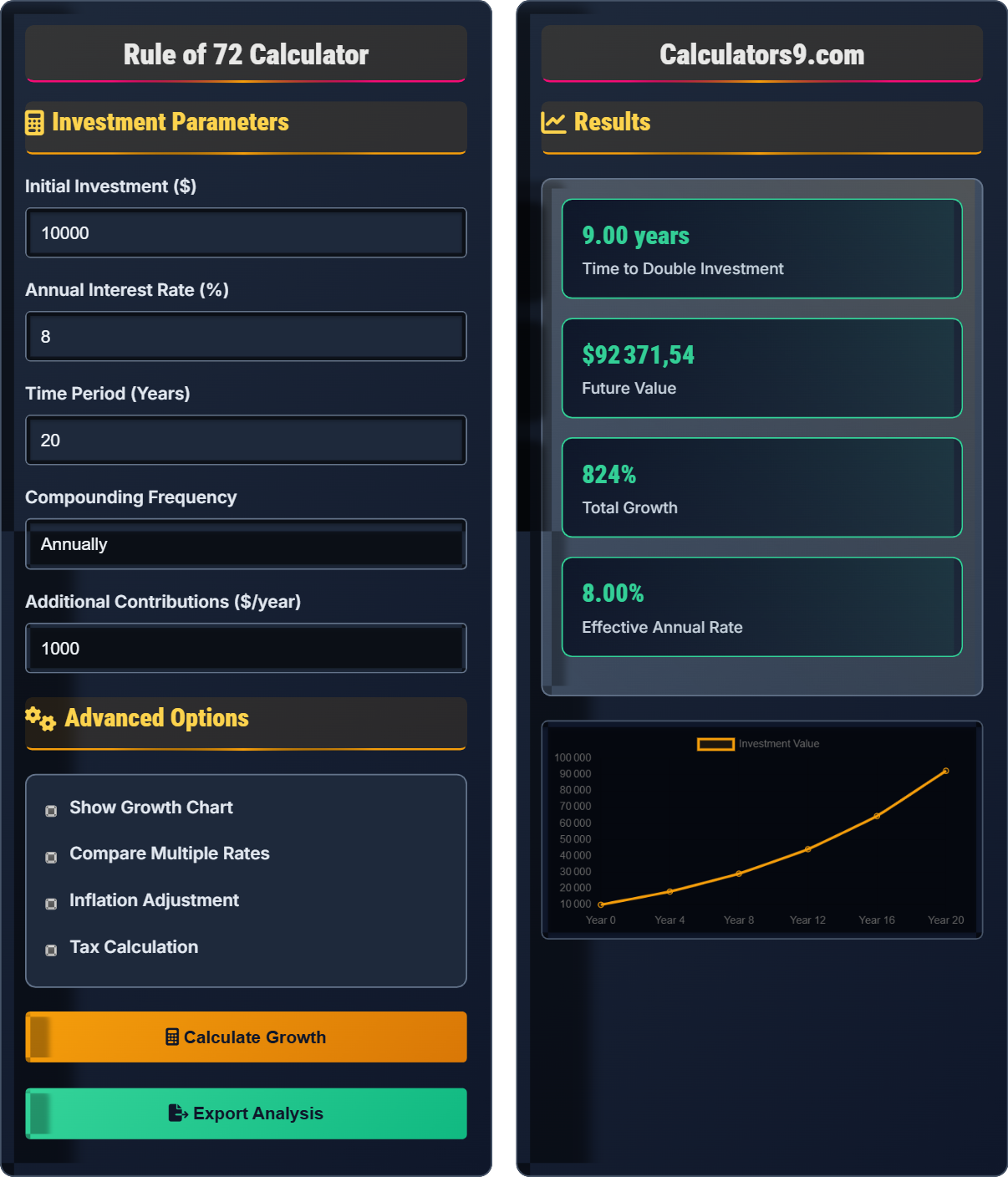
Example: At 8% interest, it takes approximately 72 ÷ 8 = 9 years to double your money. The exact calculation gives 9.01 years, demonstrating the Rule of 72's accuracy for common investment returns.
Investment Parameters
Advanced Options
Results
| Metric | Value | Description |
|---|---|---|
| Rule of 72 Estimate | 9.00 years | Time to double investment |
| Exact Calculation | 9.01 years | Precise doubling time |
| Future Value | $49,268.03 | Total investment value |
| Compound Growth | 393% | Total percentage increase |
| Effective Rate | 7.77% | Actual annual return |
| Year | Value | Change | Balance |
|---|---|---|---|
| Year 1 | $10,800.00 | $800.00 | $11,800.00 |
| Year 5 | $14,693.28 | $1,815.73 | $19,693.28 |
| Year 10 | $21,589.25 | $2,491.97 | $31,589.25 |
| Year 15 | $31,721.69 | $3,632.44 | $41,721.69 |
| Year 20 | $46,609.57 | $5,317.88 | $49,268.03 |
Comprehensive Compound Interest Guide
The Rule of 72 is a mental math shortcut to estimate how long it takes for an investment to double at a given annual interest rate. It's particularly useful for quick comparisons between different investment options and understanding the power of compound interest. The rule becomes more accurate for interest rates between 6% and 10%.
Key compound interest calculations include:
Where:
- Future Value: Final investment value
- PV: Present value (initial investment)
- r: Annual interest rate (decimal)
- n: Compounding frequency per year
- t: Time in years
Key metrics for evaluating compound growth:
- Effective Annual Rate: Actual annual return considering compounding
- Real Rate of Return: Nominal rate adjusted for inflation
- Time Value of Money: Present vs future value calculations
- Compound Annual Growth Rate (CAGR): Smoothed rate of return
- Maximize Contribution Period: The longer money stays invested, the more powerful compounding becomes
- Choose Higher Compounding Frequencies: More frequent compounding accelerates growth
- Minimize Fees: High fees erode compound growth over time
- Stay Invested: Avoid pulling money out prematurely to maintain compounding momentum
- Regular Contributions: Systematic investing builds wealth through dollar-cost averaging
Compound Interest Basics
Interest earned on both the initial principal and the accumulated interest from previous periods.
\( \text{Years to Double} = \frac{72}{\text{Interest Rate}} \)
Simple approximation for compound interest doubling time.
- Most accurate for rates 6-10%
- Higher rates become less accurate
- Works for exponential growth
Analysis
Actual annual return considering compounding frequency and inflation.
- Time to double
- Future value
- Compound growth rate
- Real vs nominal returns
- Inflation impact
- Tax implications
- Compounding frequency
- Investment fees
Compound Interest Learning Quiz
Using the Rule of 72, how long would it take for an investment to double at an annual interest rate of 6%?
The answer is B) 12 years. Using the Rule of 72: Years to double = 72 ÷ Interest Rate = 72 ÷ 6 = 12 years. This means it would take approximately 12 years for an investment to double at a 6% annual interest rate.
The Rule of 72 is a quick mental math shortcut that demonstrates the power of compound interest. The formula is simple: divide 72 by the interest rate to get the approximate number of years it takes for an investment to double. This rule works best for interest rates between 6% and 10%. At 6%, the investment doubles in 12 years, showing how even modest interest rates can generate significant growth over time.
Rule of 72: Mental math shortcut to estimate doubling time
Compound Interest: Interest earned on principal and accumulated interest
Time Value of Money: Concept that money grows over time
• Rule of 72 = 72 ÷ Interest Rate
• Most accurate for rates 6-10%
• Works for exponential growth
• Use 72 ÷ rate to estimate doubling time
• For rates above 10%, use 70 ÷ rate
• For continuous compounding, use 69 ÷ rate
• Using the wrong divisor (not 72)
• Forgetting to divide by 100 for percentages
• Not considering compounding frequency
If you invest $5,000 at an annual interest rate of 8% compounded annually, how much will the investment be worth after 10 years? Also, calculate the effective annual rate if the interest were compounded monthly instead of annually.
Annual Compounding:
Future Value = PV × (1 + r)^t
Future Value = $5,000 × (1 + 0.08)^10
Future Value = $5,000 × (1.08)^10
Future Value = $5,000 × 2.1589
Future Value = $10,794.50
Monthly Compounding:
Future Value = PV × (1 + r/n)^(nt)
Future Value = $5,000 × (1 + 0.08/12)^(12×10)
Future Value = $5,000 × (1.00667)^120
Future Value = $5,000 × 2.2196
Future Value = $11,098.00
Effective Annual Rate:
EAR = (1 + r/n)^n - 1
EAR = (1 + 0.08/12)^12 - 1
EAR = (1.00667)^12 - 1
EAR = 1.0830 - 1 = 0.0830 or 8.30%
This calculation demonstrates how compounding frequency affects investment growth. The more frequent the compounding, the higher the final value due to earning interest on interest more often. In this example, monthly compounding yields $303.50 more than annual compounding over 10 years. The effective annual rate (EAR) shows the actual return considering compounding frequency, which is slightly higher than the stated annual rate.
Future Value: Value of an investment at a future date
Present Value: Current value of the investment
Effective Annual Rate: Actual annual return considering compounding
• More frequent compounding = higher returns
• EAR > stated rate when compounding > annually
• Formula: FV = PV × (1 + r/n)^(nt)
• Use the compound interest formula: FV = PV(1+r/n)^(nt)
• More frequent compounding accelerates growth
• Calculate EAR to compare different investments
• Forgetting to adjust for compounding frequency
• Using simple interest instead of compound interest
• Not converting percentages to decimals
FAQ
Q: How accurate is the Rule of 72, and when should I use the exact formula instead?
A: The Rule of 72 is most accurate for interest rates between 6% and 10%. The accuracy decreases at higher or lower rates. The exact formula for doubling time is:
Exact Formula: Years = ln(2) ÷ ln(1 + r)
Where r is the interest rate in decimal form.
For example, at 8%: Rule of 72 = 72 ÷ 8 = 9 years; Exact = ln(2) ÷ ln(1.08) = 0.693 ÷ 0.077 = 9.01 years. The difference is minimal.
At 20%: Rule of 72 = 72 ÷ 20 = 3.6 years; Exact = ln(2) ÷ ln(1.20) = 0.693 ÷ 0.182 = 3.80 years. Here, the Rule of 72 is less accurate.
Use the Rule of 72 for quick estimates and the exact formula when precision is needed or for rates outside the 6-10% range.
Q: How does inflation affect the real value of compound growth?
A: Inflation significantly impacts the real value of compound growth. The real rate of return adjusts for inflation using the formula:
Real Rate of Return = [(1 + Nominal Rate) ÷ (1 + Inflation Rate)] - 1
For example, if your investment earns 8% annually but inflation is 3%, your real rate of return is: [(1.08 ÷ 1.03) - 1] = 4.85%.
Over 20 years, $10,000 growing at 8% would become $46,610, but accounting for 3% inflation, the purchasing power would be equivalent to $25,600 in today's dollars. This demonstrates that while nominal growth appears substantial, inflation erodes the real purchasing power of your investment.
The Rule of 72 for real returns: Years to double real value = 72 ÷ Real Rate. In our example, it would take 72 ÷ 4.85 = 14.8 years to double your purchasing power, not the 9 years suggested by the nominal rate.