Vocabulary Progress Tracker
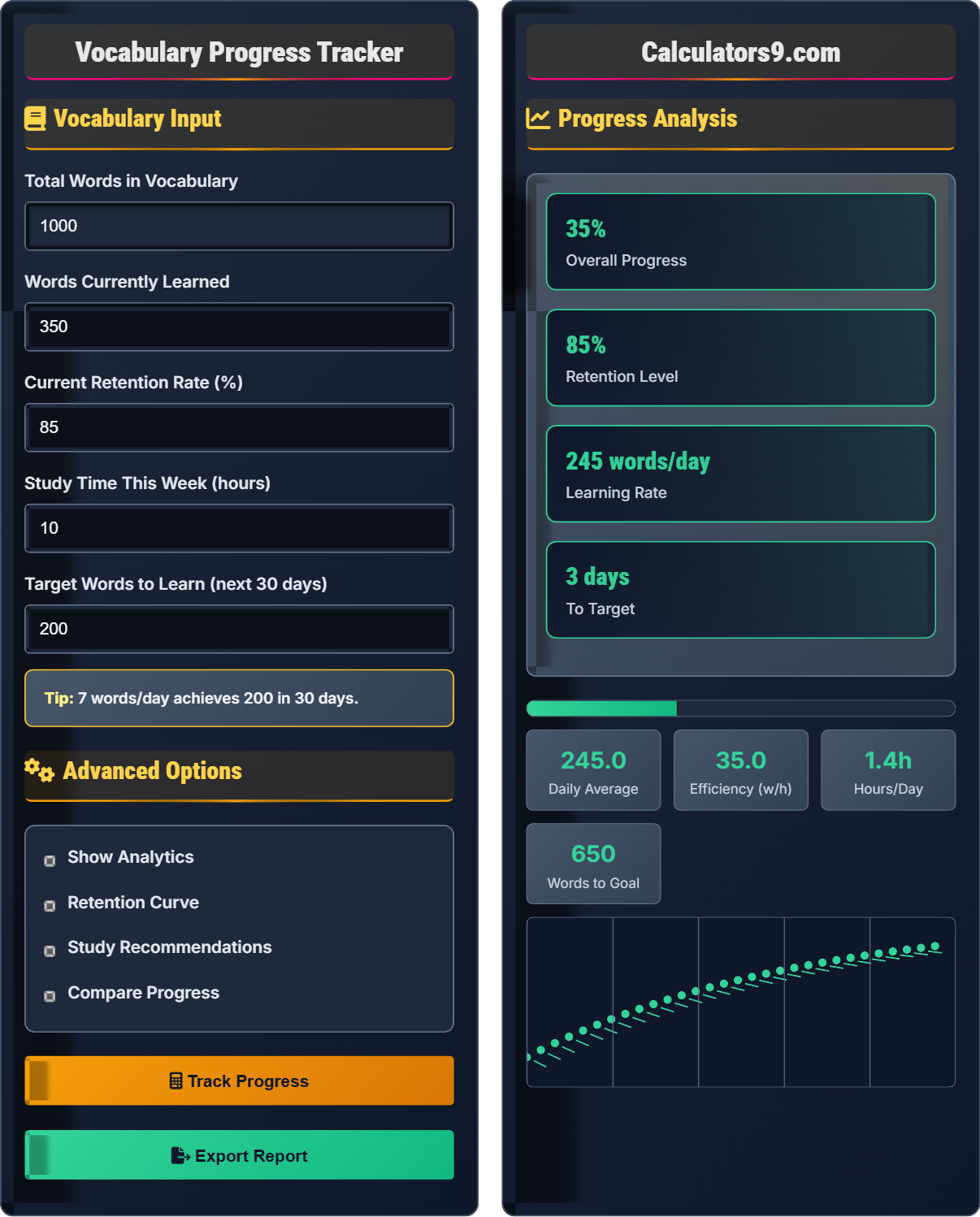
Learning analytics • Retention tracking
Vocabulary Learning Formula:
Show the tracker\( RL = \frac{W_R}{W_T} \times 100 \)
Where:
- \( RL \) = Retention Level (%)
- \( W_R \) = Words recalled correctly
- \( W_T \) = Total words tested
This formula calculates the percentage of vocabulary retained over time, which is fundamental to measuring learning effectiveness.
Example: If you correctly recall 85 out of 100 words tested:
\( RL = \frac{85}{100} \times 100 = 85\% \)
Additional metrics include:
- Daily learning rate: \( LR = \frac{W_L}{D} \) (words learned per day)
- Retention decay: \( RD = RL_0 - RL_t \) (loss over time)
- Learning efficiency: \( LE = \frac{W_M}{T_S} \) (words mastered per hour studied)
These metrics help optimize study schedules and identify effective learning strategies.
Vocabulary Input
Advanced Options
Progress Analysis
Comprehensive Vocabulary Learning Guide
Vocabulary learning is the process of acquiring and retaining new words in a language. It involves not just memorizing definitions, but understanding usage, context, and nuances. Effective vocabulary acquisition follows principles of spaced repetition, contextual learning, and active recall.
Key metrics for tracking vocabulary learning include:
Other important metrics:
- Learning rate: Words acquired per unit time
- Retention decay: Loss of knowledge over time without review
- Efficiency: Words learned per hour of study
- Spaced interval: Optimal timing between reviews
Ebbinghaus forgetting curve shows how quickly we forget new information without reinforcement:
- After 20 minutes: 42% forgotten
- After 1 hour: 56% forgotten
- After 1 day: 74% forgotten
- After 1 week: 77% forgotten
Spaced repetition combats this by scheduling reviews at optimal intervals.
- Consistent daily practice: Even 15 minutes daily is better than 2 hours weekly
- Focus on weak areas: Identify and prioritize words you struggle to remember
- Use spaced intervals: Review at 1, 3, 7, 14, 30-day intervals
- Track progress: Monitor metrics to adjust strategy
- Practice in context: Use new words in speaking and writing
Vocabulary Fundamentals
Percentage of words correctly recalled after learning.
\(R = \frac{W_r}{W_t} \times 100\)
Where R=retention rate, W_r=words recalled, W_t=words tested.
- Review within 24 hours of learning
- Space reviews at increasing intervals
- Focus on difficult words more frequently
Optimization Strategies
Algorithmic approach to schedule reviews at optimal intervals.
- Learn new words
- Review after 1 day
- Review after 3 days
- Review after 7 days
- Review after 14 days
- Review after 30 days
- Set daily learning goals
- Track retention metrics
- Adjust intervals based on difficulty
- Combine with contextual learning
Vocabulary Learning Quiz
If a learner knows 500 words and correctly recalls 425 of them during testing, what is their retention rate?
The retention rate is calculated using the formula: \(RL = \frac{W_R}{W_T} \times 100\)
Where:
- \(W_R\) = Words recalled correctly = 425
- \(W_T\) = Total words tested = 500
So: \(RL = \frac{425}{500} \times 100 = 0.85 \times 100 = 85\%\)
The answer is C) 85%.
Retention rate is a fundamental metric in language learning that measures how well you've internalized vocabulary. It's calculated by dividing the number of words you can recall by the total number tested, then multiplying by 100 to get a percentage. A high retention rate indicates effective learning and memory consolidation.
Retention Rate: Percentage of learned words that can be recalled correctly
Active Recall: Process of retrieving information from memory without cues
Spaced Repetition: Learning technique that involves reviewing material at increasing intervals
• Retention rate = (Recalled words ÷ Tested words) × 100
• Higher retention rates indicate more effective learning
• Regular testing improves long-term retention
• Use the mnemonic "Rate = Recall over Total times 100" to remember the formula
• Test yourself regularly to maintain high retention
• Focus more on words with lower recall rates
• Confusing retention rate with learning speed
• Calculating with wrong numerator/denominator
• Forgetting to multiply by 100 for percentage
You want to learn 300 new vocabulary words in 60 days. You can dedicate 1.5 hours per day to vocabulary study, and you learn at a rate of 4 words per hour. How many days per week should you study to achieve your goal? Is this schedule sustainable?
First, calculate the total number of words you can learn:
- Study time per day: 1.5 hours
- Learning rate: 4 words/hour
- Words learned per day: 1.5 × 4 = 6 words
Next, calculate the total capacity over 60 days:
- Total capacity: 6 words/day × 60 days = 360 words
Since your goal is 300 words and your capacity is 360 words, the goal is achievable. Now calculate the minimum days needed:
- Days needed: 300 ÷ 6 = 50 days
To find the weekly schedule:
- Study 50 days over 60 days
- That's about 50/60 = 0.83 or 83% of days
- In a 7-day week: 0.83 × 7 ≈ 6 days per week
Yes, this schedule is sustainable since you have flexibility to miss some days while still achieving your goal.
This problem demonstrates the importance of planning vocabulary learning goals based on realistic capacity. By calculating your learning rate and available time, you can determine if a goal is achievable and plan an optimal schedule. The key is balancing intensity with sustainability to avoid burnout.
Learning Rate: Number of items acquired per unit of time
Capacity: Maximum number of items that can be learned given available time
Sustainability: Ability to maintain a learning schedule over time without exhaustion
• Learning capacity = (Hours/day) × (Words/hour) × (Days)
• Always plan for buffer time to account for missed days
• Sustainable schedules allow for rest and flexibility
• Calculate your personal learning rate through experimentation
• Build in 10-20% buffer time to accommodate life disruptions
• Adjust goals if initial estimates prove unrealistic
• Overestimating learning capacity leading to burnout
• Not accounting for rest days in planning
• Setting goals without considering available time
FAQ
Q: How does the forgetting curve affect vocabulary retention and what can I do about it?
A: The forgetting curve, discovered by Hermann Ebbinghaus, shows that we rapidly lose newly acquired information without reinforcement. Within 20 minutes, we forget 42% of new information; after an hour, 56%; and after a day, 74%.
For vocabulary learning, this means that if you learn 100 new words today, you'll likely only remember about 26 of them tomorrow without review. The mathematical model of the forgetting curve is:
\(R = e^{-t/S}\)
Where \(R\) is retention, \(t\) is time, and \(S\) is strength of memory.
To combat this, spaced repetition systems schedule reviews at optimal intervals:
- First review: after 1 day
- Second review: after 3 days
- Third review: after 7 days
- Fourth review: after 14 days
- Subsequent reviews: after 30 days or more
This approach increases long-term retention to 80-90% compared to 20-30% with traditional studying.
Q: What's the difference between learning rate and retention rate in vocabulary acquisition?
A: Learning rate and retention rate are two distinct but related metrics in vocabulary acquisition:
Learning Rate measures how quickly you acquire new words:
\(LR = \frac{\text{New words learned}}{\text{Time spent}}\)
For example, if you learn 50 new words in 5 hours, your learning rate is 10 words per hour.
Retention Rate measures how well you maintain knowledge of learned words:
\(RR = \frac{\text{Words correctly recalled}}{\text{Words tested}} \times 100\)
For example, if you correctly recall 85 out of 100 words tested, your retention rate is 85%.
Both metrics are important: learning rate determines how fast you expand your vocabulary, while retention rate indicates how well you maintain what you've learned. The most effective learners have both high learning rates and high retention rates.