Word Frequency Calculator
Text analysis • Occurrence patterns
Word Frequency Formula:
Show the calculator\( WF = \frac{OC}{TC} \times 100 \)
\( RF = \frac{OC}{TC} \)
Where:
- \( WF \) = Word Frequency (%)
- \( RF \) = Relative Frequency
- \( OC \) = Occurrences of a word
- \( TC \) = Total word count
Additional metrics include:
- Type-Token Ratio: \( TTR = \frac{Unique\ Words}{Total\ Words} \)
- Zipf's Law: \( f(r) = \frac{C}{r^s} \) (frequency inversely proportional to rank)
Example: In a text of 1000 words, if "the" appears 50 times:
\( WF = \frac{50}{1000} \times 100 = 5\% \)
This means "the" constitutes 5% of the text, making it a very common word.
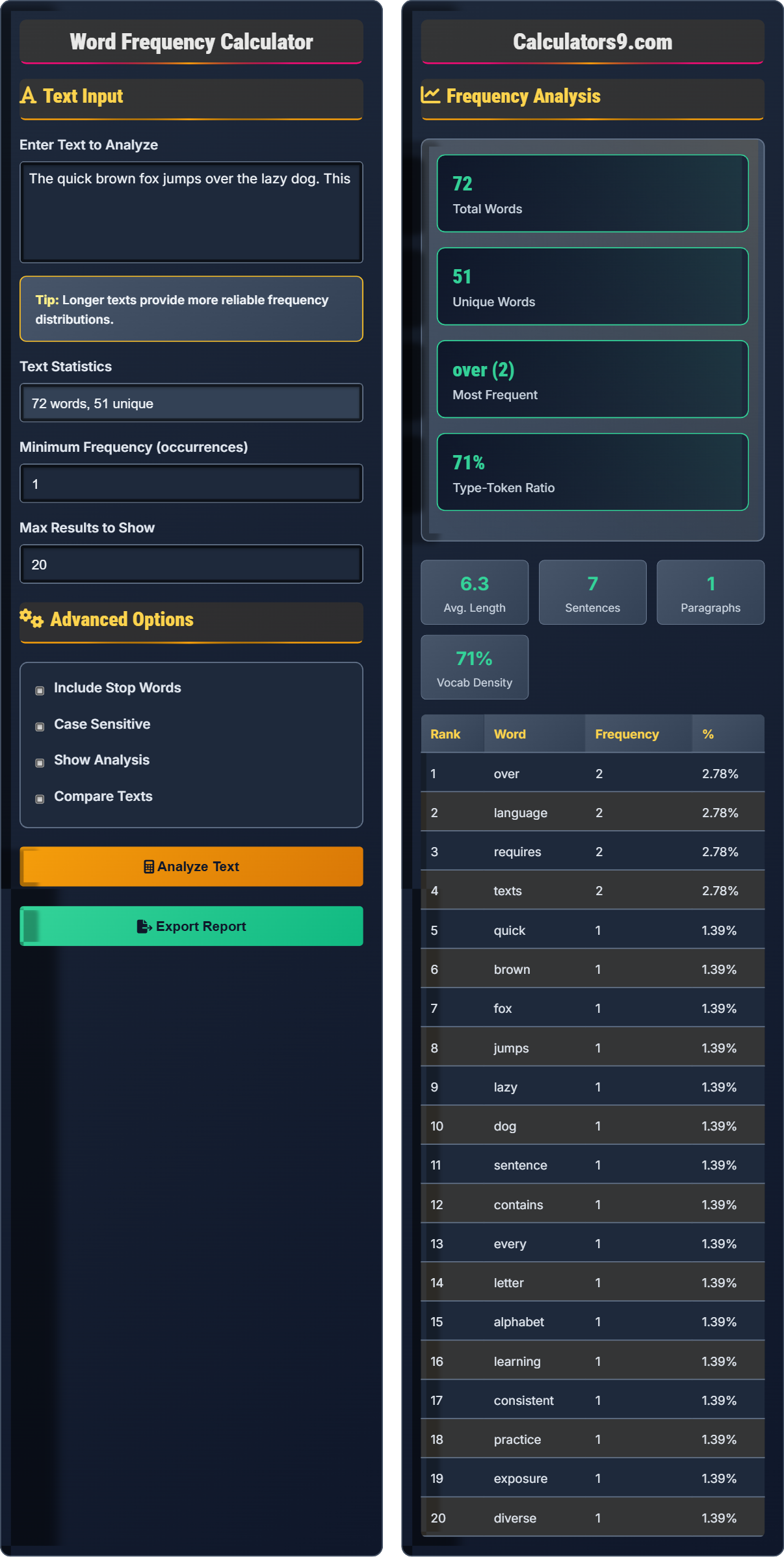
Text Input
Advanced Options
Frequency Analysis
| Rank | Word | Frequency | % |
|---|---|---|---|
| Enter text and click "Analyze Text" to see results | |||
Comprehensive Word Frequency Guide
Word frequency analysis measures how often specific words appear in a text. It reveals patterns in language use, identifies key concepts, and helps understand text characteristics. Frequency analysis is fundamental in linguistics, computational text analysis, and language learning.
Key metrics in word frequency analysis include:
Other important metrics:
- Type-Token Ratio (TTR): Measures lexical diversity
- Zipf's Law: Describes frequency distribution patterns
- Relative Frequency: Normalized frequency per thousand words
- Frequency Rank: Position in frequency ordering
Zipf's Law states that in natural language, the frequency of any word is inversely proportional to its rank in the frequency table. Mathematically: \( f(r) = \frac{C}{r^s} \), where C and s are parameters. This means the second most common word occurs half as often as the most common word, the third occurs one-third as often, and so on.
- Stop Word Filtering: Remove common words like "the", "and", "of"
- Stemming/Lemmatization: Group word variations
- Normalization: Account for case and punctuation
- Contextual Analysis: Consider word relationships
- Comparative Analysis: Compare across texts or genres
Frequency Fundamentals
Measure of how often a word appears in a text relative to total word count.
\(WF = \frac{O}{T} \times 100\)
Where O=occurrences, T=total words.
- Higher frequency = more common word
- Top 100 words cover ~50% of text
- Stop words dominate frequency lists
- Content words are less frequent
Analysis Techniques
Measure of lexical diversity comparing unique words to total words.
- Preprocess text (clean, normalize)
- Tokenize into words
- Count occurrences
- Calculate frequencies
- Sort and analyze results
- Filter stop words if needed
- Use larger samples for reliability
- Filter stop words for content analysis
- Consider context and genre
- Normalize for text length differences
Word Frequency Analysis Quiz
If a text contains 1000 words and the word "the" appears 50 times, what is the frequency percentage of "the"?
The word frequency percentage is calculated using the formula:
\(WF = \frac{OC}{TC} \times 100\)
Where:
- WF = Word Frequency percentage
- OC = Occurrences of the word = 50
- TC = Total word count = 1000
So: \(WF = \frac{50}{1000} \times 100 = 0.05 \times 100 = 5\%\)
The answer is B) 5%.
Word frequency is a fundamental metric in text analysis that expresses how often a particular word appears relative to the total word count. This percentage helps identify the importance and prevalence of words in a text, which is valuable for language learning, content analysis, and linguistic research.
Word Frequency: Percentage of times a word appears in a text
Occurrence: Number of times a word appears
Total Word Count: Sum of all words in the text
• Frequency = (Occurrences ÷ Total Words) × 100
• Higher percentages indicate more frequent words
• Stop words typically have high frequencies
• Remember: Divide occurrences by total words, then multiply by 100
• Common words like "the", "and", "of" usually have high frequencies
• Forgetting to multiply by 100 for percentage
• Dividing total words by occurrences instead of vice versa
• Confusing absolute count with relative frequency
A text contains 500 words with 300 unique words. Calculate the Type-Token Ratio (TTR). If another text of 1000 words contains 500 unique words, which text has greater lexical diversity? How would you interpret this for language learning purposes?
First, calculate the Type-Token Ratio for each text:
\(TTR = \frac{\text{Unique Words}}{\text{Total Words}}\)
Text 1:
- Unique Words: 300
- Total Words: 500
- TTR = 300 ÷ 500 = 0.60 or 60%
Text 2:
- Unique Words: 500
- Total Words: 1000
- TTR = 500 ÷ 1000 = 0.50 or 50%
Text 1 has a higher TTR (60%) than Text 2 (50%), meaning Text 1 has greater lexical diversity. A higher TTR indicates that a larger proportion of the text consists of different words rather than repetitions.
For language learning, Text 1 would provide more vocabulary variety, which could be beneficial for expanding word knowledge. However, Text 2, with its lower TTR, might be easier to read as it uses more repeated vocabulary.
The Type-Token Ratio is a measure of lexical diversity that compares the number of unique words (types) to the total number of words (tokens). A higher TTR indicates greater vocabulary variety, which can be important for language learners to encounter new words. However, a balance is needed between variety and repetition for effective learning.
Type-Token Ratio (TTR): Measure of lexical diversity
Types: Unique words in a text
Tokens: Total word count in a text
• TTR = Unique Words ÷ Total Words
• Higher TTR = Greater lexical diversity
• Lower TTR = More repetitive vocabulary
• TTR decreases as text length increases
• Compare texts of similar length for fair assessment
• Consider both TTR and absolute vocabulary size
• Confusing types with tokens
• Not accounting for text length when comparing TTR
• Misinterpreting higher TTR as always better
FAQ
Q: How does word frequency analysis help in language learning and vocabulary prioritization?
A: Word frequency analysis is invaluable for language learning because it helps prioritize vocabulary study:
High-Frequency Words: The most common words in a language (like "the", "be", "to", "of") appear in a large percentage of texts. Learning the top 1000-3000 high-frequency words covers approximately 80-90% of most texts.
Zipf's Law in Learning: Since word frequency follows a power law distribution, focusing on the most frequent words yields the greatest return on investment. The formula for this relationship is: \( f(r) = \frac{C}{r^s} \), where f(r) is frequency of the r-th ranked word.
Practical Application:
- Focus on the 100 most frequent words first
- Learn words in frequency order up to 3000 words
- Supplement with domain-specific vocabulary
- Use frequency data to choose reading materials
Research shows that learners who study high-frequency words first achieve faster reading comprehension gains than those who study words randomly.
Q: What is the difference between absolute frequency and relative frequency in text analysis?
A: Absolute frequency and relative frequency measure different aspects of word occurrence:
Absolute Frequency:
- Simply counts how many times a word appears
- Example: "the" appears 50 times in a text
- Dependent on text length
- Not suitable for comparing texts of different lengths
Relative Frequency:
- Measures frequency per unit of text (usually per 1000 words)
- Formula: \(RF = \frac{Absolute\ Frequency}{Total\ Words} \times 1000\)
- Normalized measure independent of text length
- Suitable for comparing across texts
Example:
- Text A (500 words): "the" appears 25 times → RF = (25/500)×1000 = 50 per 1000 words
- Text B (1000 words): "the" appears 50 times → RF = (50/1000)×1000 = 50 per 1000 words
Both texts have the same relative frequency despite different absolute counts, showing the importance of normalization in comparative analysis.