Alimony Calculator
Fast spousal support calculator • 2026 laws
Alimony Calculation Formula:
Show the calculator\( AS = (HI - HP) \times F \)
Where:
- \( AS \) = Alimony Support amount
- \( HI \) = Higher earner's monthly income
- \( HP \) = Higher earner's monthly payments
- \( F \) = Formula factor (typically 0.3 to 0.4)
Alternative formula: \( AS = HI \times 0.25 - LI \times 0.15 \) (where LI is lower earner's income)
Duration guidelines: 1 year for every 3 years of marriage (some jurisdictions). Courts consider multiple factors including health, education, earning capacity, and standard of living.
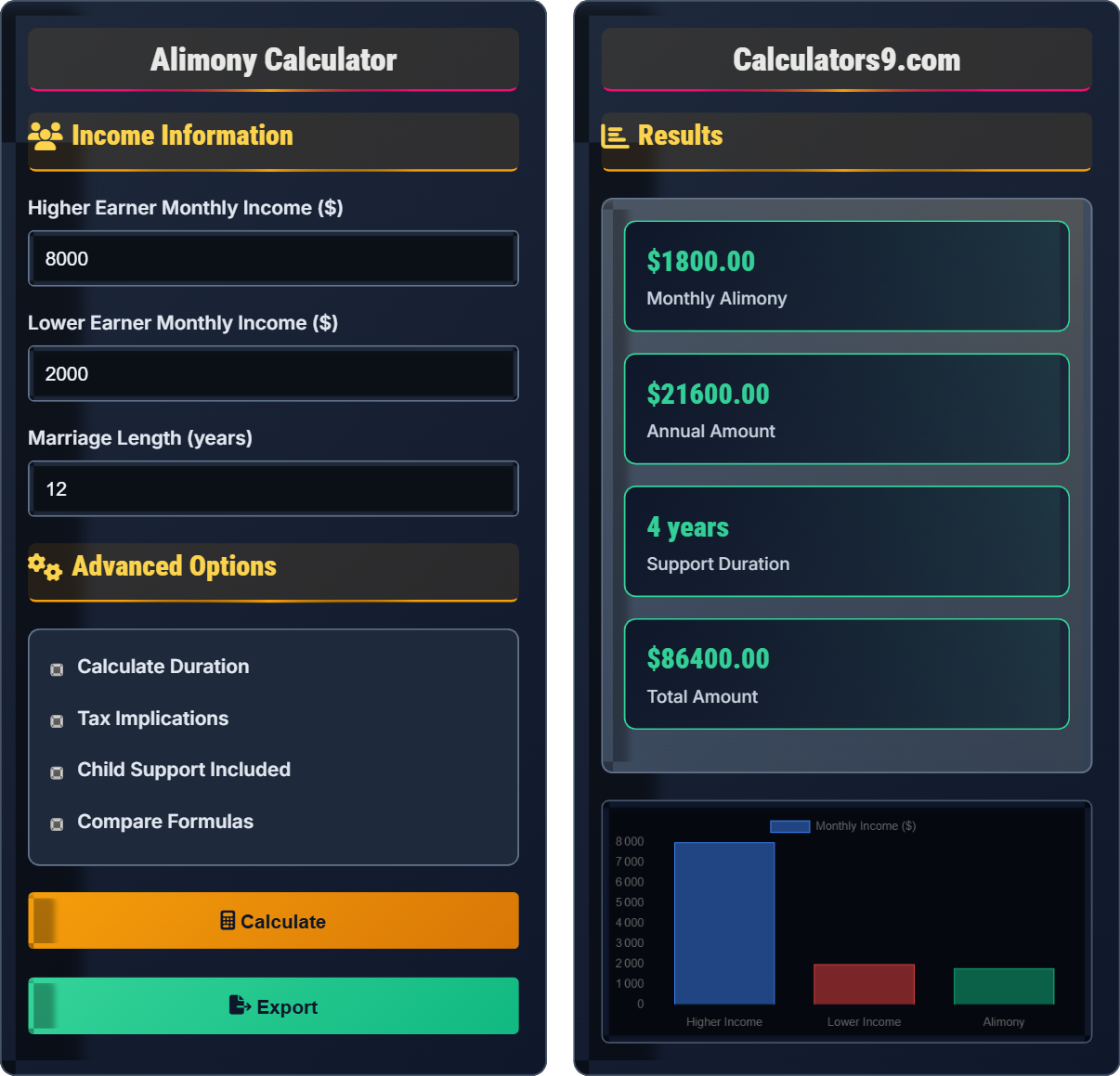
Example: For a spouse earning $8,000/month paying $2,000/month in obligations, with factor 0.3:
Alimony = ($8,000 - $2,000) × 0.3 = $1,800/month
For 12-year marriage: Duration = 12 ÷ 3 = 4 years
Therefore, support would be $1,800/month for 4 years.
Income Information
Advanced Options
Results
| Information | Value |
|---|
| Calculation | Details |
|---|
Comprehensive Legal Guide
Alimony (spousal support) is financial assistance provided by one spouse to another after separation or divorce. Courts award alimony to help the lower-earning spouse maintain a reasonable standard of living. The purpose is to address economic imbalances created by the dissolution of marriage. Awards are based on numerous factors and vary significantly by jurisdiction.
Common calculation approaches include:
Where:
- \(AS\) = Alimony Support
- \(HI\) = Higher earner's income
- \(HP\) = Higher earner's payments
- \(LI\) = Lower earner's income
- \(F\) = Formula factor
Courts have discretion and consider multiple factors.
Various forms of support available:
- Temporary: During divorce proceedings
- Rehabilitative: Until recipient can become self-supporting
- Permanent: Long-term support for long marriages
- Reimbursement: Repayment for contributions during marriage
- Lump Sum: One-time payment instead of monthly
- Modification: Support may change with changed circumstances
- Tax Implications: Deductible by payer, taxable to recipient
- Termination: Ends with death or remarriage of recipient
- Enforcement: Court orders are enforceable through contempt
- Agreements: Parties may negotiate terms
Legal Fundamentals
Financial support from one spouse to another after divorce or separation.
\( AS = (HI - HP) \times F \)
Where AS=alimony, HI=higher income, HP=higher's payments, F=formula factor.
- Courts have broad discretion
- Based on need and ability to pay
- Duration varies by circumstances
Application Guidelines
Marriage length, income disparity, education, health, standard of living
- Short marriages: Temporary support
- Medium marriages: 1 year per 3 years
- Long marriages: Potentially permanent
- Consider recipient's needs
- Each case is unique
- Court discretion applies
- Tax implications matter
Alimony Calculation Learning Quiz
What is the primary purpose of alimony?
The answer is B) To address economic imbalances after divorce. Alimony aims to help the lower-earning spouse maintain a reasonable standard of living established during the marriage. It's designed to provide temporary or permanent support based on need and the other spouse's ability to pay, not as punishment or to permanently equalize incomes.
Students must understand that alimony serves a remedial purpose, addressing the economic consequences of divorce. It's not punitive but rather aims to provide fairness in the distribution of resources. The goal is often to help the recipient become self-supporting, though in some cases permanent support may be warranted.
Alimony: Financial support after divorce
Spousal Support: Same as alimony in many jurisdictions
Equitable Distribution: Fair division of resources
• Based on need and ability to pay
• Not punitive in nature
• Addresses economic imbalances
• Focus on economic need
• Consider recipient's earning capacity
• Evaluate payer's ability to pay
• Viewing as punishment rather than support
• Assuming permanent support in all cases
• Not considering recipient's self-sufficiency
Using the income share method, calculate alimony for a spouse earning $6,000/month with $1,000/month in other obligations, where the formula factor is 0.3. The other spouse earns $2,500/month.
Step 1: Identify the higher earner: $6,000/month
Step 2: Identify higher earner's obligations: $1,000/month
Step 3: Apply income share formula: AS = (HI - HP) × F
AS = ($6,000 - $1,000) × 0.3
AS = $5,000 × 0.3 = $1,500/month
Therefore, the monthly alimony would be $1,500.
This problem demonstrates the income share method, which considers the higher earner's disposable income. Students learn to subtract obligations from income before applying the formula factor. This approach recognizes that the higher earner also has financial responsibilities.
Disposable Income: Income after obligations
Income Share Method: Based on higher earner's net income
Formula Factor: Percentage used in calculation
• Subtract obligations from gross income
• Apply factor to net amount
• Consider both parties' incomes
• Always use net disposable income
• Factor typically ranges from 0.25 to 0.4
• Higher earners have obligations too
• Using gross income instead of net
• Not considering higher earner's obligations
• Forgetting to apply the formula factor
A couple was married for 15 years. If the court uses the guideline of 1 year of support for every 3 years of marriage, how long would alimony last? What if the marriage lasted 20 years?
Step 1: Apply the 1:3 ratio to 15-year marriage
Duration = 15 ÷ 3 = 5 years
Step 2: Apply the 1:3 ratio to 20-year marriage
Duration = 20 ÷ 3 = 6.67 years → 7 years (rounded)
Therefore, 15-year marriage = 5 years of support, 20-year marriage = 7 years.
This example demonstrates common duration guidelines used by courts. The 1:3 ratio is a starting point, but courts have discretion to deviate based on circumstances. Longer marriages often result in longer support periods, reflecting the greater investment in the relationship.
Duration Guidelines: Rules of thumb for support length
Court Discretion: Judge's ability to vary from guidelines
Long-Term Marriage: Generally 10+ years
• Guidelines vary by jurisdiction
• Longer marriages may justify longer support
• Common ratios: 1:2, 1:3, or 1:4
• Consider recipient's age and health
• Evaluate career sacrifice during marriage
• Assuming guidelines are mandatory
• Not considering individual circumstances
• Forgetting about permanent support possibilities
If alimony is $2,000 per month, the payer is in a 28% tax bracket, and the recipient is in a 22% tax bracket, what are the tax implications for both parties? What is the effective cost to the payer and after-tax benefit to the recipient?
Step 1: Calculate annual alimony: $2,000 × 12 = $24,000
Step 2: Calculate payer's tax deduction: $24,000 × 28% = $6,720 tax savings
Step 3: Calculate effective cost to payer: $24,000 - $6,720 = $17,280
Step 4: Calculate recipient's tax liability: $24,000 × 22% = $5,280
Step 5: Calculate after-tax benefit: $24,000 - $5,280 = $18,720
Therefore, payer's effective cost is $17,280, recipient's benefit is $18,720.
This demonstrates the tax treatment of alimony, which provides a deduction to the payer and creates taxable income for the recipient. The tax implications can significantly affect the net cost and benefit of support arrangements. Understanding these implications is important for negotiations.
Tax Deduction: Reduces payer's taxable income
Taxable Income: Increases recipient's tax obligation
Effective Cost: Net cost after tax benefits
• Payer deducts alimony payments
• Recipient reports as taxable income
• Affects net cost and benefit
• Consider both parties' tax brackets
• Calculate net effects
• Negotiate accordingly
• Forgetting about tax implications
• Not calculating net effects
• Assuming same tax treatment for both parties
Under what circumstances can alimony be modified?
The answer is C) Upon showing substantial change in circumstances. Courts can modify alimony when there's a significant change in financial circumstances, such as job loss, disability, remarriage, or substantial change in income. The modification requires demonstrating that circumstances have changed substantially since the original order.
Students must understand that alimony is not fixed forever. Courts retain jurisdiction to modify support based on changed circumstances. This flexibility protects both parties from unforeseen events while maintaining the original intent of the support order. The burden is on the requesting party to prove the change.
Modification: Change to existing court order
Substantial Change: Significant alteration in circumstances
Court Jurisdiction: Authority to make changes
• Changes require substantial circumstances
• Burden of proof on requesting party
• Courts have continuing jurisdiction
• Document all changes
• File petition for modification
• Consider income changes
• Assuming alimony is never modifiable
• Not documenting changes
• Failing to seek court approval
FAQ
Q: How do courts determine the appropriate alimony amount?
A: Courts consider multiple factors:
1. Financial needs of recipient spouse
2. Ability of paying spouse to provide support
3. Length of marriage
4. Standard of living during marriage
5. Age and health of both parties
6. Education and training needs
7. Career sacrifices during marriage
Formula: \( AS = (HI - HP) \times F \) is commonly used as guidance.
Q: What's the difference between temporary and permanent alimony?
A: The main differences are:
- Temporary: Provided during divorce proceedings, short-term
- Rehabilitative: Until recipient can become self-supporting
- Permanent: Long-term support, typically for long marriages
- Duration: Temporary (during proceedings), Rehabilitative (until self-sufficient), Permanent (until death/remarriage)
For example, a 25-year marriage might warrant permanent support, while a 3-year marriage would typically receive temporary or rehabilitative support.