Child Support Calculator
Fast custody payment calculator • 2026 laws
Child Support Formula:
Show the calculator\( CS = (PI \times PR) \times NF \)
Where:
- \( CS \) = Child Support amount
- \( PI \) = Paying parent's income
- \( PR \) = Percentage rate (typically 0.25 for one child)
- \( NF \) = Number of children factor
Alternative Income Shares Model: \( CS = \frac{PI}{(PI + RI)} \times TC \) where RI is receiving parent's income and TC is total child costs.
Percentage guidelines vary by state: 25% for 1 child, 33% for 2, 40% for 3+, with caps and adjustments for shared custody.
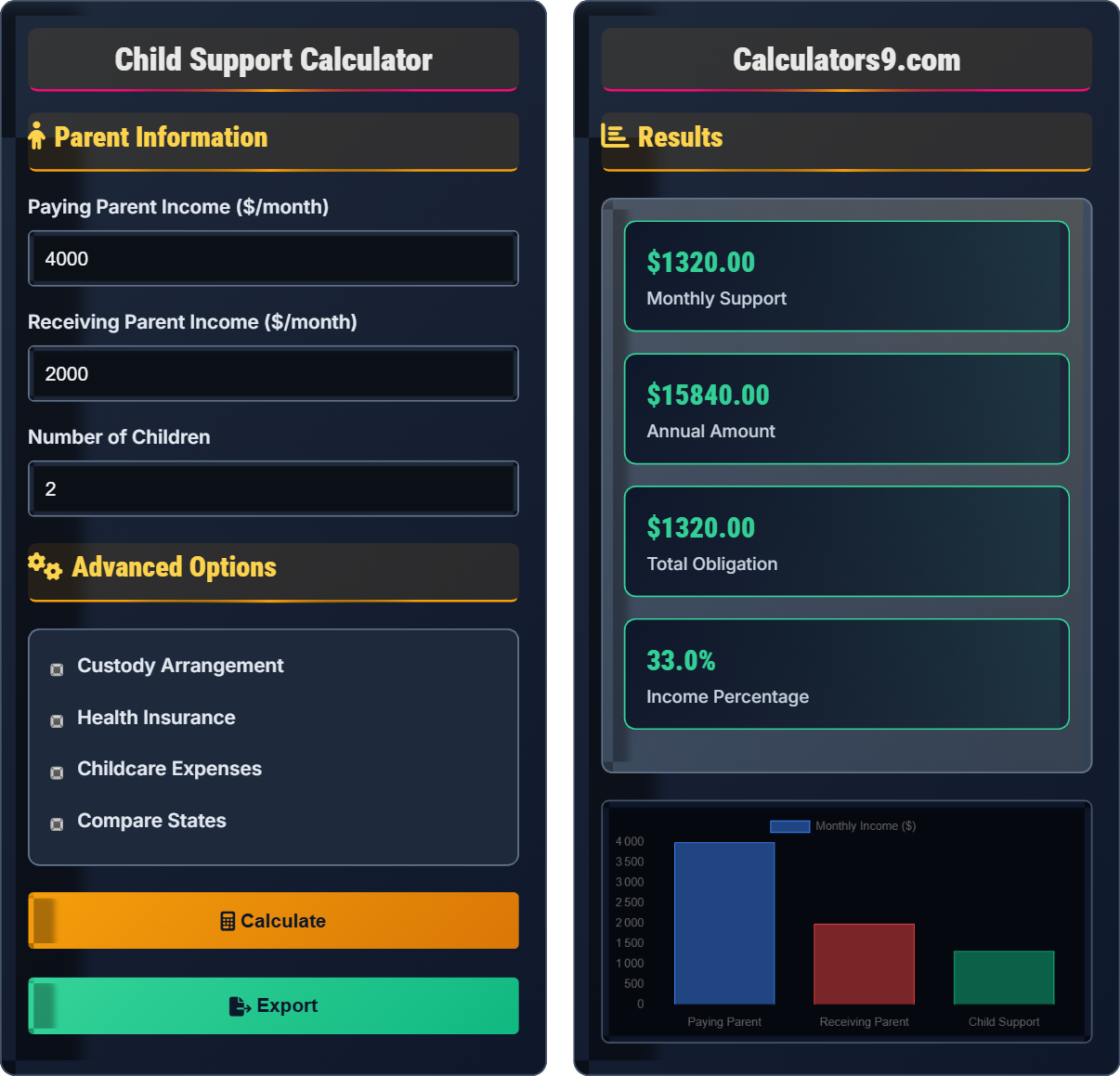
Example: For a parent earning $4,000/month with 2 children:
CS = $4,000 × 0.33 = $1,320/month
With 20% shared custody: $1,320 × (1 - 0.20) = $1,056/month
Therefore, support would be $1,056/month.
Parent Information
Advanced Options
Results
| Information | Value |
|---|
| Calculation | Details |
|---|
Comprehensive Legal Guide
Child support is a court-ordered payment made by one parent to another for the care and maintenance of their children. The primary goal is to ensure children's financial needs are met regardless of parental separation. Courts prioritize children's welfare and establish support based on state guidelines that consider both parents' incomes and the children's needs.
Common calculation approaches include:
Where:
- \(CS\) = Child Support
- \(PI\) = Paying parent's income
- \(RI\) = Receiving parent's income
- \(PR\) = Percentage rate
- \(NF\) = Number of children factor
- \(TC\) = Total child costs
States use different methodologies.
Many factors influence child support calculations:
- Custody Arrangements: Shared custody reduces support
- Health Insurance: Premiums may be added to support
- Childcare: Daycare costs may be split
- Extraordinary Needs: Medical, educational expenses
- Income Caps: Some states limit calculations
- Modification: Orders can change with changed circumstances
- Enforcement: Courts have various enforcement tools
- Duration: Typically until age 18 or graduation
- Tax Implications: Support is not tax deductible
- Agreements: Parents can agree to different amounts
Legal Fundamentals
Court-ordered payment for child's care and maintenance after separation.
\( CS = (PI \times PR) \times NF \)
Where CS=child support, PI=payer income, PR=percentage rate, NF=number of children.
- Based on both parents' incomes
- Priority is child's welfare
- Calculations vary by state
Application Guidelines
1 Child: 25%, 2 Children: 33%, 3 Children: 40%, 4 Children: 45%, 5+: 50%
- Custody time sharing
- Health insurance costs
- Childcare expenses
- Extraordinary medical needs
- Each state has different rules
- Guidelines are presumptive
- Courts can deviate from guidelines
Child Support Calculation Learning Quiz
What is the primary purpose of child support?
The answer is B) To ensure children's financial needs are met. Child support exists primarily to provide for the child's necessities regardless of the parents' separation. Courts prioritize the child's welfare above the parents' financial interests. The goal is to maintain the child's standard of living and provide for their basic needs.
Students must understand that child support serves the child's interests, not to penalize a parent. Courts focus on the child's needs and both parents' abilities to contribute. The obligation is based on the recognition that both parents have a duty to support their children financially.
Child Support: Financial obligation for child's care
Best Interest: Child's welfare priority
Parental Duty: Legal obligation to support children
• Priority is child's welfare
• Both parents have obligations
• Not punitive in nature
• Focus on child's needs
• Consider both parents' abilities
• Evaluate standard of living
• Viewing as punishment rather than support
• Assuming equal division of responsibility
• Not considering child's specific needs
Calculate child support for a parent earning $3,500/month with 1 child, using the standard percentage of 25%.
Step 1: Identify the formula: CS = PI × PR
Step 2: Identify values
Paying Income (PI) = $3,500/month
Percentage Rate (PR) = 25% = 0.25
Step 3: Apply formula: CS = $3,500 × 0.25
CS = $875/month
Therefore, the monthly child support would be $875.
This problem demonstrates the basic percentage method used in many states. Students learn to identify the key variables and apply the formula. The percentage typically increases with the number of children to account for increased costs.
Percentage Method: Support based on income percentage
Standard Rate: Presumptive percentage for calculations
Net Income: Income after deductions
• Use net monthly income
• Apply correct percentage for number of children
• Consider state-specific guidelines
• Common rates: 1 child=25%, 2=33%, 3=40%
• Verify state-specific rates
• Use monthly income figures
• Using gross instead of net income
• Applying wrong percentage for number of children
• Not considering state variations
A parent earning $5,000/month owes $1,650/month in child support for 2 children. If the custody arrangement gives the paying parent 30% of parenting time, what is the adjusted support amount assuming proportional reduction?
Step 1: Calculate basic support: $5,000 × 0.33 = $1,650
Step 2: Apply shared custody reduction
Reduction = 30% of $1,650 = $1,650 × 0.30 = $495
Step 3: Calculate adjusted support
Adjusted Support = $1,650 - $495 = $1,155
Therefore, the adjusted support would be $1,155/month.
This example demonstrates how shared custody arrangements reduce support obligations. The rationale is that the paying parent incurs expenses for the child during their parenting time. Different states use different methods to calculate reductions.
Shared Custody: Significant parenting time for both parents
Proportional Reduction: Reduction based on custody percentage
Parenting Time: Time spent with child
• Shared custody reduces support
• Methods vary by state
• Consider actual expenses incurred
• More custody time = lower support
• Verify state-specific rules
• Consider actual expense sharing
• Not adjusting for shared custody
• Using wrong reduction method
• Assuming no reduction for any custody time
Using the Income Shares Model, calculate child support when the paying parent earns $4,500/month, the receiving parent earns $2,500/month, and total child costs are estimated at $1,500/month. What percentage of the total does each parent pay?
Step 1: Calculate combined income: $4,500 + $2,500 = $7,000
Step 2: Calculate paying parent's proportion: $4,500 ÷ $7,000 = 0.643 (64.3%)
Step 3: Calculate receiving parent's proportion: $2,500 ÷ $7,000 = 0.357 (35.7%)
Step 4: Calculate paying parent's contribution: $1,500 × 0.643 = $964.50
Step 5: Calculate receiving parent's contribution: $1,500 × 0.357 = $535.50
Therefore, paying parent contributes $964.50 (64.3%) and receiving parent contributes $535.50 (35.7%).
This demonstrates the Income Shares Model, which is used in many states. It allocates child costs based on each parent's proportion of total income. This method considers both parents' incomes rather than just the paying parent's income.
Income Shares Model: Support based on both parents' incomes
Proportional Allocation: Costs shared according to income
Total Child Costs: Estimated expenses for children
• Both parents' incomes considered
• Proportional to income share
• Total costs must be estimated
• Add both parents' incomes
• Calculate each parent's percentage
• Apply percentage to total costs
• Only considering paying parent's income
• Not calculating proportions correctly
• Misunderstanding total cost estimation
Under what circumstances can child support orders be modified?
The answer is C) Upon showing substantial change in circumstances. Courts can modify child support when there's a significant change such as job loss, disability, substantial change in income, or change in custody arrangements. The modification requires demonstrating that circumstances have changed substantially since the original order.
Students must understand that child support is not fixed forever. Courts retain jurisdiction to modify support based on changed circumstances affecting the child's needs or parents' abilities to pay. The system is designed to adapt to changing life situations while maintaining focus on the child's welfare.
Modification: Change to existing court order
Substantial Change: Significant alteration in circumstances
Court Jurisdiction: Authority to make changes
• Changes require substantial circumstances
• Burden of proof on requesting party
• Courts have continuing jurisdiction
• Document all changes
• File petition for modification
• Consider income changes
• Assuming support is never modifiable
• Not documenting changes
• Failing to seek court approval
FAQ
Q: How do courts determine the appropriate child support amount?
A: Courts use different methods:
1. Percentage Method: CS = PI × PR (Paying Income × Percentage Rate)
2. Income Shares Model: CS = (PI ÷ Combined Income) × Total Child Costs
3. Number of Children: 1 child = 25%, 2 = 33%, 3 = 40%, etc.
Formula: \( CS = \frac{PI}{(PI + RI)} \times TC \) where RI is receiving parent's income and TC is total child costs.
Q: What's the difference between percentage and income shares models?
A: The main differences are:
- Percentage Model: Support based on paying parent's income only
- Income Shares: Support based on both parents' combined income
- Allocation: Percentage model uses fixed percentages, income shares allocates costs proportionally
- States: Different states use different methods
For example, with paying parent at $4,000 and receiving parent at $2,000:
Percentage: $4,000 × 25% = $1,000
Income Shares: ($4,000 ÷ $6,000) × $1,200 = $800