Contract Penalty Calculator
Legal compliance tool • 2026 edition
Contract Penalty Formula:
Show the calculator\( PP = CB \times (PF + LF) \times (1 + DF) \)
Where:
- \( PP \) = Penalty Payment
- \( CB \) = Contract Base Value (original contract amount)
- \( PF \) = Penalty Factor (percentage for breach type)
- \( LF \) = Late Fee Factor (additional percentage for delays)
- \( DF \) = Duration Factor (multiplier based on time elapsed)
This formula calculates penalties for contract breaches, incorporating multiple factors including severity, timing, and duration of the violation. Legal jurisdictions may impose limits on penalty amounts to prevent excessive penalties.
Example: For a contract of \( CB = \$100{,}000 \) with a breach penalty factor of 10% and a late fee factor of 5% over a duration factor of 1.2:
\( PP = 100{,}000 \times (0.10 + 0.05) \times 1.2 = 100{,}000 \times 0.15 \times 1.2 = \$18{,}000 \)
Thus, the penalty would be $18,000.
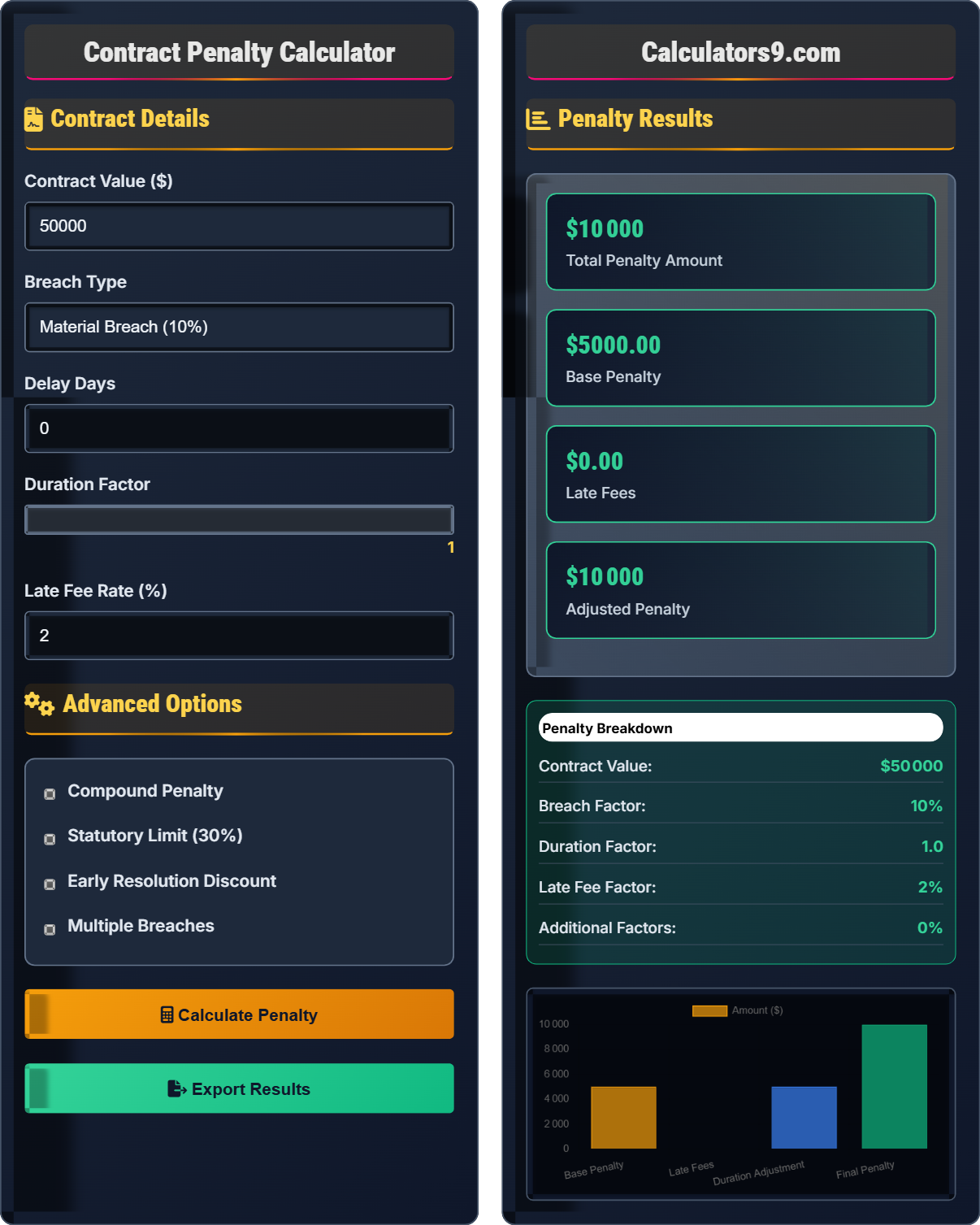
Contract Details
Advanced Options
Penalty Results
Contract Penalty Fundamentals
Contract penalties are predetermined amounts specified in contracts that become payable when one party breaches the agreement. These serve as deterrents against non-performance and provide compensation to the non-breaching party. Courts distinguish between liquidated damages (reasonable estimates of actual harm) and penalty clauses (excessive amounts intended to punish).
The standard contract penalty calculation uses the following formula:
Where:
- \(PP\) = Penalty Payment
- \(CB\) = Contract Base Value
- \(PF\) = Penalty Factor (based on breach severity)
- \(LF\) = Late Fee Factor (for delays)
- \(DF\) = Duration Factor (time multiplier)
When implementing contract penalties, consider:
- Liquidated Damages Test: Penalties must represent reasonable forecast of harm
- Penalty Clause Restrictions: Some jurisdictions limit penalty amounts
- Enforceability: Clauses must be reasonable and not punitive
- Statutory Limits: Some jurisdictions cap penalties at 20-30% of contract value
- Reasonable Estimates: Base penalties on actual expected losses
- Graduated Scales: Increase penalties proportionally to breach severity
- Time Limits: Specify when penalties apply based on delay duration
- Dispute Resolution: Include arbitration clauses for penalty disputes
- Review Periodically: Adjust for inflation and changing business conditions
Contract Law Basics
Failure to perform contractual obligations as specified in the agreement.
\(PP = CB \times (PF + LF) \times (1 + DF)\)
Where PP=penalty payment, CB=contract base, PF=penalty factor, LF=late fee factor, DF=duration factor.
- Penalties must be reasonable estimates of harm
- Courts may void excessive penalty clauses
- Distinction between liquidated damages and penalties
Calculation Methods
Pre-agreed compensation representing reasonable estimate of anticipated harm.
- Determine contract base value
- Select appropriate breach factor
- Apply duration and late fee multipliers
- Consider statutory limits
- Penalties must not be punitive
- Consider enforceability across jurisdictions
- Document reasonable basis for amounts
Contract Penalty Learning Quiz
Which of the following best describes liquidated damages as opposed to a penalty clause?
The answer is B) Liquidated damages are reasonable estimates of anticipated harm. Liquidated damages are enforceable because they represent a genuine attempt to estimate actual damages that would be difficult to prove at the time of breach. Penalty clauses, on the other hand, are designed to deter breach through excessive punishment and are generally unenforceable.
Understanding the distinction between liquidated damages and penalty clauses is fundamental to contract law. Courts will enforce liquidated damages clauses if they represent a reasonable forecast of just compensation for harm that would be difficult to estimate accurately. The key test is whether the amount is disproportionate to the likely harm.
Liquidated Damages: Pre-agreed compensation that represents a reasonable estimate of actual harm expected from breach
Penalty Clause: A provision designed to punish the breaching party rather than compensate for harm
Reasonable Forecast Test: Legal standard to determine if a damage clause is enforceable
• Liquidated damages must be reasonable estimates of harm
• Courts will not enforce purely punitive clauses
• Document the reasoning behind damage estimates
• Use industry standards and historical data
• Ensure amounts reflect actual expected losses
• Setting penalty amounts that are clearly excessive
• Failing to demonstrate difficulty in estimating damages
• Not documenting the rationale for chosen amounts
Calculate the penalty for a $100,000 contract with a material breach (10%), 30-day delay with a late fee rate of 1.5%, and a duration factor of 1.1. Show your work.
Using the penalty formula: \(PP = CB \times (PF + LF) \times (1 + DF)\)
Given:
- CB = $100,000
- PF = 10% = 0.10
- LF = 1.5% = 0.015
- DF = 1.1
Step 1: Calculate base penalty factor = PF + LF = 0.10 + 0.015 = 0.115
Step 2: Apply duration multiplier = 1 + DF = 1 + 1.1 = 2.1
Step 3: Calculate total penalty = $100,000 × 0.115 × 2.1 = $100,000 × 0.2415 = $24,150
This calculation demonstrates how multiple factors compound to determine the final penalty amount. The duration factor amplifies both the base penalty and late fees, showing how delays can significantly increase liability. The formula ensures all relevant factors are considered in a systematic way.
Contract Base (CB): The original value of the contract
Penalty Factor (PF): Percentage based on breach severity
Duration Factor (DF): Multiplier based on time elapsed since breach
• Convert all percentages to decimals for calculations
• Apply factors in the correct sequence
• Consider statutory limits on total penalties
• Work step by step to avoid calculation errors
• Verify each factor is in decimal form
• Double-check final results against contract limits
• Forgetting to convert percentages to decimals
• Misapplying the order of operations
• Not accounting for statutory maximums
Company A has a service contract worth $200,000 with a penalty clause of 8% for material breaches. They experienced three separate breaches over 6 months: first breach lasted 15 days (duration factor 1.0), second lasted 30 days (duration factor 1.2), and third lasted 45 days (duration factor 1.5). Calculate the total penalty if compound penalties apply at 1% per occurrence.
Step 1: Calculate individual penalties
First breach: $200,000 × 0.08 × (1 + 1.0) = $200,000 × 0.08 × 2.0 = $32,000
Second breach: $200,000 × 0.08 × (1 + 1.2) = $200,000 × 0.08 × 2.2 = $35,200
Third breach: $200,000 × 0.08 × (1 + 1.5) = $200,000 × 0.08 × 2.5 = $40,000
Step 2: Calculate compound penalty = 1% of each penalty
Compound on first: $32,000 × 0.01 = $320
Compound on second: $35,200 × 0.01 = $352
Compound on third: $40,000 × 0.01 = $400
Step 3: Total = $32,000 + $35,200 + $40,000 + $320 + $352 + $400 = $108,272
This example illustrates how multiple breaches compound both in terms of duration and occurrence. The cumulative effect of repeated breaches can significantly increase liability beyond what might initially appear. The compound penalty mechanism adds an additional layer of accountability for each occurrence.
Compound Penalty: Additional penalty applied for each breach occurrence
Multiple Breaches: Several violations under the same contract
Duration Factor: Multiplier based on length of breach period
• Calculate each breach separately with its specific factors
• Apply compound penalties to each occurrence
• Sum all penalties for total liability
• Track each breach separately before summing
• Use spreadsheets for multiple breach calculations
• Consider settlement negotiations for multiple breaches
• Combining all breaches into a single calculation
• Forgetting to apply compound penalties
• Not considering aggregate liability limits
A construction contract valued at $500,000 has a penalty clause of 15% for fundamental breaches. The contractor commits a fundamental breach with a duration factor of 1.8. However, state law caps penalties at 25% of the contract value. Calculate the enforceable penalty amount considering the statutory limit.
Step 1: Calculate contractual penalty = $500,000 × 0.15 × (1 + 1.8) = $500,000 × 0.15 × 2.8 = $210,000
Step 2: Calculate statutory limit = $500,000 × 0.25 = $125,000
Step 3: Determine enforceable penalty = min($210,000, $125,000) = $125,000
Therefore, despite the contractual agreement for $210,000 in penalties, the enforceable amount is limited to $125,000 due to the statutory cap.
This demonstrates the critical importance of understanding applicable statutory limitations. Even well-drafted contract provisions may be overridden by public policy considerations reflected in statutory caps. Legal professionals must account for these limits when structuring penalty clauses.
Statutory Limit: Legal maximum penalty amount set by legislation
Public Policy: Legal principle preventing unconscionable penalties
Enforceability: Whether a contract provision will be upheld by courts
• Statutory limits override contractual agreements
• Research applicable laws in contract jurisdiction
• Structure penalties within enforceable bounds
• Research local laws before setting penalty amounts
• Include severability clauses for partial enforcement
• Consult legal counsel for complex penalty structures
• Ignoring statutory penalty limitations
• Not researching applicable jurisdiction's laws
• Assuming all contractual terms are enforceable
What is the primary legal justification for offering early resolution discounts in contract penalty clauses?
The answer is B) To encourage compliance and reduce litigation costs. Early resolution discounts provide incentives for parties to address breaches quickly and amicably, reducing the need for expensive litigation. This approach is generally viewed favorably by courts as it promotes efficient dispute resolution.
Early resolution mechanisms demonstrate good faith and promote efficient contract administration. By offering discounts for prompt breach correction, parties incentivize compliance while avoiding costly legal proceedings. Courts often view such clauses favorably as they promote practical solutions.
Early Resolution Discount: Reduced penalty for prompt breach correction
Good Faith: Honest intention to fulfill contract obligations
Efficient Dispute Resolution: Methods to resolve conflicts quickly
• Discounts must be reasonable and not punitive
• Should promote compliance rather than punishment
• Set clear timelines for discount eligibility
• Define specific actions that qualify for discounts
• Document compliance efforts for verification
• Creating overly complex discount structures
• Not defining clear eligibility criteria
• Setting discounts too high or too low
Legal FAQ
Q: How do courts determine if a penalty clause is enforceable?
A: Courts apply the reasonable forecast test to determine enforceability of penalty clauses. The key factors are:
1. Difficulty of Estimation: At contract formation, would actual damages be difficult to estimate?
2. Reasonable Relationship: Is the agreed amount a reasonable forecast of just compensation for harm?
3. Punitive Intent: Is the clause designed to punish rather than compensate?
For example, in a construction contract of \( CB = \$500{,}000 \), if actual damages from delay would be difficult to prove (\( D \) is high), and the penalty \( PP = CB \times 0.15 = \$75{,}000 \) represents a reasonable estimate of likely harm, the clause is likely enforceable.
Courts will not enforce clauses where \( PP \gg \) actual expected damages, as these are considered penalties rather than liquidated damages.
Q: What's the difference between liquidated damages and penalty clauses in business contracts?
A: The distinction lies in purpose and enforceability:
Liquidated Damages: Designed to compensate for anticipated harm that would be difficult to quantify. Enforceable if reasonable. Example: For a service contract of \( \$100{,}000 \), if actual damages from breach would be approximately \( \$10{,}000 \), a clause specifying \( \$10{,}000 \) is likely enforceable.
Penalty Clauses: Designed to punish the breaching party or coerce performance. Generally unenforceable. Example: A clause requiring \( \$50{,}000 \) for a minor delay that caused no actual harm would likely be deemed a penalty.
The formula \( PP = CB \times PF \times DF \) works for both, but courts examine whether \( PF \) represents reasonable compensation or excessive punishment.