Interest on Judgment Calculator
Fast legal interest calculator • 2026 laws
Interest on Judgment Formula:
Show the calculator\( I = P \times r \times t \)
Where:
- \( I \) = interest earned
- \( P \) = principal amount (judgment amount)
- \( r \) = interest rate per period
- \( t \) = time in years
For compound interest: \( A = P \times (1 + r)^t \) where A is total amount.
Legal judgments typically earn post-judgment interest at statutory rates that vary by jurisdiction. Simple interest is calculated daily on the original principal. The calculation begins from the date of judgment entry.
Example: For a $10,000 judgment at 10% simple interest for 2 years:
Interest = $10,000 × 0.10 × 2 = $2,000
Total amount owed = $10,000 + $2,000 = $12,000
Therefore, the debtor would owe $12,000 after 2 years.
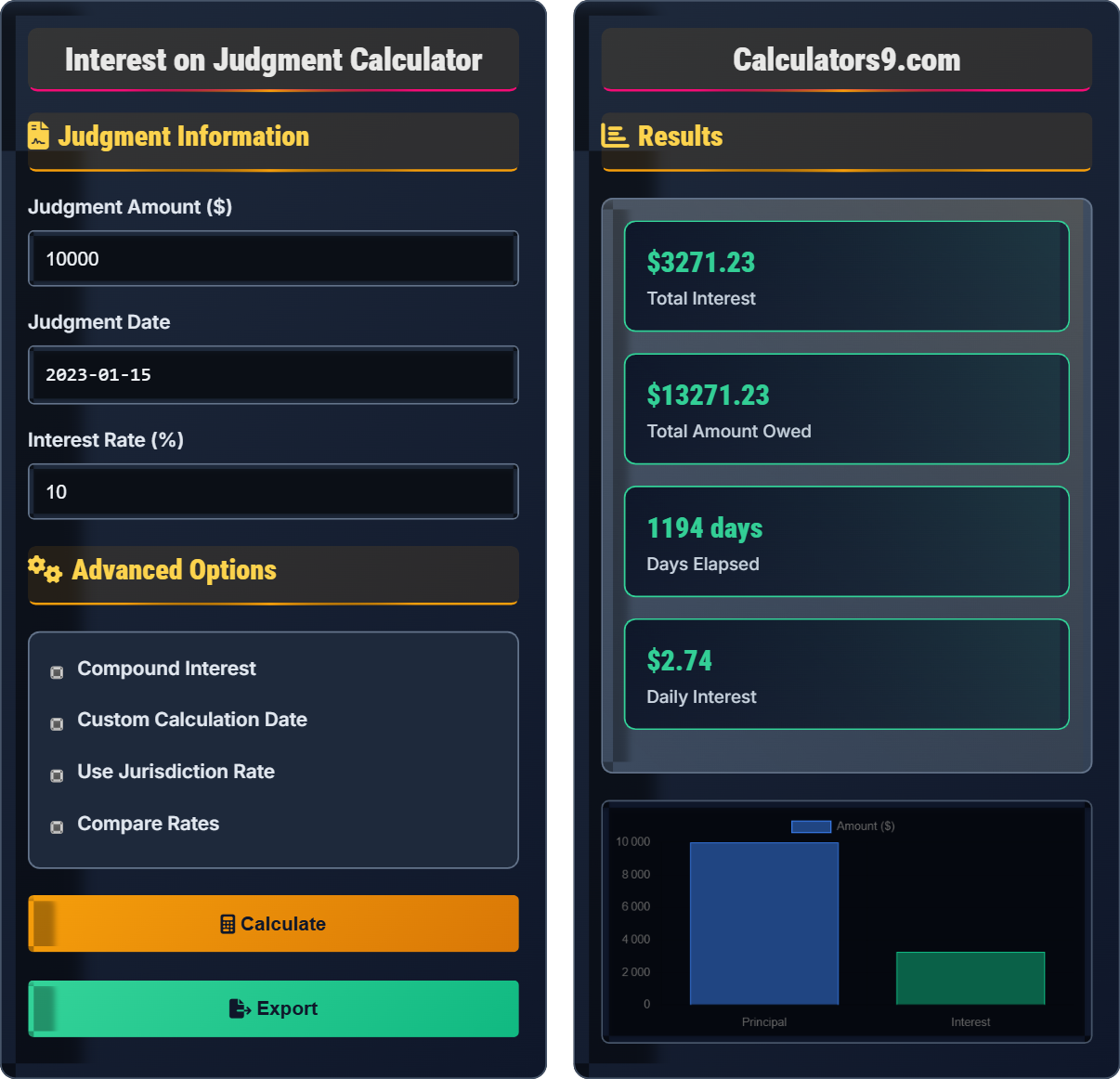
Judgment Information
Advanced Options
Results
| Information | Value |
|---|
| Calculation | Details |
|---|
Comprehensive Legal Guide
Post-judgment interest is awarded to compensate prevailing parties for the time value of money while a judgment remains unpaid. These rates are typically set by statute and vary by jurisdiction. Interest begins accruing from the date the judgment is entered and continues until full satisfaction. The purpose is to incentivize prompt payment and compensate creditors for delayed receipt of funds.
Two primary methods are used for judgment interest:
Where:
- \(I\) = interest earned
- \(P\) = principal amount
- \(r\) = interest rate per period
- \(t\) = time in years
- \(A\) = total amount
Most jurisdictions use simple interest for judgments.
Several important factors affect judgment interest:
- Accrual Date: Interest begins from judgment entry date
- Payment Credit: Payments reduce principal and future interest
- Compounding: Most jurisdictions use simple interest
- Collection: Judgments can be enforced through various means
- Expiration: Judgments typically last 10 years, renewable
- Act promptly: Begin collection efforts early
- Locate assets: Use judgment debtor examinations
- Consider garnishment: Wage and bank account levies
- Record liens: Property attachments
- Renew judgments: Before expiration dates
Legal Fundamentals
Interest awarded on monetary judgments from entry date until satisfaction.
\( I = P \times r \times t \)
Where I=interest, P=principal, r=rate per period, t=time in years.
- Accrues from judgment entry date
- Statutory rates vary by jurisdiction
- Most use simple interest calculation
Application Guidelines
CA: 10%, NY: 9%, TX: 5%, FL: 5.75%, Federal: 0.12%
- Simple Interest: Principal × Rate × Time
- Compound Interest: Principal × (1 + Rate)^Time
- Daily Rate: Annual Rate ÷ 365
- Accrued Interest: Daily Rate × Days Elapsed
- Check jurisdiction for specific rates
- Simple interest is most common
- Payments reduce principal balance
Interest on Judgment Learning Quiz
When does post-judgment interest typically begin to accrue?
The answer is B) From the date of judgment entry. Post-judgment interest begins to accrue from the date the judgment is officially entered by the court. This is a statutory right designed to compensate the prevailing party for the time value of money while waiting for payment. The accrual starts automatically upon entry of judgment, regardless of notification to the defendant.
Students must understand that interest accrual is tied to the formal entry of judgment, not to when the defendant learns about it. This protects the judgment creditor's rights from the moment the court officially enters the judgment. The accrual is automatic and doesn't depend on the defendant's knowledge or the creditor's collection efforts.
Post-Judgment Interest: Interest on monetary judgments
Judgment Entry: Official court record of judgment
Automatic Accrual: Begins without further action required
• Interest begins on judgment entry date
• Accrual is automatic by statute
• Not dependent on defendant's knowledge
• Record judgment date carefully
• Interest accrues daily from entry date
• Check local statutes for specific rules
• Starting interest from wrong date
• Assuming accrual requires notice
• Not understanding automatic nature
Calculate the interest on a $15,000 judgment at 8% annual interest for 18 months using simple interest. What is the total amount owed?
Step 1: Identify the values
Principal (P) = $15,000
Rate (r) = 8% = 0.08
Time (t) = 18 months = 1.5 years
Step 2: Apply simple interest formula: I = P × r × t
I = $15,000 × 0.08 × 1.5 = $1,800
Step 3: Calculate total amount: Total = Principal + Interest
Total = $15,000 + $1,800 = $16,800
Therefore, the total amount owed is $16,800.
This problem demonstrates the simple interest calculation, which is most commonly used for judgments. Students learn to convert time periods to years when necessary and to calculate the total amount owed. The simple interest formula applies the rate only to the original principal, not to accumulated interest.
Simple Interest: Interest calculated on original principal only
Principal: Original amount of judgment
Total Amount: Principal plus accrued interest
• Use decimal form for interest rates
• Convert time to same units as rate
• Simple interest: I = P × r × t
• Convert months to years (divide by 12)
• Convert percentage to decimal (divide by 100)
• Always add interest to principal for total
• Forgetting to convert percentage to decimal
• Not converting months to years
• Using compound interest when simple is required
A judgment for $25,000 earns 10% annual interest. What is the daily interest rate, and how much interest accrues in 30 days?
Step 1: Calculate daily interest rate
Daily Rate = Annual Rate ÷ 365
Daily Rate = 10% ÷ 365 = 0.10 ÷ 365 = 0.000274 (0.0274%)
Step 2: Calculate daily interest amount
Daily Interest = Principal × Daily Rate
Daily Interest = $25,000 × 0.000274 = $6.85
Step 3: Calculate 30-day interest
30-Day Interest = $6.85 × 30 = $205.50
Therefore, the daily interest is $6.85 and 30-day interest is $205.50.
This example demonstrates how to convert annual rates to daily rates, which is useful for tracking interest accumulation. Students learn the daily calculation method and how to scale it for different time periods. Understanding daily rates helps in monitoring interest growth over time.
Daily Rate: Annual rate divided by 365 days
Accrual: Accumulation of interest over time
Annual Rate: Interest rate per year
• Daily Rate = Annual Rate ÷ 365
• Daily Interest = Principal × Daily Rate
• Use 365 days (not 360) for legal calculations
• Use 365 days for daily rate calculation
• Multiply daily rate by days for period interest
• Daily tracking helps monitor growth
• Using 360 instead of 365 days
• Not converting annual rate to daily
• Forgetting to multiply by days elapsed
A judgment for $10,000 at 12% annual interest has been outstanding for 1 year ($1,200 interest). If the debtor pays $5,000 after 1 year, what is the new principal balance and how much interest will accrue in the next 6 months?
Step 1: Calculate amount after 1 year
Total after 1 year = $10,000 + $1,200 = $11,200
Step 2: Apply payment to reduce principal
Payment of $5,000 reduces principal to: $10,000 - $5,000 = $5,000
(Payment first covers interest, then reduces principal)
Step 3: Calculate 6-month interest on new principal
Time = 0.5 years
Interest = $5,000 × 0.12 × 0.5 = $300
Therefore, new principal is $5,000 and 6-month interest is $300.
This demonstrates how payments affect future interest calculations. Payments first satisfy accrued interest, then reduce the principal balance. The reduced principal results in lower future interest accrual. This is important for both creditors and debtors to understand.
Principal Reduction: Decrease in original amount
Payment Allocation: How payments are applied
Future Accrual: Interest on reduced principal
• Payments first satisfy accrued interest
• Remaining payment reduces principal
• Future interest calculated on reduced principal
• Understand payment allocation sequence
• Principal reduction lowers future interest
• Early payments save interest costs
• Not accounting for payment allocation order
• Continuing interest on original principal
• Forgetting to reduce principal after payment
Which of the following statements about judgment interest rates is TRUE?
The answer is B) Rates vary significantly by jurisdiction. Each state and federal district has its own statutory interest rates for judgments. For example, California has 10%, Texas has 5%, and federal courts have 0.12% (as of recent rates). The rates are set by state legislatures or federal statutes and reflect local economic conditions and policy preferences.
Students must understand that judgment interest rates are not uniform across jurisdictions. This variation reflects different state policies regarding compensation for delayed payment. Legal practitioners must check the specific rate applicable in each jurisdiction where enforcement is sought.
Jurisdiction: Geographic area with legal authority
Statutory Rate: Rate set by law
Local Variation: Differences by location
• Rates are jurisdiction-specific
• Check local statutes for exact rates
• Federal and state rates differ
• Research applicable jurisdiction's rate
• Rates can change over time
• Consider enforcement location
• Assuming uniform national rate
• Using wrong jurisdiction's rate
• Not verifying current rates
FAQ
Q: How do I calculate interest on partial payments?
A: Partial payments are typically allocated as follows:
1. First, satisfy all accrued interest
2. Then, apply remainder to principal reduction
Formula: New Principal = Old Principal - (Payment - Accrued Interest)
For example, with $10,000 principal, $1,000 accrued interest, and $6,000 payment:
Step 1: $6,000 - $1,000 = $5,000 applied to principal
Step 2: New Principal = $10,000 - $5,000 = $5,000
Future interest calculated on $5,000 principal.
Q: What's the difference between simple and compound interest in judgments?
A: The main differences are:
- Simple Interest: Calculated only on original principal. Formula: \(I = P \times r \times t\)
- Compound Interest: Calculated on principal plus accumulated interest. Formula: \(A = P \times (1 + r)^t\)
Most jurisdictions use simple interest for judgments to prevent exponential growth. For example, with $10,000 at 10% for 2 years:
Simple: $10,000 × 0.10 × 2 = $2,000 interest
Compound: $10,000 × (1.10)² - $10,000 = $2,100 interest